The Direct File program that had been promised and launched by the Internal Revenue Service (IRS) has faced opposition from lobbyists and tax preparation companies such as TurboTax ever since the government-provided free tax filing service was introduced in 2023. Amid the threat of Direct File being removed entirely by the current administration, members of the IRS made a bold decision. They just open sourced Direct File, completely free for anyone to use.
According to 404 Media, the IRS published the majority of Direct File’s code on GitHub, an online platform that allows users and developers to share and store their code to test, develop, and improve their software. While many may see this action as an act of defiance against the current federal government, this is not the case. Per the IRS’s 2024 report on Direct File, it was always intended to become open sourced and available “to build public trust and enable independent assessment of its work.” This would allow more people to try out the program and also create improvements upon it.
For the past 18 months, I've had the privilege to build IRS DirectFile with so many dedicated public servants across government. Last year we helped 140k+ people file their taxes for free with the IRS!
This comes at a time when Direct File showed lasting promise. As according to the Tax Policy Center, the majority of Americans were interested in using it to file their taxes. In the same report, the 12 states that did have access to Direct File for the 2024 tax season were pleased with it, with 90% of users rating their experience as positive. Many of the users made it known that they liked how simple and easy it was to file their taxes, especially for free. Direct File was marked for further expansion and availability to even more states prior to the current administration.
Most Americans would welcome a free and easier means to file their taxes. Per a 2024 report by the Tax Foundation, Americans pay $133 billion per year on payments to tax professionals, online tax preparation services, and fees. In addition to the expense, another report showed the average taxpayer spends 13 hours to comply with a Form 1040 tax form.
Filing my taxes causes me a tremendous amount of anxiety. Because I am self-employed doing my taxes means scouring my calendar for every deductible mile and then reviewing a year’s worth of credit card statements for every deductible expense. Once I’ve made the exhausting list of mileage and expenses, I must double and triple check if I’m allowed to deduct those expenses. What if I’m NOT allowed to deduct the ice cream cone I bought at the bodega for this video? What if I am committing tax fraud?? ??? Once the expenses are triple cleared, I must go back and triple check my addition because if I add wrong and deduct to much (or too little), then you guessed it—I’m once again obviously committing tax fraud. The fear of unintentionally doing my taxes wrong can feel so overwhelming that it should come as no surprise that The Procrastinator shows up to spare me from all of that pain. When I was diagnosed with OCD, it was honestly a relief to learn that my tax anxiety is related to moral scrupulosity, an OCD theme that I struggle with. Moral scrupulosity is an obsessive concern with obtaining moral perfection, or with being a good person (and above all, not a bad person). I was really moved when I read these words by Kimberley Quinlan : ”I am not a good person or a bad person. I am a person.” Accepting that I am neither a good or bad person has (very slowly) helped me to allow myself to make some mistakes. I am a person and people make mistakes. And that is ok. That is being human. So for real now I’m going to actually start my taxes….after I post this video…and then yeah, probably after I have some lunch…and then I really do need to water that one plant…but then for sure I’ll get started on the script for next week’s video……wait……. ? #procrastination#perfectionist#perfectionism#perfectionistproblems#innervoices#taxes#taxseason#tax#deduction#expenses#anxiety#procrastinator#comedy#sketchcomedy#comedyvideos#character#womenincomedy#mentalhealth#mentalhealthawareness#mentalhealthmatters#therapy#therapyforall#funnyvideos#voicesinmyhead#karaleemo#taxes2022#fyp#foryou#goofyvideo♬ original sound – Kara Morgan
Time will tell to see if Direct File becomes an even more sought-after method to file taxes, but with that in mind there are ways to still save money before you file. Former financial analyst Tina Orem recommends tweaking your W-4 to have your employer withhold more tax from your paycheck to better ensure a refund the following year. You could also investigate investing more money into a 401(k) or an IRA to both save more money for retirement along with keeping it, tax-free.
If you still want the eyes of a professional to make sure everything is kosher and that you have every advantage before filing, you could still hire a certified public accountant to go through your forms and receipts. While you may spend an average of $319 for a basic non-itemized 1040, it could be cheaper than mistakenly owing more money to the IRS. When shopping around for a CPA, be sure to ask for their preparer tax identification number (PTIN) and verify their credentials through the IRS website.
While things are in flux to determine how the IRS and tax payment will function in the future, it is good to know that there are options available that allow you to file with peace of mind for a low cost or, even better, free of charge.
Solo travel is surging – and an industry still largely built for two is taking note.
Google reported in April 2026 that online searches involving “solo travel” hit an all-time high this year, with queries for “women solo travel” reaching a 15-year peak. Hilton’s 2026 trends report found that 26% of travelers planned to take a trip alone this year, and that nearly half said they planned to add solo days to the front or back of a family trip.
The issue isn’t new. In 1992, marketing researchers identified the solo consumer as an underserved market. But as tourism researchers have documented, the accommodation sector treats double occupancy as the default unit of consumption, which often slaps a “single supplement” charge on customers when they travel without a partner. The industry essentially penalizes travelers for arriving without a second body to fill the other half of a room they aren’t using.
The reason why so many hotels, cruise lines and tour operators still base prices on double occupancy is that their costs – the room, the berth, the coach seat, the guide – don’t fall by half when the second person fails to materialize. But the supplement isn’t just a pricing convention. It’s the clearest signal the industry sends about who it built the product for.
I’m a scholar who studies what I call the solo economy: how institutions and markets adapt, or fail to adapt, to the rise of single living. I’ve written before about how retail and restaurants still design for pairs.
Travel is further along than most in recognizing this cultural shift. It’s also a useful case because the industry has started on the easy part of the problem but barely touched the rest.
Demographics matter, but not the way you’d think
The broader shift toward solo living is real. In 2025, 39.7 million Americans lived alone. That’s 29% of all households, up from 20% in 1975. Married couples, meanwhile, fell to 47% of households from 66% 50 years earlier.
Those numbers alone don’t explain solo travel. Some of that decline went to people living alone; some went to unmarried couples, who are still a party of two on a booking page. Married people take trips alone. Single people travel with friends, siblings and parents, and plenty of them have logged serious hours as an extra wheel. Living alone and vacationing alone are different behaviors with different causes.
What connects them is the erosion of a single assumption: that every adult arrives with a plus-one. That assumption is weakening at home, and it’s now encountering the booking page.
Price is the easy rung
One response by the travel industry has been to shave the single supplement. For example, the tour operator Tauck announced this year that it’s waiving the single supplement on a class of its riverboat cabins across more than 250 European river cruise departures and reducing it by up to US$600 on 105 land departures.
Another touring company has taken a more committed approach to adjusting its offerings: Aurora Expeditions sets aside 10 dedicated solo cabins on every sailing across its three ships, with no single supplement, through its 2026 and 2027 seasons.
Then there’s Norwegian Cruise Line, which was early to the shift. In 2010, it introduced Studio staterooms aboard Norwegian Epic: Small cabins designed for one passenger, sold at single-occupancy prices and arranged around a keycard-access Studio Lounge reserved for solo travelers. The trade-off is less private space, but at a price for one, with access to a room full of fellow travelers going it alone.
Norwegian then expanded solo categories in 2024 from nine ships to its full 19-ship fleet. But on ships without Studios, much of the expansion was relabeling. Cruise Critic reported that standard double-occupancy rooms would likely be reclassified rather than retrofitted. And by Norwegian’s own account, the Studio Lounge is reserved for guests in Solo Studios – so the fleetwide solo categories come with the discount but not the room full of other solo travelers.
That’s the difference between repricing and redesigning. The 2010 Studio was a purpose-built 100-square-foot (9 square-meter) cabin that cost Norwegian something to construct. The 2024 categories are, in many cases, the same rooms as before, with a new label and a discount. The solo traveler pays less than two people would, but it’s still more than half for a room sized and built for two. A cabin sold to one occupies the same space as a cabin sold to two, and the industry still counts berths.
There’s a cleaner approach. Yotel sells a room type it calls Solo – 114 square feet (about 10 square meters) in New York City, maximum occupancy one, at the bottom of its price range. Nothing was subtracted to make it. It was built at that size, for that guest, and priced accordingly. That’s what designing for one looks like, and it’s rare enough that a tiny room counts as progress.
Many solo travelers seek control over their experiences and schedules, but they still seek a social component. Keriliwi on Unsplash
Traveling alone doesn’t mean being alone
A common mistake in designing for solo travelers is assuming that solitude is the product. It isn’t.
In the same 2026 data showing record interest in solo travel, Google found that searches for “travel groups” and “tour groups” also hit record highs. A Mastercard survey of more than 15,000 consumers across 11 countries found that 39% of international travelers had already taken a trip alone — and 7 in 10 international leisure travelers were interested in solo experiences built to connect them with like-minded people.
The contradiction makes sense when you acknowledge that privacy and isolation are two different things. A person can want total control over where to go, when to eat and when to return to the room – and still want company at dinner.
The issue with double-occupancy pricing is that it assumes the customer brings their own company. But when only one person books, the operator has to address the pricing problem – whether or how to discount; and a product problem – how to supply a social component. Waiving a solo supplement solves the first issue, but it ignores the second. Norwegian understood this in 2010 by creating its lounge for solo travelers.
The pitch is easier when the product is for one
For all these changes, travel advertising often still runs on couples: two glasses of wine, two lounge chairs, two silhouettes against a sunset. Sandals Resorts built an entire resort category around the premise.
When solo travel does appear, it gets a different script. The traveler is adventurous, on a journey of self-discovery. AARP’s current solo-travel guide emphasizes personal growth and self-reliance. Even Norwegian closes its solo pitch by reassuring the reader that “you’re pretty good company.”
The effect is to mark solo travel as exceptional at precisely the moment it stops being exceptional. Nobody reassures a couple that they will enjoy the balcony. Calling a solo traveler “brave” can be a compliment, but it can also reveal the assumption that traveling alone is abnormal, even when that’s changing.
That all said, parts of the tourism industry have taken big steps over the past 15 years. But treating solo travelers as an audience rather than an accommodation is harder. It’s about selling them what they have already said they want: control over the trip, and access to other people, on their own terms.
Marketing researchers named this opportunity in 1992. Thirty-four years later, the industry is still learning to build for one. Meanwhile, the solo traveler is standing at reception, holding a credit card, waiting for someone to design a room.
Should the U.S. follow these other countries and broadly eliminate the ability to write checks?
Years ago, experts predicted that checks would have disappeared by now. However, they are still around, and billions are written each year in the United States.
Why? The quick answer is that businesses love them. And plenty of Americans still use checks for good reasons. But there is more to the story.
I am a business school professor and one of the few academics who advocates for the use of cash. While I have long told everyone about the benefits of paper money, I didn’t give paper checks much thought or use them until my mother’s recent death. Then I found myself writing checks to the cemetery, funeral home, gravestone engraver and a host of other places. Plus, I started getting refund checks back from her landlord and insurance companies.
These experiences made me look more deeply into this form of payment to understand what was happening.
Fewer checks for bigger bucks
Every three years the U.S. government runs the Federal Reserve Payments Study by asking banks and credit unions for internal information. This survey tracks everything from how often credit cards are used to the number of checks written.
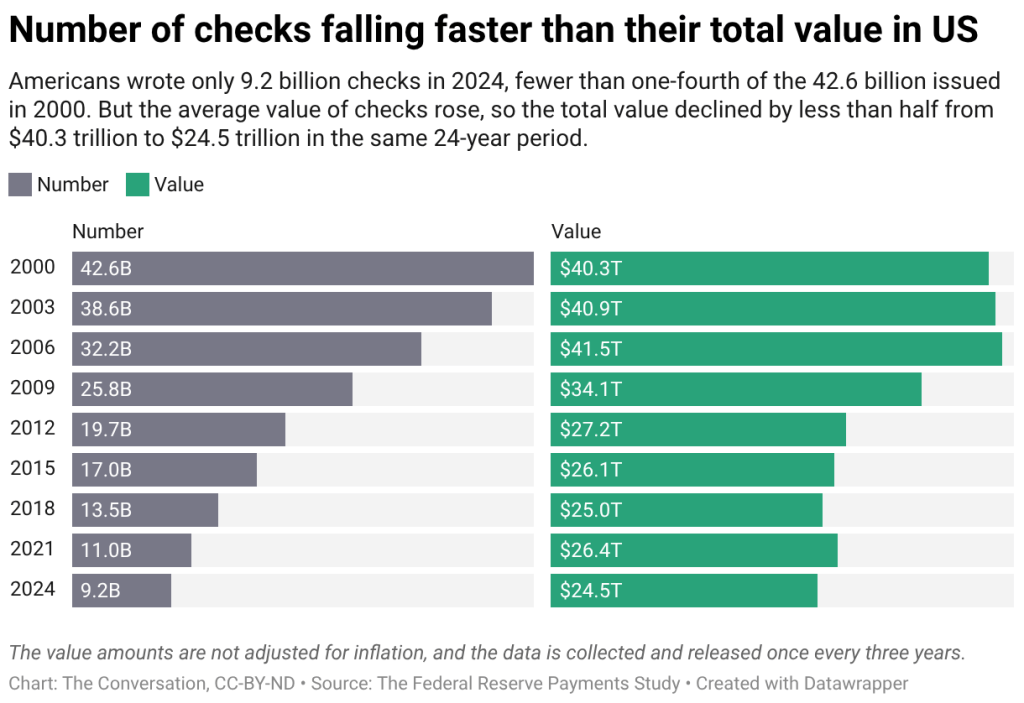
While check usage has sharply declined in the U.S., a significant number – about 9.2 billion in 2024 – are still written, the data shows. The face value of those checks is probably bigger than you’d expect: more than US$24 trillion, not adjusted for inflation. That is almost as large as U.S. gross domestic product of $29 trillion that year.
Not everyone can imagine numbers in billions or trillions, so let’s put those figures in more manageable terms.
A little over 150 checks were written per person in 2000. By 2024, the average had plummeted to 27 checks – slightly more than two per month. However, over that time, the amounts typically scribbled or printed on the face of those checks rose.
In 2000, the typical check was worth less than $1,000. By 2024, the average amount had more than doubled to $2,600.
And in both of those countries, check usage has fallen more sharply than in the United States.
Who uses checks today?
While check payments have declined, there are still two big groups of check writers in the United States.
The Federal Reserve Bank of Atlanta runs the Survey and Diary of Consumer Payment Choice. This survey asks people, rather than banks, for information on their payment habits. Roughly one-third of all respondents stated they used a paper check in the past 30 days.
Not surprisingly, the answers vary by age. About 60% of people 65 and over say they wrote a check. Among those 18 to 24, under 6% said they did.
It also turns out that a lot of people who think they never write checks actually unknowingly do it all the time. If you pay your bills online, your bank tries to pay them electronically. If it cannot electronically make the payment, the bank cuts a paper check on your behalf. Any online bill payment taking more than a couple of business days to post is being sent by check.
Another important factor is that small businesses love checks. Over 80% of businesses with sales between $1 and $10 million make payments using checks. Why? Small businesses often require two signatures on a check. The need for signatures means owners have to sign their name before any money goes out the door. This gives them control over money and a clear idea who is getting paid and how much.
Small businesses also like receiving checks. I wrote a lot of checks after my mother’s death because many of those small businesses I dealt with wanted an extra 3% and sometimes more to cover the cost to them of a credit card payment. Writing paper checks saved me and the businesses a lot of money.
The future
While many Americans still write checks, their declining usage clearly underscores that they are not ideal for making payments in all situations.
One of the biggest problems with checks is that you never know if the check writer has sufficient funds to cover the amount. When an account doesn’t have enough money, the check bounces. The Federal Reserve, which clears about one-third of all U.S. checks, returned about 22 million checks, with a total face value of around $80 billion. While these numbers are large, over 99% of all checks written don’t bounce.
Another problem with checks is forgery. Thieves steal checks from mailboxes, alter information and then cash them. The most recent figures show about 500,000 annual cases of check fraud in the U.S. Again, while a half-million is large, it is a tiny fraction of the 9.2 billion checks written annually.
The unit, which costs about $100 million a year to run, turned a $6.6 million profit in 2024. But its machines need replacing, and the Federal Reserve is wavering on spending the money.
For me, the answer is a clear no. While checks are clearly less important today than in the past, the numbers show that the American people and businesses still use and need checks.
Regardless of how well or poorly the overall economy is doing, many Americans are saddled with crushing medical debt. Such debt can hold people in a dangerous place: they can’t prosper or build wealth because they’re too deep in the hole, and they might make their health worse by forgoing necessary care in order to save. However, one million residents in Illinois are breathing a sigh of relief knowing their medical debt has been paid for.
Partnering with officials in Cook County and Undue Medical Debt, Illinois Gov. J.B. Pritzker worked on the Illinois Medical Debt Relief Program based on a Cook County Medical Debt Relief Initiative. The patients needn’t apply for the relief initiative; they just had to be Illinois residents with a household income at or below 400% of the federal poverty level. They could still qualify if they had medical debts equal or more than 5% of their annual household income. If qualified, the resident would receive a confirmation letter that their debt had been paid.
“In Illinois, we believe healthcare is a human right—and affordability is central to that promise,” Lieutenant Gov. Juliana Stratton said in a press release. “No one should ever delay care because of cost or face financial ruin simply because they got sick. The Illinois Medical Debt Relief Program is about lifting that burden, strengthening families, and ensuring every Illinoisan can seek the care they need. When we make healthcare more affordable, we build healthier and stronger communities.”
“Combined with our partners here in Cook County, who have erased $1.5 billion, we have delivered more than $2 billion in relief to over a million Illinoisans in all 102 counties of our state, with an average elimination across the state of $1,200 per patient,” Pritzker told The Center Square.
Another state collaboration with Undue Medical Debt
If this story sounds familiar, GOOD recently covered the state of Connecticut partnering with Undue Medical Debt in a similar fashion. To put it simply, the strategy UMD and their partners use is to purchase medical debt from bill collectors. They bundle and purchase the debt for a discount and, since they are buying so much debt at once, they’re typically able to negotiate a good deal. This means that they’re able to purchase most debt for pennies on the dollar.
While this has been bringing relief to many folks, there are still critics. A 2024 National Bureau of Economic Research study found that medical debt erasure didn’t improve the recipients’ overall financial well-being. While no longer having medical debt relieves a burden, it doesn’t automatically raise a person’s wages, assist housing needs, etc.
They also argue that having medical debt relieved wouldn’t improve a person’s access to healthcare. A patient may accrue new, additional debt because of ongoing care. A person may also still avoid getting necessary care to avoid a new bill.
It will be interesting to see if this version of medical debt relief becomes even more common or if different solutions are inspired from it.