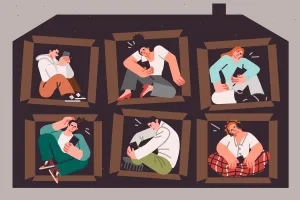
The United States was founded on the idea of idea of individual liberty, individual ownership, and individual needs. Unfortunately, this is a costly way for a country to develop, especially if every citizen aspires to express his freedom and individuality by owning a car or a house or a hammer.

Nearly 250 years into the evolution of our ethos of individuality, some Americans are starting to recognize that the primacy of individual ownership is not always economically sustainable. A movement has begun that places value on providing access to products and services, rather than ownership. Do we all really need to own a car? Or can we share a ZipCar that can be rented by the hour and used as needed? Consider the space we use. Do we all need to live in a house? Or can we seek out co-housing situations, where families share communal spaces like kitchens and yards, but have private sleeping quarters. Consider items that are used by all, but infrequently: Could the residents of each floor of an apartment building share tools like hammers and brooms instead of buying their own?

The move toward access, rather than ownership is documented and promoted in three recently released books, The Age of Access, The Mesh, and What’s Mine Is Yours. (See GOOD’s infographic on this.) This trend has applications far beyond liberal American households and communities.

The concept of communal living and shared resources has long been a feature of Eastern society. Households are characterized by their joint family nature. Food is shared, and often served from one bowl. In poorer areas, multiple families share water taps, groups of women access microfinance together, strangers share taxis and rickshaws. However, the collective nature of Eastern society is less a political statement than an imperative to stretch sparse resources.

As the East develops, and the size of the middle class grows, there is a push toward individual ownership. With increased incomes, the incidence of joint families reduces, and sharing resources is less of a financial necessity. However, if the East starts to choose individual ownership more readily over communal access, emerging economies will likely struggle to manage these patterns of consumption, particularly with regard to pollution and waste.

From an economic development perspective, Western practitioners are guilty of seeking solutions for the poor that are based on these American values. It’s only natural; this ideal is integral to the West’s notion of progress. Solutions to a lack of access to clean water, sanitation, healthcare, and education often cater to the provision of individual ownership: a faucet in every kitchen, a toilet in every home. However, this paradigm is wasteful, and thus, may not be ideal or sustainable for developing world countries.

The indicators we use to gauge wealth creation and poverty alleviation often involve measuring whether each person or family owns a TV or a phone, or has a toilet. These indicators may be an imperfect way of evaluating progress, and more importantly, they place value on a framework of development that may not be in a developing country’s best interest.

While instinct pushes us to value ownership, it may actually be better to approach complex issues by instead offering access. Rather than providing every household financing for a solar battery charger, a better option might be a communal charging station in each village. Rather than pushing for every citizen to own a mobile device, perhaps merely having access to a phone number will suffice for a group of people that can share a single phone.

Development experts and social entrepreneurs from the West are sometimes tempted to provide solutions that we enjoy for ourselves. However, as our eyes open to the waste and excess that are byproducts of Western development, we must seek new paradigms instead of grafting traditional ideals onto others.

Lindsay Clinton is the Editor of Beyond Profit, and an Associate Vice President at Intellecap, a social development advisory firm in India.


Image: (CC) by Flickr user tibchris.

  • Man’s dog suddenly becomes protective of his wife, Internet clocks the reason right away
    Dogs have impressive observational powers.Photo credit: Canva

    Reddit user Girlfriendhatesmefor’s three-year-old pitbull, Otis, had recently become overprotective of his wife. So he asked the online community if they knew what might be wrong with the dog.

    “A week or two ago, my wife got some sort of stomach bug,” the Reddit user wrote under the subreddit /r/dogs. “She was really nauseous and ill for about a week. Otis is very in tune with her emotions (we once got in a fight and she was upset, I swear he was staring daggers at me lol) and during this time didn’t even want to leave her to go on walks. We thought it was adorable!”

    His wife soon felt better, butthe dog’s behavior didn’t change.

    pregnancy signs, dogs and pregnancy, pitbull behavior, pet intuition, dog overprotection, Reddit stories, viral Reddit, dog instincts, canine emotions, dog owner tips
    Otis knew before they did. Canva

    Girlfriendhatesmefor began to fear that Otis’ behavior may be an early sign of an aggression issue or an indication that the dog was hurt or sick.

    So he threw a question out to fellow Reddit users: “Has anyone else’s dog suddenly developed attachment/aggression issues? Any and all advice appreciated, even if it’s that we’re being paranoid!”

    The most popular response to his thread was by ZZBC.

    Any chance your wife is pregnant?

    ZZBC | Reddit

    The potential news hit Girlfriendhatesmefor like a ton of bricks. A few days later, Girlfriendhatesmefor posted an update and ZZBC was right!

    “The wifey is pregnant!” the father-to-be wrote. “Otis is still being overprotective but it all makes sense now! Thanks for all the advice and kind words! Sorry for the delayed reply, I didn’t check back until just now!”

    Redditors responded with similar experiences.

    Anecdotal I know but I swear my dog knew I was pregnant before I was. He was super clingy (more than normal) and was always resting his head on my belly.

    realityisworse | Reddit

    So why do dogs get overprotective when someone is pregnant?

    Jeff Werber, PhD, president and chief veterinarian of the Century Veterinary Group in Los Angeles, told Health.com that “dogs can also smell the hormonal changes going on in a woman’s body at that time.” He added the dog may “not understand that this new scent of your skin and breath is caused by a developing baby, but they will know that something is different with you—which might cause them to be more curious or attentive.”

    The big lesson here is to listen to your pets and to ask questions when their behavior abruptly changes. They may be trying to tell you something, and the news may be life-changing.

    This article originally appeared last year.

  • Throughout history, women have stood up and fought to break down barriers imposed on them from stereotypes and societal expectations. The trailblazers in these photos made history and redefined what a woman could be. In doing so, they paved the way for future generations to stand up and continue to fight for equality.

  • ,

    Why mass shootings spawn conspiracy theories

    Mass shootings and conspiracy theories have a long history.

    While conspiracy theories are not limited to any topic, there is one type of event that seems particularly likely to spark them: mass shootings, typically defined as attacks in which a shooter kills at least four other people.

    When one person kills many others in a single incident, particularly when it seems random, people naturally seek out answers for why the tragedy happened. After all, if a mass shooting is random, anyone can be a target.

    Pointing to some nefarious plan by a powerful group – such as the government – can be more comforting than the idea that the attack was the result of a disturbed or mentally ill individual who obtained a firearm legally.


Explore More Articles Stories

Articles

Man’s dog suddenly becomes protective of his wife, Internet clocks the reason right away

Articles

14 images of badass women who destroyed stereotypes and inspired future generations

Articles

Why mass shootings spawn conspiracy theories

Articles

11 hilarious posts describe the everyday struggles of being a woman