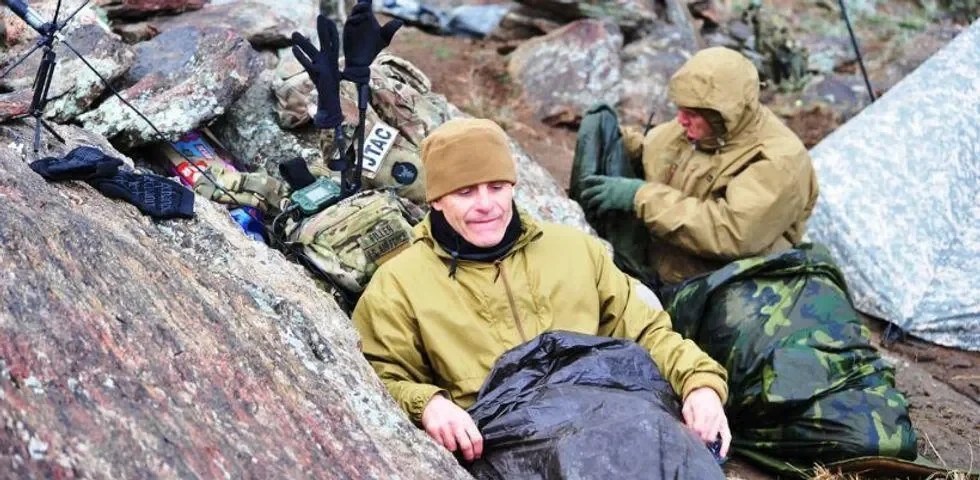
For those in the military, sleep can mean the difference between life and death. But shut-eye can be very hard to come by, especially during active conflict.
According to Sharon Ackman, the U.S. Navy Pre-Flight School developed a scientific method to help its pilots fall asleep. This technique allowed 96% of the pilots to fall asleep in two minutes or less.
If this technique lets pilots fall asleep during war, you can certainly use it to fall asleep in the comfort of your bedroom.
Here’s how to do it:
Step 1: Relax in your seat
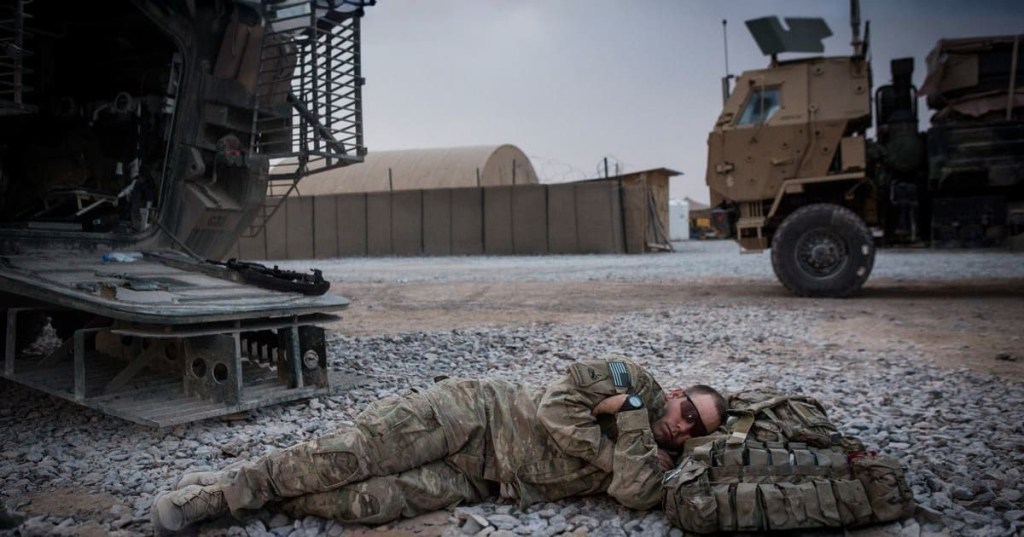
via DVIDShub / Flickr | Sleeping in difficult environments.
Due to the cramped space in planes, pilots were trained to sleep while seated. They placed their feet flat on the ground and rested their hands in their laps.
Breathe slow, deep breaths while relaxing every muscle in your face and letting your forehead, cheeks, mouth, tongue, and jaw go limp.
Step 2: Relax your upper body
Let your shoulders drop as low as possible and allow the muscles in your neck to go limp.
Starting with your dominant side, let your bicep feel like it’s falling off your body, then move to your forearm, hand, and fingers. If a muscle won’t relax, tense it first, then let it go loose.
Slowly exhale your tension.
Step 3: Relax your lower body
Tell your right thigh muscle to sink, then move down your leg, saying the same thing to your calf, ankle, and foot. Your leg should feel like it has sunk into the ground. Then move on to your left leg.
Step 4: Clear your mind
Finally, clear your mind for ten seconds by focusing on your breath moving through your nostrils or holding a static image in your mind.
Once your body is relaxed and your mind quiet, you should slip away into darkness.
Appiah is a national team athlete whose training means she flies between the two cities constantly. Over the years she’s accumulated enough airline points to occasionally upgrade, and on this particular flight she’d used some to book a premium economy aisle seat. She chose the aisle specifically so she could move around freely during the four-hour flight without climbing over anyone. She paid for the upgrade at the time of booking, as she always does, because she doesn’t want to be an inconvenience to other passengers.
She boarded, found her row, and discovered a woman already sitting in her seat. The woman’s boyfriend was next to her in the adjacent window seat. Appiah triple-checked her ticket. The seat was hers.
When she pointed this out, the woman acknowledged it without much embarrassment. She knew she was in the wrong seat, she said. She was just wondering if Appiah might not mind switching with her own seat, just one row back, so she could sit next to her boyfriend for the flight. Her seat was also premium economy, but it was a window seat.
Appiah’s answer was no.
“I told her, nope, I paid for this seat. I would rather stick with my seat,” she said in the TikTok video, as reported by Narcity Canada. “I was just like, I bought the aisle and I’m not moving.”
The woman was upset, but as Appiah noted, she knew there wasn’t much of a fight to be had. She moved. The flight proceeded.
Appiah posted the story to TikTok under the caption “Seat selection is your friend. I promise you,” and it spread rapidly, resonating with the sizable portion of the traveling public who have been in exactly her position. What made her framing stand out was a phrase she used for what the couple had attempted: “Nice bullying.” The strategy of occupying someone’s seat and then sweetly asking them to accommodate you, banking on social pressure to make refusal feel rude. As Appiah put it, people should not “kindly ask, but really bully, people into giving up their seats.”
Her point wasn’t that couples shouldn’t want to sit together. It’s that the time to sort that out is before the flight, not after someone has already paid for the seat you’re sitting in. “If you don’t want to pay for seat selection, then that’s up to you and you deal with the consequences,” she said.
The response in the comments was largely in agreement. A Delta flight attendant with 28 years of experience said that seat swaps are only really reasonable when they involve seats of equivalent value. A window seat for a window seat. An aisle for an aisle. Asking someone to trade a paid aisle upgrade for an unrequested window seat is a different thing entirely.
Appiah grew up in Toronto public housing, the daughter of Ghanaian immigrants, and was introduced to sport through a Blue Jays community outreach initiative in her neighborhood. She made Canada’s national bobsleigh team through years of work, competed at the 2022 Beijing Winter Olympics, and has now completed her second Olympic Games in Milan.
She also recently competed on Jeopardy, incorrectly answered a question about Tim Hortons, and says she may never fully recover. She is, by all available evidence, exactly the kind of person who is going to politely but firmly keep the seat she paid for.
You can follow Cynthia Appiah (@cyndiesel) on TikTok to learn more about her daily life as a bobsleigh athlete.
This article originally appeared earlier this year.
A complex and unflattering conversation is happening around education. Jonathan Buchwalter, a history teacher posting as jonstertruck on TikTok, argues that learning has been reduced to a simplified game. In trying to make learning more accessible, students have increasingly been guided toward a “gamification” of education.
In his video, he describes students clamoring and begging counselors to gain access to his classroom. By stripping things back to a more traditional style where kids have to wrestle with challenging material and develop real critical thinking, Buchwalter suggests it may be more valuable than the educational system recognizes.
With a budget crunch, standardized testing to quantify outcomes, and progress created to deliver a dopamine response, Buchwalter describes the current situation:
“There has been this odd shift away from the academic skills that make someone a critical thinker and toward short-form content in the classroom. Whether it’s smaller and smaller articles, more and more scaffolding, or supports for students whenever they do any kind of complex task… Layers and layers of apps that all make a game out of the learning.”
A 2024 study in Frontiers revealed that the gamification of education was specifically used to increase attention and self-regulation. Facing a growing problem of student disengagement, schools hope this strategy will help motivate them.
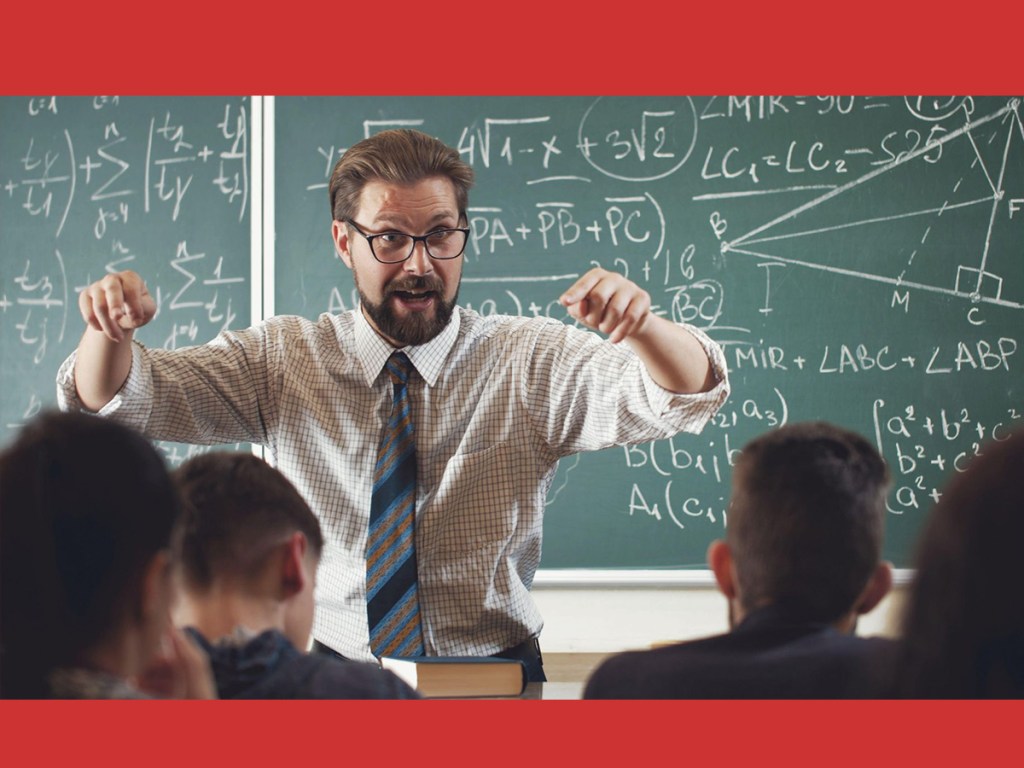
An inspired teacher in the classroom. Photo credit Canva
Kids Want To Be Treated Like Adults
Buchwalter argues that kids actually want to be educated in the old school way. They want to be challenged, and they desire to learn critical thinking skills even though it might be harder.
“The reason that I’ve got a line of students every year that go to the counselors and beg them to be put in my history class isn’t because I’m the best teacher ever. It’s because I treat them like adults and they know that.”
But wanting to learn differently doesn’t mean that it’s going to be easy. Many students have to overcome a learning curve to catch up.
“Most of my kids are sixteen or seventeen. They’ve been sort of indoctrinated into the gamefication of learning. And so those first few weeks of my class are really tough for a lot of my students. Because they’re used to the short form [of] everything and games, and I’m not giving them that.”
Even though the gamification of learning might improve engagement, are students actually winning the game of education? A 2025 study in Nature found understanding, critical thinking, and general knowledge transfer in decline. Students may, in fact, be focusing on “winning the game” rather than mastering the material.
Research reports mixed or contradictory effects on actual learning performance. Some studies hail student performance while others warn of shallow learning. Buchwalter doesn’t believe in the new system of education and claims his own experience in teaching shows why:
“The mythos built around it is that the kids can’t focus on the harder stuff, the more challenging stuff. And so we have to gamify to meet them where they are. But what I found because we do so much old school paper and pencil, reading and writing in my class. They can do it. They can. And they tend to do pretty well on it after a few weeks of friction. That once they learn what my expectations are, and they learn how to meet them, and they learn that my standard doesn’t move, they can meet my high standard. These kids are smart. These kids are sharp.”
A 2024 study in MDPI compared gamified learning to traditional education. Results showed that gamification improved engagement. However, traditional learning has established a solid baseline for academic performance. There are significant differences between participation and gaining depth, knowledge, and mastery.
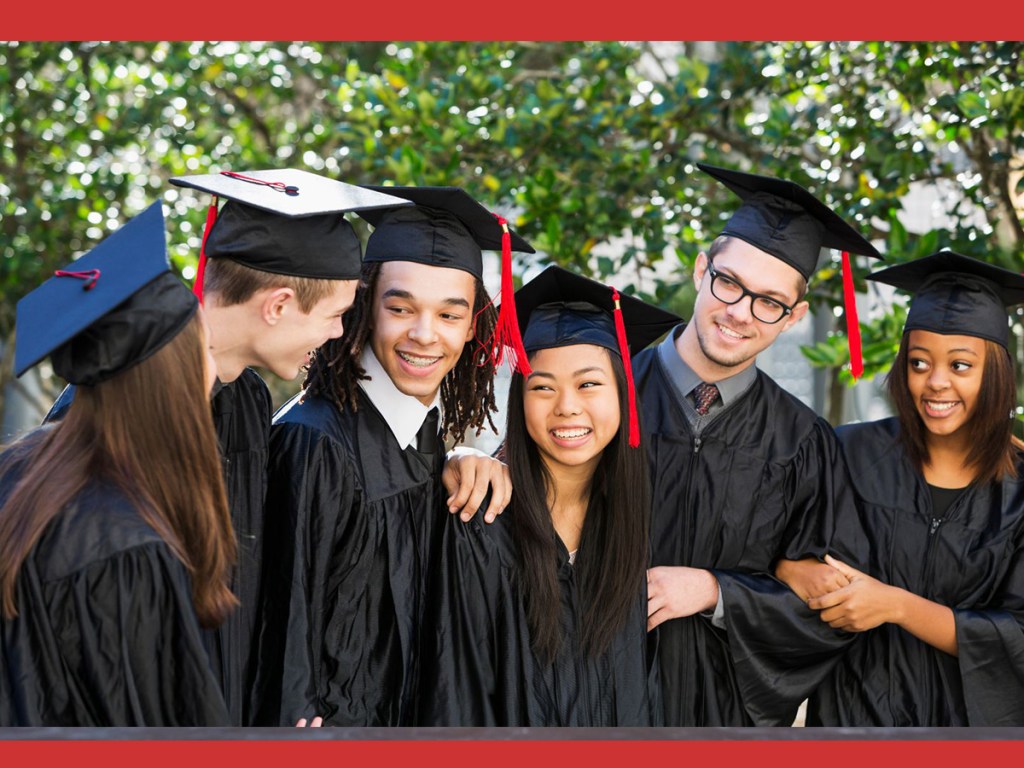
Students are ready to graduate. Photo credit Canva
Receiving An Education Or Getting ‘A’ Grade
With the current trend toward short content instruction, many wonder if the students are receiving an education or just a grade. People chimed in with their own thoughts:
“My best teachers were the ones that pushed me. Made me think. Made it challenging. I’m certain you would have made my best teacher list!”
“Community college English prof here. Most of my students have never read a book cover to cover before my class”
“Productive struggle is so important for learning!”
“Get textbooks and primary sources back in the classroom!”
“I’m in shock reading some of these comments, are they intent on purposely failing the youth?”
“We are in school to learn, not play games.”
“Say it louder for the people in the back, yes sir!!!!!”
“Me, a 12th grade literature teacher, BEGGING my district to let me keep teaching full novels and not just tiny pieces of them”
With competing ideas for educating the leaders of tomorrow, more teachers must share their own experiences like Buchwalter. Finding students apathetic to the system is concerning. Getting students more engaged is great. Graduating people who lack critical thinking skills or meaningful understanding is not only devastating for them, but represents a fundamental failure of the educational system itself.
A man went on his usual jog down a trail he used daily, but this time it was a little different. Dressed in matching sweatpants and a hoodie, he saw a woman coming from the opposite direction. The man noticed that the woman changed pace from walking to running. He then looked behind him and…
A man went on his usual jog down a trail he used daily, but this time it was a little different. Dressed in matching sweatpants and a hoodie, he saw a woman coming from the opposite direction. The man noticed that the woman changed pace from walking to running. He then looked behind him and saw her giving him a concerned look when their eyes met. Later, the man went on Reddit to discuss the situation, writing, “I can’t help but feel like she was running from me.”
While he was just doing his routine exercise, the man couldn’t help but feel “bad and in a way gross.” Wanting to make sure he didn’t make women feel unsafe, he then asked folks online what he could have done better.
The comments were filled with men who empathized and offered advice:
“I had a teacher put cat bells on his runners so people would stop calling the police on him for running in his own neighborhood. Can’t sneak up on anyone or surprise them.”
“I’m 7’2”. I have an oddly quiet and frankly creepy voice, I have many tattoos and I walk like im a killer in a slasher movie due to knee issues. I couldn’t be more scary if I tried. I was once walking to my truck after working at an office park with a shared parking lot. It was just going dark and I think I gave a woman a heart attack. I thought about a propeller hat but that just feels somehow more sinister.”
“Neon running clothes can help you be seen and have the benefit of looking goofy.”
“Man, the sneak up thing is a real headscratcher. People just do not pay attention and there’s only so much you can do. I was running with a bright (I mean BRIGHT) headlamp one evening and still managed to scare the piss out of a lady. She actually screamed.”
“I believe a closed mouth smile can go a long way. It says “I’m friendly but not trying to be friendly with you.”
There were also comments from women offering tips and explaining their feelings about such situations:
“I’d suggest you keep the interaction to a minimum — just a “morning” is enough, or even pretending not to notice. And, unless you feel like you are in danger (say, you hear footsteps approaching you from behind), no need to look back. Speaking from a woman’s perspective: it’s not personal. You’re a stranger, and some of us will be wary regardless, especially alone.”
“I feel safest when I think I’m going unnoticed. Pretending like you dont see her is best bet but if you do make eye contact, a short hello would be fine. Thanks for caring, OP.”
“When I am approaching someone from behind I say ‘beep beep.’ But I’m also female and dress like a dude when I go out for walks so I don’t get harassed. I go for walks at night with dark colored pants, hoodie on over my head, stun gun flashlight in my hand. It’s funny how we have to behave differently for the opposite gender. It’s like instinctual for me. I never really thought about it. But yeah if I saw a man in some neon colors or doing little dance-run moves I’d feel safer than if I saw me coming.”
“Personally, I’ve had a few men over the years call out from a decent distance ‘coming up behind you!’ when they were running, and I’ve appreciated their thoughtfulness and I always thank them. I even had a guy at a craft store looking at the same display as me several years ago say ‘reaching behind you’ when he needed something in front of me, and I found that extra sweet and thoughtful, too.”
“Not taking it personally is the only thing to do. When we do things for our safety it’s not about you. We’d rather be safe than risk being hurt to avoid hurting your feelings. The only way to stop that is to stop men from being threats to women and that’s just not possible. Or at least, it’s never happened. The best way to make a woman feel safe when you’re out running at night is to go about your business and pay no attention to her.”
“As a woman, my advice would be to try and not take things personally. The way we react has little to do with you, and more to do with previous situations me and many others have found ourselves in. One creepy dude is all it takes for us to become extra cautious forever, and react in ways which might make you feel like there’s something about you that causes it. There isn’t. And honestly, other than minding your business there’s not much else you can do, unfortunately.”
There are many thoughts on how to make women feel safer when jogging, including how women prepare and how men should behave. Regardless of what specific advice one follows, staying mindful can help everyone involved stay and feel safe.