Living on a farm often means dealing with the beauty of nature, but for Stuart Baldwin, a livestock farmer in Haydock, it also meant dealing with the mess left behind by others. Baldwin says about 25 times a year his land is targeted by “fly-tippers,” people who illegally dump trash on private property. As the Manchester Evening News reported, the situation recently reached a breaking point when Baldwin discovered a staggering 421 tires scattered across his fields.
Instead of just cleaning up the mess and footing the bill, Baldwin decided to check the CCTV cameras he had recently installed. The footage clearly showed a van arriving at the property and unloading the massive haul of rubber.
Baldwin didn’t immediately call the authorities or retaliate. In a move that reflects a very grounded sense of fairness, he tracked the man down and gave him a chance to make it right. He offered the man a few days to return and clear the field himself.
When the deadline passed and the tires remained, Baldwin decided that if the man wouldn’t come to the tires, the tires would go to the man. Utilizing a truck from his family’s recycling business, Baldwin and a group of volunteers loaded every single one of the 421 tires and drove them straight to the address associated with the van. As The Daily Mail reported, they carefully unloaded the entire pile into the man’s front garden, ensuring no property was damaged in the process.
This wasn’t just about a “petty” dispute. Illegal dumping is a massive problem that places a heavy financial and emotional burden on farmers. According to official government data from the UK, authorities dealt with over 1.2 million fly-tipping incidents in the last year alone. Baldwin’s daughter, Megan, told reporters that the family simply wanted to prove a point about respect and accountability. They wanted to show that a farmer’s land is a livelihood, not a convenient trash can.
The community response has been overwhelmingly supportive. Baldwin noted that people have even approached him on the street to thank him for standing up for the neighborhood. While he joked that the culprit was likely feeling “deflated” after the delivery, the message was serious. By returning the waste to its source, Baldwin turned a frustrating violation of his property into a legendary lesson in personal responsibility.
This article originally appeared earlier this year.
Each year on the holiday that bears his name, Martin Luther King Jr. is remembered for his immense contributions to the struggle for racial equality. What is less often remembered but equally important is that King saw the fight for racial equality as deeply intertwined with economic justice.
To address inequality – and out of growing concern for how automation might displace workers – King became an early advocate for universal basic income. Under universal basic income, the government provides direct cash payments to all citizens to help them afford life’s expenses.
In recent years, more than a dozen U.S. cities have run universal basic income programs, often smaller or pilot programs that have offered guaranteed basic incomes to select groups of needy residents. As politicalscientists, we have followed these experiments closely.
One of us recently co-authored a study which found that universal basic income is generally popular. In two out of three surveys analyzed, majorities of white Americans supported a universal basic income proposal. Support is particularly high among those with low incomes.
King’s intuition was that white people with lower incomes would support this type of policy because they could also benefit from it. In 1967, King argued, “It seems to me that the Civil Rights Movement must now begin to organize for the guaranteed annual income … which I believe will go a long, long way toward dealing with the Negro’s economic problem and the economic problem with many other poor people confronting our nation.”
But there is one notable group that does not support universal basic income: those with higher levels of racial resentment. Racial resentment is a scale that social scientists have used to describe and measure anti-Black prejudice since the 1980s.
Economic self-interest can trump resentment
At the same time, the results of the study also suggest that coalition building is possible, even among the racially resentful.
Economic status matters. Racially resentful whites with lower incomes tend to be supportive of universal basic income. In short, self-interest seems to trump racial resentment. This is consistent with King’s idea of how an economic coalition could be built and pave the way toward racial progress.
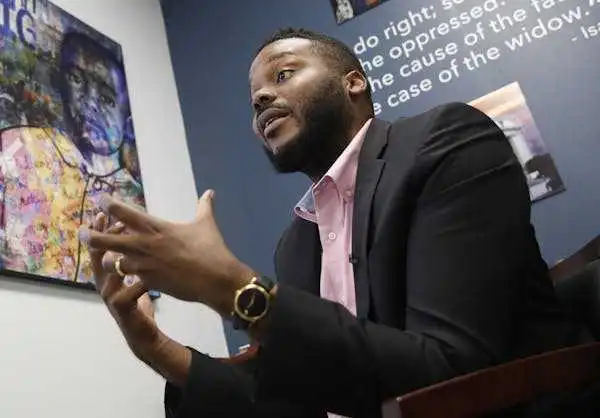
As mayor of Stockton, Calif., Michael Tubbs ran a pioneering program that provided a basic income to a limited number of residents. Rich Pedroncelli/AP
Income is not the only thing that shapes attitudes, however. Some of the strongest supporters of universal basic income are those who have higher incomes but low levels of racial resentment. This suggests an opportunity to build coalitions across economic lines, something King believed was necessary. “The rich must not ignore the poor,” he argued in his Nobel Peace Prize lecture, “because both rich and poor are tied in a single garment of destiny.” Our data shows that this is possible.
This approach to coalition building is also suggested by our earlier research. Using American National Election Studies surveys from 2004-2016, we found that for white Americans, racial resentment predicted lower support for social welfare policies. But we also found that economic position mattered, too.
Economic need can unite white Americans in support of more generous welfare policies, including among some who are racially prejudiced. At a minimum, this suggests that racial resentment does not necessarily prevent white Americans from supporting policies that would also benefit Black Americans.
Building lasting coalitions
During his career as an activist in the 1950s and 1960s, King struggled with building long-term, multiracial coalitions. He understood that many forms of racial prejudice could undermine his work. He therefore sought strategies that could forge alliances across lines of difference. He helped build coalitions of poor and working-class Americans, including those who are white. He was not so naive as to think that shared economic progress would eliminate racial prejudice, but he saw it as a place to start.
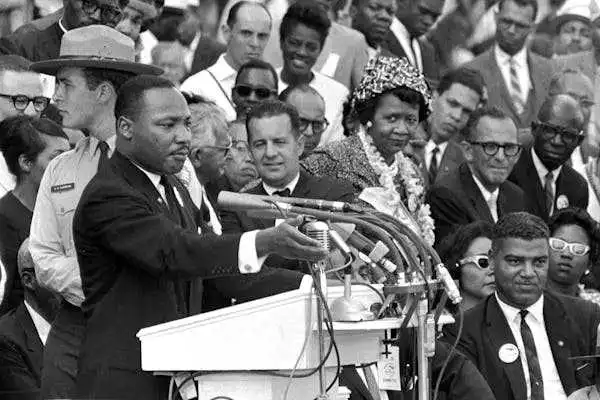
Martin Luther King Jr. believed Americans of different racial backgrounds could coalesce around shared economic interests. AP
Racial prejudice continues to fuel opposition to universal basic income, as well as other forms of social welfare. But our research suggests that this is not insurmountable.
As King knew, progress toward economic equality is not inevitable. But, as his legacy reminds us, progress does remain possible through organizing around shared interests.
If the homeowners’ association (HOA) demands that someone rip out their vibrant, wild garden, what happens if they just plant more? In a Reddit post, one redditor shared a photo of an eco-conscious insect sanctuary. They wrote in their caption, “Guess what HOA. You have no power here. So many bees and butterflies.”
It can be confusing to understand what rights a homeowner has when compared to the mythical reach of a HOA. This person’s garden might be unique, but the approach can be something every homeowner can learn from. If you’re HOA feels a little bit more like a tyrant, there are ways to protect your rights without losing sleep.
These are seven steps to follow when facing a difficult homeowners’ association:
If you’re going to be interacting with an HOA, it’s best to know the rules behind this governing body. A 2025 article in Better Homes & Gardens explains the importance, writing, “Before purchasing a home, the buyer should read through the policies and see if they are comfortable with the rules,” said Sarkie Ampim, an agent with Coldwell Banker Warburg. “If a homeowner isn’t sure about something, then they should reach out directly to the board for clarification to avoid any possible conflict.”
This means keeping a record of all correspondence, which includes emails, texts, and letters. If you’re in a meeting or speaking to board members, it’s advisable to take notes. National Property Management Group, an organization comprised of certified managers and accountants located in LA County, shared in a 2025 letter, “Keep written records of complaints, meeting notes, and communications related to disputes. This ensures transparency and protects the HOA if legal involvement becomes necessary.”
Documentation protects you if things somehow escalate or legal action is required.
3. Be respectful and be assertive
Sometimes emotions can get heated. If an HOA is being difficult and unreasonable, it’s still important to remain calm and professional. A 2024 study published in the National Library of Medicine found that more assertive people experience reduced feelings of anxiety, stress, and depression. Staying assertive without being aggressive will make it easier to gain allies, and the HOA will be less likely to simply dismiss any of your concerns.
4. Get to know your neighbors
This may not come as a surprise, but other homeowners could be experiencing similar issues. There’s always power to be gained with numbers. A 2025 study in the National Library of Medicine found that strong neighborhood relationships led to better mental health and quality of life. When dealing with the HOA, try hosting informal gatherings or creating a group chat to share your concerns and strategies.
5. Attend HOA meetings regularly
Everyone can find themselves with a difficult, busy schedule to navigate, but go to HOA meetings. Ask questions. Request clarification on things that you don’t understand. ProManage Experts, a community management and administrative service, share that attending meetings leads to shared democracy in action (express concerns, share opinions, share ideas), transparency (stay informed on upcoming projects and ongoing initiatives), and effective conflict resolution (address, discuss, and resolve issues fairly and impartially). If they see you’re invested and watching what they’re doing, fewer corners will be cut and they’re less likely to push questionable actions.
Sometimes it’s necessary to get a real estate or HOA attorney involved. You might find yourself in the position of a suer or a defendant. A letter from an attorney can prompt a more cooperative response from the HOA. Also, an attorney can help clarify your legal rights, offer guidance, negotiate terms, or, when necessary, represent you in court.
7. In some instances, leverage the problems against the HOA where they have fallen short
Running an HOA can be extremely difficult. Most HOA members have lives deeply invested outside the needs of the community. They might be mismanaging funds, failing to maintain common areas, or violating the rules themselves. Having built relationships with your neighbors, have multiple people make similar complaint to add more weight to your argument or defense. A 2025 article reported in The U.S. Sun found one homeowner in a dispute over his doorbell camera. The dispute led to an audit where bookkeeping discrepancies by the HOA turned attention and scrutiny toward them.
It’s important to know when to pick your battles. Not every problem or disagreement is worth fighting over. Try to find the best way to maintain peace of mind and avoid HOA drama. Getting plugged into your community and participating with an open mind and with positive, assertive action seems to be the best course for living within a difficult HOA.
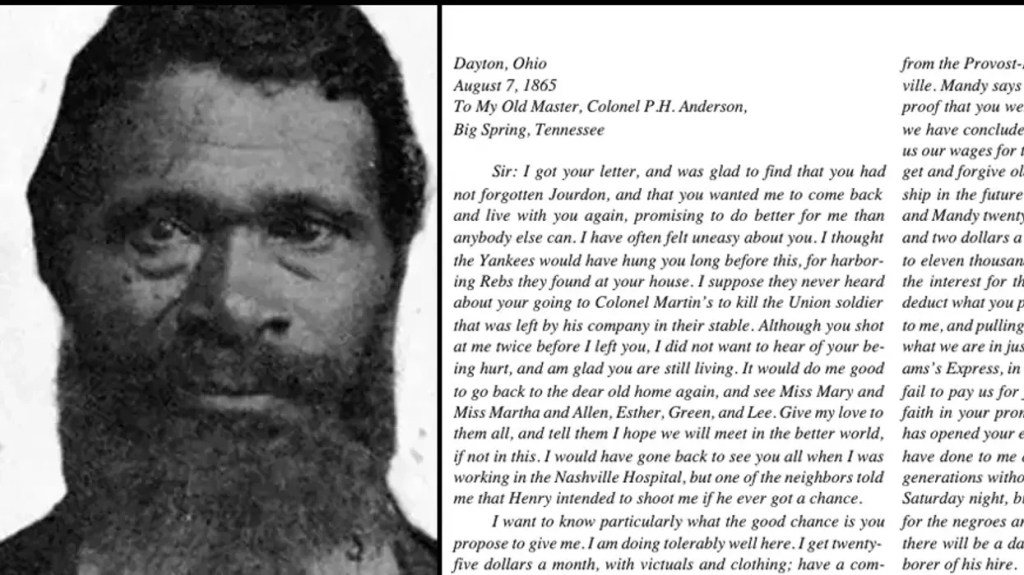
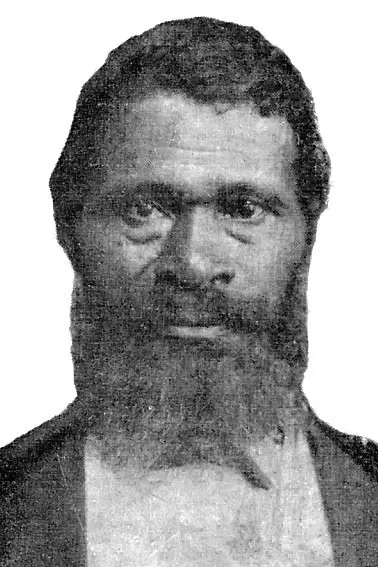
In 1825, at approximately age 8, Jordan Anderson (sometimes spelled “Jordon”) was sold into slavery and served the Anderson family for 39 years. In 1864, the Union Army camped on the Anderson plantation, liberating Jordan and his wife, Amanda.
The couple eventually made it safely to Dayton, Ohio, where, in July 1865, Jordan received a letter from his former owner, Colonel P.H. Anderson. The letter kindly asked Jordan to return to work on the plantation because it had fallen into disarray during the war.
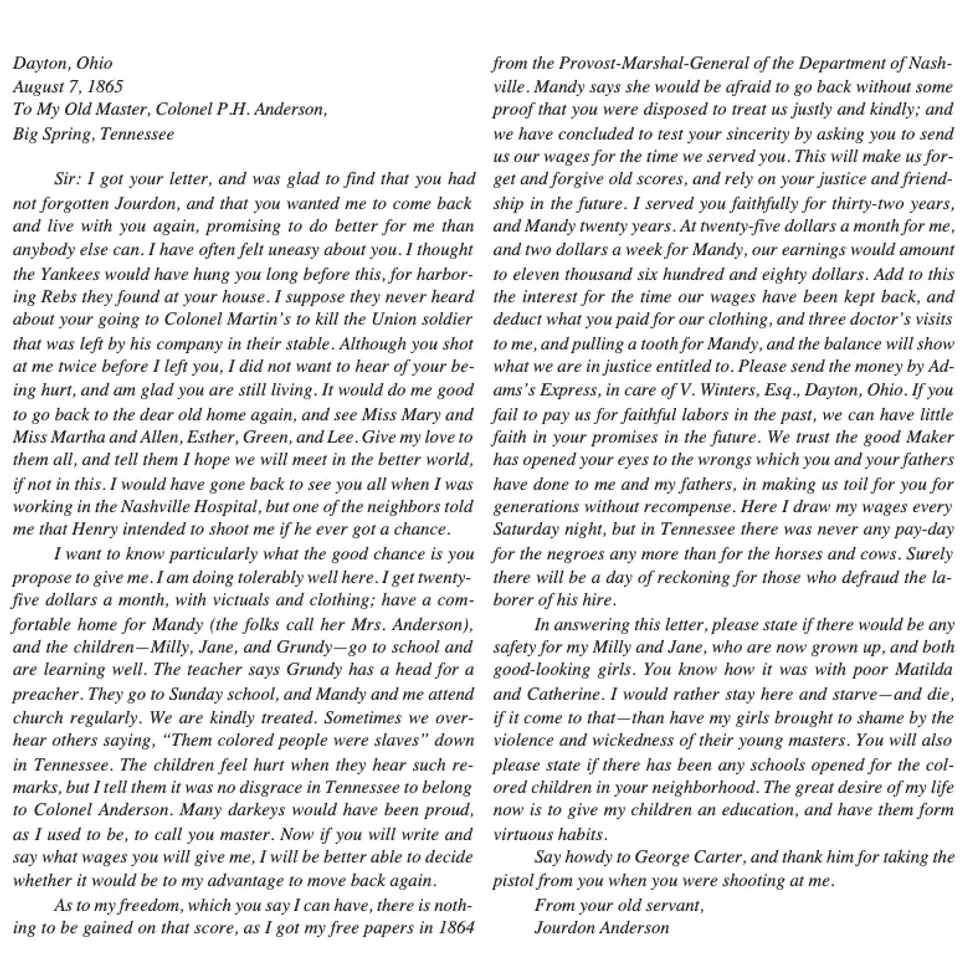
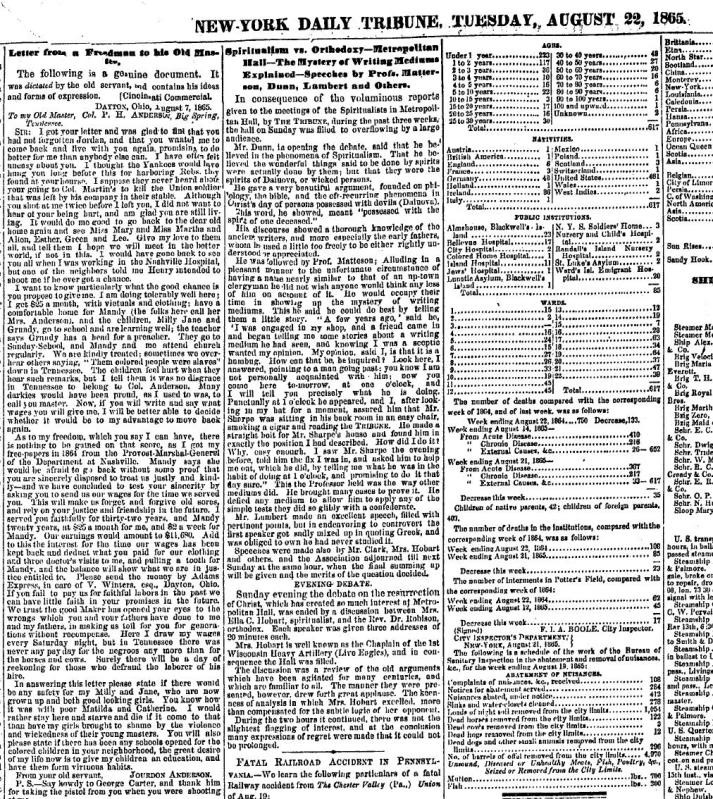
On Aug. 7, 1865, Jordan dictated his response through his new boss, Valentine Winters, and it was published in the Cincinnati Commercial. The letter, entitled “Letter from a Freedman to His Old Master,” was not only hilarious but showed compassion, defiance, and dignity.
The letter from Jordan Anderson to his former master Reddit
The letter mentions a “Miss Mary” (Col. Anderson’s Wife), “Martha” (Col. Anderson’s daughter), Henry (most likely Col. Anderson’s son), and George Carter (a local carpenter).
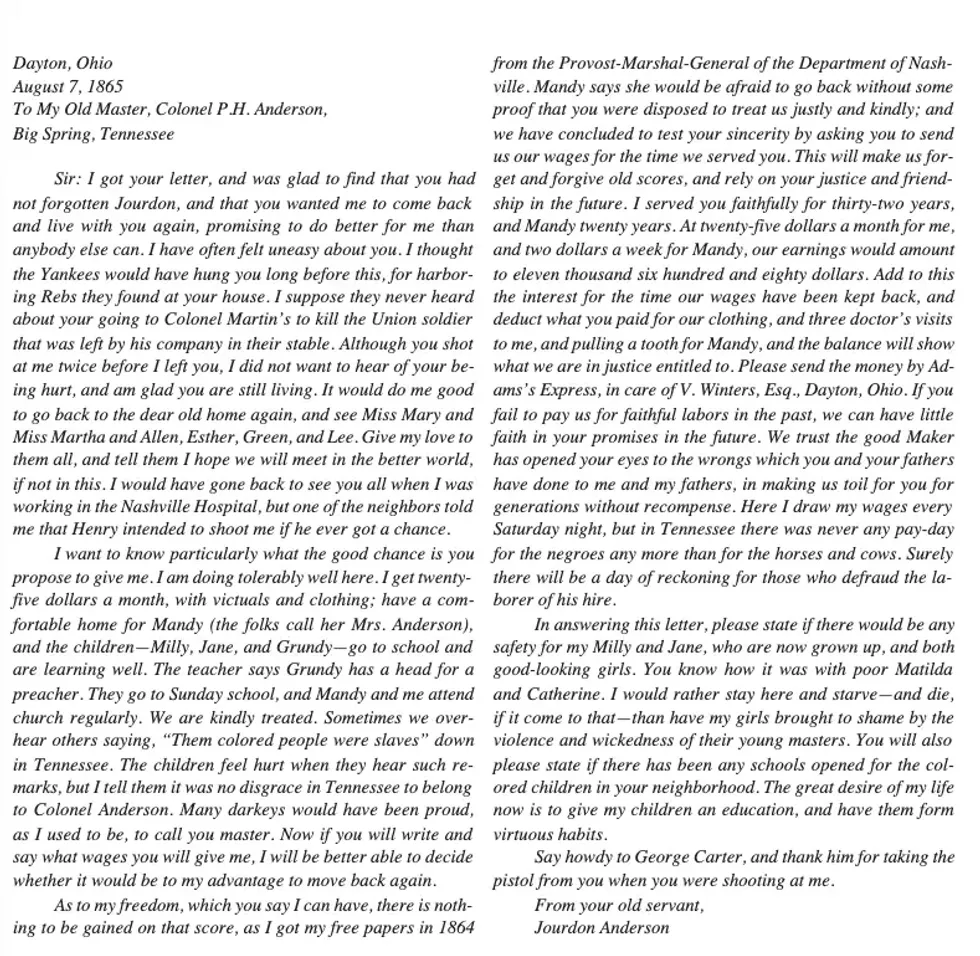
Dayton, Ohio, August 7, 1865 To My Old Master, Colonel P.H. Anderson, Big Spring, Tennessee “Sir: I got your letter, and was glad to find that you had not forgotten Jordon, and that you wanted me to come back and live with you again, promising to do better for me than anybody else can. I have often felt uneasy about you. I thought the Yankees would have hung you long before this, for harboring Rebs they found at your house. I suppose they never heard about your going to Colonel Martin’s to kill the Union soldier that was left by his company in their stable. Although you shot at me twice before I left you, I did not want to hear of your being hurt, and am glad you are still living. It would do me good to go back to the dear old home again, and see Miss Mary and Miss Martha and Allen, Esther, Green, and Lee. Give my love to them all, and tell them I hope we will meet in the better world, if not in this. I would have gone back to see you all when I was working in the Nashville Hospital, but one of the neighbors told me that Henry intended to shoot me if he ever got a chance.”
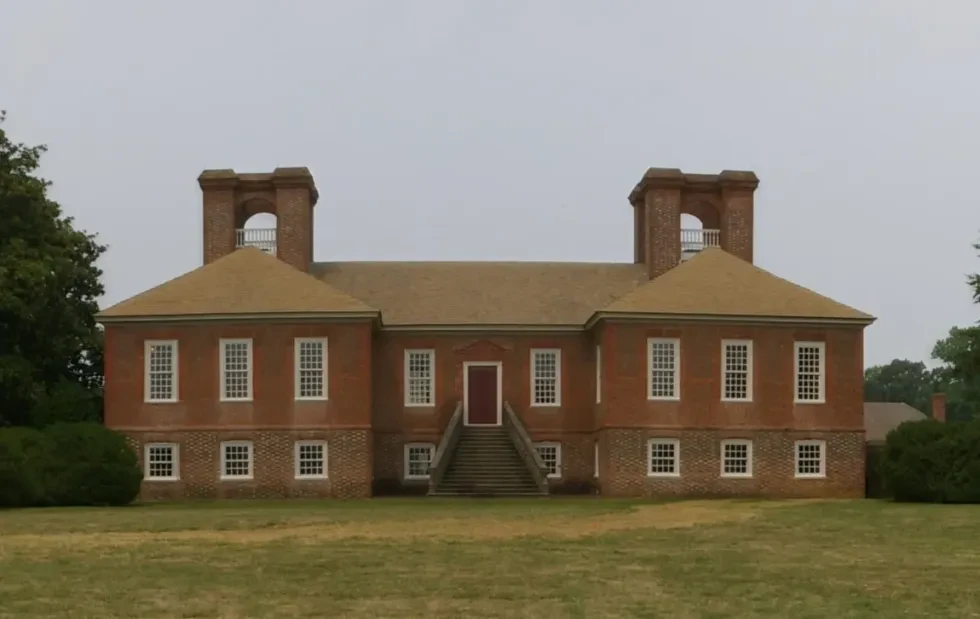
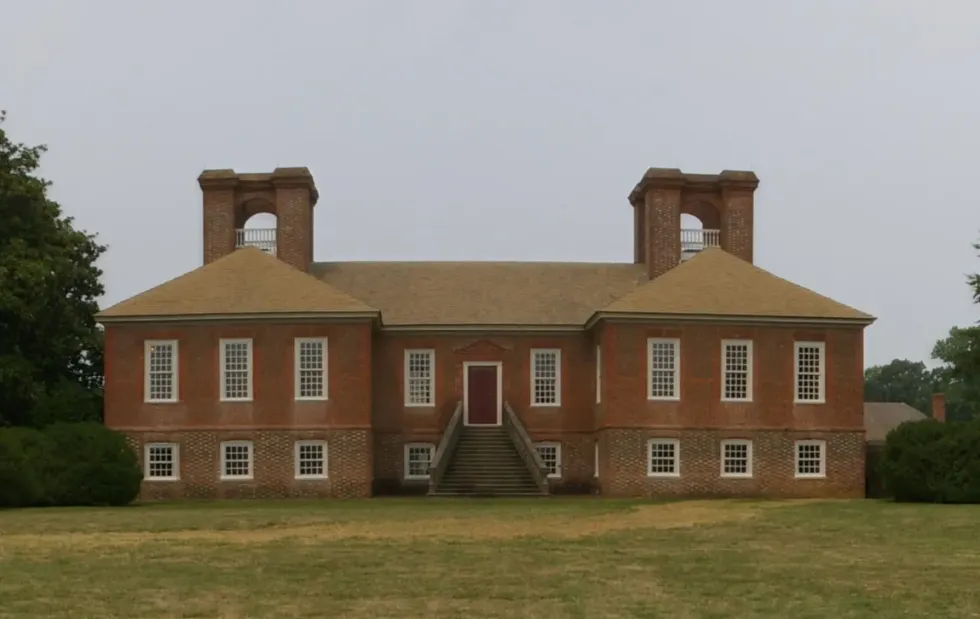
Jordan Anderson's formeru00a0plantation in the South Canva
“I want to know particularly what the good chance is you propose to give me. I am doing tolerably well here. I get twenty-five dollars a month, with victuals and clothing; have a comfortable home for Mandy, — the folks call her Mrs. Anderson, — and the children — Milly, Jane, and Grundy — go to school and are learning well. The teacher says Grundy has a head for a preacher. They go to Sunday school, and Mandy and me attend church regularly. We are kindly treated. Sometimes we overhear others saying, “Them colored people were slaves” down in Tennessee. The children feel hurt when they hear such remarks; but I tell them it was no disgrace in Tennessee to belong to Colonel Anderson. Many darkeys would have been proud, as I used to be, to call you master. Now if you will write and say what wages you will give me, I will be better able to decide whether it would be to my advantage to move back again.”
A dilapidated former plantationu00a0in the South Canva
“As to my freedom, which you say I can have, there is nothing to be gained on that score, as I got my free papers in 1864 from the Provost-Marshal-General of the Department of Nashville. Mandy says she would be afraid to go back without some proof that you were disposed to treat us justly and kindly; and we have concluded to test your sincerity by asking you to send us our wages for the time we served you. This will make us forget and forgive old scores, and rely on your justice and friendship in the future. I served you faithfully for thirty-two years, and Mandy twenty years. At twenty-five dollars a month for me, and two dollars a week for Mandy, our earnings would amount to eleven thousand six hundred and eighty dollars.”
“Add to this the interest for the time our wages have been kept back, and deduct what you paid for our clothing, and three doctor’s visits to me, and pulling a tooth for Mandy, and the balance will show what we are in justice entitled to. Please send the money by Adams’s Express, in care of V. Winters, Esq., Dayton, Ohio. If you fail to pay us for faithful labors in the past, we can have little faith in your promises in the future. We trust the good Maker has opened your eyes to the wrongs which you and your fathers have done to me and my fathers, in making us toil for you for generations without recompense. Here I draw my wages every Saturday night; but in Tennessee there was never any pay-day for the negroes any more than for the horses and cows. Surely there will be a day of reckoning for those who defraud the laborer of his hire.”
Newspaper print of Anderson's letter in the New-York Daily Tribune Wikimedia Commons
“In answering this letter, please state if there would be any safety for my Milly and Jane, who are now grown up, and both good-looking girls. You know how it was with poor Matilda and Catherine. I would rather stay here and starve — and die, if it come to that — than have my girls brought to shame by the violence and wickedness of their young masters. You will also please state if there has been any schools opened for the colored children in your neighborhood. The great desire of my life now is to give my children an education, and have them form virtuous habits.”
“Say howdy to George Carter, and thank him for taking the pistol from you when you were shooting at me.” From your old servant, Jordon Anderson