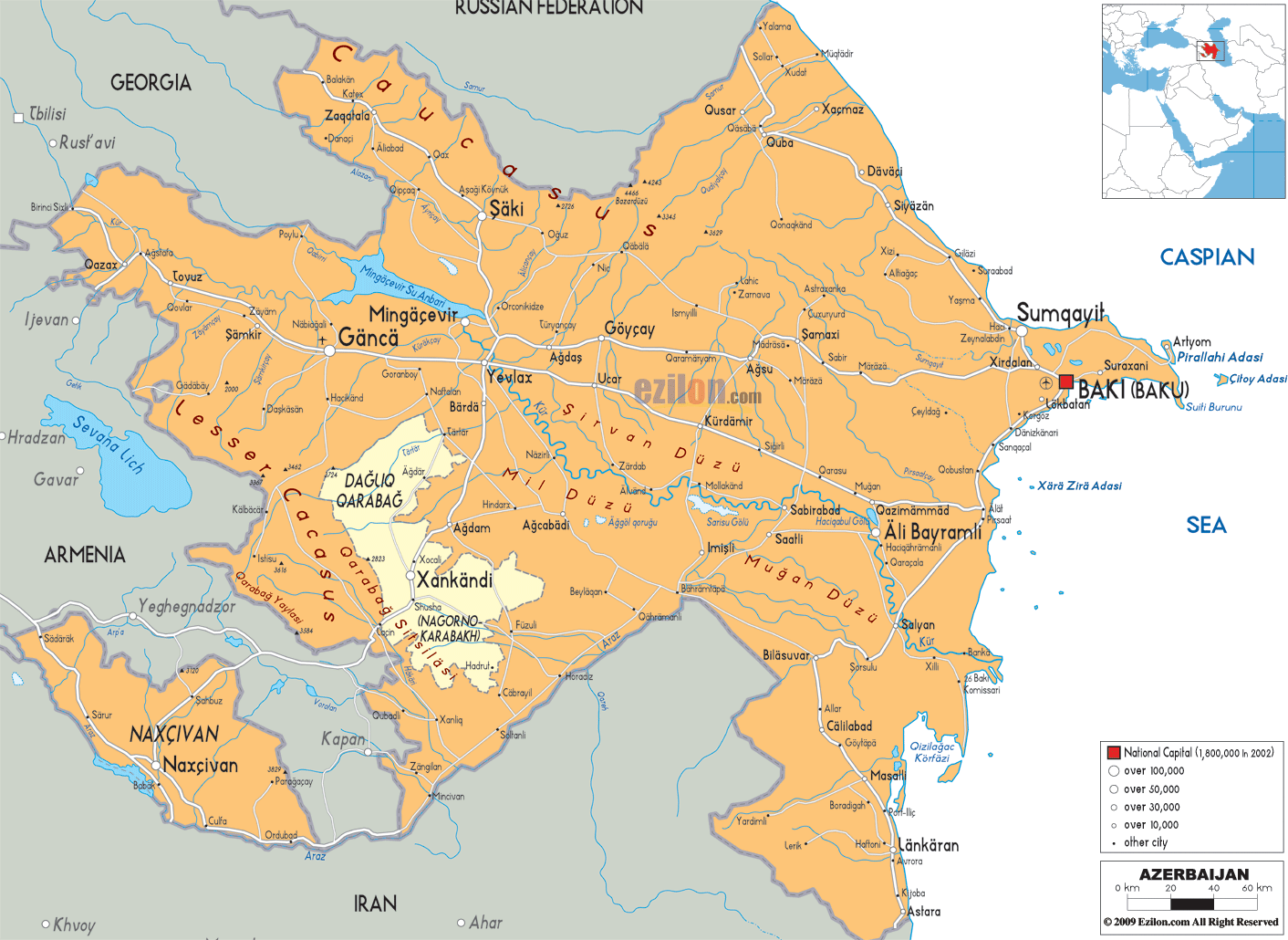
Anyone who manages to make their way to the isolated Nakhchivan Autonomous Republic in the southern Caucasus Mountains will find rolling, jagged terrain dotted with unexpected wonders. In biblical times, so the legends go, this was the land where Noah settled. Roaming across the peaks and plains, you’ll find a mountain with a gap in its peak supposedly caused by the Ark slamming through during its descent, ancient salt caverns so deep they’ve carved houses and hotels into the shafts, and hundreds of stone sheep carved by Turkic invaders centuries ago. But perhaps the most amazing, if overlooked, sites in the region are the small groves of weedy tree saplings popping up by the roadside. Although Nakchivan’s history is full of wonder, its recent past is one of strife, which, over the past 30 years, stripped away almost every piece of wood in the countryside. Yet, despite continued hardships, the peoples of this small and secluded part of the world are, of their own accord and powers, bringing back their lost forests.
It’s understandable if the name Nakhchivan isn’t familiar to most people. Though the region existed throughout history as an independent polity and was even at one point an autonomous Soviet Socialist Republic, since 1991 it’s been a part of Azerbaijan, despite maintaining its own government and sharing no borders with the nation—at its closest, it’s separated by 30 miles of foreign state. Nakhchivan is 410,000 people and 2,071 square miles of land separated from a hostile Armenia by the Zangezur Mountains and a saber-rattling Iran by the Aras River. The region joined with Azerbaijan as, over the course of the 20th century, local demographics shifted from heavily Armenian to almost entirely Azeri. Hence, along with the Zangezur Mountains, Qazakh, and the more famous Nagorno-Karabakh, Nakhchivan became a site of perpetual tension and bloodshed throughout the turn of the century, held down mainly by the force of Soviet control.
As Soviet power faded, the lid popped off the simmering conflict and both Azerbaijan and Armenia were sabotaging each other’s rail lines by the late 1980s. Though both states proper had other borders to the outside world, by 1988 Nakhchivan was effectively cut off, save for a nine-mile border to a then underdeveloped and unhelpful region of Turkey. Serviced by dicey air routes, by 1989, access to basic materials, like fuel, had become so scarce in the dependent region that many locals braved the border with Iran to flee into the less than friendly state. And that’s before 1992, when war broke out in full, mobilizing a total blockade, an Armenian invasion of the exclave of Karki, and the commencement of cross-border shelling. Those who remained had no gas or coal to survive the harsh winters, so they hacked away at the sparse local forests, already degraded by agricultural development in the 1960-70s, until there was almost nothing left.
Nakhchivan’s fortunes have changed since the 1994 ceasefire with Armenia. Although their direct access to Azerbaijan is still blocked, they’ve increased connections with Turkey and even Iran in recent years. In 2007, a new bridge across the Aras River to Iran opened and a Turkish rail line connected Nakhchivan indirectly to Azerbaijan’s capital, Baku, in 2013. The Turks, long supporters of Azerbaijan and its Turkic Azeri peoples, even agreed to transport Azerbaijani gas to the region free of charge to aid with their fuel crisis. And as of this year, a German firm is even exploring possible oil extraction and production in the republic. This opening has alleviated the scarcity of resources in Nakhchivan, and allowed the limited reemergence of local agriculture, industry, and mining. But thanks to intensive support from the central government in Baku, who supplies up to 75 percent of the region’s budgetary needs, and from numerous Turkish NGOs, the region has attained a standard of living comparable to Malaysia and Mauritius, and even better than chunks of Azerbaijan itself.
But it’s not all sunshine and roses. The local Prime Minister, Vasif Talibov, has been accused of massive corruption and authoritarianism and, just last month, the Committee to Protect Journalists reported the beating of a local human rights reporter. But the increased capital and relative stability in the region has allowed the population enough peace of mind to address the consequences of years of conflict. Nakhchivanis write about how, after the blockade, floods and soil erosion spiked because of the decreased forest cover along riverbanks. So, rather than waiting for the central government or some international body to come in and save them, the proactive local government has initiated a program where, every Saturday, officials and citizens trek out to the countryside together to plant new trees. It’s a unifying, low-cost measure aimed at overcoming the area’s recent past of scarcity.
Nakhchivan’s reforestation project isn’t the only one like it in the world. There is an active program in the States, and NGOs and international organizations like the Eden Project, United Nations Development Programme, and World Wildlife Foundation offer incentives and grants to encourage tree planting in Belize, Bhutan, Bolivia, Brazil, Cambodia, Colombia, Ecuador, Ethiopia, Guatemala, Haiti, Honduras, Indonesia, Kenya, Laos, Madagascar, Mozambique, Myanmar, Nepal, Peru, Rwanda, Tanzania, and more. In 2014 alone, the Indian and Panamanian states ordered astonishing large-scale tree planting programs; China has been planting swaths of forest the size of Massachusetts annually for years. But Nakhchivan’s program is unique—initiated and executed by local hands, it’s a strange move for a small and recently beleaguered people still so busy clawing back from the brink. Usually environmentalism would be last on the agenda in a state like this, but by talking to Nakhchivanis, one can get a sense of why this mission feels so important to them. It’s nice, after so much deprivation, not only to see something green again, but also to prove that they won’t go down easily, no matter what befalls them. The program itself may not be entirely efficient or even necessarily make sense, from a logistical point of view, but it’s important for more than simply replanting what was destroyed—the trees represent rebirth, and pride of a resolute people.