As Donald Trump’s historic second impeachment commenced in the Senate on Tuesday, lead prosecutor Rep. Jamie Raskin delivered a powerful opening argument combining poignant personal testimony with damning evidence of the former president’s incitement of the deadly January 6 mob attack on the U.S. Capitol.
Raskin (D-Md.) began the Senate trial by screening a harrowing 13-minute video showing footage of the January 6 attack interspersed with clips of the former president’s lie-filled incitement of the insurrectionists.
“You ask what a high crime and misdemeanor is under our Constitution? That’s a high crime and misdemeanor,” said Raskin. “If that’s not an impeachable offense, then there is no such thing.”
Raskin then recounted how his daughter and son-in-law had accompanied him to the Capitol on January 6 so that their family could remain close as they grieved the loss of the congressman’s 25-year-old son Tommy, who took his own life on New Year’s Eve and was buried the previous day.
In emotional recounting, Rep. Jamie Raskin says members of his family hid under a desk during the Capitol siege, "placing what they thought were their final texts and whispered phone calls to say their goodbyes. They thought they were going to die." https://t.co/Lau7kmD368pic.twitter.com/oVkxJmttgm— ABC News (@ABC) February 9, 2021
A brilliant national treasure and hero appealing in vain to soulless, heartless #GOPcowards who are moved only by their own chances to hold onto self-enriching power. https://t.co/Ej9z5mmn1H— ChateauK (@karendolan) February 9, 2021
As the pro-Trump mob closed on the Congress floor and lawmakers heard “the sound of pounding on the door like a battering ram”—which Raskin called the “most haunting sound I ever heard”—the Maryland Democrat said he was unable to reach his relatives, who were barricaded in a nearby office “hiding under the desk, placing what they thought were their final texts and whispered phone calls to say their goodbyes.”
“They thought they were going to die,” he said.
After being reunited with his relatives, Raskin said he apologized. “I hugged them and I told my daughter Tabitha, who’s 24… how sorry I was… and I promised her that it would not be like this again the next time she came back to the Capitol with me.” He choked up as he recalled her heartbreaking reply.
“Dad,” she said, “I don’t want to come back to the Capitol.”
This is heartbreaking. Rep. Raskin's daughter told him she didn't want to come to the Capitol again after she was caught in the insurrection.
“Of all the terrible things I saw and heard on that day and since then, that one hit me the hardest,” a tearful Raskin said. “That, and watching someone use an American flag pole, the flag still on it, to spear and pummel one of our police officers, ruthlessly, mercilessly, tortured by a pole with a flag on it that he was defending with his very life.”
“People died that day,” Raskin continued. “Officers ended up with head damage and brain damage. People’s eyes were gouged. An officer had a heart attack. An officer lost three fingers that day. Two officers have taken their own lives.”
We’re right up there with you, @RepRaskin. We're wind at your back today. Thank you for your brilliance, your courage and your eloquent defense of our democracy.pic.twitter.com/AUCh28k2gf— Rep. Jim McGovern (@RepMcGovern) February 9, 2021
“Senators, this cannot be our future,” he asserted. “This cannot be the future of America. We cannot have presidents inciting and mobilizing mob violence against our government and our institutions because they refuse to accept the will of the people under the Constitution of the United States.”
Raskin’s remarks moved many observers—including Trump defense attorney Bruce Castor.
“I’ll be quite frank with you,” Castor said in his opening argument, “we changed what we were going to do on account that we thought that the House managers’ presentation was well done.”
This article first appeared on Common Dreams. You can read it here.
Should the U.S. follow these other countries and broadly eliminate the ability to write checks?
Years ago, experts predicted that checks would have disappeared by now. However, they are still around, and billions are written each year in the United States.
Why? The quick answer is that businesses love them. And plenty of Americans still use checks for good reasons. But there is more to the story.
I am a business school professor and one of the few academics who advocates for the use of cash. While I have long told everyone about the benefits of paper money, I didn’t give paper checks much thought or use them until my mother’s recent death. Then I found myself writing checks to the cemetery, funeral home, gravestone engraver and a host of other places. Plus, I started getting refund checks back from her landlord and insurance companies.
These experiences made me look more deeply into this form of payment to understand what was happening.
Fewer checks for bigger bucks
Every three years the U.S. government runs the Federal Reserve Payments Study by asking banks and credit unions for internal information. This survey tracks everything from how often credit cards are used to the number of checks written.
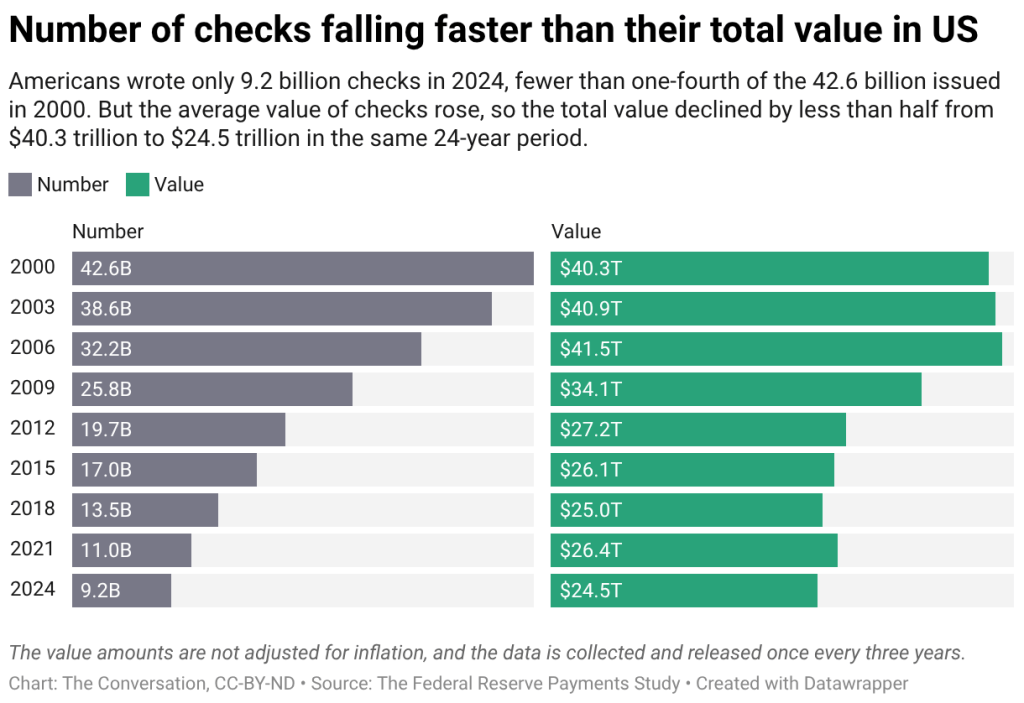
While check usage has sharply declined in the U.S., a significant number – about 9.2 billion in 2024 – are still written, the data shows. The face value of those checks is probably bigger than you’d expect: more than US$24 trillion, not adjusted for inflation. That is almost as large as U.S. gross domestic product of $29 trillion that year.
Not everyone can imagine numbers in billions or trillions, so let’s put those figures in more manageable terms.
A little over 150 checks were written per person in 2000. By 2024, the average had plummeted to 27 checks – slightly more than two per month. However, over that time, the amounts typically scribbled or printed on the face of those checks rose.
In 2000, the typical check was worth less than $1,000. By 2024, the average amount had more than doubled to $2,600.
And in both of those countries, check usage has fallen more sharply than in the United States.
Who uses checks today?
While check payments have declined, there are still two big groups of check writers in the United States.
The Federal Reserve Bank of Atlanta runs the Survey and Diary of Consumer Payment Choice. This survey asks people, rather than banks, for information on their payment habits. Roughly one-third of all respondents stated they used a paper check in the past 30 days.
Not surprisingly, the answers vary by age. About 60% of people 65 and over say they wrote a check. Among those 18 to 24, under 6% said they did.
It also turns out that a lot of people who think they never write checks actually unknowingly do it all the time. If you pay your bills online, your bank tries to pay them electronically. If it cannot electronically make the payment, the bank cuts a paper check on your behalf. Any online bill payment taking more than a couple of business days to post is being sent by check.
Another important factor is that small businesses love checks. Over 80% of businesses with sales between $1 and $10 million make payments using checks. Why? Small businesses often require two signatures on a check. The need for signatures means owners have to sign their name before any money goes out the door. This gives them control over money and a clear idea who is getting paid and how much.
Small businesses also like receiving checks. I wrote a lot of checks after my mother’s death because many of those small businesses I dealt with wanted an extra 3% and sometimes more to cover the cost to them of a credit card payment. Writing paper checks saved me and the businesses a lot of money.
The future
While many Americans still write checks, their declining usage clearly underscores that they are not ideal for making payments in all situations.
One of the biggest problems with checks is that you never know if the check writer has sufficient funds to cover the amount. When an account doesn’t have enough money, the check bounces. The Federal Reserve, which clears about one-third of all U.S. checks, returned about 22 million checks, with a total face value of around $80 billion. While these numbers are large, over 99% of all checks written don’t bounce.
Another problem with checks is forgery. Thieves steal checks from mailboxes, alter information and then cash them. The most recent figures show about 500,000 annual cases of check fraud in the U.S. Again, while a half-million is large, it is a tiny fraction of the 9.2 billion checks written annually.
The unit, which costs about $100 million a year to run, turned a $6.6 million profit in 2024. But its machines need replacing, and the Federal Reserve is wavering on spending the money.
For me, the answer is a clear no. While checks are clearly less important today than in the past, the numbers show that the American people and businesses still use and need checks.
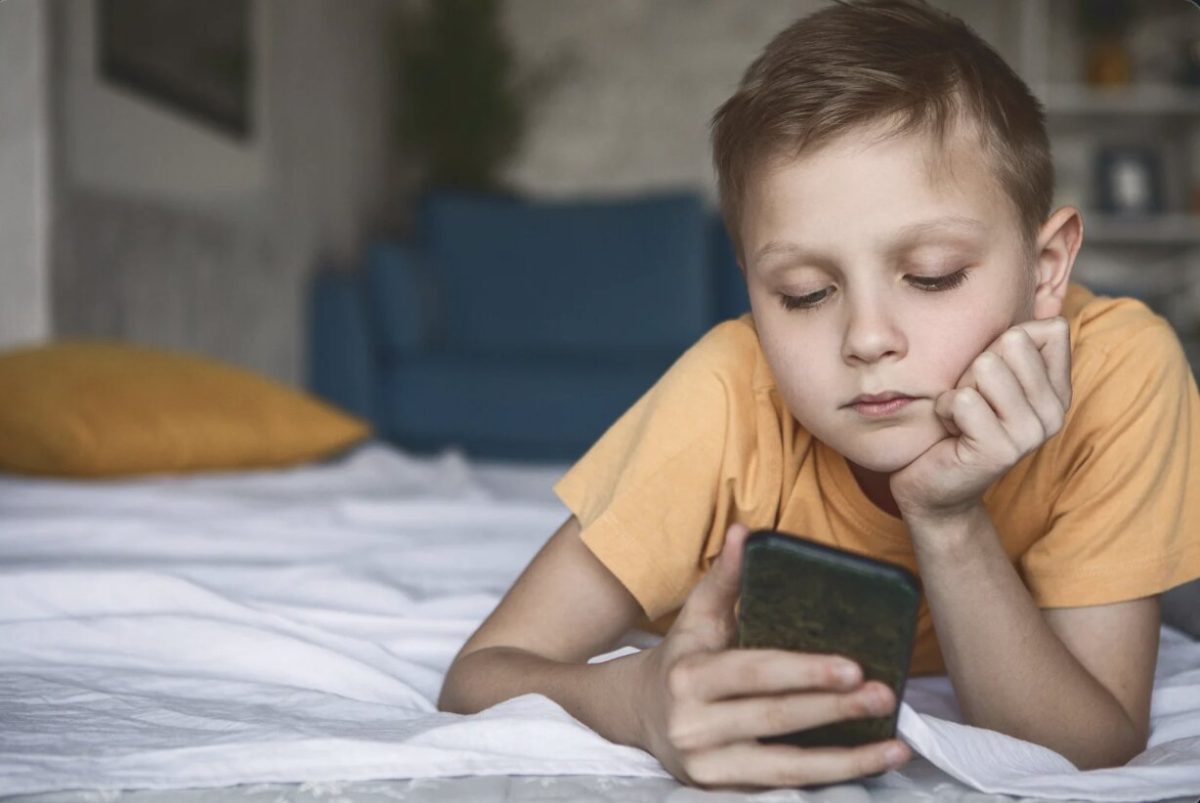
“Kids and their phones these days” has been a complaint ever since the first cellular phone was introduced. However, there has been growing concern over the amount of time children spend not just on their phone, but scrolling through social media. The state of New York is hoping to address this issue through their finalized SAFE for Kids Act.
The Stop Addictive Feeds Exploitation (SAFE) for Kids Act aims to hold social media companies more accountable for the time children spend on their apps. It also seeks to limit kids’ exposure to their algorithms. Officials believe that constantly scrolling through social media feeds negatively impacts a child’s sleep and overall mental health.
New York Governor Kathy Holchul and Attorney General Letitia James made a public announcement to social media companies affected by this law, specifically Instagram, TikTok, YouTube, Facebook, Snapchat, and X.
“What changes is the default,” said James. “Platforms cannot automatically place minors into feeds engineered to maximize engagement. This is not a question of privacy, this is a question about content. This is not about the First Amendment. Again, this is about protecting children.”
“Social media companies, you’re now on notice,” said Holchul.
Critics and the issues that still need to be addressed
There are some criticisms of this law, particularly around age-verification. The law offers the option of using government-issued identification along with another proof of identity (such as an email address or an uploaded photo of the user). This complicates things aside from First Amendment rights. It would require millions of adults to share private information to scroll and post on social media after hours. While the law states that the companies must encrypt and erase such information upon age verification, that’s not guaranteed. This is especially concerning as social media companies already deal with users’ private information being hacked and leaked.
Governor Holchul still believes this criticism isn’t a governmental issue but a business one that social media companies need to resolve.
“Social media companies tell me, ‘We have no way of knowing whether someone’s under 18 or not,’” Holchul claimed. “I said, ‘You’re smart people. Use [artificial intelligence] to figure it out. Ask how you do it.’ And you’re not supposed to allow underage gaming anyhow—sports betting—so you must have some metric. So don’t tell me you can’t do it. Figure it out.”
How parents can help their children on social media
Regardless of where people stand on this law, experts offer some advice for parents who feel social media is negatively affecting their children. They recommend setting personal screen time limits for their children and taking advantage of built-in parental controls on their platforms. Parents limiting their own social media use can also influence how kids use it, too.
Psychologists also recommend talking with children about how and why they use social media. Specifically, discuss the fantasy that social media showcases from influencers versus the real lives of those people. Talk about why there was a social media post (advertisement, sharing joy, hoping for engagement, etc.) along with the content of it. Asking how they feel after watching or reading content in their feed helps as well. Such practices, along with limiting exposure, creates trust between child and parent without judgement.
Though how we fix screen and social media addiction is still largely in the air, take comfort knowing brilliant minds are exploring methods to address the growing issue.
According to the Guinness Book of World Records, the oldest person lived to the ripe age of 122 years old. Such a lifespan is an incredible feat, but what if the average person could beat that record by 34 years? Recent research done in Russia has led scientists to believe that the average human lifespan could be up to 156 years.
The researchers at Skoltech Biomed Technologies Center developed a mathematical model that allowed them to “switch on” a variety of aging mechanisms. This allowed them to calculate a human’s lifespan where mortality risk never increased with age. After experimenting with different scenarios and conditions, they found the biggest barriers to longevity were caused by non-renewable tissues and somatic mutations.
What are these barriers against longer life?
Somatic mutations are DNA changes within a cell. They accumulate over time during a human’s life and cannot be reversed with any existing therapy. These DNA errors that pile up in our cells contribute to the aging process.
Many human organs like the liver and skin continually replace cells and regrow damaged portions of themselves. However, there are two organs that can’t do this: the brain and the heart. Brain tissue (neurons) and heart tissue (cardiomyocytes) cannot regenerate. This proves to be the most prominent biological limit that shortens our lifespans. This explains why issues like dementia and heart disease are prominent causes of death and morbidity later in life. Since those organs’ tissues don’t replace damaged cells, they’re prone to irrevocably decline over time.
“The key finding of the study is the discovery of substantial differences between tissue types. Neurons and cardiomyocytes, which lack the ability to divide, turned out to be the main limiting factors: when all other causes of aging are eliminated, somatic mutations alone reduce the theoretical median lifespan from 1,759 years (for a hypothetical non-aging human organism) to 156 years,” said Evgeny Efimov, a research intern at the Skoltech Biomed Technologies Center, researcher at AIRI, and one of the key authors of the study.
This suggests that somatic mutations and DNA damage is what ultimately prevents humans from living indefinitely, even if our brains and hearts regenerated cells like other organs.
So what’s next?
Now knowing these biological limitations, the researchers hope to study other areas of aging impacting the human lifespan that could plausibly be reversed. This includes mitochondrial dysfunction, telomere shortening, epigenetic drift, and loss of proteostasis.
The hope is to have a clearer priority list of issues for future therapies to tackle. This is not just to possibly extend life, but to improve lives in general. By developing a fully comprehensive theory of aging, Skoltech hopes to pinpoint which aspects of aging are within our scope to address. After all, thoroughly studying each puzzle piece that makes up human life gives us a better understanding of the whole.
Of course, other impactful factors in a person’s lifespan can be addressed today. As most know, things like diet, sleep, and exercise are among them. A person’s living environment can also negatively impact their lifespan if it doesn’t have clean air, access to clean water, and so on.
For now, the best method for living long is to follow instructions from your physician. Whether you make it to 156 years or not, living well is best for whatever time you’re given.