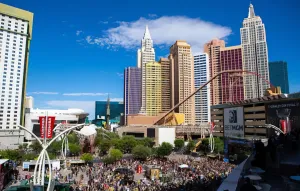
It’s not everyday you hear artists citing collaterized debt obligations and other Wall Street enigmas as inspiration, but Mike Schuwerk’s photo montages aim to reflect the disorientation of our economic times. Schuwerk’s work will be featured in the upcoming exhibition season of the Baang + Burn Contemporary Gallery in New York City. We caught up with Schuwerk to hear about how mortgage backed securities inform his pinwheeling humanless images of post industrial architecture and abandoned suburbs.
GOOD: We found the collaged images of Derivatives sometimes disorienting, producing almost a feeling of vertigo. Was this intentional?
MIKE SCHUWERK: It’s an outgrowth of the subject matter. Derivatives began with a desire to portray a peculiar sort of commons using cut up, collaged photographs of real places. It was inspired by the novelty of complex financial tools–like CDOs and mortgage-backed securities–and by how these tools ultimately transform the places we inhabit and lives we live.
I think disorientation and vertigo—I’d add fragmentation to that list—are appropriate metaphors for the times we live in. To what are we anchored? In these works the eye recognizes elements of buildings and the built environment, but struggles to locate the foundation.
That said, my intention is not to dizzy the viewer, and there is something beautiful about putting the pieces back together. That is also happening.
GOOD: How do you choose the sort of buildings and urban locations that you are reimagining in this work?
SCHUWERK: I look at local and regional economies to determine the places I’ll visit. I’m interested in which places are being activated by the global economy and which are being left fallow: manicured landscapes of high finance, technology, service or consumption on the one hand versus decadent post-industrial landscapes or aging and abandoned suburbs on the other. Both represent extremes of human existence.
Once I am on the ground taking pictures I really let the terrain take over. Beauty is always a factor. Occasionally I need a specific element for a given piece and go out to find and photograph just that.
GOOD: Though your locations are urban, this work is completely devoid of people. What is the significance of the fact that your re-imagined landscapes are unpopulated?
SCHUWERK: This work is about systems and social processes that prioritize quantitative principles. So people, at least as individuals with unique qualities, don’t fit well into the work. I’d posit that housing more people wasn’t the primary concern of mortgage-backed securities either. I am not entirely opposed to populating these landscapes, but it remains to be seen how.
GOOD: There’s an Escheresque quality to these images. What were some of your influences when you conceived of this body of work?
SCHUWERK: I know relatively little about Escher’s work. Jorge Luis Borges’ On Exactitude in Science and the writings of Paul Virilio were big influences early on. Gordon Matta Clark’s sliced up buildings and Teddy Cruz’s studies of migrant laborers repurposing American refuse to build communities south of the border were critical. The Situationist International’s theory of the dérive and study of psychogeography informed my working process. Chris Marker’s approach to studying society in his films has a broad influence on my work more generally. But I’d say more than anything that I work from life.
GOOD: What social or economic forces are informing this body of work?
SCHUWERK: The privatization of public space, emergence of enormous virtual markets, growing wealth disparity, upswing in DIY culture, mutual aid, and focus on self-sufficiency.
GOOD: What are you working on now?
SCHUWERK: I am continuing to work on Derivatives and will be traveling to Spain in August to gather material there. I also have a series of animations underway, the first of which, Happiness is the Right Choice, was the springboard for this project.