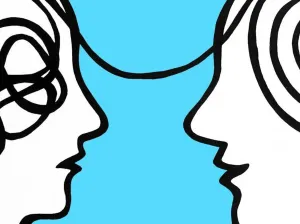
Ever since online social networks were created, people have wondered why they’re popular and how they affect users. Researchers, practitioners, and social commentators have expressed concern that they reduce more meaningful face-to-face interaction, leaving users depressed and lonely. However, new research that I have conducted together with marketing professor Jonah Berger suggests that social networks’ dissimilarities to more traditional communication methods can actually help some people connect better.
Proponents have long touted social networks’ ability to connect distant friends and relatives. When a user posts a tweet or a Facebook status update, it is visible to a group of people, whether that is all of a user’s contacts or some subset, such as fellow alumni of a school or residents of a particular neighborhood.
Our research shows that the quasi-personal nature of these kinds of posts — which are written for people who know the writer and can respond but which at the same time are shared more widely — can make connecting with others less threatening for people who experience social anxiety.
How microblogs can aid communication
People feel a need for social interaction, especially when they feel sad, stressed, or troubled. Connecting with friends or family can help soothe negative feelings. But for some people, reaching out in person can feel daunting. People who are anxious about social interactions might wonder, “What if they don’t want to talk to me?” or “What if I’m bothering them?”
In our research, we found that sharing via tweets or Facebook posts — more broadly called “microblogging” — can alleviate these concerns. This method of communication, unique to social media, allows people to reach out to a large audience without having to direct their message to any one person who might be annoyed or busy. As a result, the person posting may have reduced anxiety about initiating social interaction.
Accordingly, we found that people who felt apprehensive or anxious about social interaction were actually more likely to post or tweet on social media sites. In one experiment, half the participants were asked to write about a time they were at a party and felt anxious about interacting with others. The other half were asked to write about a neutral topic.
We then gave participants the opportunity to use their favorite social network for a few minutes, and afterward, we asked what they did while online. People who had written about their social anxiety were more likely to microblog (tweet or post a status update) than those who had written about a neutral topic.
Diving deeper into the results
Our follow-up studies show that while experiencing social apprehension or anxiety increases microblogging, it decreases face-to-face sharing. Indeed, when we asked people about how they preferred to communicate with others, the ones prone to experience social anxiety were more likely to choose microblogging over reaching out face-to-face.
But microblogging is not the only way social networks let users connect with friends and relatives. Users can also send direct messages, which again do not require in-person interaction. However, unlike microblogs, they are usually directed at an individual rather than a wider friend group. When we explored people’s interest in reaching out via direct message, we learned that experiencing social apprehension does not increase direct messaging and that the effect of social apprehension on sharing was unique to posting status updates or tweeting.
This finding tells us that the undirected nature of microblogs is key for socially anxious people, allowing them a new way to reach out to friends when they might not feel comfortable doing so otherwise.
Sharing via microblogging can increase well-being
Then we wondered: If some people feel more comfortable posting on social networks than they do when directly interacting with friends and family members, might their way of using microblogging be a way to help them feel better? Preliminary evidence from our research suggests that writing to others who might respond — such as posting on online social networks — can help people who are upset feel better.
In a laboratory study, we induced negative emotions by having participants take a brief multiple-choice test and telling them they had not performed very well, regardless of how well they actually performed. Then we split the participants into four groups and asked each to write something. One group was asked to write about office products to serve as a neutral baseline comparison group. Members of the other three groups were asked to write about their emotions: One group’s members were told their writing would be private. One group was told what they wrote would be shared with someone who would not be able to respond. The last group was told their writing would be shared with someone who could respond.
After this writing exercise, we measured each participant’s well-being by asking them about how good, happy, and relaxed they felt. The results showed that writing to someone who might respond helped people heal their negative feelings; members of that group reported greater well-being. This healing did not result from writing in general, writing privately about emotions, or even telling someone else about their feelings.
The potential for someone to respond made people feel better — even if nobody actually did reply. Our research did not identify exactly why the benefit occurred without receiving an actual response, but it could be related to others’ findings that anticipating the potential of something occurring can be particularly appealing.
 This highlights the different ways that social networks can offer people unique and valuable communications options that don’t exist offline or in other online environments.