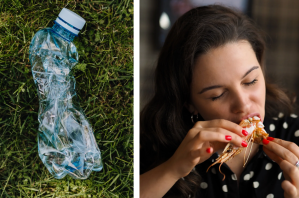
Often, the best green lifestyle advice boils down to a simple principle: “Buy less stuff.”

But according to a new analysis [PDF] from the Stockholm Environment Institute, scaling back consumption has negative consequences, too. Greener purchasing choices could cause the average gross domestic product of low-income countries to drop by more than 4 percent—the average amount a country’s GDP might be expected to grow in a given year. The GDP of the world’s least-developed countries could take an even bigger hit, of more than 5 percent.


It’d be convenient if the world’s social and environmental problems didn’t overlap. But policymakers and researchers looking at climate change are increasingly realizing that addressing climate change requires addressing poverty and economic growth. In the past, economic development caused huge releases of greenhouse gas, and in recent rounds of international climate negotiations, developing countries have been reluctant to sign onto carbon commitments that could limit their growth. In international climate change negotiations, the importance of sustainable, low-carbon development has gained traction, and the Rio+20 conference in June will focus on sustainable development

But SEI’s Peter Erickson, the lead author of the new study, says he hadn’t heard development discussed among leaders focused on decreasing consumption. “We had not seen it be much a part of the conversation in this strong but growing group of policymakers and researchers focused on consumption,” he says.

While decreasing consumption alone won’t stop climate change, it can help—and in the absence of a global or even national system to deal with carbon emissions, state and local leaders are looking to the “buy less stuff” strategy as a manageable way to take action. But all that stuff comes from somewhere, and its creation helps drives economies. The potential impacts on the economies of the least developed countries “are driven overwhelmingly by reductions in clothing,” SEI reported.

Erickson and his colleagues suggested a few ideas that could reduce consumption-driven greenhouse gas emissions without hurting lower-income countries. Clothing made in China, for instance, has a higher carbon footprint than clothing made in Romania. Buying clothes from a country like Romania could do just as much to reduce emissions as buying clothing that lasts twice as long, the SEI researchers suggest. Right now, there’s not enough information available about the emissions associated with specific products—for example, a t-shirt made in Romania versus one made in China—but with more research, consumers could start choosing lower-carbon goods.

For state and local policymakers, that’s not the most obvious solution, though. “It runs counter to some messages that are still quite popular around buying local,” Erickson says. In SEI’s analysis, consumers compensated for buying less stuff by buying more local services—like a car share service instead of a car. Those purchases increased the GDP of the higher-income countries that are usually the consumers and generally not the creators.

But high-income countries shouldn’t necessarily view those GDP boosts as a positive. “If we’re going to solve the climate problem, we’re going to need to address equity,” Erickson says.

Photo via (cc) Flickr user Thing Three

  • Man’s dog suddenly becomes protective of his wife, Internet clocks the reason right away
    Dogs have impressive observational powers.Photo credit: Canva

    Reddit user Girlfriendhatesmefor’s three-year-old pitbull, Otis, had recently become overprotective of his wife. So he asked the online community if they knew what might be wrong with the dog.

    “A week or two ago, my wife got some sort of stomach bug,” the Reddit user wrote under the subreddit /r/dogs. “She was really nauseous and ill for about a week. Otis is very in tune with her emotions (we once got in a fight and she was upset, I swear he was staring daggers at me lol) and during this time didn’t even want to leave her to go on walks. We thought it was adorable!”

    His wife soon felt better, butthe dog’s behavior didn’t change.

    pregnancy signs, dogs and pregnancy, pitbull behavior, pet intuition, dog overprotection, Reddit stories, viral Reddit, dog instincts, canine emotions, dog owner tips
    Otis knew before they did. Canva

    Girlfriendhatesmefor began to fear that Otis’ behavior may be an early sign of an aggression issue or an indication that the dog was hurt or sick.

    So he threw a question out to fellow Reddit users: “Has anyone else’s dog suddenly developed attachment/aggression issues? Any and all advice appreciated, even if it’s that we’re being paranoid!”

    The most popular response to his thread was by ZZBC.

    Any chance your wife is pregnant?

    ZZBC | Reddit

    The potential news hit Girlfriendhatesmefor like a ton of bricks. A few days later, Girlfriendhatesmefor posted an update and ZZBC was right!

    “The wifey is pregnant!” the father-to-be wrote. “Otis is still being overprotective but it all makes sense now! Thanks for all the advice and kind words! Sorry for the delayed reply, I didn’t check back until just now!”

    Redditors responded with similar experiences.

    Anecdotal I know but I swear my dog knew I was pregnant before I was. He was super clingy (more than normal) and was always resting his head on my belly.

    realityisworse | Reddit

    So why do dogs get overprotective when someone is pregnant?

    Jeff Werber, PhD, president and chief veterinarian of the Century Veterinary Group in Los Angeles, told Health.com that “dogs can also smell the hormonal changes going on in a woman’s body at that time.” He added the dog may “not understand that this new scent of your skin and breath is caused by a developing baby, but they will know that something is different with you—which might cause them to be more curious or attentive.”

    The big lesson here is to listen to your pets and to ask questions when their behavior abruptly changes. They may be trying to tell you something, and the news may be life-changing.

    This article originally appeared last year.

  • Throughout history, women have stood up and fought to break down barriers imposed on them from stereotypes and societal expectations. The trailblazers in these photos made history and redefined what a woman could be. In doing so, they paved the way for future generations to stand up and continue to fight for equality.

  • ,

    Why mass shootings spawn conspiracy theories

    Mass shootings and conspiracy theories have a long history.

    While conspiracy theories are not limited to any topic, there is one type of event that seems particularly likely to spark them: mass shootings, typically defined as attacks in which a shooter kills at least four other people.

    When one person kills many others in a single incident, particularly when it seems random, people naturally seek out answers for why the tragedy happened. After all, if a mass shooting is random, anyone can be a target.

    Pointing to some nefarious plan by a powerful group – such as the government – can be more comforting than the idea that the attack was the result of a disturbed or mentally ill individual who obtained a firearm legally.


Explore More Articles Stories

Articles

Man’s dog suddenly becomes protective of his wife, Internet clocks the reason right away

Articles

14 images of badass women who destroyed stereotypes and inspired future generations

Articles

Why mass shootings spawn conspiracy theories

Articles

11 hilarious posts describe the everyday struggles of being a woman