They claimed they were doing the world, or Oregon, a favor. The “Pedestal Rock” at Oregon’s Cape Kiwanda State Natural Area was a site to behold. Exponentially older than human history, the 18-million-year-old rock formation wasn’t just ancient, it was beautiful, a larger half boulder perched on a spire seemingly too narrow to hold its weight.
Of course, it was a hot spot for Instagram photos and selfies. People even posted wedding photos atop the formation. Still, the attention was natural and people respected the awe-inspiring beauty before them. At least until two guys showed up and decided the destroy the whole thing out of some misguided spite for what they considered a “risk” to the health of themselves and others.
NPR reports that the 7-by10-foot sandstone pedestal was destroyed by unnamed vandals caught on video by fellow visitor David Kalas. In the 18-second-clip, as the men push and pull on the formation, it finally collapses with one guy shouting, “Got ‘em!” Over 1.5 millino people have watched the video since it was posted last week.
In an interview, Kalas said he approached the men asking for an explanation. This is what happened:
“I asked them, you know, why they knocked the rock down, and the reply I got was: their buddy broke their leg earlier because of that rock,” Kalas told local affiliate KATU. “They basically told me themselves that it was a safety hazard, and that they did the world or Oregon a favor.”
While it’s true that the formation posed a risk to visitors, the local park service has attempted to keep people out for decades, posting warning signs and fencing around the area. But none of it works. Now, as they investigate the incident, all the Oregon Parks and Recreation Department can do is threaten a $400 fine — assuming they can even catch who did it.
Hopefully, the public outcry over this incident sends a message to everyone to obviously not destroy beautiful creations of nature but also to respect efforts to maintain a healthy respect for such places lest future misguided people feel entitled to take vigilante action that ends up serving no one.
Still, I could not have imagined how significantly his leave would end up affecting our family and our connections with community.
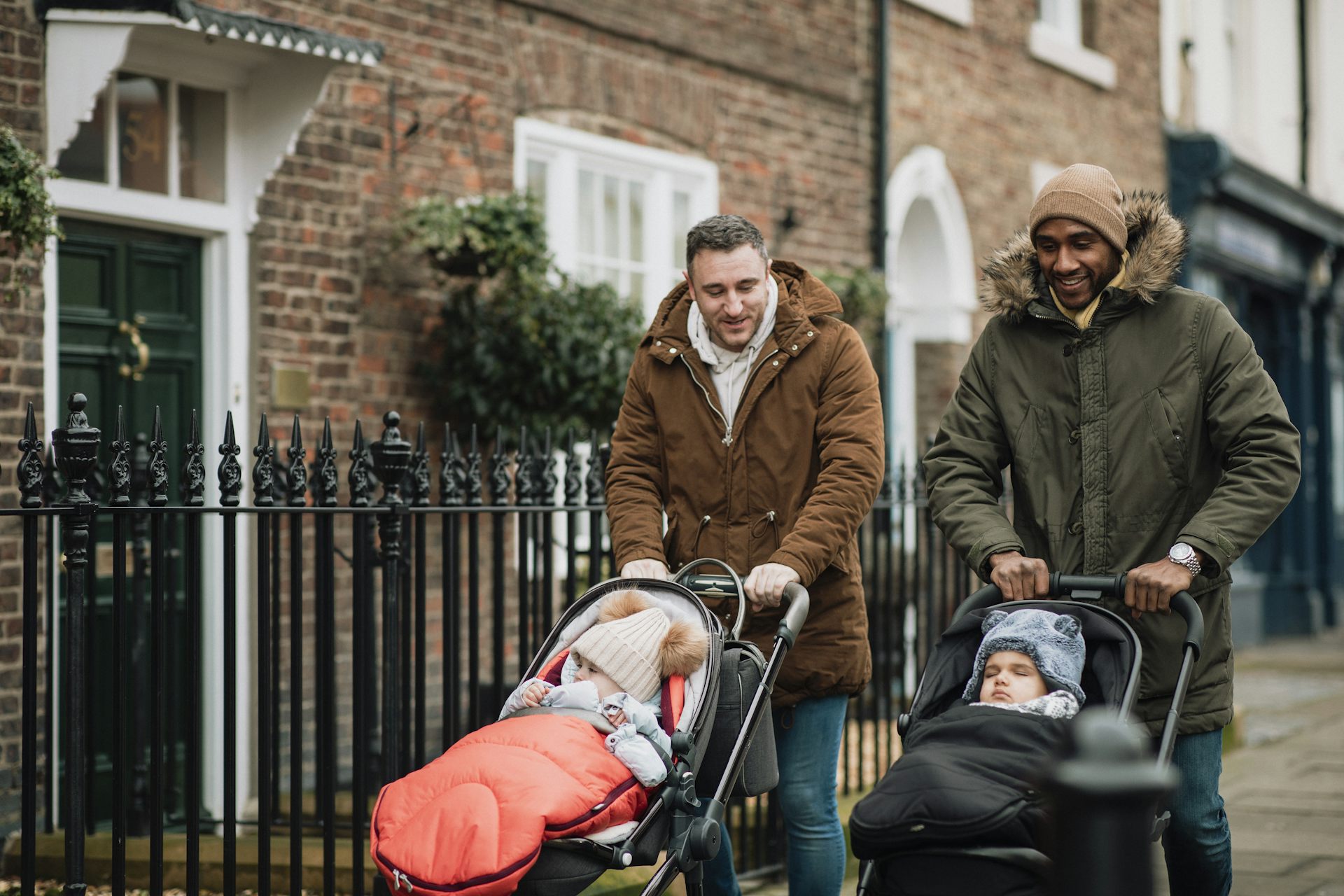
During his leave time, my spouse took our oldest child to playdates and birthday parties. He quickly became connected with our small-town network of families with kids close in age. I witnessed my spouse becoming more comfortable being the “main” parent in public, going to kid-centered community events and connecting with other parents.
Our family is still seeing the benefits of those few weeks 10 years later.
This diversity in leave policies can make it hard to assess the impact of leave for the non-birthing parent. But existing research suggests that extended leave for birthing parents and moderate leave for non-birthing partners positively impact infant well-being and reduce postpartum mental health challenges.
Children also benefit from paternity leave. When a father takes significant leave – meaning at least two weeks – children report experiencing more father-child closeness and better communication in the relationship up to nine years later. And overall child health tends to improve when fathers take paternity leave.
Paternity leave is an opportunity for fathers to become comfortable in their parenting role and connect with other parents.SolStock/E+ via Getty Images
Family balance
Allowing both parents to have sufficient time off to bond and adjust to their new roles can also have longer-term benefits within the family unit and contribute toward more equity in child rearing. Even in 2026, mothers are often considered the “default” parent, with fathers taking a more secondary role.
As I experienced in my own family, when fathers have ample time off, it sets up the dynamic to be more balanced between parents. This helps reduce the strain on recovering mothers and redistributes some of the care work that goes into raising children.
Home economics
What’s more, paid leave policies have been shown to help families’ financial health. Pay rates during leave can vary widely depending on your company, organization or country. Without full or close to full pay, many families cannot afford to take leave.
In the U.S., for example, the Family and Medical Leave Act allows time off, but not in all circumstances, nor is that time required to be paid. Many families cannot afford to take the full allowable time off, using up sick or vacation time if available. Many parents in the U.S. end up going back to work sooner than seems healthy.
New parents in the U.S. often find themselves in an economic bind – they can’t afford to take leave, nor can they afford to rely on a single income to have a parent stay home. But many also can’t afford the childcare rates for newborns, which tend to be particularly high. National averages for infant care at childcare centers are nearly US$200 more per month than toddler care. While rates vary significantly depending on where you live and what type of care you choose, infant care remains the most expensive.
Despite the lack of a paid U.S. federal leave policy for parents, both domestic and multinational companies have noticed that their workers care about parental leave policies. Some have begun to offer leave for supporting parents in order to recruit and retain workers.
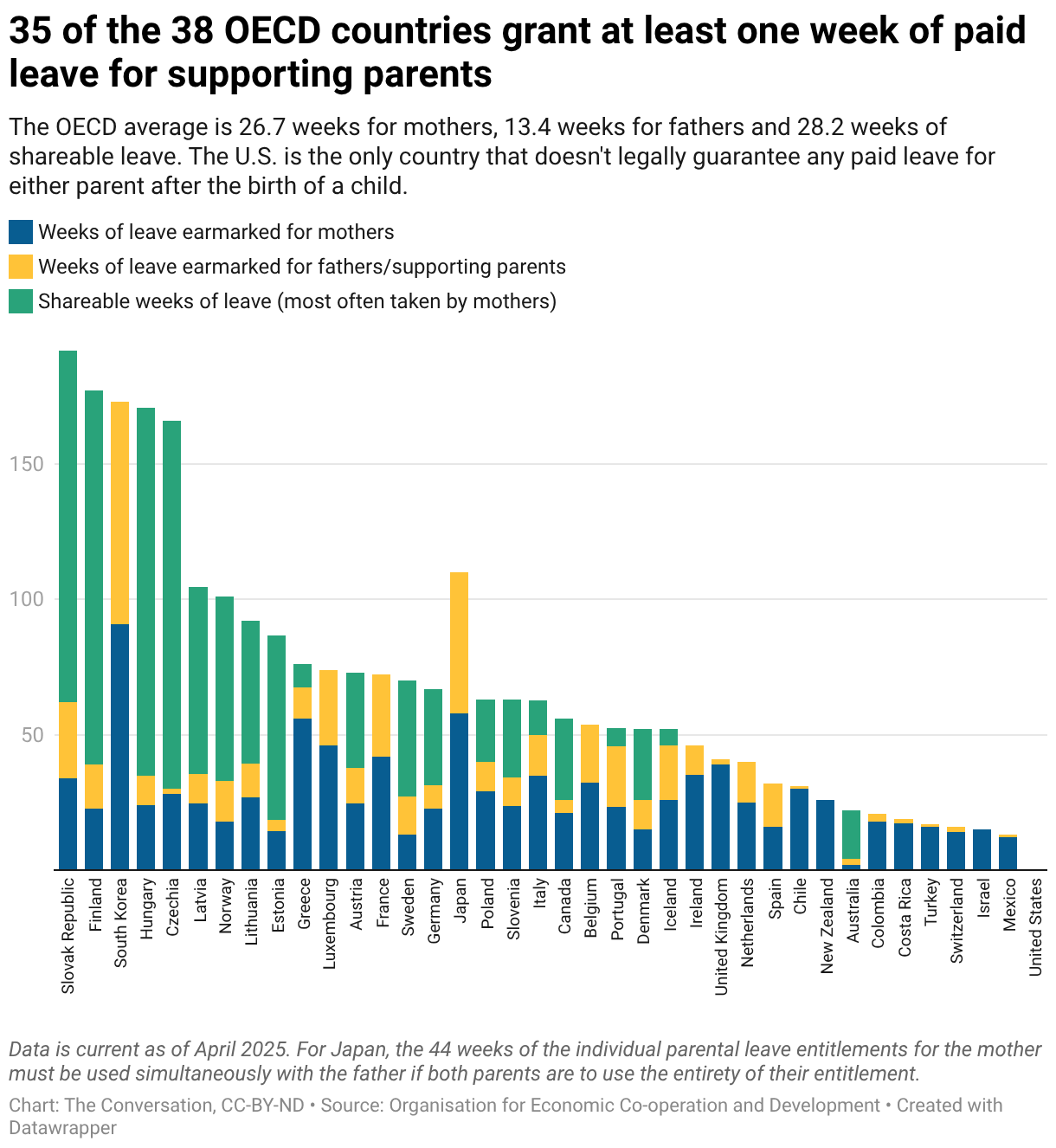
U.S. leave policies consistently rank at or near the bottom when compared with other similarly developed countries, like the 38 members of the Organization for Economic Cooperation and Development, or OECD.
Some countries follow a “use-it-or-lose-it” model of parental leave, where fathers in particular are encouraged to take a more substantial role in childcare. Sweden and Norway, for example, earmark 90 days of leave for each parent, and it cannot be transferred to or split with the other parent. This encourages both parents to take time off.
There are many options across countries with parental leave policies. Flexibility and defined expectations seem to be key contributors to getting the most out of the parental leave that is offered.
Cultural adoption
When non-birthing parents are men, another barrier to taking leave is the perceived social acceptability within their communities. Even when paid paternity leave is available, many men struggle to take it because of how traditional gender roles and expectations of masculinity frame childcare as women’s work.
To offset these kinds of social pressures, countries like Japan and Austria offer incentives such as bonus leave time for families when fathers actually take their available leave. Germany offers a similar bonus, and it has found improved couple relationship satisfaction when fathers take more of their leave time.
Beyond improvements in maternal and infant health, both parents taking leave can create a more equitable workplace environment. Disparities and discrimination that come when only women take leave after birth can lessen when fathers and other supporting parents also take leave. Childbearing women are then less likely to be penalized, formally or informally, for taking parental leave.
Paid parental leave policies that provide leave for all parents, regardless of gender, also can help reduce structural inequality in the workplace across race and class. In the U.S., Hispanic and Black workers often have less access to paid leave policies and may experience increased pressure to return to work earlier than their white counterparts.
As more states, countries and corporations adopt more flexible and inclusive leave policies, researchers will continue to learn how parental leave benefits both parents and children. What they’ve found so far leads me to believe that, just like we’ve seen with prenatal care and early education programs, parental leave will prove to be an early investment in healthy children and families that pays dividends in the long term.
Old age and forgetfulness seem to go hand in hand. But my colleagues and I found that memories actually becomes less precise, not entirely forgotten. Our study, published in the journal Cerebral Cortex, shows how the brain blends related experiences as you age rather than replaying the exact one you need.
Memory is a complicated process. Even when everything’s working as it should, the way people remember specific events has many parts.
Say you have a conversation with a friend. The first stage of memory is when you’re experiencing, feeling and perceiving details of an event as it happens. The second stage involves storing these details in your brain’s file cabinet. The third stage covers when you need to search that file cabinet for just the right file when, a week later, you want to remember that conversation with your friend. This last retrieval stage is what many people think of as memory.
Imagine that when your brain was retrieving information from that conversation with your friend, it accidentally combined details from that conversation with one you had with your spouse that morning. When you then try to remember the conversation with your friend, you actually pull the file for the conversation with your spouse instead. This kind of mix-up might be an example of what happens with the aging brain.
Why it matters
Remembering people and events is important for many social activities. Confusing people’s names can be embarrassing. The fear of confusing memories can even lead to social isolation.
Scientists already know that confusing memories happens more often than forgetting them altogether. What’s less clear is how the brain gets confused.
My team’s study tried to understand when in the memory process these mix-ups happen and how the brain’s memory center, called the hippocampus, plays a role.
The hippocampus is involved in all stages of memory. The patterns of neural firing that occur during the first stage of memory – the initial experience of talking with your friend – often recur while your brain is filing that memory away and later when retrieving it.
For our study, we scanned the brains of young, middle-aged and older adults while they went through those same three stages of memory. While in the scanner, they briefly saw images of a face at the top of the screen and an image of either a scene or an object, such as a forest or an apple, on the bottom of the screen.
We told participants to imagine the person at the top interacting in the scene or with the object. Each image pair served as a separate “event.”
They then relaxed for 20 minutes while we continued to record their brain activity. Finally, they took a memory test in which a face they had previously seen reappeared on top with four images below. Participants had to remember which of those images had previously been paired with the face. We repeated this test several times to gauge how well people remembered links between faces and scenes and objects across events.
We found that older people had more memory mix-ups than young adults. For instance, they were more likely to falsely remember a face that was initially paired with an apple as having been paired with a forest. Older people were also less likely to repeat the same brain activity patterns seen when they first experienced, stored and retrieved a specific memory. Surprisingly, even when older adults did repeat the original brain patterns, they were even more likely to confuse their memories.
Our study provides new evidence that the hippocampus is inappropriately changing memories between different memory phases as one gets older.
What still isn’t known
Research in young adults, including those in our study, suggests that the hippocampus is supposed to engage in the same neural firing patterns when remembering an event as when first experiencing it.
But the older adults who made more memory mix-ups than younger participants showed these same neural patterns. So what is the brain signature when older adults get a memory right? Are other brain regions outside the hippocampus helping? We did not get a good answer for these questions from our study.
What’s next
Researchers are still learning how different brain regions talk to one another. One of the next frontiers in neuroscience is understanding how electrically stimulating the hippocampus prevents memory loss or restores lost memories.
There is nothing wrong with politeness and a particular point of view, unless, of course, your interpretation of kindness is different from everyone else’s. Case in point? Boomers and every other generation.
What is it about Boomer energy that can just rub people the wrong way sometimes? It’s quite common for different age groups to have different needs and habits, and perhaps the Boomers you know may find 20% tips an absolute must, yet the concept of a service fee infuriating. Maybe they feel there is only one perfect way to load a dishwasher. Maybe job loyalty does have value. Whatever the topic, Boomers are likely to have a certain opinion about it that they feel is the best.
Finding ways to communicate and connect are important dynamics to building community and bridging the generation gap, and sometimes understanding what Boomer actions bother the other generations can help start a dialogue. VegOut Magazine described seven habits that may seem thoughtful to Boomers, but are actually emotionally taxing to younger generations.
Calling whenever they want
Boomers largely grew up in an age of landline phones that often ran unexpectedly. Instead of the horror that Millennials experience from an unsolicited phone call, Boomers find them normal and inviting. A reach out to say “Hello!” means they care and are interested in your life.
Younger generations feel it’s an uninvited threat. Where’s the heads up text? Nothing triggers anxiety like an unexpected ring.
Solution: How about everyone just chill? Older people can learn to text first. Younger people can acknowledge they don’t have to answer the phone, and often don’t anyway.
The unexpected visit
Boomers grew up in an age of the unannounced visit. There was a time when neighbors just rang a doorbell and offered up some extra muffins, freshly baked. Today, people guard their homes with intensity. A doorbell ring is terrifying, especially if pizza hasn’t been ordered.
Solution: Boomers, just send a text first. It’s not that complicated. Younger generations, you can always hide in the closet and pretend you’re not home.
Comments on personal appearance
Into today’s world, unsolicited comments on someone’s appearance seem a bit risky. And yet, Boomers never seem afraid to comment on someone’s weight loss or ask questions like, “Why aren’t you smiling?” These questions and comments were once considered tools of connection. It showed interest and concern for the mental and physical health of friends and people in general.
Younger people guard all aspects of “self” and “body image.” It’s dangerous territory leading toward hurt feelings and possible backlash.
Solution: If you don’t have anything to say nice, don’t say it. Even if you do, probably don’t say it.
With age comes wisdom, yet sometimes nobody wants to hear it. Knowledge acquired over time and experience is valuable and should be passed on, but in certain contexts. Younger people often find unsolicited advice to be a rude personal attack, so be careful about offering a note no one asked for.
Solution: I had a friend who used to always ask, “Do you want to hear my opinion?” before they shared it. It was a pretty amazing quality that gave me time to prepare for what might be coming. In the end, it’s best to get permission. Simple.
Chain messages
Breaking chains. Image via Canva – Photo by Merydolla
There’s nothing quite like the inspirational chain meme your grandma found. Especially when it was making the rounds eight months ago. Like everyone else, older people benefit from feeling connected. They’re just attempting to get in the digital meta. It’s easy to point out who’s out of the loop when you’re in it.
Solution: Can we all cut one another some slack? Instead of attacks, reconnect and appreciate the meme or image you already saw months ago. Replying with, “Ha, that’s a good one” isn’t that much of a stretch, and it isn’t that much to ask when given an opportunity to share love instead of disdain. I have an aunt who gets concerned when those chain mails say, “Pass this on to 10 people…” I told her to send them my way, because I’m not afraid to dump them in the digital garbage.
Lengthy conversations for business
Boomers have worked networking and building relationships into their business model. A chat about what’s trending is a great way to ease into an important conversation. It’s a way to be polite and build-up camaraderie before the deal is done.
Younger generations don’t want to waste time. A “thumbs up” emoji can be enough to get things going.
Solution: Acumen took a look at getting generations to learn how to connect with one another. They found that “common ground” was crucial for networking. Younger people can work on patience and respecting the time offered by older generations, and Boomers can learn to fire a quick text instead of dragging every conversation into a “life lesson.”
Checking and rechecking replies
Boomers may not be totally confident in how the whole digital world works. It’s not uncommon to receive texts and emails asking, “Did you get that email…” or “Curious on your thoughts of the text I sent.” These follow-ups were designed to show interest and thoroughness. Younger people can just find them bothersome.
Solution: Boomers can learn to not treat texting and emails like a personal journal. It’s okay to be brief and to the point. A short message doesn’t mean someone is being short with you.Speak with People suggested that younger generations can give Boomers the “benefit of the doubt.”
The wrap up
Everyone is trying to fit in the best they can. It can be difficult to adapt and move with the times. Some day, younger people will be a little out of touch with the next generation.
Philosopher and theologian Martin Buber wrote, “All real living is meeting.” The more we can learn to help each other connect, the better. Learning to be curious about other people and their generation instead of dictating will build deeper and more mutual connections.
This article originally appeared 1 year ago. It has been updated.