Albania’s young voters try “Yes we can!”-but can’t quite yet.

I was invited to Albania to help the newly formed G99 party fundamentally change the way Albanians thought about and conducted politics. G99-developed out of Albania’s youth-driven democratization movement-began in 2003 in response to rampant government corruption. Inspired by the “yes we can” attitude in America, G99 wanted to try its hand at Obama-style organizing in advance of their June 28 parliamentary elections. Having spent the better part of five years in political organizing on different levels, including for Obama’s Florida campaign in the general election, I came to add perspective and experience to G99’s operation.I felt proud to aid their mission. After decades of oppression and corruption, cynicism had a stranglehold on the country. G99 understood that they could not achieve a full democracy until the Albanian people saw themselves as agents of change and bearers of responsibility. Organizing strengthens democracy by enabling participation in the political process; it opens avenues for people to hold their elected officials accountable, to dictate the debates, and to confront the immediate needs of the community from the ground up.But organizing requires volunteers and community building, and “volunteering” had been compulsory during the 45 years of communism. Walking through the trash-ridden streets, by the graffiti-covered public buildings from which the communist regime once presided, one understands why most Albanians feel an absence of responsibility in their communities.These former political realities very much constrain Albania’s older generations. But they liberate its youth, who empathize with the past but see their country not as it is but as it could be. G99 sought to change all of this. Member after member of G99 told me of how they came to the organization asking the question: Why couldn’t Albania be better?This was the very mindset of those who helped get President Obama elected, the majority of whom were under the age of 30. The “Millenial generation,” as it has come to be called, made up of those of us born between 1978 and 2000, has been shaped by a democratized access to information and the experience of growing up in a transitional, malleable post-Cold War world. We have a more optimistic, innovative, politically motivated mindset geared towards connecting the world around us. We are post-ideological and pragmatic. What’s more, the under 30 demographic accounts for over 50 percent of the world’s population.Many Albanians work to leave the country rather than change it. These G99 youth, however, felt a responsibility to make their country better and, with 50 percent of the population under 28, know they are the only ones that can. But knowing that Albania should be better and knowing how to carry out that vision effectively are different things.We did our best. I helped train volunteers and then watched them go out, elicit support, and empower others with their mission. They worked tirelessly and without precedent, the only motivating example was the vague understanding of the Obama campaign that they had gathered secondhand from my experiences and from newspapers. In the end, G99 came up short of its expectations and goals with less than 1 percent of the vote, gaining no representation in parliament.I see this shortcoming not as an abject failure in G99’s mission nor in the lack of applicability of Obama’s model beyond the United States. Rather, I see this as an important lesson in democracy-building. Obama’s general model-of creating participatory democracy through community organizing-is replicable but only if adapted in the right ways. The Millennial mindset and energy will prove indispensable as these youth come of age, but only if harnessed and given the direction and tools to succeed.G99 simply needs more time, more training, an informed strategy, and better resources. Ideally, they could also have a global network of youth leaders who are doing the same work, reaching for the same goals, and building off of each other’s successes-from Albania to Turkey to Vietnam to the United States. Ultimate success will not come in the short span of one campaign, but it can come if they build off of smaller successes. As tools like Facebook continue to give us a common platform, we have to work to create a common language. As the mistakes of our peers and the confines of our past continue to teach us what not to do, we have to work together to effectively learn what to do. These lessons and this language are not inherent even with the noblest of missions and the biggest of ideas.We stand on the brink of a momentous opportunity to harness the power of a generation to redefine the way we relate to each other and to our governments and, in turn, tackle our most pressing challenges. But this window of opportunity is relatively small. Sure, there will always be youth ripe for empowerment, but the Millennial generation is coming of age now, and, given our sheer numbers, will set the political tone in countries around the world for at least the next forty years. These are the world’s future leaders, and we have to ensure they have the tools to translate “yes we can” into real solutions for today’s toughest challenges.Erin is a proud member of the Millennial generation, an independent nonprofit and political consultant, and a fellow at the Truman National Security Project.
  • US giving grew 3% in 2025, crossing the $600B mark for the first time
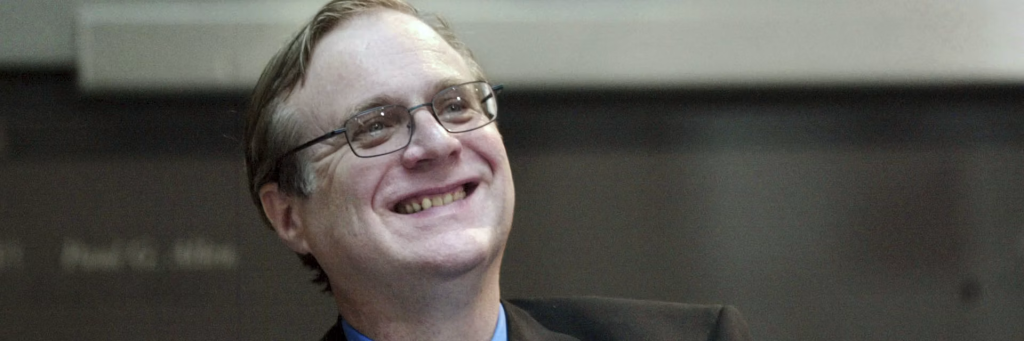
    Photo credit: AP Photo/John FroschauerThe estate of Microsoft co-founder Paul G. Allen, who died in 2018, made a big charitable bequest in 2025.
    ,

    US giving grew 3% in 2025, crossing the $600B mark for the first time

    Bequests and foundations drove a record-breaking year.

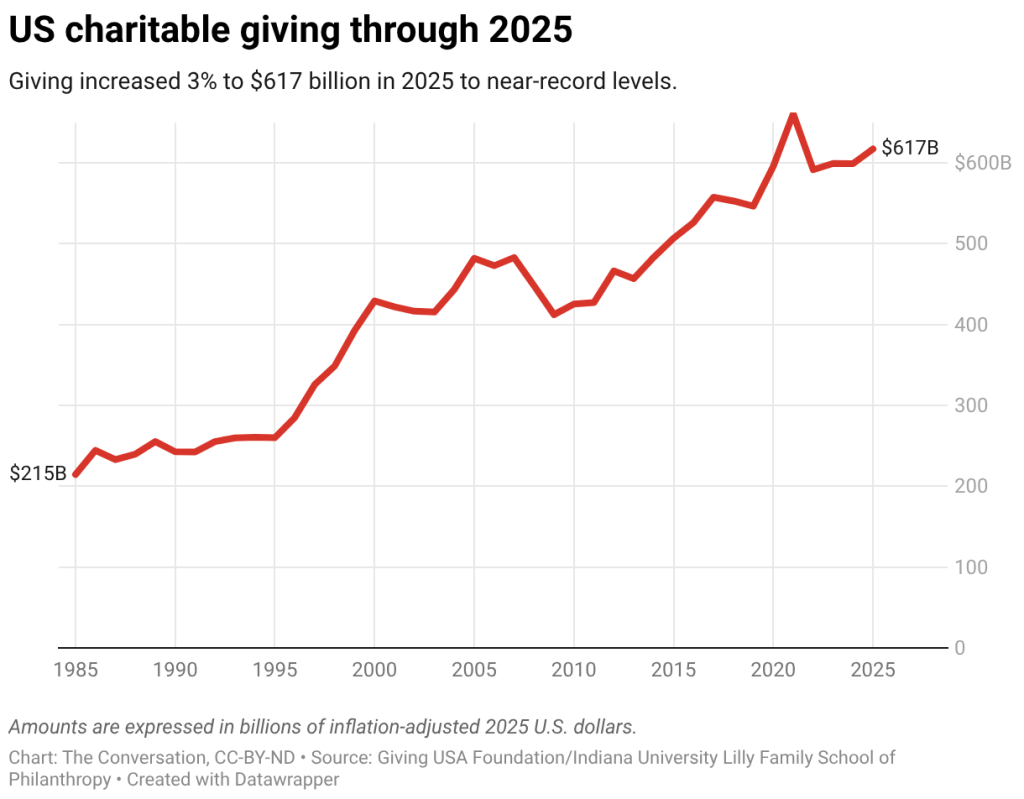
    U.S. charitable giving rose 3% in 2025, surpassing US$600 billion for the first time.

    The $617 billion that Americans gave to everything from churches to cat rescues was the second-highest ever in inflation-adjusted terms, but it fell short of the record set in 2021, when there was a burst of social services giving in response to the COVID-19 pandemic.

    This growth was slightly faster than the long-term annual average of 2.7%, thanks to the nation’s relatively strong – if mixed – economy. While the stock market performed well in 2025 and personal income roseconsumer sentiment was extremely low and inflation remained above the Fed’s 2% target.

    As part of my job researching trends in philanthropy and nonprofits, I’ve been the lead analyst for over a decade of this annual report from the Giving USA Foundation, produced in partnership with the Indiana University Lilly Family School of Philanthropy. In recent years it’s grown clearer that as giving grows, the kinds of donations the wealthy favor are gaining ground.

    US charitable giving through 2025

    Bequests and foundations led overall growth

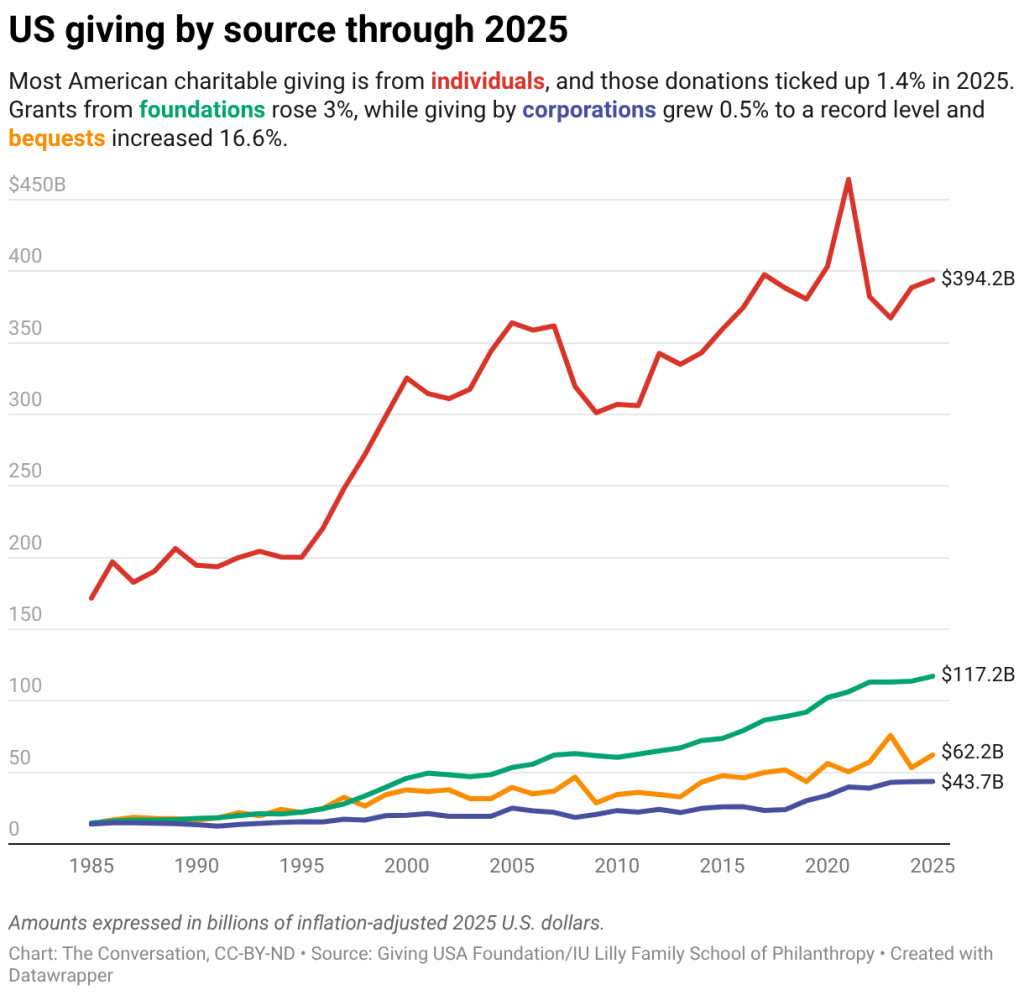
    Charitable bequests – gifts to causes that happen after someone dies – represented about 10% of all U.S. giving in 2025, up from 9% in 2024. They grew by 16.6% to $62 billion in 2025, faster than all other sources of donations. Bequeathed gifts have exceeded $50 billion every year since 2022, growing significantly in three of the past four years.

    There are several possible reasons for this increase. One is the impending passing of tens of trillions of dollars in wealth from people over 65 to their younger heirs, often called the “great wealth transfer.” However, the total value of charitable bequests may be rising simply because stocks have been performing better than normal for several years. The stock market boom has increased the net worth of the estates of the wealthiest Americans, who are the main people making these gifts after death.

    This value does vary greatly year to year, partly because even a single very large bequest can significantly skew the total amount. And when these changes will occur is unpredictable due to the complexity of multibillion-dollar estates, which can get paid out several years after a wealthy person dies. For example, Microsoft co-founder Paul Allen, who died in 2018, was among the largest donors of 2025 due to the $3.1 billion bequest his estate made.

    Giving by foundations also tends to respond to strong stock market growth. By law, private foundations must spend at least 5% of their assets for charitable purposes, primarily through grants to nonprofits, to retain their tax-exempt status. Endowment growth tends to boost what foundations disburse.

    US giving by source through 2025

    Giving by foundations, which accounted for about 1 in 5 dollars given to charity in 2025, rose by 3% to $117 billion – an all-time high, even when adjusting for inflation. Giving by foundations has not decreased in any year in real terms since 2010.

    Giving by individuals, whether they’re rich, poor or in between, is clearly influenced by consumer sentiment and other trends that affect typical households more directly. And consumer sentiment declined in 2025 to the lowest annual level ever recorded.

    Giving by individuals grew by 1.4% in 2025, though that share of charitable giving has gradually shrunk. It dipped to 64% of the total in 2025 – the second-lowest share of total giving ever.

    Corporate giving was responsible for around 7% of all charitable gifts made in 2025 – a record high. It totaled $44 billion in 2025, up 0.5% from a year earlier. Giving by corporations has grown by almost 30% since 2020 in inflation-adjusted terms.

    Most kinds of donations increased

    Donations to seven of the nine charitable categories that Giving USA tracks grew.

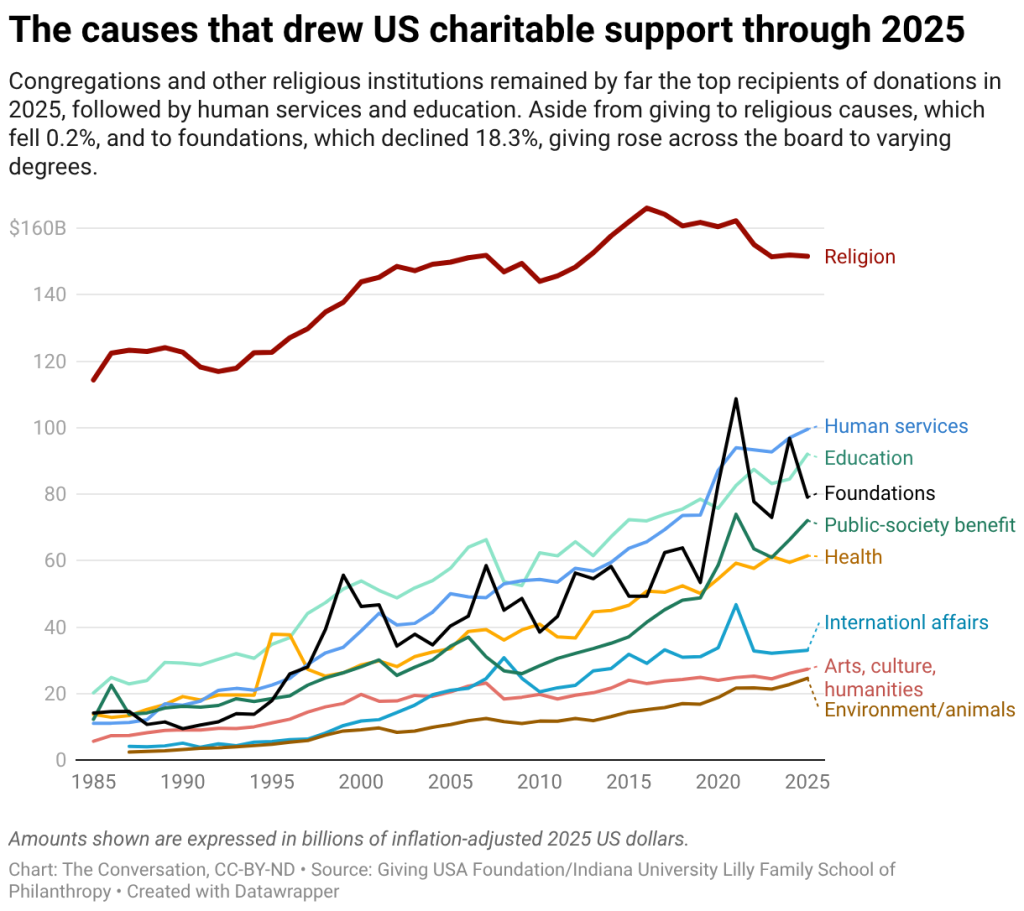
    One exception was gifts to houses of worship and religious institutions. Religious giving was essentially flat in inflation-adjusted terms, with a 0.2% decline. That’s in keeping with a long-term trend.

    Religious giving has barely budged in the U.S. over the past two decades, increasing by only 1.2% since 2005. That pace is the most sluggish of all the categories we track. Even so, the $152 billion Americans gave to congregations and other religious institutions remains by far the largest category. It accounted for 23% of all donations in 2025.

    The other exception was gifts to foundations, which fell 18.3% in 2025 after surging to their second-highest level ever in 2024. In 2025 they represented 12% of all giving, totaling $79 billion.

    Giving to social services nonprofits, such as food banks and homeless shelters, grew 2.6% in 2025, reaching almost $100 billion. That marked a record high and represented 15% of all giving.

    Giving to education and public-society benefit causes, categories associated with wealthier donors, grew the most in 2025.

    Charitable gifts for education, which primarily support colleges and universities, grew 8.9% – faster than any other category in 2025. They totaled $92 billion, an all-time high.

    The causes that drew US charitable support through 2025

    Public-society benefit giving grew by 8.7% to $72 billion. This category consists of organizations serving the public more generally, such as advocacy organizations, independent research institutions and donor-advised funds, which function as charitable investment accounts.

    Giving to several other categories reached record highs, including the $61 billion Americans donated to hospitals and other health-related causes; the $27 billion they gave to the arts; and $25 billion dispatched to nonprofits tied to the environment and animals.

    While charitable donations did grow broadly in 2025, the giving categories the wealthiest Americans tend to favor – bequests, foundations, education, public-society benefit organizations – fared better than usual. Giving by less affluent U.S. donors – gifts from individuals and donations to religious institutions – lagged.

    Beginning in 2026, however, virtually all U.S. taxpayers will have some incentive to make charitable gifts due to the addition of the universal charitable deduction as part of President Donald Trump’s big package of tax and spending measures that Republican lawmakers passed in July 2025. That should increase the number of donors who make modest gifts to charity.

    This article originally appeared on The Conversation. You can read it here.

  • The drawer problem: Why so many of us can’t let go of our old electronics, and what we can do about it
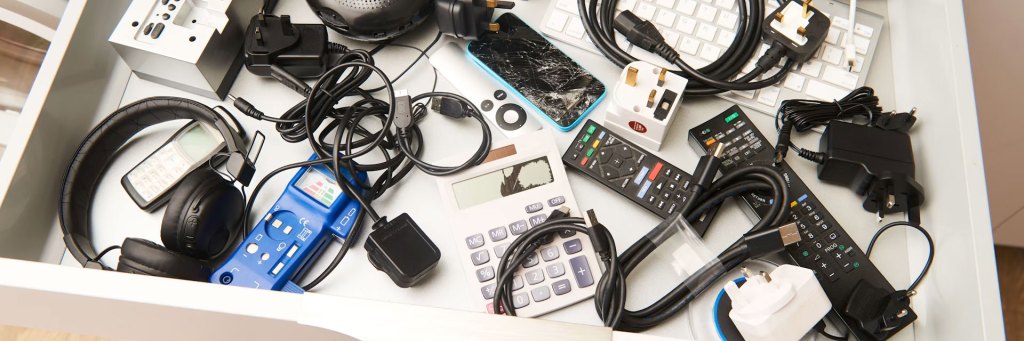
    Photo credit: Peter Dazeley/Photodisc via Getty ImagesThis look familiar?

    Think about the last smartphone, tablet or smartwatch you stopped using. Odds are it is not in a recycling bin or a new owner’s hands; it is sitting in a drawer.

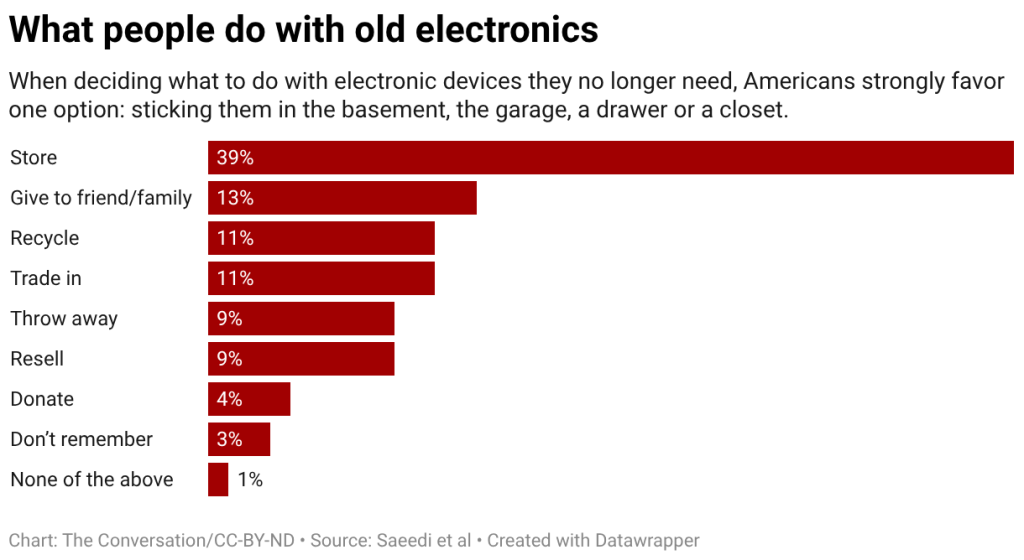
    From our survey of 4,000 American consumers, we found the single most common thing people did with a device they were finished with was nothing at all: 39% simply stored it. Recycling and reselling, outcomes better for the environment, each accounted for only about 1 in 10 devices. Throwing devices in the trash claimed another 9%.

    What people do with old electronics

    Funded by the National Science Foundation, our multidisciplinary team blended our expertise in causal inferencesustainability and cybersecurity, to work on the tangled question of what people do with their consumer electronics when they’re done using them. We used statistical models to connect what people say – that is, their stated knowledge and attitudes – to what they actually did.

    Why the drawer wins

    Two main forces keep devices in the drawer. The first is anxiety about data. People who worried that recycling or reselling a device would compromise their data were 14% and 9% more likely to store it instead.

    The second force is simply not knowing how to. People who did not know where to recycle were 10% more likely to hold onto a device, and many also kept old gadgets as a perceived data backup.

    Recycling and reselling electronics are a lot easier than a lot of people think. In the U.S., the national chain Best Buy accepts devices for recycling; reselling online is convenient with vendors such as Back Market and Gazelle.

    Just be sure to wipe data before parting with a phone or computer. Also, remove the device from your account, for instance with Apple or Android. Unless you do, the device stays locked to you, and no one else can use it.

    We also compared what people intended to do with what they had actually done. This led to a telling detail: Data security worries led to people storing devices at a greater rate than they said they intended to.

    In other words, the fear of leaking personal data kicks in only when someone is facing the real decision of whether to hand off their device to a recycler or secondhand buyer.

    Getting at why people don’t recycle

    Researchers have long studied why people do or don’t recycle electronics: Convenience, awareness and incentives showed up as affecting the decision. But prior work examined recycling as the only option.

    Instead of considering the issue as a yes-or-no vote on recycling, we treat it as a comparison between different options: Storing, reselling, donating, trading in, recycling and throwing away the device in the trash. When modeling this way, trade-offs became visible.

    Knowing where to recycle, for instance, made recycling 47% more likely, but it also pulled people away from reselling, which is often the more environmentally friendly choice. You can explore the survey results in our interactive dashboards.

    Getting people to let go

    Storage is the worst of both worlds: A device sitting unused for years loses its resale value, and erasing its data only gets harder over time. The good news is that the main barriers – data concerns and not knowing where to turn – can be addressed with better information.

    We are experimenting with information interventions that walk people through their options, including how to securely wipe their data. We are testing nudges with randomized, controlled trials to test what leads people to give their old electronics a second life.

    It might be a good time to remember what old devices you’re holding onto and revisit your reasons for not letting go of them.

    This article originally appeared on The Conversation. You can read it here.

  • First new US sunscreen ingredient since 1999 approved by FDA – a skin scientist explains how bemotrizinol works
    Photo credit: mihailomilovanovic/iStock via Getty Images PlusChemical sunscreens have come a long way since they were first developed in 1891.

    As summer in the U.S. heats up, people become more diligent about protecting their skin from the Sun. Another option for doing so will soon be available.

    On June 9, 2026, the U.S. Food and Drug Administration approved the first new sunscreen ingredient to be permitted for over-the-counter consumer use in the U.S. since 1999 – a chemical called bemotrizinol.

    Bemotrizinol isn’t new – consumers in Europe and Asia have used it for decades. Some are hailing its long-overdue approval and arrival onto the U.S. sunscreen scene.

    I am a biomedical engineer studying skin science – including the damaging effects of the Sun’s rays. To understand what bemotrizinol does and how it fits in with products already available to consumers in the U.S., let’s take a tour of the physics of sunlight and sunscreens.

    A short primer on sunlight

    Our planet is irradiated by a yellow dwarf star 93,000,000 miles away that we fondly call the Sun. It radiates light from its surface at a temperature of about 10,000 degrees Fahrenheit.

    The Earth’s atmosphere blocks most of the Sun’s radiation. Of the rays that get through, about half consist of infrared light – which gives you that warm feeling you feel on a sunny day – and 40% visible light, which you are probably familiar with as daylight.

    About 10% of those rays are ultraviolet, or UV, light. UV light has the shortest wavelengths of the three types. That makes it the most dangerous – it’s invisible and can damage living tissue.

    Ultraviolet damage

    Physicists further categorize solar UV light into several types, based on the wavelength, which is measured in nanometers. About 95% of it is UVA (315-400 nm) and 5% is UVB (280-315 nm). Sunscreens need to be able to block those rays from penetrating the skin.

    The sun also emits two other types of UV light – UVC (200-280 nm) and vacuum UV (100-200 nm) – but these are stopped by the atmosphere, so sunscreens do not typically need to be able to block them.

    A graphic depiction of UVA and UVB rays penetrating the skin and their deflection with sunscreen.
    Scientists previously thought that only UVB rays were dangerous because they cause sunburns, but UVA can also damage the skin. m.malinika/iStock via Getty Images Plus

    Scientists used to think only UVB was harmful because UVB rays cause sunburns. But today, researchers know both types of UV can damage the skin.

    UVB, with its shorter wavelength, has more energy, but UVA can penetrate the skin more deeply. And all UV can degrade the integrity of your skin, damage the structure of your DNA and cause skin cancer.

    The only natural safeguard your body has against UV light is a microscopically thin layer of a pigment called melanin in your epidermis. The skin produces more melanin when exposed to the sun – that’s what tanning is.

    This extra melanin does protect the skin, but not fully. That’s why protecting your skin with sunscreen is so important.

    Sunscreens old and new

    Sunscreens come in two different forms – mineral and chemical.

    The first chemical sunscreen, developed in 1891, was an ointment made from quinine – a plant-derived compound that makes tonic water bitter.

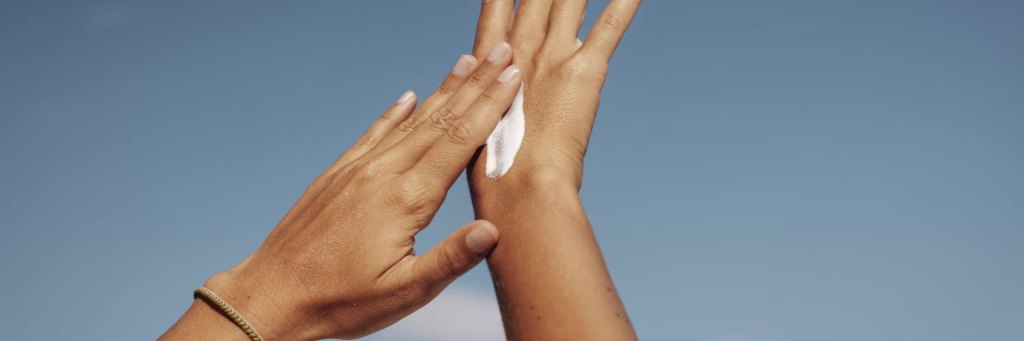
    Chemical sunscreens cover the skin in a transparent coating, acting like a solar sponge. They absorb UV photons and undergo a harmless chemical reaction, then dissipate the energy as heat. Bemotrizinol falls into this category.

    Mineral sunscreens such as zinc or titanium oxide ward off the Sun’s rays by forming a protective film that also absorbs most UV light, but reflects some of it. Unlike chemical sunscreens, the film absorbs the light naturally, without a chemical reaction – which is why they are often visible as a white film on the skin.

    Chemical sunscreens that have been available in the U.S until now combine ingredients like avobenzone, the most widely used UVA filter, with UVB filters such as octinoxate, octocrylene octisalate and homosalate. Working together, these substances protect the skin against the broad spectrum of ultraviolet rays.

    These sunscreens are only effective for a short time because they are degraded by the chemical reactions they undergo, which means they must be frequently re-applied.

    Another important element of sunscreen – whether mineral or chemical – is its Sun Protection Factor, or SPF. This number tells you how well a sunscreen prevents your skin from burning – in other words, what amount of UVB rays it absorbs.

    An SPF of 2 would mean a sunscreen cuts your exposure to UVB rays in half, filtering out 50% of those rays. An SPF of 30 means the sunscreen lets just 1/30 of the rays penetrate your skin – which is 3.3%. So it blocks about 97% of the UVB rays.

    Dermatologists generally recommend using a sunscreen with an SPF of at least 30.

    Benefits of bemotrizonol

    Bemotrizinol, while new to the U.S., isn’t a new compound. European regulators approved it in 2000. Chances are, if you brought back sunscreen from a vacation in Mexico, Europe, Canada or South Korea, you may even have some laying around your house.

    One benefit of bemotrizinol is its ability to filter both UVA and UVB rays, so it doesn’t have to be mixed with other products to do the job.

    It has some other beneficial features as well. First, its molecules prefer to sit on the surface of the skin rather than being more readily absorbed into the bloodstream, which can occur for some formulations.

    Such absorption has raised concerns that sunscreens might be harmful – though this has not been demonstrated in people, it may discourage some people from using it.

    Bemotrizinol also does not degrade as readily in the sun than other chemical sunscreen products. That photostability means it can last for four to eight hours, rather than having to be applied every two hours or so.

    Regardless of the type, as a skin scientist I can say with certainty that any sunscreen is better than none. Your skin does an excellent job protecting you from the world outside – so make sure you protect it in return.

    This article originally appeared on The Conversation. You can read it here.

Explore More Stories

Well-being

5 ways how stickers psychologically boost the lives of grown adults

Care

Student with severe facial burns from a frat house fire healed through new innovative treatment

Science

How window‑mounted heat pumps can give tenants efficient heating and cooling

Money

The ‘right to repair’ movement has a point, but consumers should read the warranty fine print first