The Empire State really is something. The communities in New York have been doing remarkable things through the Pepsi Refresh Project, from major school improvements to veterans’ support, and everything in between. Here’s a look at some the amazing things New Yorkers have done to make their wold a better place.
A rapidly growing trend on TikTok encourages people to see themselves as the protagonist of their own lives. In “main character energy” videos, creators turn ordinary moments into cinema. Clips of people walking to work, grabbing coffee, or reading a book sometimes attract thousands of views after specialized music and stylized cuts are added.
The social media posts might look like just another aesthetic trend. But the reason people keep returning and liking them seems less about style and more about how they turn a regular day into something special.
“Main character energy” is Internet slang for seeing yourself as the central figure of your own story. Not in an inflated sense, but more in a way that turns ordinary routines into something a little more intentional.
TikTok creators have embraced the trend, creating an easily recognizable video that encourages self-focus and a playful, story-driven way of seeing themselves. Entire feeds are now filled with “main character walks” and similar clips of daily activities where nothing remarkable happens, but the attitude suggests it matters.
People seem to really respond to the trend. Comment sections are filled with thoughts about their own “main character” moments. The video just above, posted by @chelsbol received over 15,000 comments.
“Me every time I walk home from Trader Joe’s”
“my newest coping tool has been: *make it an imaginary situation, you are now playing pretend, cosplaying even*
“this is gonna flip my mindset so much thank you.”
“Im 100% doing this tomorrow”
“Be your starring role in your own movie everyday!”
“Making the best out of any situation”
People generally move through their lives from one obligation to another. Work, errands, commuting, cooking, cleaning, and endless scrolling can make days blend in a blur. In that repeated normalcy, a video that slows down and has a little theatrical fun can feel surprisingly refreshing.
However, these unique videos may point to deeper underlying concerns. In a Psychology Today article, psychotherapist Duygu Balan warns that what begins as self-discovery can turn into content made primarily for clicks and likes. There’s a toxic risk when personal growth becomes something curated for an audience.
The same videos that encourage people to romanticize their own lives can also invite comparison. Videos carefully crafted to elicit audience engagement rarely project reality. A 2025 study in Frontiers in Psychology found that social comparison on social media can dramatically affect a person’s mental health. Viewers don’t always stop at appreciating someone else’s perspective. Sometimes they get lost in measuring their own lives against it.
Most successful “main character energy” creators focus on more ordinary moments than extraordinary ones. The appeal isn’t necessarily about having a better life. It’s more about finding a different way to approach the one you already have.
Whether people see the trend as a helpful mindset or just another social media trend, its popularity suggests viewers crave it. By framing routine differently, they invite the audience to craft a little more joy in the mundane of their own lives.
At their best, these videos aren’t about becoming the star of a movie. They propose finding meaning from the moments people often overlook. In a culture driven by productivity, infusing everyday life with a little lighthearted whimsy is a big reason people keep watching.
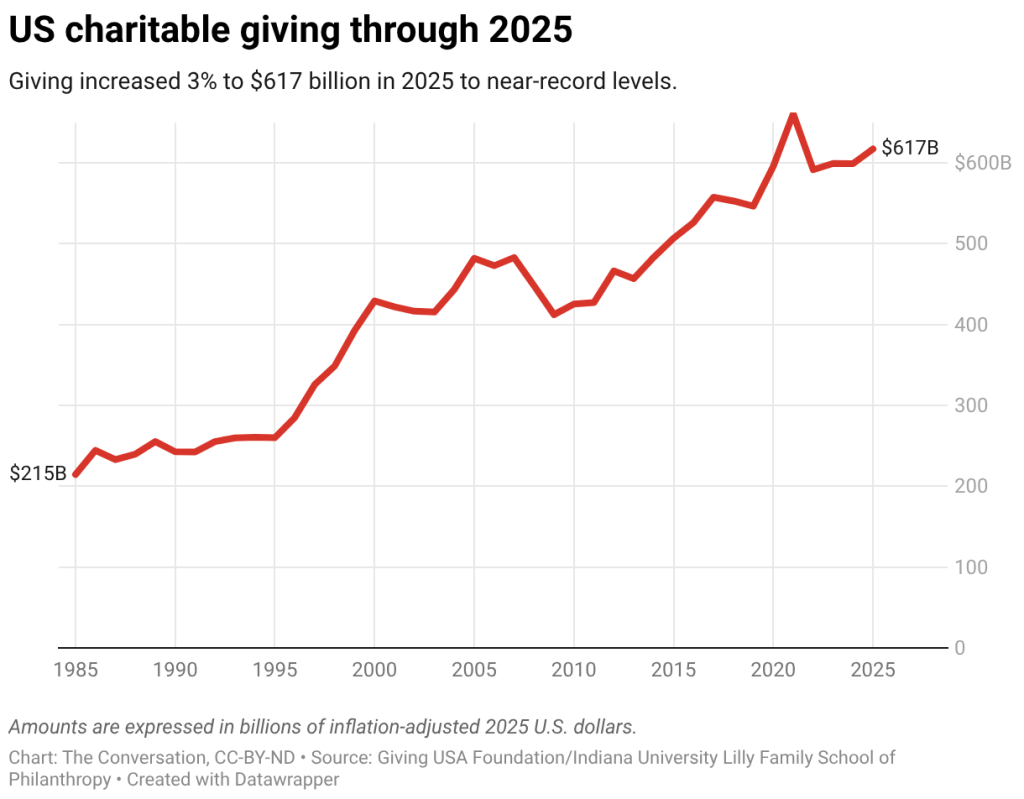
The $617 billion that Americans gave to everything from churches to cat rescues was the second-highest ever in inflation-adjusted terms, but it fell short of the record set in 2021, when there was a burst of social services giving in response to the COVID-19 pandemic.
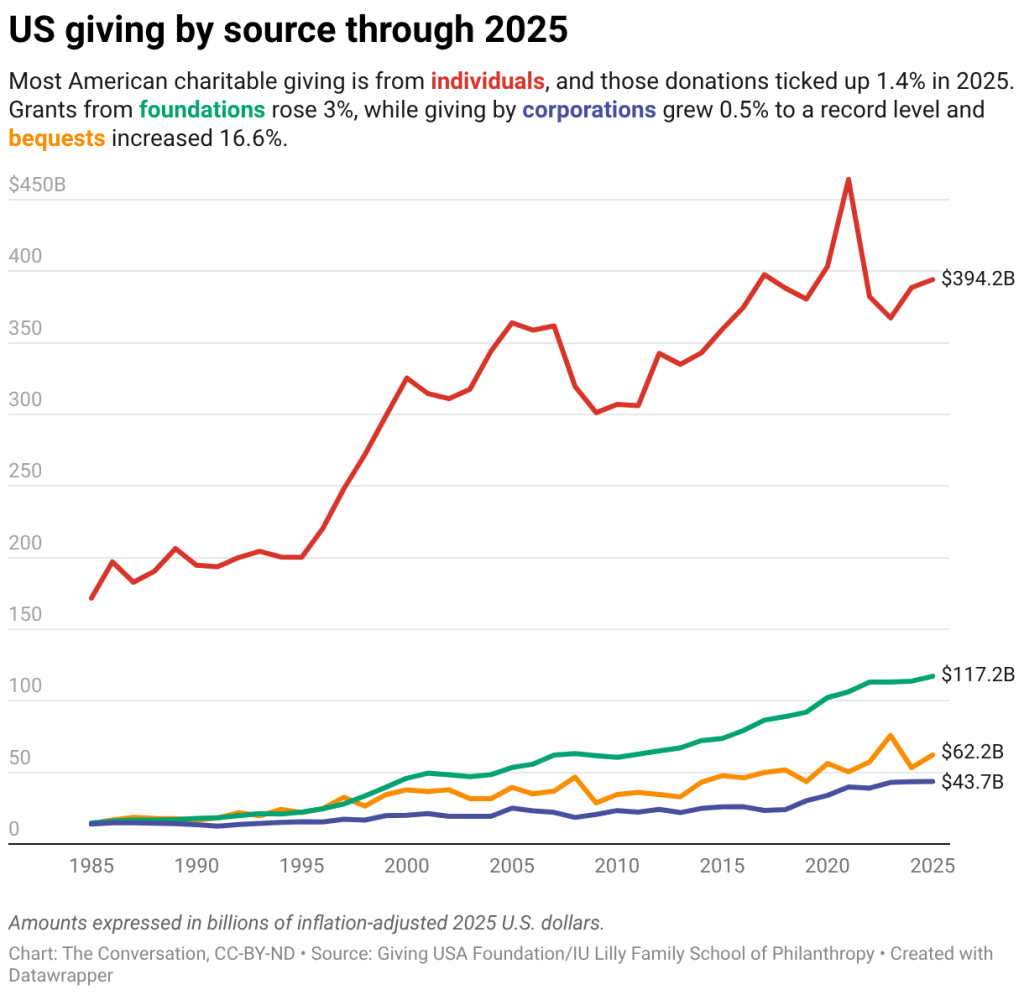
Charitable bequests – gifts to causes that happen after someone dies – represented about 10% of all U.S. giving in 2025, up from 9% in 2024. They grew by 16.6% to $62 billion in 2025, faster than all other sources of donations. Bequeathed gifts have exceeded $50 billion every year since 2022, growing significantly in three of the past four years.
There are several possible reasons for this increase. One is the impending passing of tens of trillions of dollars in wealth from people over 65 to their younger heirs, often called the “great wealth transfer.” However, the total value of charitable bequests may be rising simply because stocks have been performing better than normal for several years. The stock market boom has increased the net worth of the estates of the wealthiest Americans, who are the main people making these gifts after death.
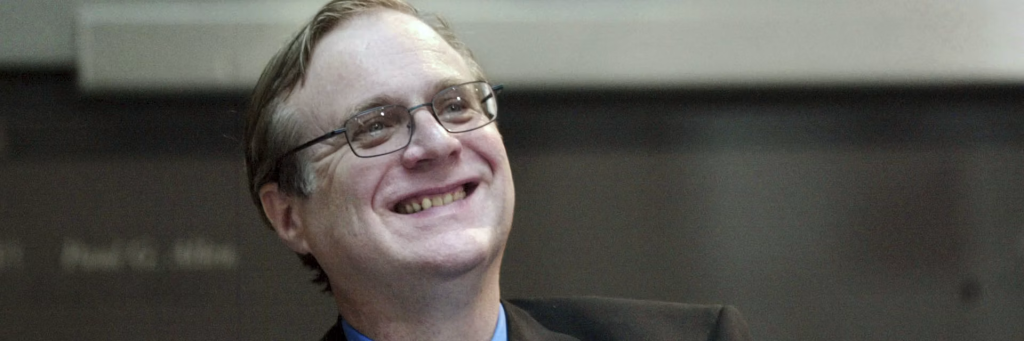
This value does vary greatly year to year, partly because even a single very large bequest can significantly skew the total amount. And when these changes will occur is unpredictable due to the complexity of multibillion-dollar estates, which can get paid out several years after a wealthy person dies. For example, Microsoft co-founder Paul Allen, who died in 2018, was among the largest donors of 2025 due to the $3.1 billion bequest his estate made.
Giving by foundations also tends to respond to strong stock market growth. By law, private foundations must spend at least 5% of their assets for charitable purposes, primarily through grants to nonprofits, to retain their tax-exempt status. Endowment growth tends to boost what foundations disburse.
Giving by foundations, which accounted for about 1 in 5 dollars given to charity in 2025, rose by 3% to $117 billion – an all-time high, even when adjusting for inflation. Giving by foundations has not decreased in any year in real terms since 2010.
Giving by individuals, whether they’re rich, poor or in between, is clearly influenced by consumer sentiment and other trends that affect typical households more directly. And consumer sentiment declined in 2025 to the lowest annual level ever recorded.
Giving by individuals grew by 1.4% in 2025, though that share of charitable giving has gradually shrunk. It dipped to 64% of the total in 2025 – the second-lowest share of total giving ever.
Corporate giving was responsible for around 7% of all charitable gifts made in 2025 – a record high. It totaled $44 billion in 2025, up 0.5% from a year earlier. Giving by corporations has grown by almost 30% since 2020 in inflation-adjusted terms.
Most kinds of donations increased
Donations to seven of the nine charitable categories that Giving USA tracks grew.
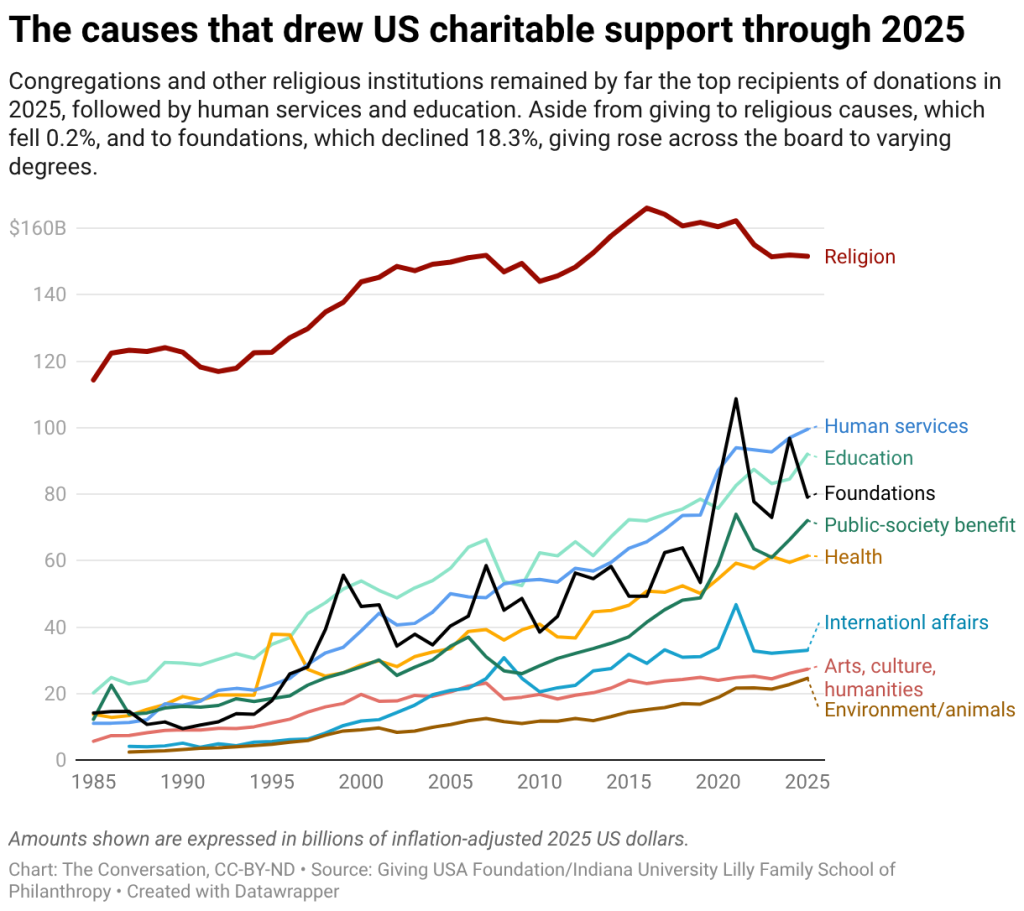
One exception was gifts to houses of worship and religious institutions. Religious giving was essentially flat in inflation-adjusted terms, with a 0.2% decline. That’s in keeping with a long-term trend.
Religious giving has barely budged in the U.S. over the past two decades, increasing by only 1.2% since 2005. That pace is the most sluggish of all the categories we track. Even so, the $152 billion Americans gave to congregations and other religious institutions remains by far the largest category. It accounted for 23% of all donations in 2025.
The other exception was gifts to foundations, which fell 18.3% in 2025 after surging to their second-highest level ever in 2024. In 2025 they represented 12% of all giving, totaling $79 billion.
Giving to social services nonprofits, such as food banks and homeless shelters, grew 2.6% in 2025, reaching almost $100 billion. That marked a record high and represented 15% of all giving.
Giving to education and public-society benefit causes, categories associated with wealthier donors, grew the most in 2025.
Charitable gifts for education, which primarily support colleges and universities, grew 8.9% – faster than any other category in 2025. They totaled $92 billion, an all-time high.
Public-society benefit giving grew by 8.7% to $72 billion. This category consists of organizations serving the public more generally, such as advocacy organizations, independent research institutions and donor-advised funds, which function as charitable investment accounts.
Giving to several other categories reached record highs, including the $61 billion Americans donated to hospitals and other health-related causes; the $27 billion they gave to the arts; and $25 billion dispatched to nonprofits tied to the environment and animals.
While charitable donations did grow broadly in 2025, the giving categories the wealthiest Americans tend to favor – bequests, foundations, education, public-society benefit organizations – fared better than usual. Giving by less affluent U.S. donors – gifts from individuals and donations to religious institutions – lagged.
Beginning in 2026, however, virtually all U.S. taxpayers will have some incentive to make charitable gifts due to the addition of the universal charitable deduction as part of President Donald Trump’s big package of tax and spending measures that Republican lawmakers passed in July 2025. That should increase the number of donors who make modest gifts to charity.
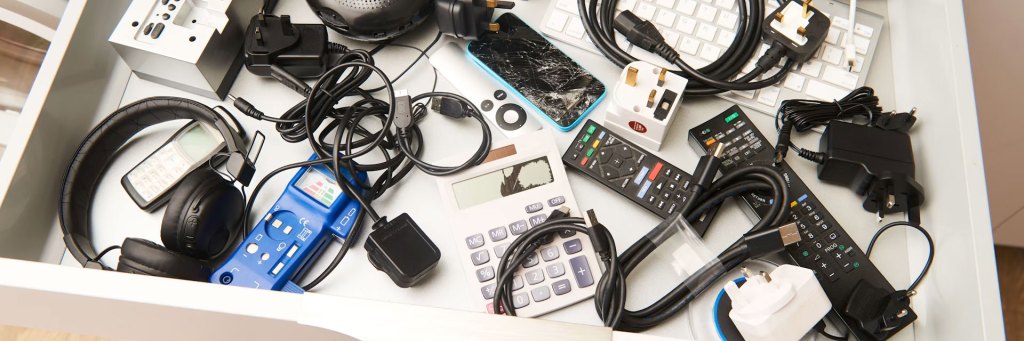
Think about the last smartphone, tablet or smartwatch you stopped using. Odds are it is not in a recycling bin or a new owner’s hands; it is sitting in a drawer.
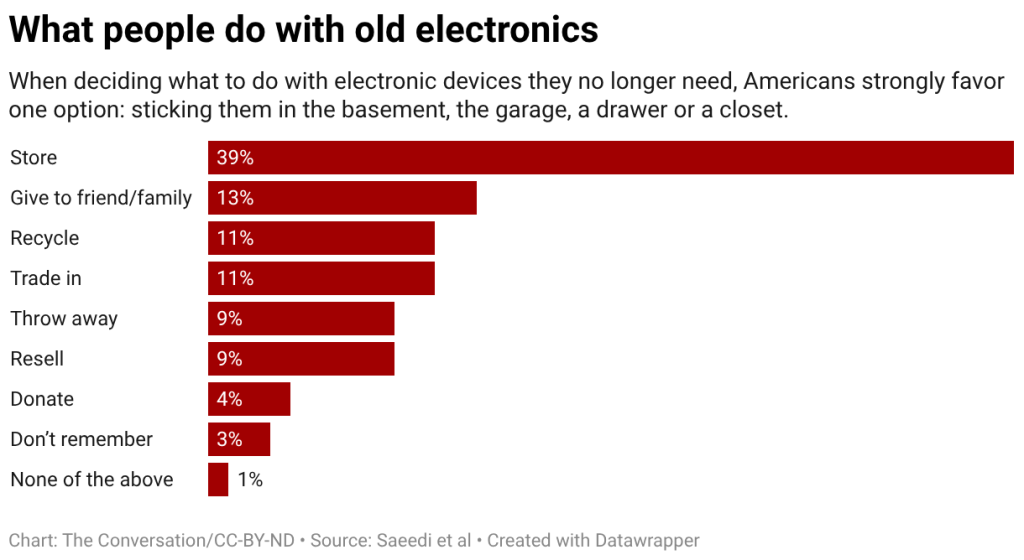
From our survey of 4,000 American consumers, we found the single most common thing people did with a device they were finished with was nothing at all: 39% simply stored it. Recycling and reselling, outcomes better for the environment, each accounted for only about 1 in 10 devices. Throwing devices in the trash claimed another 9%.
Funded by the National Science Foundation, our multidisciplinary team blended our expertise in causal inference, sustainability and cybersecurity, to work on the tangled question of what people do with their consumer electronics when they’re done using them. We used statistical models to connect what people say – that is, their stated knowledge and attitudes – to what they actually did.
Why the drawer wins
Two main forces keep devices in the drawer. The first is anxiety about data. People who worried that recycling or reselling a device would compromise their data were 14% and 9% more likely to store it instead.
The second force is simply not knowing how to. People who did not know where to recycle were 10% more likely to hold onto a device, and many also kept old gadgets as a perceived data backup.
Recycling and reselling electronics are a lot easier than a lot of people think. In the U.S., the national chain Best Buy accepts devices for recycling; reselling online is convenient with vendors such as Back Market and Gazelle.
Just be sure to wipe data before parting with a phone or computer. Also, remove the device from your account, for instance with Apple or Android. Unless you do, the device stays locked to you, and no one else can use it.
We also compared what people intended to do with what they had actually done. This led to a telling detail: Data security worries led to people storing devices at a greater rate than they said they intended to.
In other words, the fear of leaking personal data kicks in only when someone is facing the real decision of whether to hand off their device to a recycler or secondhand buyer.
Getting at why people don’t recycle
Researchers have long studied why people do or don’t recycle electronics: Convenience, awareness and incentives showed up as affecting the decision. But prior work examined recycling as the only option.
Instead of considering the issue as a yes-or-no vote on recycling, we treat it as a comparison between different options: Storing, reselling, donating, trading in, recycling and throwing away the device in the trash. When modeling this way, trade-offs became visible.
Knowing where to recycle, for instance, made recycling 47% more likely, but it also pulled people away from reselling, which is often the more environmentally friendly choice. You can explore the survey results in our interactive dashboards.
Getting people to let go
Storage is the worst of both worlds: A device sitting unused for years loses its resale value, and erasing its data only gets harder over time. The good news is that the main barriers – data concerns and not knowing where to turn – can be addressed with better information.
We are experimenting with information interventions that walk people through their options, including how to securely wipe their data. We are testing nudges with randomized, controlled trials to test what leads people to give their old electronics a second life.
It might be a good time to remember what old devices you’re holding onto and revisit your reasons for not letting go of them.