If you ask people what they think the “perfect” body looks like, you’re sure to get a range of answers, depending on where the person is from. Last year, Superdrug Online Doctor created a project, “Perceptions of Perfection” that showed what people in 18 countries think the “perfect” woman looks like. The project was a viral hit.
They’ve recently released the male version. This time, they asked graphic designers—11 women and eight men—in 19 countries to Photoshop the same image to highlight the male beauty standards for their country. Some of the images are certainly amusing, but the collective result is an interesting look at what people find attractive around the world.
The idea of the project was to highlight that the idea of beauty varies from country to country and people to people.
Florida resident Luis Salazar went through something many of us have experienced: he found someone’s lost property, a fanny pack, in a convenience store bathroom. Who hasn’t gone to a public restroom to find a dropped wallet, backpack, or purse and tried to return it to its rightful owner? For Salazar, though, there was a another factor: the lost fanny pack contained $30,000 in cash.
On a Sunday afternoon, Salazar was using a Wawa gas station restroom in Riviera Beach, Florida. That’s when he noticed a fanny pack hanging on the safety railing. Salazar figured that the person who had used the restroom before him had accidentally left it behind. He tried to see if the fanny pack’s owner was still at the Wawa, but no luck.
Salazar opened the fanny pack hoping to find some identification inside so he could return it to its rightful owner. While he couldn’t find a drivers license or any other ID, he did find something else: a thick pile of cash. In fact, it was $30,023.
“My body was just numb, just seeing all this money that belonged to somebody else,” Salazar said to WPBF News.
What do you do with a lost fanny pack filled with $30K?
Salazar knew exactly what to do. He kept the money safe in the fanny pack and continued his search for the rightful owner.
As Salazar spent days looking for the owner, the owner finally noticed his $30,000 dollar-filled fanny pack was missing, and called the local police to help him find it.
“I was like, ‘Oh my God, my freaking money’s gone. I’m out of all this bread. I don’t know what I’m going to do,’” the owner said to WPBF News, declining to be identified.
After reviewing the Wawa convenient store security footage, the police were able to identify both the fanny pack owner and Salazar. They contacted Salazar who happily brought over the fanny pack to the police station with every single dollar still inside. The fanny pack owner cried and hugged Salazar, thanking him for finding and returning it.
The owner was incredibly grateful that an honest person found his lost pack.
“I was pretty astonished that anybody would have done that,” he said. “Think about it. That’s life-changing money. People would kill for that kind of money.”
Meanwhile, Salazar just did what he thought was natural.
“If something doesn’t belong to you, you didn’t earn it. Give it back. Be kind,” said Salazar. “It’s not my money to take. I was not raised that way.”
Most people are honest people
While acts of honesty like Salazar’s should be celebrated, there are more people like him than you would think. A 2019 study researched human behavior by dropping over 17,000 “lost” wallets in 40 countries over the course of two years. The results found that wallets with money inside were more likely to be reported than those without cash. In fact, the more cash inside the wallet, the more likely it was reported.
“The highest reporting rate was found in the condition where the wallet included $100,” the study’s lead researcher Alain Cohn told NPR. “Forty-six percent of wallets with no money were reported, compared with 61% of those with about $13 and 72% of those with nearly $100.”
So Luis Salazar’s behavior was part of something that is (thankfully) more normal than most would expect.
“I guess maybe there’s just more good people in the world than most people think,” said the fanny pack owner. “You never know who you’ll run into, and Luis is just one of those good people.”
A mom was relaxing poolside reading a book when her son spotted a massive tree falling toward her and yelled “Run mom!” and the video is absolutely wild.
Shocking footage taken in Alpharetta, Georgia shows a mother relaxing by a pool while her two sons play in the water. The peaceful scene quickly turned into a terrifying near-miss when one of the boys noticed something alarming overhead: a massive tree about to fall in their direction.
According to the video, the mother was lying poolside in a lounge chair, reading a book, while her sons splashed in the pool nearby. Suddenly, a cracking sound echoed through the yard.
“I was sitting at the pool relaxing and reading a book while watching my two sons swim, when I heard a tree cracking and then my son yelled ‘Run mom!’ so I bolted out of my chair right before a huge tree fell right on the chair I was sitting on,” the mother said, according to Viral Hog.
The tree crashed down with enormous force, splintering the chair and narrowly missing the spot where she had been seated just seconds before. Footage captured the dramatic moment, showing how a child’s quick thinking likely averted a tragedy.
A fallen tree against a destroyed roof after a storm. Photo credit: Canva
The source of the falling tree wasn’t immediately clear, but heavy spring rainfall in the region may have weakened its roots or trunk. Incidents involving falling trees are more common during storms or after long periods of moisture saturation, especially in areas with older or unmaintained trees.
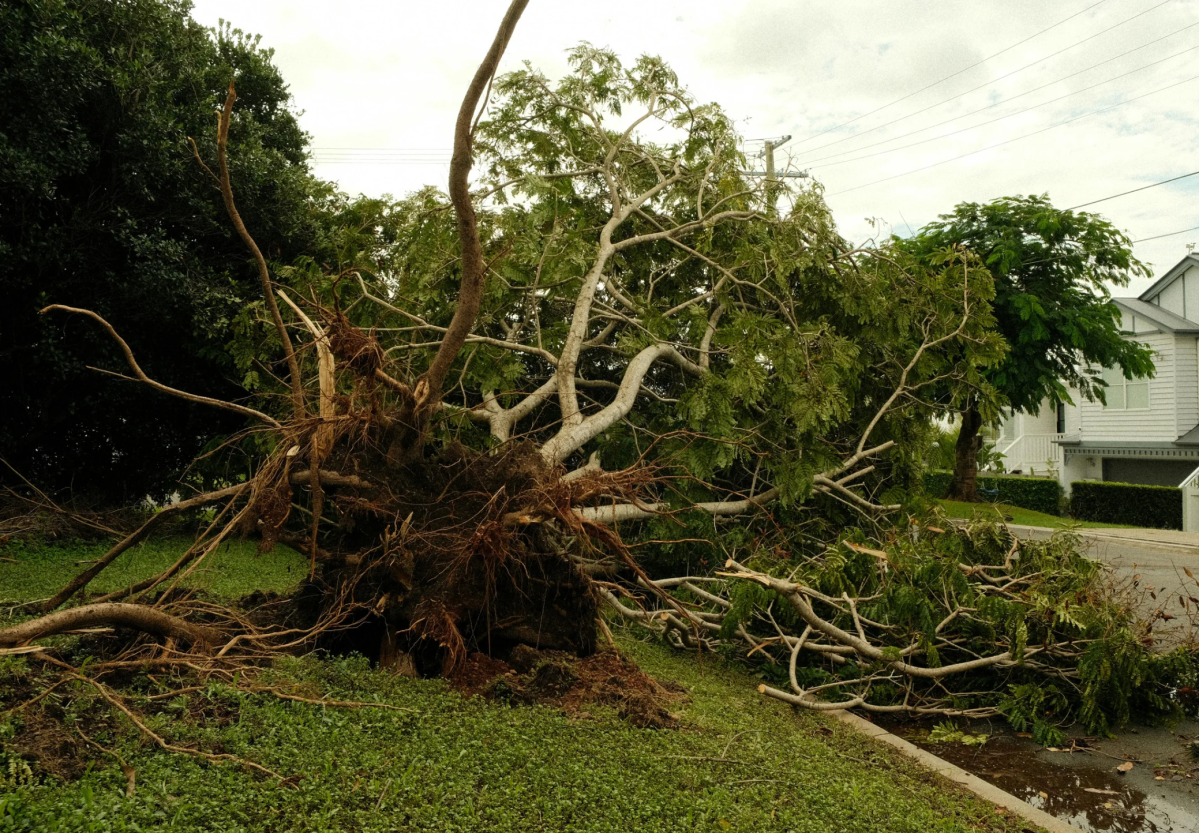
An uprooted tree after a storm. Photo credit: Canva
The boy’s awareness and ability to respond so quickly stunned viewers of the video. Many praised him online for noticing the danger and warning his mom without hesitation—an instinct that proved life-saving.
The family has not released additional details, but the video has since gone viral, viewed thousands of times on social media platforms.
This article originally appeared four years ago. It has been updated.
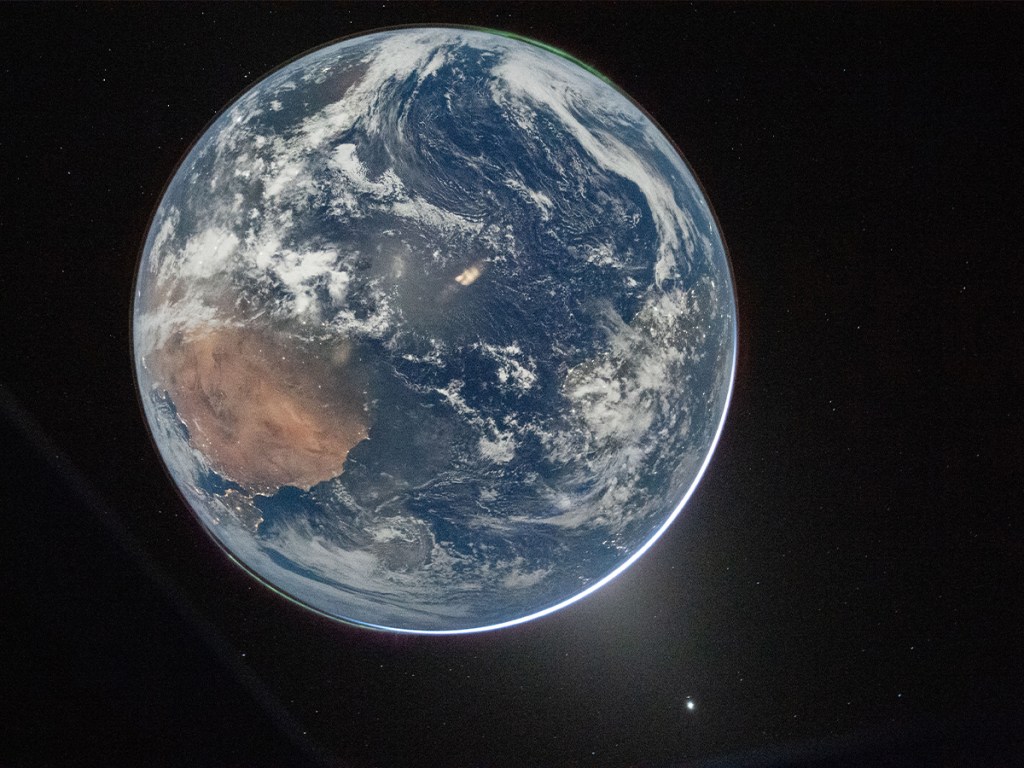
Commander Reid Wiseman’s photo, taken from Artemis II as it pushed away from Earth and races toward the Moon, reveals the majestic blue planet we all call home. NASA released the image shortly after liftoff, instantly turning it into one of the defining visuals of the mission so far.
It’s been more than 50 years since man last traveled to the moon on Apollo 17 in 1972. For younger generations, the Artemis II flyby and the eventual Artemis IV landing, might be the first time space exploration feels less like science and more like a shared human experience.
Artemis II has a simple yet extremely complicated mission to fly around the moon. Expected to take around 10 days, the crew of 4 will fly aboard NASA’s Orion spacecraft.
After orbiting twice around the Earth to ensure everything is working properly, they will perform a propulsion move called the transluna injection burn. This will send the Orion 4,600 miles beyond the far side of the moon. During the rest of the journey, the crew will test emergency procedures, conduct some science experiments, evaluate the radiation shelter, and observe the Moon.
For the return leg home, the Orion spacecraft will rely on Earth’s gravity to pull them back. Orion is scheduled to splash down in the Pacific Ocean on April 10th. There, it will be picked up by the U.S. Navy.
NASA shared in their Mission Overview, “Through Artemis, NASA will explore more of the Moon than ever before and create an enduring presence in deep space, while simultaneously preparing to land the first astronaut – an American – on Mars.”
For many Americans, this is the first time humanity has ventured this far from Earth in their lifetime. The Artemis II mission feels less like a run-of-the-mill space mission and more like the return of a dream we had quietly abandoned.
A 2025 study in Frontiers showed that experiencing awe about space can make people feel more like “science people,” sparking their curiosity about learning more science in the future. During the total 2024 solar eclipse, when the moon completely blocks the sun, people remained in awe and felt inspired even 6 months later.
Nature Reviews Psychology shared a 2024 study that showed experiencing awe can make people feel smaller in a good way. Individuals become less focused on themselves and more connected to the world. Awe has a positive influence upon thinking, motivation, social interactions, and well-being.
This most recent mission by NASA proves that humanity can still commit to projects bigger than the daily news cycle. Some achievements are worth pursuing not for immediate gratification, but because they expand the young minds that will shape our future.
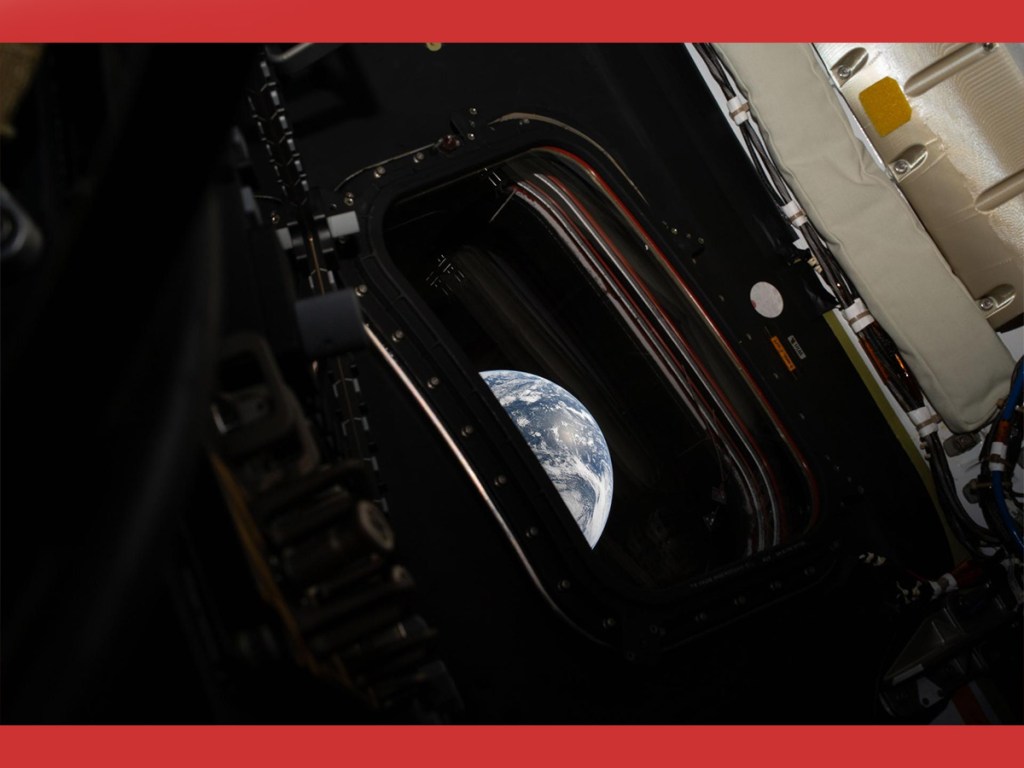
Image from Artemis II window looking back to Earth. Image Credit: NASA
People are inspired to talk about Artemis II
A Reddit post, First photo taken from Artemis commander Reid Wiseman had people excitedly sharing on the momentous achievement. Several people seemed inspired, others tried to be funny, and many seemed appreciative of the experience itself. These are a small collection of thoughts from the comments:
“In outer space you develop an instant global consciousness, a people orientation, an intense dissatisfaction with the state of the world, and a compulsion to do something about it.’
“You think any astronaut at one point did the finger pinchy thing where they’re crushing the planet?”
“Unlike watching from near-Earth orbit, this image has not been seen by human eyes in over fifty years. Mankind is able to do great things, when we all work together!”
“Lot of water/earth in front of me on that photo”
“That’s here. That’s home. That’s us. On it everyone you love, everyone you know, everyone you ever heard of, every human being who ever was, lived out their lives.”
“HELLO WORLD !!!”
“Flat-earthers gonna be upset. Lol”
“That beautiful silver line of the atmosphere the shines across the border of the globe is so surreal. Literally looks like a magic border in fantasy novels…”
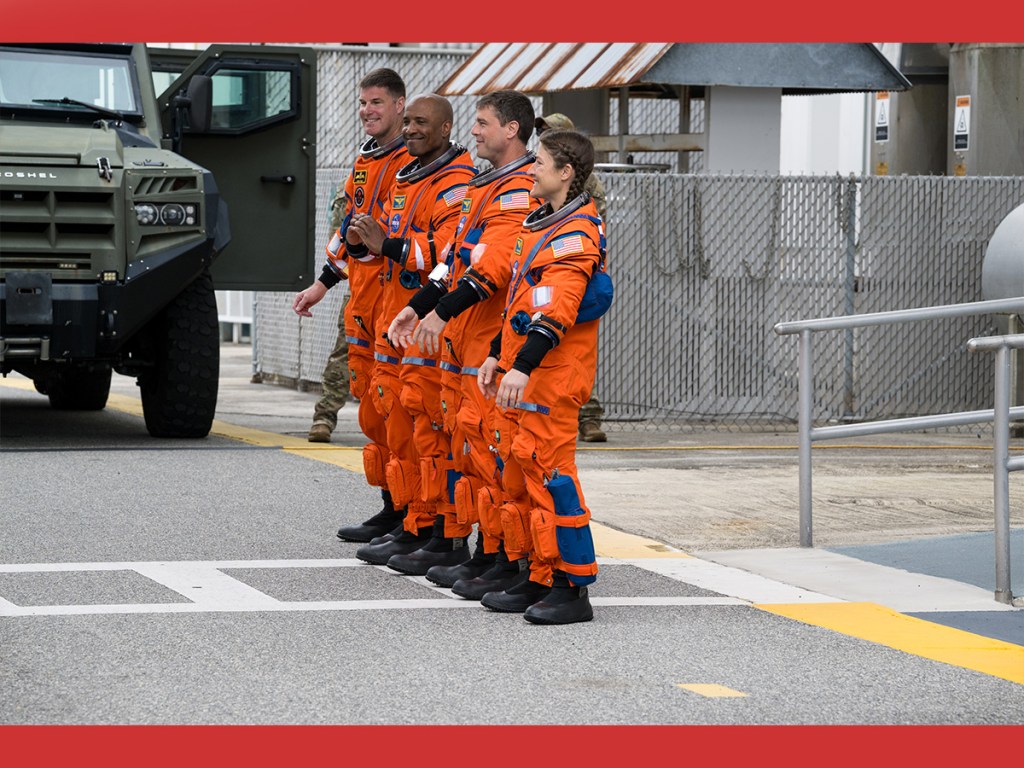
From right to left, NASA astronauts Christina Koch, mission specialist; Reid Wiseman, commander; Victor Glover, pilot; and CSA (Canadian Space Agency) astronaut Jeremy Hansen. Image Credit: NASA
10 days to bring our astronauts home
NASA’s 4 astronauts are only beginning the long journey that carries hope, wonder, and promise of future space discoveries. Mission specialist Christina Koch, commander Reid Wiseman, pilot Victor Glover, and fellow astronaut Jermey Hansen are already gathering information that can lead to eventual Moon landings and even a trip to Mars.
Weisman’s photo so beautifully captures the fragile yet powerful planet we live on. It’s a spectacular image that highlights so much of a planet most of us will see far too little of in our lifetimes. Mission specialist Koch expressed the effect of witnessing Earth from space, saying,
“… you see the Earth as it exists with the whole universe in the background. You see the thin blue line of the atmosphere, and then when you’re on the dark side of the Earth, you actually see this very thin green line that shows you where the atmosphere is. What you realize is every single person that you know is sustained and inside of that green line and everything else outside of it is completely inhospitable. You don’t see borders, you don’t see religious lines, you don’t see political boundaries. All you see is Earth and you see that we are way more alike than we are different.”