[youtube ratio=”0.5625″ position=”standard” ]

Wednesday night’s GOP presidential debate was full of high drama and–if we’re being honest here– relatively low impact. After a marathon three hour session designed to pit candidate against candidate, none of the participants could rightfully claim a decisive debate victory, much less establish themselves as an uncontested front runner for the Republican presidential nomination. Yes, Carly Fiorina had a very good night, and sure, Trump-mania may finally be showing signs of dying down, but when all is said and done, the Republican party still has a long way to go before their presidential aspirations come into sharp focus.


However, if absolutely forced to pick a single, stand-out star of Wednesday’s debate, why limit ourselves to the eleven candidates standing on the CNN stage? In fact, after careful consideration, it seems clear that the debate’s *true* winner wasn’t a candidate at all. Instead, it was the Boeing VC-137C (call sign: “SAM 27000”)–a customized version of the company’s commercial 707 airplane model–which stood behind the assembled debaters throughout the night, providing a sufficiently executive backdrop for the entirely of their time on camera.

Currently on display at the Ronald Reagan Library, where Wednesday’s debates were held, the plane, which flew multiple commanders-in-chief as their Air Force One (a designation which only applies when presidents are on-board), not only Left Shark-ed the whole evening, but ultimately came across as more presidential than nearly all the assembled candidates combined. Here, then, are five reasons why SAM 27000 definitively, absolutely, unquestionably won the second GOP primary debate:

It was the only debate attendee with an extensive track record of presidential experience: From 1973 to until its decommissioning in 2001, SAM 27000 operated as the mobile Oval Office for seven presidents, from Nixon to George W. Bush. With nearly thirty years in active presidential service, the plane has more Executive Branch experience at the Federal level than the entire GOP (as well as the Democratic) field.

It’s played an active role in crucial geopolitical events: As was mentioned many times over the course of the evening: Track records matter. And while each candidate on the debate stage has their own list of accomplishments about which they can brag, as well as must defend, nearly all pale in comparison to the global events in which SAM 27000 has played a crucial role. In an almost Zelig-like fashion, the plane can be found in proximity to any number of crucial historical moments: From shuttling former President carter to welcome home the 52 American hostages released from Iran, to carrying Ronald Reagan to and from his historic summits with Soviet leader Mikhail Gorbachev, during which he famously exclaimed “Mr. Gorbachev, tear down this wall!”

It’s entirely bipartisan: While most associated with President Ronald Reagan, for whom it flew over six hundred thousand miles, SAM 27000 served as Air Force One under both Republican and Democratic administrations. In an era in which political divisiveness seems to have reached a fever pitch, SAM 27000 has demonstrated an ability to reach across the aisle, do what needs to be done, and go where it needs to go, regardless of party affiliation. It’s the sort of optimistic, inclusive spirit which the other debate participants seemed to lack.

It looked great on Television: Yes, presidential elections are not beauty contests, but ever since the infamously telegenic JFK walloped a sallow and sickly looking Richard Nixon in the first-ever televised presidential debates, it’s been an inescapable fact of politics: Looking good on TV can only help a campaign. While Wednesday night’s debaters all looked prim, proper, and ready for primetime, it was the SAM 27000 which dazzled television viewers. With 40+ yards of polished metal, and traditional blue and white coloring, SAM 27000 not only dominated the debate arena, but was present in nearly every televised shot, ensuring it more screen time than all the other candidates, combined. And people definitely noticed:

It kept above the fray: Much of last night’s three hour (!) debate was spent watching candidates snipe back and forth over everything from smoking pot to whether or not vaccines cause autism (C’mon, seriously? No, they don’t.) Through it all, nearly ever participant had their turn to look petty, clueless, mean, or simply out of the league. SAM 27000, on the other hand, kept quiet, and stayed away from the oftentimes rancorous back-and-forths between candidates. “Sure,” you might say, “but airplanes can’t talk in general.” True, I like to think that even if they could, SAM 27000 would have chosen discretion as the better part of valor, letting actions and stature, rather than talking points, make its case.

Of course, no matter how accomplished or credentialed an airplane might be, it will never truly “win” a presidential debate. It is, after all, just an airplane. Still, in an election cycle where a medical doctor fails refute quack science suggesting a link between autism and vaccinations, or when a leading candidate suggests putting another country’s head of state on American currency, well…never say never.

  • ‘Star Trek’ and NASA have intertwined legacies – the show championed diversity and inspired generations of real space scientists
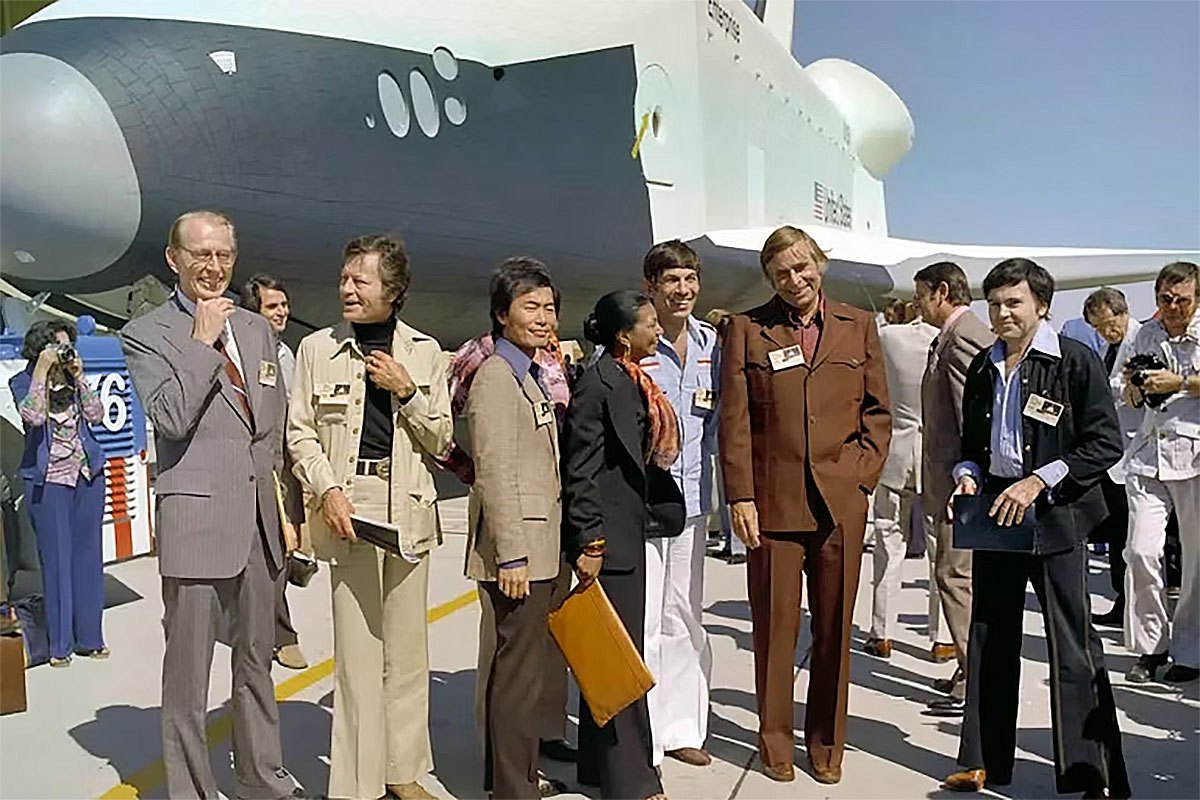
    Photo credit: NASAGene Roddenberry, second from right, and Star Trek cast members visit the Space Shuttle Enterprise in 1976 with NASA Administrator James C. Fletcher, left. NASA

    “Star Trek” began as a television series but grew into a cultural phenomenon.

    When it premiered in 1966, no one could have predicted that it would lead to more than a dozen spinoff shows, more than a dozen movies and one of the most enduring fandoms in popular culture.

    “Star Trek” is also unusual for its close connections to NASA, both in its storylines and in the real world. Decades of “Star Trek” adventures have ignited a love of spaceflight across generations, inspiring many who now work as space professionals.

    I’m a cultural anthropologist who studies why people work in space exploration. I’ve interviewed astronomers, engineers, flight surgeons and astronauts. Although I focus more on science fact than science fiction, I’ve noticed in my interviews how much the two threads intertwine.

    Because of this, I found myself at a “Star Trek” convention in early August 2026, just ahead of the show’s 60th anniversary on Sept. 8. The convention participants included people of widely different ages, appearances and identities. I was struck by just how much those gathered reflected the series’ values.

    When NASA met Star Trek

    In the original series, the show’s creator, Gene Roddenberry, came up with a philosophy held by the Vulcan people. He called it IDIC: infinite diversity in infinite combinations. It suggests that an ideal society is made up of many different types, all working together.

    It represented Roddenberry’s rejection of conformity. It also explained why the Enterprise crew included a Russian alongside Americans, and Black, Japanese and female characters all in positions of responsibility and authority. While many ordinary viewers absorbed “Star Trek’s” lessons of camaraderie and acceptance, those involved in real space exploration also took notice.

    A black-and-white photo of four characters wearing Starfleet uniforms, including two white men, an Asian man and a Black woman.
    The cast of ‘Star Trek: The Original Series’ included a diverse crew of characters. Walters Art Museum

    Roddenberry established relationships with NASA personnel in the early days of his series. NASA provided photographs of planetary bodies and advice about the realities of spaceflight, as well as stock footage and access to certain NASA facilities.

    Leonard Nimoy, who played the popular character Mr. Spock, was even brought to the National Space Club’s Goddard Memorial Dinner in 1967 as a special guest. Then-Vice President Hubert Humphrey gave the keynote speech. Afterward, though, it was Nimoy, not Humphrey, who found himself surrounded by the club’s members, including NASA employees, aerospace engineers, members of the military and government officials, all eager to meet the actor portraying the starship Enterprise’s first officer.

    The relationship between NASA and “Star Trek” benefited the show by legitimizing the series. It also helped NASA by publicizing its work and depicting a positive future where its efforts to land on the Moon would eventually lead to visits to distant worlds – and amazing scientific advances like the show’s transporter and warp drive.

    The connection between the space show and space agency was reflected in NASA’s decision to name its first space shuttle Enterprise, after some encouragement from the “Star Trek” fan community.

    Inspiring astronauts

    In 1977, actress Nichelle Nichols, who portrayed communications officer Uhura, was hired to recruit for NASA. The space agency had expanded its pool of astronauts to include scientists and other “mission specialists.” For the first time, an astronaut no longer needed to be a pilot to participate in a space mission.

    NASA selected its first Black astronaut candidates and its first female astronaut candidates in 1978. While this move toward inclusivity may not have been directly influenced by infinite diversity in infinite combinations, it was compatible with it. “Star Trek” inspired many of NASA’s future employees. In interviews for my book “The Ultraview Effect,” a quarter of the space professionals I spoke with mentioned “Star Trek” as an influence.

    A woman wearing a blue jumpsuit sitting in the pilot's chair in a space shuttle cockpit simulator
    Nichelle Nichols sits in the space shuttle simulator at the Johnson Space Center in March 1977. NASA

    An Apollo astronaut I interviewed, for instance, said he believed humans would eventually “be able to go anywhere in the universe, just like ‘Star Trek.’”

    A young engineer who had grown up in the 1990s told me his motivation came from the “opening line of ‘Star Trek’… to explore strange new worlds.”

    A space shuttle mission specialist emphasized Roddenberry’s decision to make the starship crew multicultural, explaining: “Today I look at the diversity of it … he was setting the stage back when it wasn’t acceptable [in order] to be acceptable!”

    A changing future

    That influence has accompanied a changing astronaut corps.

    Both the 2025 astronaut class, which for the first time included more women than men, and the crew of Artemis II, which sent the first woman, first Black astronaut and first Canadian on a lunar mission, resemble the future that “Star Trek” imagined.

    The “Star Trek” fans at the convention I attended were even more diverse. It was clear to me that Roddenberry’s “infinite diversity in infinite combinations” isn’t just a concept from the series, but something that has become a defining value of contemporary Trek fandom.

    A photo of space, with some bright spots representing nebulae, including a bright spot that looks like the disc-shaped hull of the starship Enterprise from Star Trek
    NASA’s Spitzer Space Telescope captured a region of the galaxy that looks a little like the USS Enterprise, which NASA highlighted in a news release in 2016. NASA/JPL-Caltech

    One such fan, Bjo Trimble, holds special status. She is credited with “saving ‘Star Trek’” when the series was almost canceled in 1968 after two seasons. Wearing a rainbow “IDIC” pin, she signed autographs at the SyFy Sistas booth, where T-shirts featuring Black “Star Trek” icons such as Uhura and Benjamin Sisko were on display.

    However, with the Trump administration’s recent orders to dismantle all of NASA’s diversity, equity, inclusion and accessibility programs and policies, institutional support for “Star Trek’s” vision of acceptance and inclusivity, which flourishes in its fan base, is being undone. This rollback occurred just as NASA’s crews were reaching new milestones in representing the diverse future that “Star Trek” has encouraged for decades.

    Sixty years later, some of the diverse future that “Star Trek” imagined has become part of everyday spaceflight. Other parts of that ideal remain unfinished.

    This article originally appeared on The Conversation. You can read it here.

  • Should paper checks be abolished like the penny?
    Photo credit: CSA Images/Getty ImagesWhile Americans are writing fewer checks, they haven’t abandoned this means of payment.
    ,

    Should paper checks be abolished like the penny?

    Billions are still written each year, even as digital payments take over.

    Germany is getting rid of paper checks at the end of 2027Australia is bidding them farewell by 2030. U.S. President Donald Trump followed up his order killing off the penny with an executive order stopping check writing by the federal government.

    Should the U.S. follow these other countries and broadly eliminate the ability to write checks?

    Years ago, experts predicted that checks would have disappeared by now. However, they are still around, and billions are written each year in the United States.

    Why? The quick answer is that businesses love them. And plenty of Americans still use checks for good reasons. But there is more to the story.

    I am a business school professor and one of the few academics who advocates for the use of cash. While I have long told everyone about the benefits of paper money, I didn’t give paper checks much thought or use them until my mother’s recent death. Then I found myself writing checks to the cemetery, funeral home, gravestone engraver and a host of other places. Plus, I started getting refund checks back from her landlord and insurance companies.

    These experiences made me look more deeply into this form of payment to understand what was happening.

    Fewer checks for bigger bucks

    Every three years the U.S. government runs the Federal Reserve Payments Study by asking banks and credit unions for internal information. This survey tracks everything from how often credit cards are used to the number of checks written.

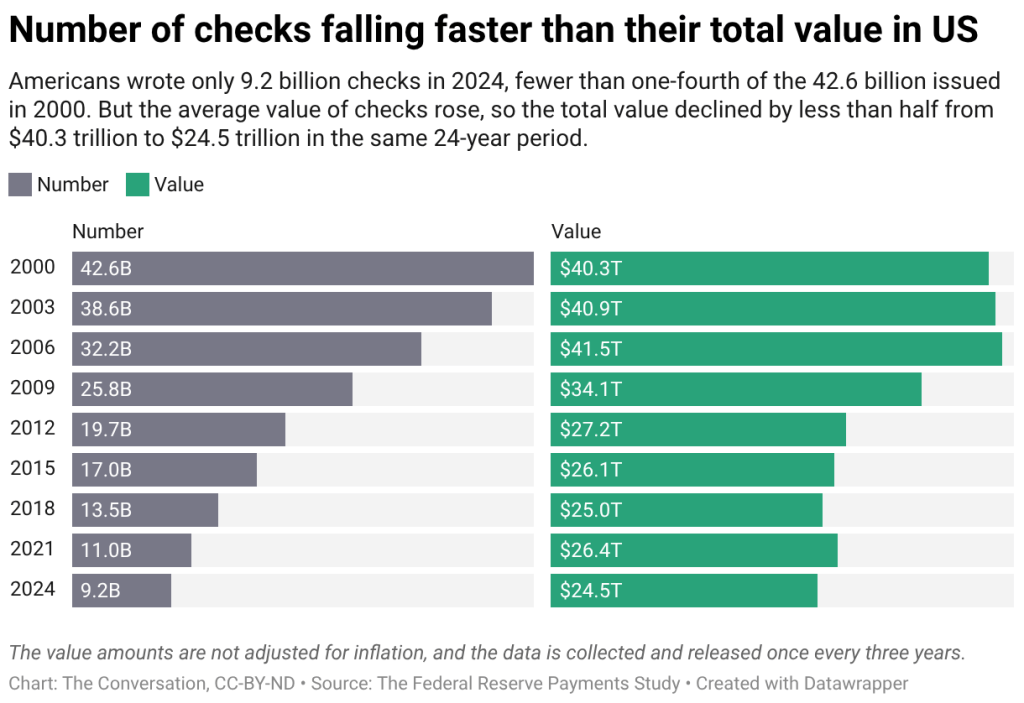
    While check usage has sharply declined in the U.S., a significant number – about 9.2 billion in 2024 – are still written, the data shows. The face value of those checks is probably bigger than you’d expect: more than US$24 trillion, not adjusted for inflation. That is almost as large as U.S. gross domestic product of $29 trillion that year.

    Not everyone can imagine numbers in billions or trillions, so let’s put those figures in more manageable terms.

    A little over 150 checks were written per person in 2000. By 2024, the average had plummeted to 27 checks – slightly more than two per month. However, over that time, the amounts typically scribbled or printed on the face of those checks rose.

    In 2000, the typical check was worth less than $1,000. By 2024, the average amount had more than doubled to $2,600.

    Trends elsewhere are similar. The Bank for International Settlements, which serves as a bank for central banks like the Federal Reserve, has tracked check usage in 25 countries since 2012. Its data shows that in only two other countries is payment by check still commonplace.

    And in both of those countries, check usage has fallen more sharply than in the United States.

    The value amounts are not adjusted for inflation, and the data is collected and released once every three years.

    Who uses checks today?

    While check payments have declined, there are still two big groups of check writers in the United States.

    The Federal Reserve Bank of Atlanta runs the Survey and Diary of Consumer Payment Choice. This survey asks people, rather than banks, for information on their payment habits. Roughly one-third of all respondents stated they used a paper check in the past 30 days.

    An older lady writes out checks to pay bills.
    Older Americans write more checks than younger people. Jupiterimages/The Image Bank via Getty Images

    Not surprisingly, the answers vary by age. About 60% of people 65 and over say they wrote a check. Among those 18 to 24, under 6% said they did.

    It also turns out that a lot of people who think they never write checks actually unknowingly do it all the time. If you pay your bills online, your bank tries to pay them electronically. If it cannot electronically make the payment, the bank cuts a paper check on your behalf. Any online bill payment taking more than a couple of business days to post is being sent by check.

    Another important factor is that small businesses love checks. Over 80% of businesses with sales between $1 and $10 million make payments using checks. Why? Small businesses often require two signatures on a check. The need for signatures means owners have to sign their name before any money goes out the door. This gives them control over money and a clear idea who is getting paid and how much.

    Small businesses also like receiving checks. I wrote a lot of checks after my mother’s death because many of those small businesses I dealt with wanted an extra 3% and sometimes more to cover the cost to them of a credit card payment. Writing paper checks saved me and the businesses a lot of money.

    The future

    While many Americans still write checks, their declining usage clearly underscores that they are not ideal for making payments in all situations.

    One of the biggest problems with checks is that you never know if the check writer has sufficient funds to cover the amount. When an account doesn’t have enough money, the check bounces. The Federal Reserve, which clears about one-third of all U.S. checks, returned about 22 million checks, with a total face value of around $80 billion. While these numbers are large, over 99% of all checks written don’t bounce.

    Another problem with checks is forgery. Thieves steal checks from mailboxes, alter information and then cash them. The most recent figures show about 500,000 annual cases of check fraud in the U.S. Again, while a half-million is large, it is a tiny fraction of the 9.2 billion checks written annually.

    Because of these problems, the Federal Reserve is contemplating leaving the check processing business. In early 2026, it accepted public comments on whether it should wind down, improve or leave alone its check processing unit.

    The unit, which costs about $100 million a year to run, turned a $6.6 million profit in 2024. But its machines need replacing, and the Federal Reserve is wavering on spending the money.

    Front and back of a U.S. half-cent coin.
    The U.S. government stopped minting its half-cent coin in 1857 due to its lack of usefulness. Mark Kostich/iStock via Getty Images Plus

    Should checks be killed off like the penny, which the federal government stopped minting in 2025, and the haypenny, which was worth half a cent and hasn’t been produced since 1857?

    For me, the answer is a clear no. While checks are clearly less important today than in the past, the numbers show that the American people and businesses still use and need checks.

    This article originally appeared on The Conversation. You can read it here.

  • New York passes SAFE for Kids Act to protect children from social media addiction
    Photo credit: CanvaNew York hopes to improve children's usage of social media.
    ,

    New York passes SAFE for Kids Act to protect children from social media addiction

    New York hopes to curb social media’s access to young kids.

    “Kids and their phones these days” has been a complaint ever since the first cellular phone was introduced. However, there has been growing concern over the amount of time children spend not just on their phone, but scrolling through social media. The state of New York is hoping to address this issue through their finalized SAFE for Kids Act.

    The Stop Addictive Feeds Exploitation (SAFE) for Kids Act aims to hold social media companies more accountable for the time children spend on their apps. It also seeks to limit kids’ exposure to their algorithms. Officials believe that constantly scrolling through social media feeds negatively impacts a child’s sleep and overall mental health.

    What are the restrictions?

    The new law requires social media companies to obey the following rules:

    • No addictive, algorithm-driven feeds for minors without explicit parental consent
    • No notifications about addictive feeds to minors between midnight and 6 a.m. without parental consent
    • No tricky website designs, called “dark patterns,” that manipulate or nag parents into giving consent
    • No degrading service, increasing prices, or retaliating against minors who don’t have parental consent for addictive feeds
    • Use certified age-assurance methods to distinguish minors from adults
    • Immediately encrypt data collected for age verification, use it only for age determination, and delete it immediately after use
    • Hire an accredited, independent third party to test and certify age-assurance methods every year

    Social media companies have until January 25, 2027 to comply. Failure to do so may result in a $5,000 fine per violation.

    New York Governor Kathy Holchul and Attorney General Letitia James made a public announcement to social media companies affected by this law, specifically Instagram, TikTok, YouTube, Facebook, Snapchat, and X.

    “What changes is the default,” said James. “Platforms cannot automatically place minors into feeds engineered to maximize engagement. This is not a question of privacy, this is a question about content. This is not about the First Amendment. Again, this is about protecting children.”

    “Social media companies, you’re now on notice,” said Holchul. 

    Critics and the issues that still need to be addressed

    There are some criticisms of this law, particularly around age-verification. The law offers the option of using government-issued identification along with another proof of identity (such as an email address or an uploaded photo of the user). This complicates things aside from First Amendment rights. It would require millions of adults to share private information to scroll and post on social media after hours. While the law states that the companies must encrypt and erase such information upon age verification, that’s not guaranteed. This is especially concerning as social media companies already deal with users’ private information being hacked and leaked.

    Governor Holchul still believes this criticism isn’t a governmental issue but a business one that social media companies need to resolve.

    “Social media companies tell me, ‘We have no way of knowing whether someone’s under 18 or not,’” Holchul claimed. “I said, ‘You’re smart people. Use [artificial intelligence] to figure it out. Ask how you do it.’ And you’re not supposed to allow underage gaming anyhow—sports betting—so you must have some metric. So don’t tell me you can’t do it. Figure it out.”

    How parents can help their children on social media

    Regardless of where people stand on this law, experts offer some advice for parents who feel social media is negatively affecting their children. They recommend setting personal screen time limits for their children and taking advantage of built-in parental controls on their platforms. Parents limiting their own social media use can also influence how kids use it, too.

    Psychologists also recommend talking with children about how and why they use social media. Specifically, discuss the fantasy that social media showcases from influencers versus the real lives of those people. Talk about why there was a social media post (advertisement, sharing joy, hoping for engagement, etc.) along with the content of it. Asking how they feel after watching or reading content in their feed helps as well. Such practices, along with limiting exposure, creates trust between child and parent without judgement.

    Though how we fix screen and social media addiction is still largely in the air, take comfort knowing brilliant minds are exploring methods to address the growing issue.

Explore More Stories

Money Culture

Millions of Illinois residents wake up to find that $2.6 billion of their medical debt has been eliminated

Local

Arizona firefighter donates her kidney to a fellow firefighter—her husband

World

After 40 years in a Portuguese circus, elephant retires to become the first resident of a new sanctuary

Public Good

Oakland officials open ‘play-lending library’ to offset the cost of equipment for youth sports