Justice Ruth Bader Ginsburg died on Friday, the Supreme Court announced.

Chief Justice John Roberts announced in a statement that “Our nation has lost a jurist of historic stature.”

Even before her appointment, she had reshaped American law. When he nominated Ginsburg to the Supreme Court, President Bill Clinton compared her legal work on behalf of women to the epochal work of Thurgood Marshall on behalf of African-Americans.

The comparison was entirely appropriate: As Marshall oversaw the legal strategy that culminated in Brown v. Board of Education, the 1954 case that outlawed segregated schools, Ginsburg coordinated a similar effort against sex discrimination.

Decades before she joined the court, Ginsburg’s work as an attorney in the 1970s fundamentally changed the Supreme Court’s approach to women’s rights, and the modern skepticism about sex-based policies stems in no small way from her lawyering. Ginsburg’s work helped to change the way we all think about women – and men, for that matter.

I’m a legal scholar who studies social reform movements and I served as a law clerk to Ginsburg when she was an appeals court judge. In my opinion – as remarkable as Marshall’s work on behalf of African-Americans was – in some ways Ginsburg faced more daunting prospects when she started.

Starting at zero

When Marshall began challenging segregation in the 1930s, the Supreme Court had rejected some forms of racial discrimination even though it had upheld segregation.

When Ginsburg started her work in the 1960s, the Supreme Court had never invalidated any type of sex-based rule. Worse, it had rejected every challenge to laws that treated women worse than men.

For instance, in 1873, the court allowed Illinois authorities to ban Myra Bradwell from becoming a lawyer because she was a woman. Justice Joseph P. Bradley, widely viewed as a progressive, wrote that women were too fragile to be lawyers: “The paramount destiny and mission of woman are to fulfil the noble and benign offices of wife and mother. This is the law of the Creator.”

And in 1908, the court upheld an Oregon law that limited the number of hours that women – but not men – could work. The opinion relied heavily on a famous brief submitted by Louis Brandeis to support the notion that women needed protection to avoid harming their reproductive function.

As late as 1961, the court upheld a Florida law that for all practical purposes kept women from serving on juries because they were “the center of the home and family life” and therefore need not incur the burden of jury service.

Challenging paternalistic notions

Ginsburg followed Marshall’s approach to promote women’s rights – despite some important differences between segregation and gender discrimination.

Segregation rested on the racist notion that blacks were less than fully human and deserved to be treated like animals. Gender discrimination reflected paternalistic notions of female frailty. Those notions placed women on a pedestal – but also denied them opportunities.

Either way, though, blacks and women got the short end of the stick.

Ginsburg started with a seemingly inconsequential case. Reed v. Reed challenged an Idaho law requiring probate courts to appoint men to administer estates, even if there were a qualified woman who could perform that task.

Sally and Cecil Reed, the long-divorced parents of a teenage son who committed suicide while in his father’s custody, both applied to administer the boy’s tiny estate.

The probate judge appointed the father as required by state law. Sally Reed appealed the case all the way to the Supreme Court.

Ginsburg did not argue the case, but wrote the brief that persuaded a unanimous court in 1971 to invalidate the state’s preference for males. As the court’s decision stated, that preference was “the very kind of arbitrary legislative choice forbidden by the Equal Protection Clause of the 14th Amendment.”

Two years later, Ginsburg won in her first appearance before the Supreme Court. She appeared on behalf of Air Force Lt. Sharron Frontiero. Frontiero was required by federal law to prove that her husband, Joseph, was dependent on her for at least half his economic support in order to qualify for housing, medical and dental benefits.

If Joseph Frontiero had been the soldier, the couple would have automatically qualified for those benefits. Ginsburg argued that sex-based classifications such as the one Sharron Frontiero challenged should be treated the same as the now-discredited race-based policies.

By an 8–1 vote, the court in Frontiero v. Richardson agreed that this sex-based rule was unconstitutional. But the justices could not agree on the legal test to use for evaluating the constitutionality of sex-based policies.
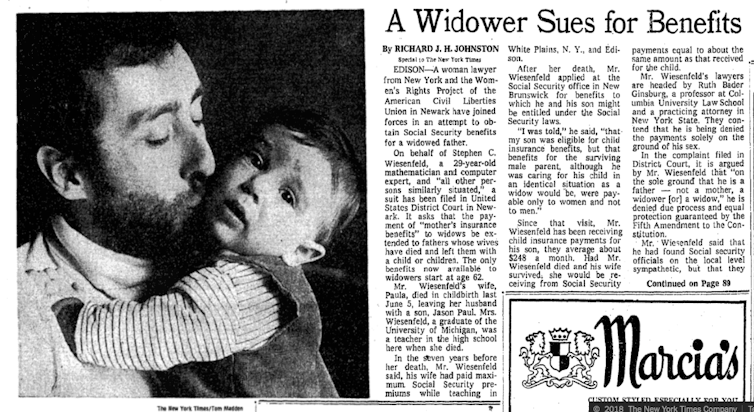
New York Times article about the Wiesenfeld case, which refers to Ginsburg as ‘a woman lawyer.’ New York Times

Strategy: Represent men

In 1974, Ginsburg suffered her only loss in the Supreme Court, in a case that she entered at the last minute.

Mel Kahn, a Florida widower, asked for the property tax exemption that state law allowed only to widows. The Florida courts ruled against him.

Ginsburg, working with the national ACLU, stepped in after the local affiliate brought the case to the Supreme Court. But a closely divided court upheld the exemption as compensation for women who had suffered economic discrimination over the years.

Despite the unfavorable result, the Kahn case showed an important aspect of Ginsburg’s approach: her willingness to work on behalf of men challenging gender discrimination. She reasoned that rigid attitudes about sex roles could harm everyone and that the all-male Supreme Court might more easily get the point in cases involving male plaintiffs.

She turned out to be correct, just not in the Kahn case.

Ginsburg represented widower Stephen Wiesenfeld in challenging a Social Security Act provision that provided parental benefits only to widows with minor children.

Wiesenfeld’s wife had died in childbirth, so he was denied benefits even though he faced all of the challenges of single parenthood that a mother would have faced. The Supreme Court gave Wiesenfeld and Ginsburg a win in 1975, unanimously ruling that sex-based distinction unconstitutional.

And two years later, Ginsburg successfully represented Leon Goldfarb in his challenge to another sex-based provision of the Social Security Act: Widows automatically received survivor’s benefits on the death of their husbands. But widowers could receive such benefits only if the men could prove that they were financially dependent on their wives’ earnings.

Ginsburg also wrote an influential brief in Craig v. Boren, the 1976 case that established the current standard for evaluating the constitutionality of sex-based laws.
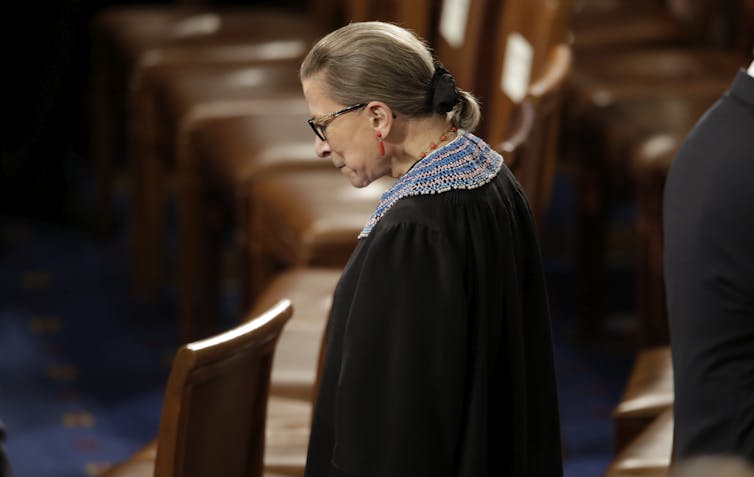
Ginsburg at the 2015 State of the Union address. Reuters/Joshua Roberts

Like Wiesenfeld and Goldfarb, the challengers in the Craig case were men. Their claim seemed trivial: They objected to an Oklahoma law that allowed women to buy low-alcohol beer at age 18 but required men to be 21 to buy the same product.

But this deceptively simple case illustrated the vices of sex stereotypes: Aggressive men (and boys) drink and drive, women (and girls) are demure passengers. And those stereotypes affected everyone’s behavior, including the enforcement decisions of police officers.

Under the standard delineated by the justices in the Boren case, such a law can be justified only if it is substantially related to an important governmental interest.

Among the few laws that satisfied this test was a California law that punished sex with an underage female but not with an underage male as a way to reduce the risk of teen pregnancy.

These are only some of the Supreme Court cases in which Ginsburg played a prominent part as a lawyer. She handled many lower-court cases as well. She had plenty of help along the way, but everyone recognized her as the key strategist.

In the century before Ginsburg won the Reed case, the Supreme Court never met a gender classification that it didn’t like. Since then, sex-based policies usually have been struck down.

I believe President Clinton was absolutely right in comparing Ruth Bader Ginsburg’s efforts to those of Thurgood Marshall, and in appointing her to the Supreme Court.

This article originally appeared on The Conversation. You can read it here.

  • Overpackers love this simple ‘5-4-3-2-1’ packing rule that makes travel way easier
    An obvious overpack for travel.Photo credit: Canva
    ,

    Overpackers love this simple ‘5-4-3-2-1’ packing rule that makes travel way easier

    When it comes to travel, packing efficiently is a skill acquired through experience. Lifestyle and content creator Alison Lumbatis shares a helpful 5-4-3-2-1 method designed to take the stress out of packing for both seasoned travelers and first-timers. Trying to pack light while still remembering everything you need can feel a little daunting. A simple…

    When it comes to travel, packing efficiently is a skill acquired through experience. Lifestyle and content creator Alison Lumbatis shares a helpful 5-4-3-2-1 method designed to take the stress out of packing for both seasoned travelers and first-timers.

    Trying to pack light while still remembering everything you need can feel a little daunting. A simple trick is knowing exactly what’s necessary, making your bag lighter and more practical.

    @alisonlumbatis

    Calling all overpackers—this one’s for you! ✈️🧳 The 5-4-3-2-1 packing method is one of my favorites because it’s totally customizable. Prefer dresses? Swap a top and bottom for a dress. Love skirts? Sub them in for pants! These pieces should last you 1-2 weeks, depending on your access to laundry. 🔗’s to everything in bio! #outfitformulas #packinglight #styleconfidence #wardrobemadeeasy #travelcapsule #dailyoutfits #closetconfidence #vacationstyle #fashionover40 #smartstyle

    ♬ original sound – Alison Lumbatis

    Putting The ‘5-4-3-2-1 Packing Method’ Into Action

    In her trending TikTok post, Lumbatis shares a packing system she claims to be “as easy as it sounds.” Here are the basics of the 5-4-3-2-1 packing method:

    • 5 TOPS
    • 4 BOTTOMS
    • 3 SHOES
    • 2 LAYERS
    • 1 MISCELLANEOUS

    Lumbatis explains, “So all you got to do is pick out 5 tops, 4 coordinating bottoms, 3 pairs of shoes, 2 layering pieces, and 1 of anything else. Like a dress, pajamas, a hat, a belt, or any other accessories that you might need. And then of course pack as many undergarments and toiletries as you need.”

    The strategy isn’t just about simplifying and maximizing the number of items you bring on a trip. It’s also about function. “The key is to pick versatile pieces that can mix and match so you can pair them up for whatever activities you have planned for your trip.”

    minimalism, versatile pieces, functionality, packing
    Packing the necessary items
    Photo credit Canva

    Taking Pictures Can Help Plan Ahead

    Another helpful step is taking photos of your outfits to remember how everything fits together. Lumbatis offers, “You can even take pictures of the outfits with you wearing them or flat lays of the pieces and keep them on your phone or in your Notes App — So you can refer back to it on your trip.”

    Is the 5-4-3-2-1 packing method effective? These were some of the thoughts in the comments from readers hopeful to put the plan into action:

    “Great tip for me. Hate packing and never wear all the clothes I bring.”

    “Heading to Japan and I was just going to my closet to put it together. I overpack so this is sooo helpful.”

    “I’m dreading how to not over pack for such a variety of occasions, heat, and limited washing facilities. Ugh.”

    “I struggle with under packing so this is super helpful!”

    travel, adventure, alleviate stress, preparation
    Soaking up the adventure.
    Photo credit Canva

    The Science Behind Good Preparation

    Traveling is a great way to alleviate the stress and burdens of our daily lives. A 2025 study in Springer Nature Link showed travel helped people improve their long-term resilience by creating positive emotions while ecouraging self reflection. National Geographic found the benefits of travel begin even before the trip begins.

    However, preparation can have a powerful effect on the simple stresses a person might acquire during traveling. A 2025 study revealed that planning reduced anxiety and helped people prepare for delays or unexpected changes. Research in 2025 reported by AP News found that even making a simple checklist reduced anxiety and helped make for smoother trips.

    Lumbatis claims, “If you struggle with overpacking and want to create a great capsule wardrobe packing list, you’ve got to try this method.”

    People hope that traveling will relieve stress more than generate it. The 5-4-3-2-1 packing method offers a clear and simple way to pack just what you need. Careful preparation helps prevent last-minute chaos and produces a more enjoyable trip. Hopefully, this method can help you spend less time worrying and more time soaking in the adventure.

    Watch this YouTube video on incredible vacation destinations to inspire your next trip:

  • Video of 3rd grade classroom’s poetic stuffed animals display is bringing people to tears
    A cute pile of stuffed animals.Photo credit: Canva
    ,

    Video of 3rd grade classroom’s poetic stuffed animals display is bringing people to tears

    When 3rd-grade teacher Kelsie Lynn posted a video of her classroom during recess, these stuffed animals on display brought people near tears. The video struck a powerful chord of nostalgia, landing thousands of plays. In her post, she shares that the magic of childhood can come alive through stuffed animals in a classroom. This call…

    When 3rd-grade teacher Kelsie Lynn posted a video of her classroom during recess, these stuffed animals on display brought people near tears. The video struck a powerful chord of nostalgia, landing thousands of plays.

    In her post, she shares that the magic of childhood can come alive through stuffed animals in a classroom. This call to happy memories inspired heartwarming reactions and a powerful sense of connection among viewers.

    A Room Of ‘Stuffies’

    After Kelsie Lynn gave the children an opportunity to vote for a class reward, they chose to bring their ‘stuffies,’ stuffed animals. As the TikTok video moves through the classroom, the stuffies sit respectfully in chairs awaiting students to return from recess.

    In an interview with People, Lynn explained, “They all chose to put their stuffies in their seats up to their desk as if they were working. It was so cute and innocent and just really reminded me how little third graders still are.”

    Lynn used the viral post to highlight the importance of childhood. She describes the special role treasured toys and a safe, inviting classroom can play. “These moments are not just about fun; they are essential in nurturing emotional connections and fostering a sense of community within the classroom. By allowing students to express themselves through their cherished toys, teachers create a welcoming environment where children feel valued and heard.”

    empathy, social connection, grandma, prosocial behavior
    Heartwarming, nostalgic moment for grandma.
    Photo credit Canva

    Classroom Video Stirs Nostalgic Emotions

    The simple classroom video of stuffed animals struck a surprisingly emotional chord. These are some of the thoughts from the comments:

    “Awww each one is waiting patiently for their person to come back. Love how some of them look a little love worn.”

    “I could cry this is so wholesome”

    “As a father this hits hard beyond words take a look at that room the innocence of every child telling us a little story about each and every one of them.”

    “This is the sweetest thing I’ve seen all month!”

    “i wish i was allowed to do this. my mom use to say she had to pry stitch out my hands till i was 4.”

    “Me at 31 watching this with my stuffy”

    “All 3 of my daughters are in elementary school and I can confirm each one of those stuffies means the world to each of them. Sometimes I have to stop and remind myself they’re still so little”

    children, happy moments, inspired, community
    Mom watches a child chew happily on a toy.
    Photo credit Canva

    The Science Behind Nostalgia

    Nostalgia is the warm feeling you get when remembering happy moments from the past. It can change how people treat others and invoke more empathy. A 2022 study in the National Library of Medicine found that nostalgia helps people feel more hopeful and inspired while adding meaning to their lives.

    Science suggests that people usually remember emotional moments more strongly than ordinary ones. A 2025 journal in Nature reports that these intense emotions allow the brain to connect different systems together, making memories easier to remember.

    love, emotional connection, friendship, cute content

    Social Media Loves A Happy Memory

    When people feel moved or touched by a post, it creates warm emotional reactions. Those feelings help explain why cute content becomes so popular on social media. A 2023 study in Frontiers created new ways to measure what makes content cute. They found posts that feel “kama muta,” moved by love, create the strongest reaction, increasing connection and virality.

    Seeing a classroom of stuffed animals during recess reminds viewers of simpler moments when beloved toys felt like a best friend. That glimpse of nostalgia mixed with the sweetness of 3rd graders creates an emotional connection people can’t help but share. The video resonates so strongly because it taps into something we recognize immediately: comfort and love.

    Here’s a fun video looking back at some nostalgic childhood moments:

  • A woman complained to her upstairs neighbor about  a strange noise in the middle of the night. His wholesome response was perfect.
    A woman reads a note from her neighborPhoto credit: Canva

    She had never actually met the man who lived above her. She knew him only as the source of the noise coming through her ceiling at 12:30 in the morning, the night after Super Bowl LIX. She pulled herself out of bed, went upstairs, and asked him through his Ring camera to please turn it down. He was polite. She went back to sleep.

    The next morning, there was a bottle of wine outside her door.

    The woman, who goes by u/operarose on Reddit, posted the photo to r/MadeMeSmile , and it pulled in 84,000 upvotes, as Newsweek reported. The caption was simple: “Had to get out of bed and go ask the upstairs neighbor (whom I’ve never actually met) to turn it down at about 12:30 am this morning. Found this outside my door when I woke up.”

    Attached to the bottle was a handwritten note. “I got too carried away watching recaps from the Superbowl and I didn’t realize how loud my TV was,” it read. “I’m so sorry for not being considerate with the volume. In positive news, the cookies you made for Christmas were amazing. Please allow me to return the favor.”

    That last part is what made the story. He already knew who she was. She’d baked Christmas cookies and apparently given some to neighbors she’d never formally met. He’d received them, remembered, and now here he was, months later, referencing them in an apology note attached to a bottle of wine.

    neighbors, kindness, apology, community, apartment living
    Plate of holiday cookies. Image source: Canva

    She reported back in the comments that the wine was good. “Never had this brand before, but I definitely recommend it,” she wrote.

    Etiquette expert Jo Hayes told Newsweek the neighbor had essentially done everything right. “A clear, sincere apology is necessary, and he did exactly this. Plus a kind word about the Christmas cookies. Plus a gift, as a token gesture of said apology, is the icing on the cake. This would have flooded the downstairs neighbor with warm fuzzies.”

    The comments filled with people who seemed almost relieved. “It’s insane just how hard it is to find people who can just be considerate and move on,” one user wrote. “Congratulations to both of you for spontaneously demonstrating how to be an adult,” said another. “This is how you neighbor,” someone summed up simply.

    The whole exchange took about two minutes of awkwardness and produced something neither of them had before the night started: a neighbor they actually know.

    This article originally appeared earlier this year.

Explore More Culture Stories

Culture

A woman complained to her upstairs neighbor about a strange noise in the middle of the night. His wholesome response was perfect.

Culture

He threw a message in a bottle into the ocean as a teen. It washed up 49 years later with a response.

Culture

Restaurant owner turns a fake 1-star tamale review into a social media frenzy

Well-being

These seven simple phrases could be the secret to deepening trust and romance in your relationship