Here Comes the (Chinese) Sun: How Chinese innovation is going to revolutionize solar power for the rest of the world

Residents of the city of Rizhao claim to be the first Chinese to greet the sun each day as it rises from the Yellow Sea. In fact, the city’s name is a condensed form of the Chinese phrase ri qu shien zhao, which literally means “first to get sunshine.” They also make some of the best use of the more than 100 kilowatt-hours of power the sun pours down on each square meter of Earth over the course of a sunny day.Though Rizhao’s 3 million residents are seemingly overshadowed by nearby Qingdao-a larger city famous worldwide for its eponymous beer (you might know it as Tsingtao)-Rizhao boasts perhaps a bigger distinction: It is the first city in all of China to pledge to become carbon-neutral.That China has surpassed the United States to become the leading emitter of greenhouse gases is no secret. The Chinese curse on the climate will have to be reckoned with, but the Chinese also have a gift to give the world: developing cheap renewable energy sources, particularly solar power. Low-cost manufacturing in China is transforming the entire array of clean energy sources, like previously expensive photovoltaic cells-and, in the process, helping to clean up the world’s energy supply.Witness Rizhao. Rooftops in newly constructed apartment blocks as well as on the houses in the surrounding countryside are often covered in angled panels of dark tubing. The tubes soak up sunlight, using its warmth to heat water within and eliminate the need to burn fossil fuel or suck up electricity for that purpose. Such solar hot-water heaters are mandatory, and are responsible (along with all the city’s other solar efforts) for cutting energy use compared to alternatives by 348 million kilowatt-hours per year-cutting greenhouse gases at the same time. That’s enough electricity to power more than 30,000 U.S. homes for a year.Indeed, China has become the world’s largest market for and producer of such solar hot-water devices, which have become cheaper than traditional electric or gas-fired varieties thanks to this growing demand. Companies like Himin Solar Energy Group churn out solar hot-water heaters from factories big enough to build jumbo jets; China as a whole installed 246 million square feet of solar hot-water-heater panels in 2007.And it’s not just hot water that Rizhao gets from the sun, as evidenced by the gleaming arrays of blue-black photovoltaic cells beneath the lampposts lining the seashore of this resort town.Rizhao has company in its use of the sun. In Jiangsu Province outside Shanghai lies China’s “Solar Valley,” which took its name from our own Silicon Valley, and which focuses on the same element. After all, silicon, a semiconductor, is an important component of both computer chips and solar cells.Suntech, a photovoltaic company with the world’s largest production capacity and JA Solar both have facilities in Jiangsu; globally, Suntech can churn out enough panels in a year to produce-under ideal conditions-1 gigawatt of energy.


Suntech alone has given China-and the world-its first solar billionaire: Shi Zhengrong, who has built the company into a solar powerhouse since its founding, in 2001. And unlike competitors such as Q-Cells, from Germany; Sharp, from Japan; and the U.S.-based SunPower; among others, Suntech has opted not to automate its production processes.”We’ve chosen to rely on labor for the obvious reason of cost: Labor rates are so much lower [in China],” says Steve Chadima, the U.S. spokesman for Suntech. “We can more easily crank up or down our operations depending on market demand.”And it’s not just workers that come cheap in China: “Glass, aluminum-all those materials are less expensive in China than they are in the U.S. or Europe,” Chadima notes. “All the way around there’s low cost.”That has led many foreign manufacturers to open operations in China or elsewhere in Asia. Evergreen Solar, for example, a Massachusetts-based company, recently opened a Chinese factory, while panel producer First Solar has built several factories capable of cranking out more than 500 megawatts’ worth of solar cells in Malaysia.And that means, ultimately, cheap solar power. “It’s very possible to get down to something in the range of one dollar per watt to manufacture a silicon solar panel,” Chadima says, though U.S. panel prices in July were more than $4.50 per watt.But, as an example, Chadima points to the 30-megawatt system that the power company Austin Energy is building with Suntech PV modules in Texas. Austin Energy expects to charge just 17 cents per kilowatt-hour of electricity. That’s not much more than the roughly 13 cents per kilowatt-hour residential customers paid on average for electricity this past May in that state.“In the case of solar, China has an advantage in its manufacturing capacity,” says Li Junfeng, the secretary general of the Chinese Renewable Energy Industry Association. “It can produce large quantities of products at a relatively low cost.”Cheap, in this case, does not mean poor quality. Suntech, for example, is considered one of the top five solar-cell producers in the world in terms of quality and has been used in projects from Germany to the United States.

“Within three to four years, we’ll be talking about the pure economic benefit of photovoltaics.”

Like its international competitors, Suntech offers a range of products, including advanced solar cells; its highly efficient, more expensive Pluto module can turn as much as 19 percent of the sunlight that falls on it into electricity. “In this case, you’ve got essentially a company known as a low-cost leader but, at the same time, introducing some of the highest technology in the world,” notes Bates Marshall of Sixtron, a Canadian company that peddles solar-cell-manufacture technology.Across the market, however, quality can still be a concern. While some of the finest solar cells in the world come from China, there are a host of smaller companies producing even cheaper, lower-quality cells. “There are three to five name-brand module companies and maybe 160 total module manufacturers,” Marshall adds. There are “a lot of no-name panels coming out of China that have some dubious quality.”Regardless, as soon as 2011, Marshall predicts, modules could cost as little as $1.40 apiece, which will put them in the same price range as other energy sources. “Within three to four years, we’ll be talking about the pure economic benefit of photovoltaics,” Marshall says.And that’s just in the United States. “All the solar photovoltaics are for export with a very small share for domestic use,” CREIA’s Li notes of Chinese-made solar panels. But “Chinese companies are being optimistic about the future because the government has set all these targets for carbon-emission reduction.”Rizhao, for its part, has a host of clean competitors-and that’s a good thing. Dezhou City, also in Shandong Province, boasts Himin’s 200,000-square-foot factory for making solar hot-water heaters as well as other solar-power manufactures. Baoding, a city in Hebei Province, offers solar, wind, and other renewable energy manufacturing. And Wuxi, in Jiangsu, is home to Suntech, among others. The Chinese government, for its part, aims to install 1.8 gigawatts of solar power nationwide by 2020-but expects to more than quadruple that goal on current progress.Rizhao is one of just four cities worldwide to even attempt so-called carbon neutrality (the others being Arendal, Norway; Vancouver, Canada; and Växjö, Sweden), according to the United Nations Environment Programme.To reach its goal, Rizhao will have to employ an arsenal of environmental improvements, from a so-called circular economy, in which industrial waste gets cycled back as energy, to harvesting the power offered for free by the city’s 260 days of yearly sunshine.As a result of these efforts, Rizhao, unlike the rest of China, is using nearly a third less energy while cutting its carbon dioxide emissions by 50 percent.Solar, it seems, is rising in the east.Top photo by Derek Brown, lower photo by Rhett A. Butler

  • Overpackers love this simple ‘5-4-3-2-1’ packing rule that makes travel way easier
    An obvious overpack for travel.Photo credit: Canva
    ,

    Overpackers love this simple ‘5-4-3-2-1’ packing rule that makes travel way easier

    When it comes to travel, packing efficiently is a skill acquired through experience. Lifestyle and content creator Alison Lumbatis shares a helpful 5-4-3-2-1 method designed to take the stress out of packing for both seasoned travelers and first-timers. Trying to pack light while still remembering everything you need can feel a little daunting. A simple…

    When it comes to travel, packing efficiently is a skill acquired through experience. Lifestyle and content creator Alison Lumbatis shares a helpful 5-4-3-2-1 method designed to take the stress out of packing for both seasoned travelers and first-timers.

    Trying to pack light while still remembering everything you need can feel a little daunting. A simple trick is knowing exactly what’s necessary, making your bag lighter and more practical.

    @alisonlumbatis

    Calling all overpackers—this one’s for you! ✈️🧳 The 5-4-3-2-1 packing method is one of my favorites because it’s totally customizable. Prefer dresses? Swap a top and bottom for a dress. Love skirts? Sub them in for pants! These pieces should last you 1-2 weeks, depending on your access to laundry. 🔗’s to everything in bio! #outfitformulas #packinglight #styleconfidence #wardrobemadeeasy #travelcapsule #dailyoutfits #closetconfidence #vacationstyle #fashionover40 #smartstyle

    ♬ original sound – Alison Lumbatis

    Putting The ‘5-4-3-2-1 Packing Method’ Into Action

    In her trending TikTok post, Lumbatis shares a packing system she claims to be “as easy as it sounds.” Here are the basics of the 5-4-3-2-1 packing method:

    • 5 TOPS
    • 4 BOTTOMS
    • 3 SHOES
    • 2 LAYERS
    • 1 MISCELLANEOUS

    Lumbatis explains, “So all you got to do is pick out 5 tops, 4 coordinating bottoms, 3 pairs of shoes, 2 layering pieces, and 1 of anything else. Like a dress, pajamas, a hat, a belt, or any other accessories that you might need. And then of course pack as many undergarments and toiletries as you need.”

    The strategy isn’t just about simplifying and maximizing the number of items you bring on a trip. It’s also about function. “The key is to pick versatile pieces that can mix and match so you can pair them up for whatever activities you have planned for your trip.”

    minimalism, versatile pieces, functionality, packing
    Packing the necessary items
    Photo credit Canva

    Taking Pictures Can Help Plan Ahead

    Another helpful step is taking photos of your outfits to remember how everything fits together. Lumbatis offers, “You can even take pictures of the outfits with you wearing them or flat lays of the pieces and keep them on your phone or in your Notes App — So you can refer back to it on your trip.”

    Is the 5-4-3-2-1 packing method effective? These were some of the thoughts in the comments from readers hopeful to put the plan into action:

    “Great tip for me. Hate packing and never wear all the clothes I bring.”

    “Heading to Japan and I was just going to my closet to put it together. I overpack so this is sooo helpful.”

    “I’m dreading how to not over pack for such a variety of occasions, heat, and limited washing facilities. Ugh.”

    “I struggle with under packing so this is super helpful!”

    travel, adventure, alleviate stress, preparation
    Soaking up the adventure.
    Photo credit Canva

    The Science Behind Good Preparation

    Traveling is a great way to alleviate the stress and burdens of our daily lives. A 2025 study in Springer Nature Link showed travel helped people improve their long-term resilience by creating positive emotions while ecouraging self reflection. National Geographic found the benefits of travel begin even before the trip begins.

    However, preparation can have a powerful effect on the simple stresses a person might acquire during traveling. A 2025 study revealed that planning reduced anxiety and helped people prepare for delays or unexpected changes. Research in 2025 reported by AP News found that even making a simple checklist reduced anxiety and helped make for smoother trips.

    Lumbatis claims, “If you struggle with overpacking and want to create a great capsule wardrobe packing list, you’ve got to try this method.”

    People hope that traveling will relieve stress more than generate it. The 5-4-3-2-1 packing method offers a clear and simple way to pack just what you need. Careful preparation helps prevent last-minute chaos and produces a more enjoyable trip. Hopefully, this method can help you spend less time worrying and more time soaking in the adventure.

    Watch this YouTube video on incredible vacation destinations to inspire your next trip:

  • People are cheering woman’s refusal to accept the latest trend in hotel bathrooms
    Sadie has declared war on non-private hotel bathrooms.Photo credit: @bring_back_doors

    People are cheering woman’s refusal to accept the latest trend in hotel bathrooms

    “I HATE how hotels started thinking going to the bathroom is a shared experience.”

    It can be frustrating seeing change for change’s sake in the world. To be more specific, changes that are said to be done in the name of innovation and design, but are in truth ways for companies to save a buck.

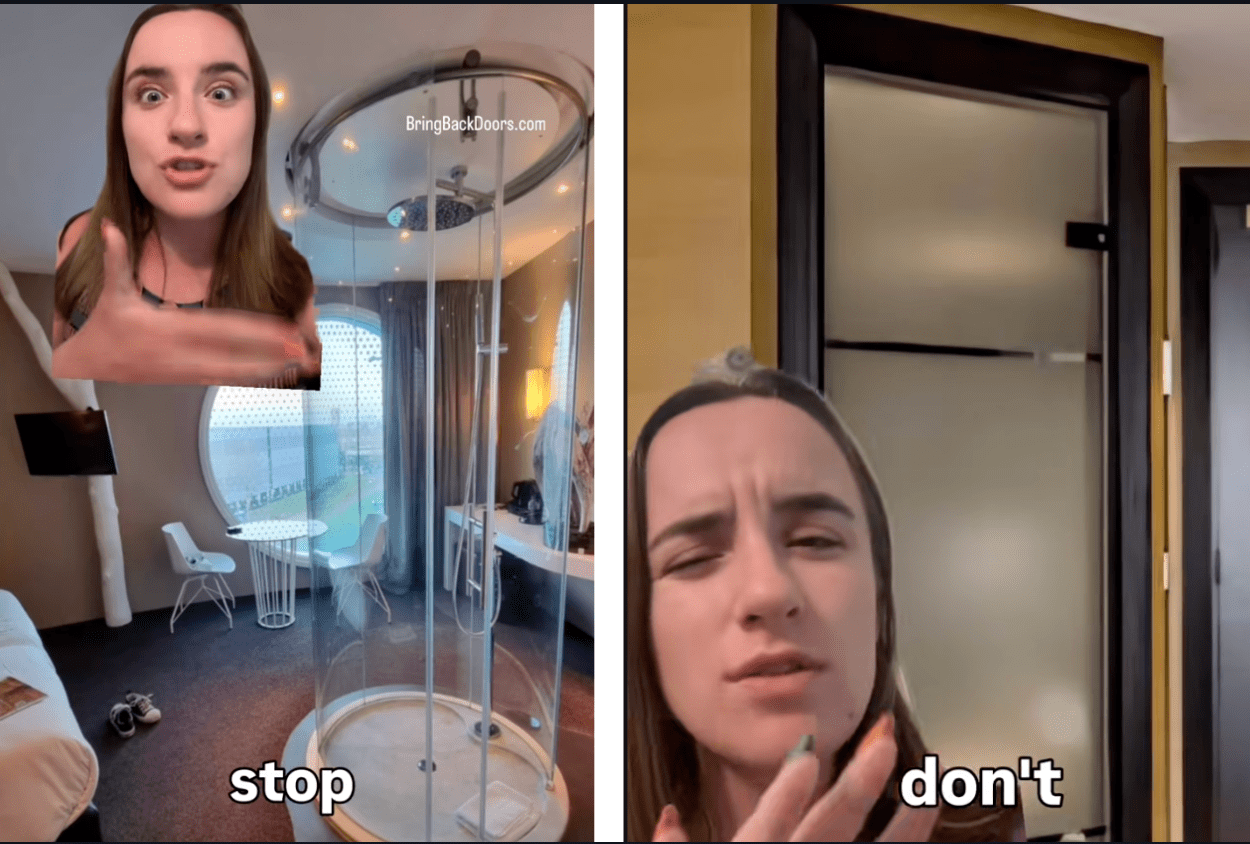
    One example that is getting attention is the bathroom doors in hotels… or the lack thereof, actually. One TikToker has had enough and has taken it upon herself to save regular bathroom doors in hotels and to point out why open-space bathrooms and glass doors just don’t cut it.

    On her @bring_back_doors TikTok account, Sadie has a collection of videos highlighting the flaws in hotel bathroom designs, with the most prominent being the lack of a regular door to the bathroom. In one viral TikTok, Sadie discussed a hotel that reached out to her, explaining that they have “foggy” glass doors to their bathroom to provide privacy. She was quick to point out that it still doesn’t provide adequate privacy. “Yes you can see through these,” Sadie said, adding that “glass doors do not close properly.”


    @bring_back_doors

    Hotel name: Alexander Hotel, Noordwijk aan Zee, Netherlands I need to be clear. Glass doors are not private. And making them foggy does not make them private. I am once again sitting here saying screw you to all bathroom doors that are not solid and close fully. And I am providing alternative hotels with guaranteed doors at bringbackdoors.com Check your hotels door situation before you book or risk your privacy. Door submitted by @mmargaridahb, DM me to submit your own bad doors. #bathroomdoors #hotel #travel #fyp Bathroom doors | bathroom design | hotel design | bad hotel design | travel fail | travel memories | travel inspo | door design | hotels with privacy

    ♬ original sound – Bring Back Bathroom Doors

    The comments rallied behind Sadie’s bathroom-door crusade

    The commenters joined in with Sadie, demanding the return of solid, closing, and lockable doors to bathrooms in hotels:

    “I HATE how hotels started thinking going to the bathroom is a shared experience.”

    “I hate how you can’t turn the bathroom light on without disturbing the other person in the room.”

    “The foggy ones are almost worse, you just get a hazy fleshy silhouette hunched over on the crapper like some kind of sack of ham.”

    “I just don’t get it, NOBODY wants this, even couples. I won’t be more likely to book two separate rooms for me and my friend/sibling/parent, I’ll just book another hotel.”

    “Love this campaign, I do not want a romantic weekend listening to the other person poo.”


    @bring_back_doors

    Hotel Names⬇️⬇️ Citizen M South Hotel (first pics) and Fletcher Hotel (third pic) both in Amsterdam. As part of this project, I’ve been emailing hotels around the world to put together an easy to reference list for people to find hotels with guaranteed doors at BringBackDoors.com And I did notice that in Amsterdam a lot of hotels were saying they don’t have doors. It wasn’t the worst city (that honor goes to Barcelona, so far I’ve only found TWO that have said yes to all doors), but it was still bad. Then I went into the comments. And kept getting people mentioning these hotels in Amsterdam. And I realized that clearly the city has a designer or architect on the loose who has a thing for test tubes. It’s horrible. Luckily, I was able to find 6 hotels in Amsterdam that all have bathroom doors in every room and have them all listed on BringBackDoors.com These hotels were submitted by so many people I couldn’t name them all. But to submit your own bad hotel bathroom send me a DM with hotel photo, name, and location! #hotel #bathroom #hoteldesignfail Bathroom doors | hotel bathrooms | hotel privacy | no privacy | travel problems | hotel issues | travel | hotel design | hotel design fail | hotel designers | design fail | hotel concept | bathrooms | Citizen M | Hotel Fletcher | Hotels in Amsterdam | Visit Amsterdam | Amsterdam

    ♬ original sound – Bring Back Bathroom Doors

    A great way to save a buck—er, I mean, ‘create a modern look’

    As many commenters asked, why do hotels have glass doors — or, worse, no doors at all—in their bathrooms? Well, this has been a growing trend in modern hotels over the past decade as a means to create a sleek aesthetic and to allow glass partitions to bring more daylight into otherwise darker sections of the room.

    At least that’s what’s being promoted to the customer. In reality, skimping on solid doors for glass ones or none at all gives the illusion that the room is bigger than it is while requiring fewer building materials. It does bring in more daylight, but mostly with the hope that you’ll cut down on electricity use for lights in an otherwise enclosed space. These reasons are also why some hotels don’t have solid walls around their bathroom areas at all.

    TikTok · Bring Back Doors

    TikTok u00b7 Bring Back Doors www.tiktok.com


    Tired of the lack of privacy? Check out the database

    To combat this trend, Sadie has developed a database at bringbackdoors.com for her and her followers to report which hotels have true, solid, private bathrooms in their accommodations and which ones do not, so people can properly plan where to stay and have true privacy during their most vulnerable moments.

    “I get it, you can save on material costs and make the room feel bigger, but what about my dignity?,” Sadie wrote on her website. “I can’t save that, when you don’t include a bathroom door.”

    Over time, the hope is that sanity and dignity can be restored as hotels realize that their glass “features” don’t have any real benefit when they don’t allow basic privacy.

  • MIT’s super-fast camera can capture light as it travels
    ArrayPhoto credit: assets.rebelmouse.io

    MIT’s super-fast camera can capture light as it travels

    It has a resolution rate of one frame per trillionth of a second.

    A camera developed at MIT can photograph a trillion frames per second. Compare that with a traditional movie camera which takes a mere 24. This new advancement in photographic technology has given scientists the ability to photograph the movement of the fastest thing in the Universe, light. In the video below, you’ll see experimental footage of light photons traveling 600-million-miles-per-hour through water.

    The actual event occurred in a nano second, but the camera has the ability to slow it down to twenty seconds. For some perspective, according to New York Times writer, John Markoff, “If a bullet were tracked in the same fashion moving through the same fluid, the resulting movie would last three years.”


    It’s impossible to directly record light so the camera takes millions of scans to recreate each image. The process has been called femto-photography and according to Andrea Velten, a researcher involved with the project, “There’s nothing in the universe that looks fast to this camera.”


    This article originally appeared seven years ago.

Explore More Design Stories

Design

People are cheering woman’s refusal to accept the latest trend in hotel bathrooms

Design

MIT’s super-fast camera can capture light as it travels

Articles

Kelsey Wells’ Side-By-Side Photos Prove That Weight Doesn’t Equal Health

Articles

No one noticed what this woman was staring at when they chose her for their label