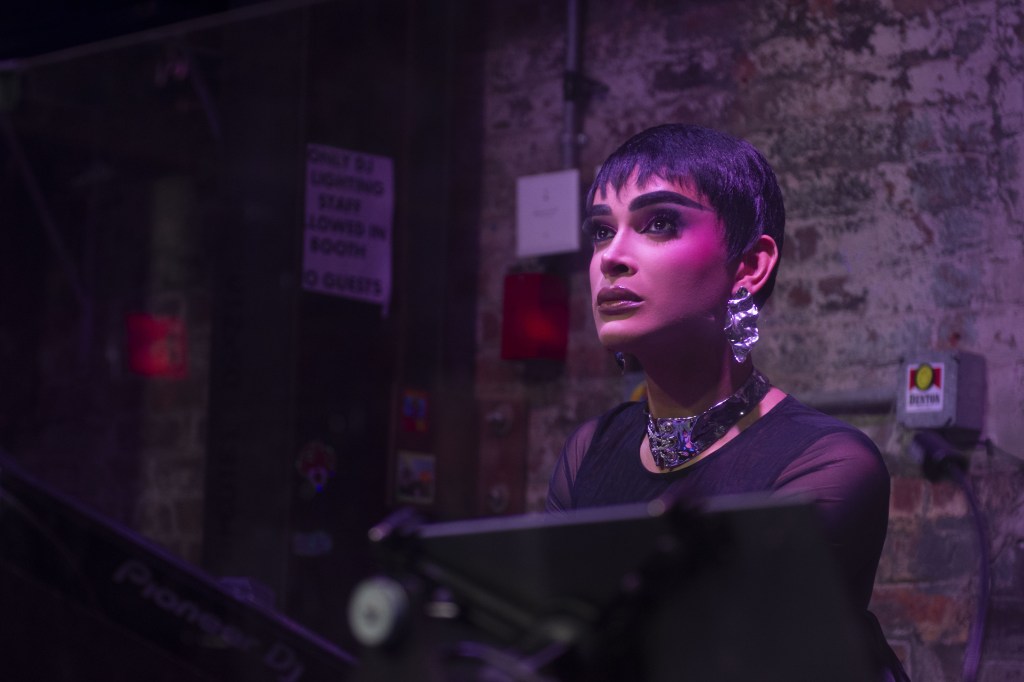
When Julie J glides into Gran Torino in Brooklyn, she wears a silken headscarf and a Missy Elliott sweatshirt and has Alexis Bittar hoops dangling from her ears. Many might recognize the drag artist, writer, and actress from her journey through the “Bittarverse” over the last year and half, playing the long-suffering Hazel/Jules to Patricia Black’s Upper East Side terror Margeaux in Bittar’s wildly successful social media series. Over the last several years, however, Julie has developed an abiding role as a beloved performer and community organizer in Brooklyn.

As a drag artist, Julie has also been featured by Maybelline, on MSNBC, and in The Washington Post, to name a few. She has received artist fellowships from La MaMa Experimental Theatre. She won Miss Bushwig in 2023 at the country’s largest drag festival of the same name, and Entertainer of the Year at New York’s Glam Awards in 2024, which honors achievements in nightlife performance and programming. Since March 2023, she has been the founder and co-producer, with Aaron Hock, of marathon drag benefit Stand Up NYC, which has since raised over $110,000 for organizations like Advocates for Trans Equality, Black Trans Femmes in the Arts, the Hetrick-Martin Institute, and many others.
Julie J, drag, drag queen, entertainment, stand up NYC
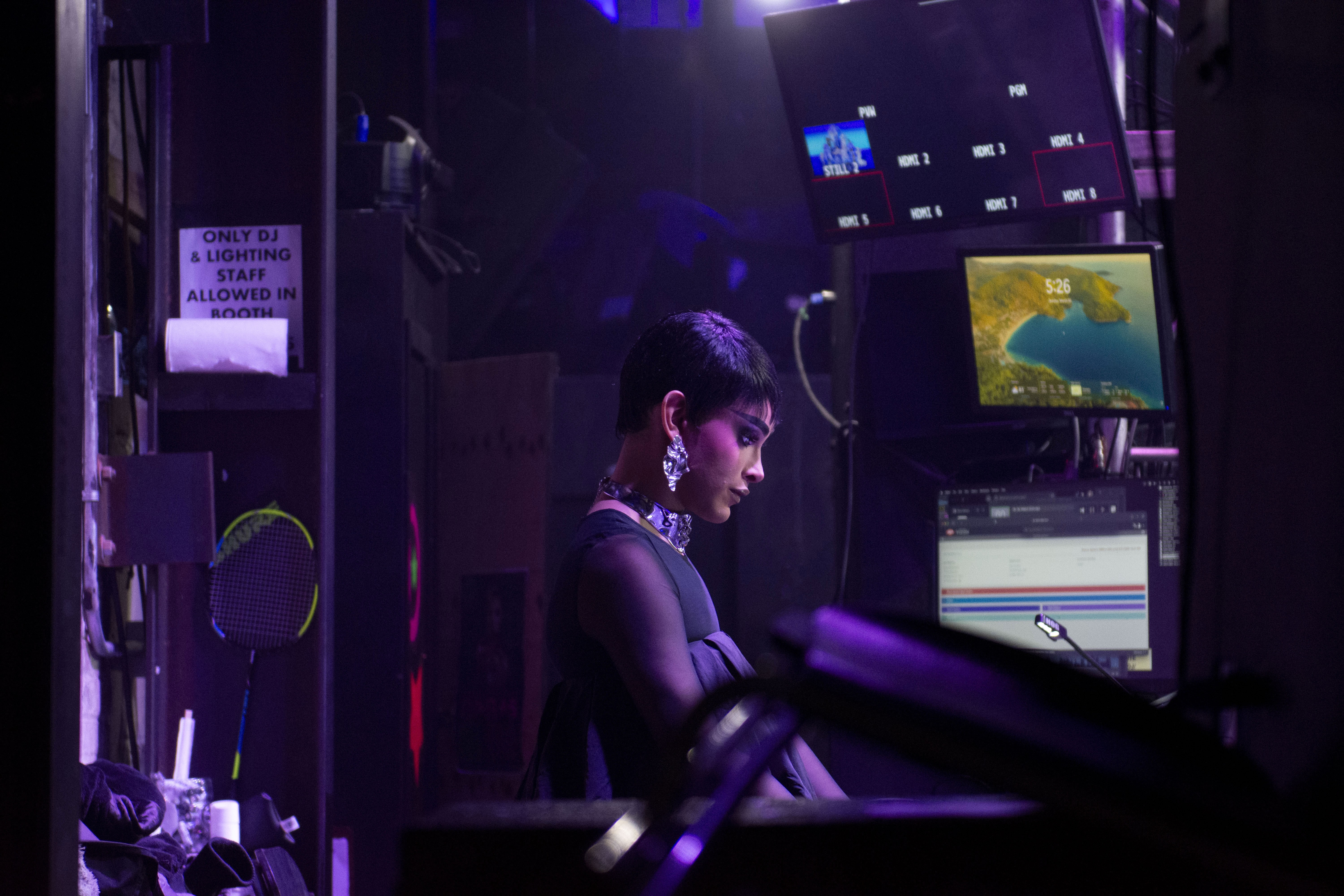
On March 30, Julie J gets organized in the DJ booth before Stand Up NYC begins at 3 Dollar Bill in Brooklyn. Elyssa Goodman

In March 2023, Tennessee governor Bill Lee signed the “Adult Entertainment Act” into law, which made it “a Class A misdemeanor offense for a person to engage in an adult cabaret performance on public property or in a location where the adult cabaret performance could be viewed by a person who is not an adult,” the bill wrote, and “establishe[d] that a second or subsequent such offense is a Class E felony.” “Adult cabaret” was defined “as a performance in a location other than an adult cabaret that features topless dancers, go-go dancers, exotic dancers, strippers, male or female impersonators who provide entertainment that appeals to a prurient interest, or similar entertainers, regardless of whether or not performed for consideration.” Because the strokes around “male and female impersonation” were so broad and left undefined, the language also challenged the existence of transgender individuals. “The language is vague enough that it leaves it in the hands of each individual jurisdiction to define what counts as a ‘male or female impersonator,’” Dahron Johnson, of the Tennessee Equality Project, told The New York Times. In a cultural moment where transgender individuals and drag artists were (and are still) already fighting for their rights and their lives, many were scared of what this meant for their futures.

That month, Julie J woke up with the urge to do something about it. “There was this electrifying feeling, this fire, that something needs to be done. We need to make something now, we need to put something together, because if we don’t do it now, things are going to start getting much worse,” she says when we meet, a few days before the next Stand Up NYC event. “I imagine it’s how people feel when they write books or when they decide to run for public office, this feeling of, someone else could do it, but they’re not, so I have to do it. This story hasn’t been told, so I have to tell it, or people aren’t paying attention to this, so I have to make the noise about it.”

Stand Up NYC was born in March 2023 and that single show raised over $25,000 for the ACLU of Tennessee, Black Trans Liberation, and the Trans Formations Project. Several times a year since then, Stand Up NYC gathers together drag artists from across New York to raise money for organizations in need.
Julie J, drag, trans activist, LGTBQ+ rights, Stand Up NYC
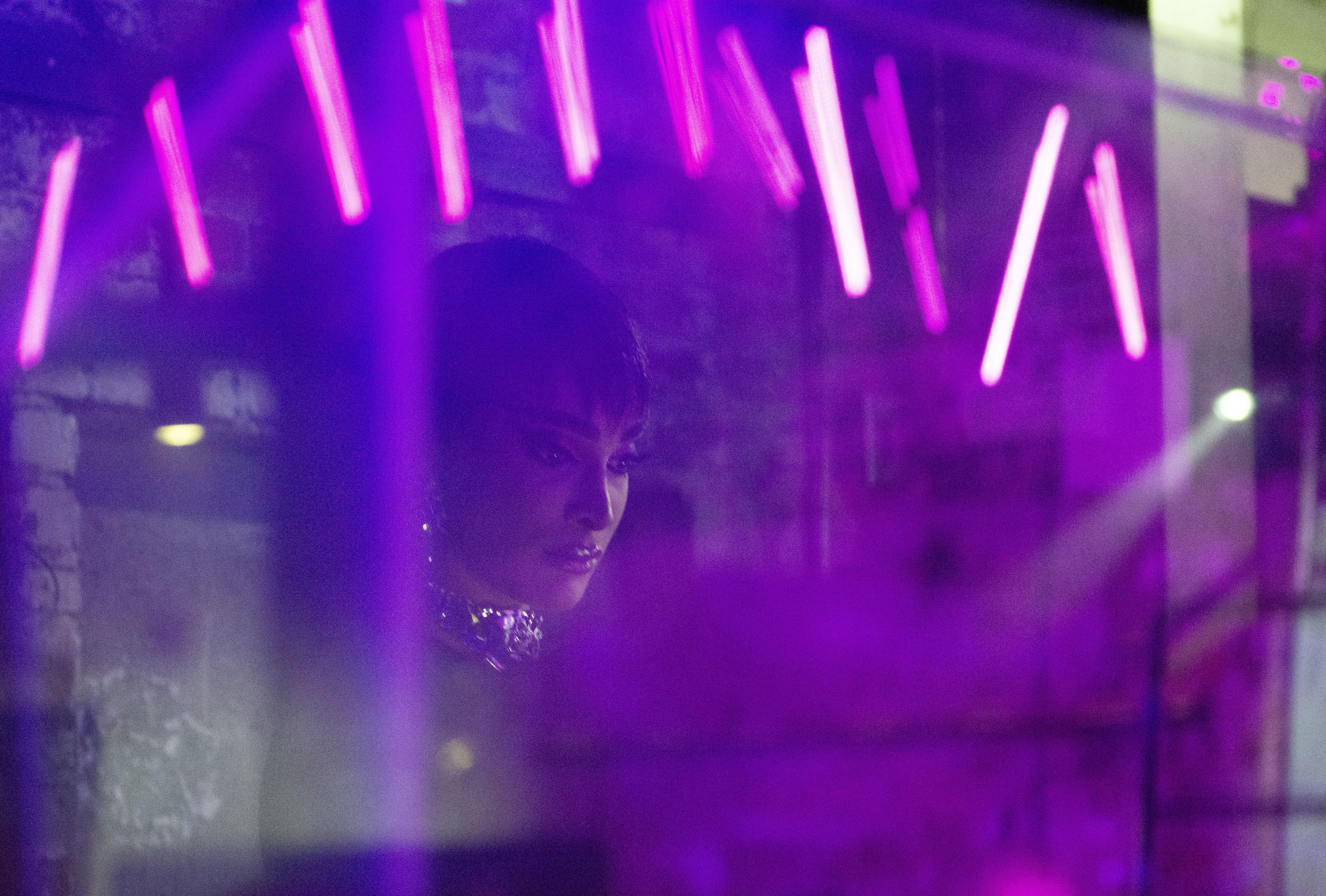
Julie J in the DJ booth. Elyssa Goodman

It’s March 2025 and another Stand Up NYC show is upon us. It’s a little after 5 p.m. on Sunday, March 30 when Julie and Aaron arrive at 3 Dollar Bill in Brooklyn. There’s a long night ahead of them as co-producers of their latest show, which is set to start at 7 p.m. (or thereabouts). In a short black wig and long lashes, Julie’s eyes glimmer. She wears a black cocktail dress and boots, and it’s time to get to work. Julie, who carries herself with an energy and grace not unlike Diahann Carroll or Audrey Hepburn, works on the show’s tech in the DJ booth, carries a ladder, arranges seats, discusses the event with Aaron and co-host Mariyea, and greets everyone who’s volunteering that day with genuine gratitude accompanied by a hug or a loving handshake. She knows people don’t have to show up the way they do.

“Specifically with Stand Up and starting it, I have learned the power of community, of what it means to bring a group of people together for a shared goal,” she says. “In the past, because I come from a theater background, it was kind of separate. It was like, I’m doing a task, or I am expressing myself, and these people are receiving it,” she says. “The more I got involved in community organizing spaces and even had the desire to make an impact, it was like, I can make an impact as an individual, but it’s much different when you can have other people with you.”

This is also a lesson she says she’s learned from drag, which itself has a storied tradition of mutual aid and activism that dates back centuries in the U.S., not to mention the rest of the world. “You can try to be a drag queen, drag king, drag thing, alone. It’s very hard to do. And I think something that I quickly learned is that, especially in queer spaces, and especially in drag spaces, there’s always going to be someone that’s like, do you need me to zip you up? Do you need a safety pin? Do you need this? Do you need that?” she says. “And there will always be someone that has it or that can do it. That is not always a shared thing in other spaces.”
Julie J, Stand Up NYC, entertainer, community, drag
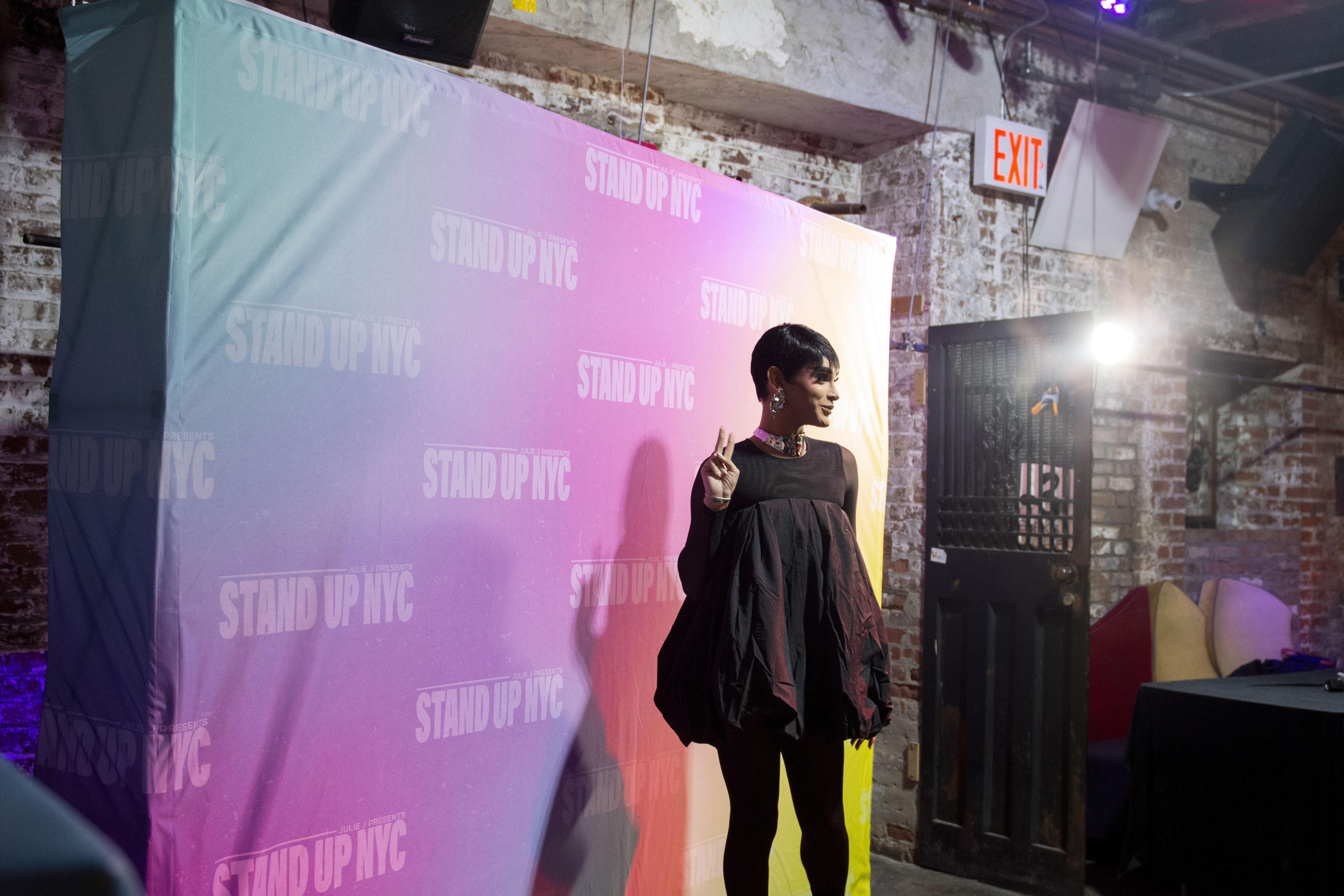
Julie J poses for pictures prior to the show's start. Elyssa Goodman

Julie’s relationship to community organizing actually starts long before Stand Up NYC, back to growing up in Texas. “My great grandparents grew up in segregation and the Jim Crow South. So, my understanding of life has always been informed by people who have had to prove their humanity or their talent or their ability,” she says. “There was always the expectation of, you need to do well in school. You need to stand up for not only yourself, but for other people who are less fortunate or have less than you do.” Understanding the relationship between civil rights, queer history and activism in college, she was further reminded of her family’s fight for rights as well. “When the opportunity presents itself, it’s like my mind and my soul can’t help but act on it and can’t help but lean into it,” she says.

As a young queer teen, Julie remembers making a point to find other queer teens and let them know she had their backs; she remembers little queer community to speak of beyond that. In college, she found herself shaped by witnessing student activism at Sarah Lawrence College, where she studied Theatre and Literature. “When I got out of college, it was like, well, how can I keep that same momentum going? My mom has always told me, you always want to be of service to people, that’s just a part of who you are,” she says. Coming from a family of teachers is also a part of it, she believes–”this kind of lineage of care, of education, of information is ingrained in my personhood,” she says.

This makes me think of an interview Andy Warhol did with Dolly Parton in 1984.

“You could be a great preacher,” he says.
“What do you mean?” Parton says. “I am a great preacher.”

Maybe it’s the same with Julie, I wonder, but with being a teacher. Being a drag artist is not unlike being a teacher, after all. She sees it this way, too. “Especially now, whether we want to or not, [we] are teaching people that gender expansiveness is not to be feared, that it’s not something that is rooted in evil,” Julie says. Rather, it’s the opposite. “It’s a celebration, it’s joy, it’s rooted in appreciation…we’re teaching how to express joy, how to celebrate individuality.”
Julie J, drag, drag queen, activism, Stand Up NYC
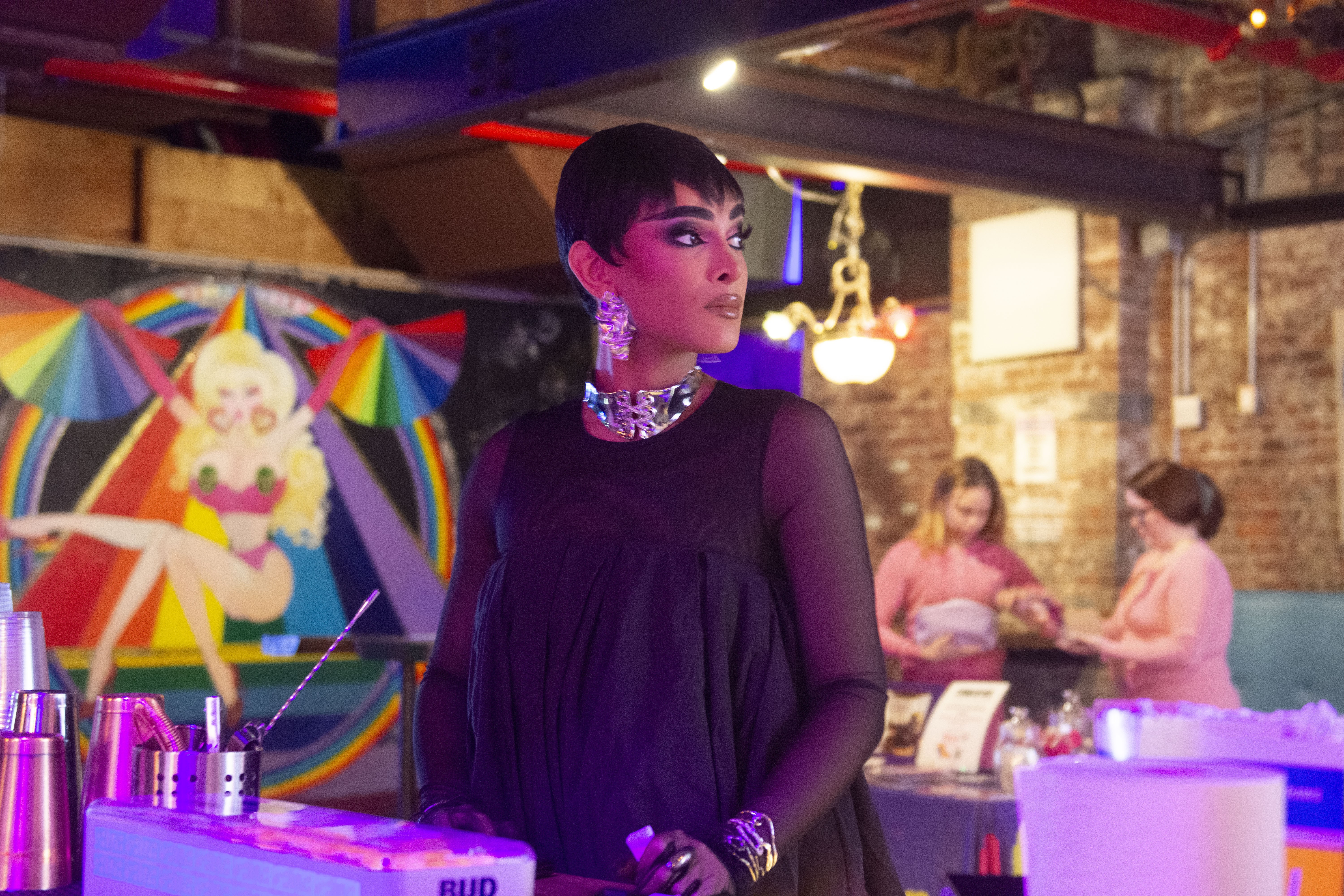
Julie J at 3 Dollar Bill before Stand Up NYC begins. Elyssa Goodman

To create space for people to do this onstage and raise funds for charitable organizations in a cultural moment such as this is its own act of radicality and love. Doing all of this for other people as you navigate your own life and a burgeoning career is another matter. And while it’s a successful career, it’s not always easy to balance, Julie says: “I think that a lot of a lot of community organizers and activists will relate to this, that there is sometimes a point in time when the the the darkness or the thing that you’re fighting so hard against, feels really close, and it feels like you’re taking a really big risk doing the things that you’re doing.” She continues, “I felt that way about when I spoke at MSNBC. Like, oh gosh, I’m making myself a target for the right-wing media and this side of the world that has no desire to see someone like me in a public place.” But doing Stand Up NYC made her think back to her childhood in Texas, and what she would have wanted then as an openly queer child in Catholic school. “There is someone who is that age now, who is looking to me and is saying, well, if she can do it, then I can, too. And I always have wanted to be the person that younger Julie wanted to look towards.”

Julie’s celebrated turn as Hazel will continue into the immediate future, and in the meantime it’s created opportunities for her at New York Fashion Week, in the upcoming campy Tina Romero horror film Queens of the Dead; and in essay contributions to the forthcoming HarperOne book No Tea, No Shade: Life as a Drag Queen. She also continues to co-produce Sylvester, “The All Black Experimental Drag Variety Show,” with Voxigma Lo and Paris Alexander. The next Stand Up NYC will be June 19. Julie’s solo show, as yet untitled, will run at lauded off-off-Broadway theatre La MaMa in 2026.

“Not that my work has ever been specifically about being a Black trans person, [but] I think I’m more intentional now about making work that just speaks to my human experience. When I’m making work now I’m saying, ‘I am a human being that happens to be x, y and z,’ rather than ‘I am x y and z and and I need to validate my humanity,’” she says. “My humanity is not up for question, that part of it is guaranteed. There are some parts of it that are decorated or that might be more unique than, say, your humanity, but they are just as valid.”

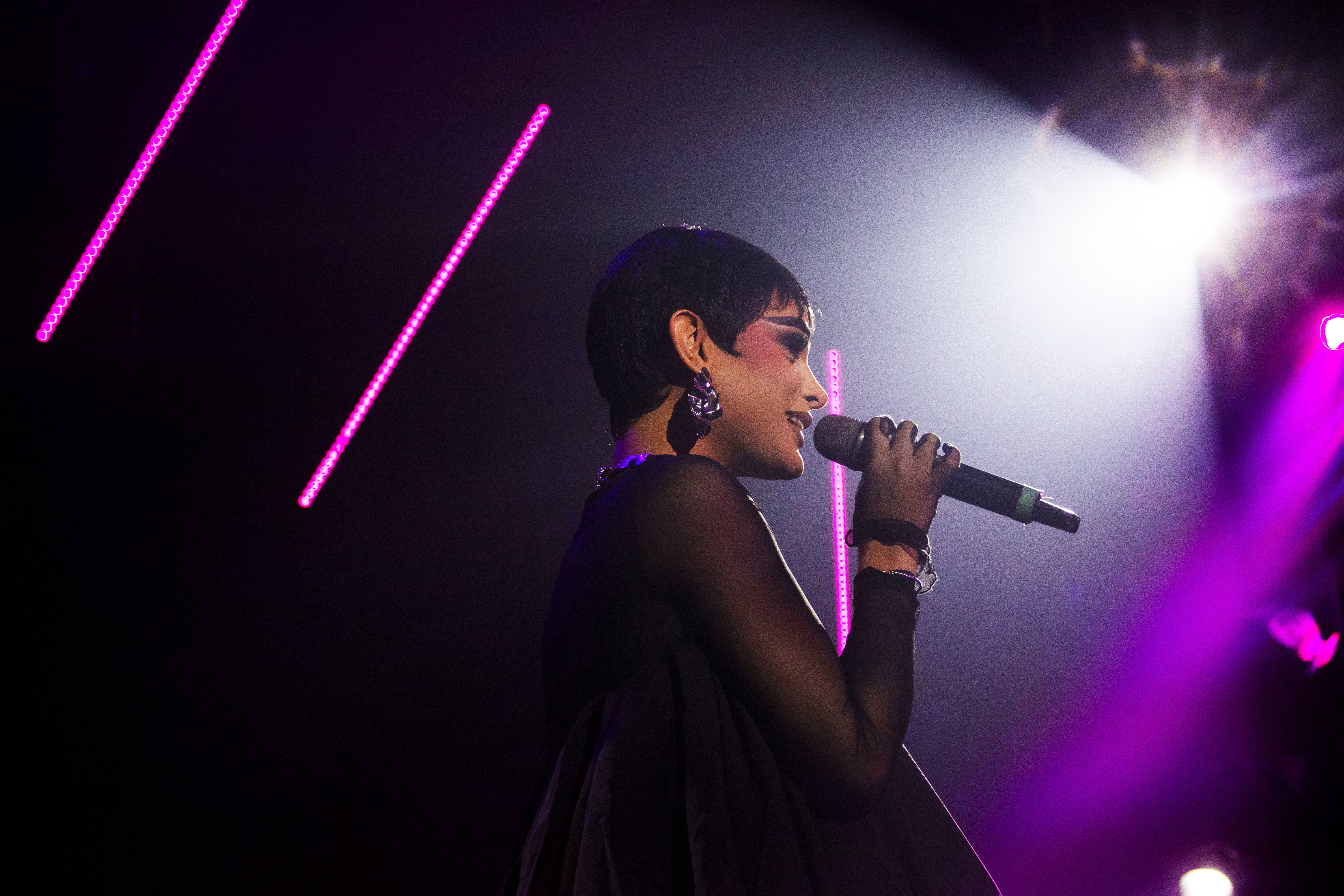
When the lights come up at Stand Up NYC, Julie and co-host Mariyea introduce the show, its mission, and soon, its bevy of performers. Throughout the night there are wild cheers. Money’s thrown and litters the stage like green confetti. People applaud, and at least one wears Julie J merch.

Partway through the evening, the performer Dawn takes the stage with a mix of Chappell Roan songs, and encourages the audience to sing along. The lyrics to “Pink Pony Club” and “Good Luck, Babe!” pour out of mouths. The feeling is of being swathed in joy, in love, in community.

As a writer, I regularly crawl into my own little cave, isolated from people, to do my work. Tonight, though, I understand the word community a little better. Because of Stand Up NYC, we all have the opportunity to know what it looks like, too.
Julie J, stand up NYC, drag, queer spaces, activism
Julie J on stage co-hosting Stand Up NYC. Elyssa Goodman

  • Therapist shares why Justin Bieber’s duet with 13-year-old self was so incredibly moving
    Photo credit: Wikimedia Commons & FlickrJustin Bieber performs onstage (left) and at a Nintendo store in 2009 (right).

    Taking the stage at Coachella, singer Justin Bieber gave fans something unique: singing along to a YouTube video of himself at just 13, he harmonized on songs like “Baby,” “Never Say Never,” “With You,” and others.

    Blake Roberts, a licensed therapist and self-proclaimed “dude,” shared his perspective on Bieber’s performance. While reactions to the appearance may be mixed, Roberts found it courageous.

    Therapist finds Bieber’s performance incredibly moving

    “From the perspective of a therapist and dude, I have to talk about this Justin Bieber-Coachella thing,” Roberts said in an Instagram Reel. “If you’ve ever done any amount of inner child work, you can appreciate what that moment was.”

    “That little boy was artistic and creative. Just doing his thing. Probably got made fun of a bunch, and then he gets thrown into this industry. And he loses parts of himself, and people probably take advantage of him,” he added.

    Roberts turned the performance into a learning experience, discussing a form of therapy known as inner child work:

    “Like we watched this man’s trauma, and yet he still shared a moment with us. Like a peek inside what it looks like to do inner child work. What looks like to look back at the younger versions of ourselves who have been rejected, who have been abused, who we ourselves have left behind. And to look at them with compassion and see them from the purity that they were.”

    Mixed reactions to Coachella performance

    Bieber’s performance relied heavily on nostalgia and early-career callbacks. A review in Entertainment Weekly described the set as “lacking some swag.” For much of the performance, Bieber sat at a desk onstage, scrolling through viral videos of himself.

    Despite negative feedback on his set, some fans appeared to be very appreciative of Bieber. One fan commented on Roberts’ Instagram post, saying, “I loved it so so much, aaaand now I’m crying again.”

    Regardless of whether people admire what the artist did, Roberts saw an opportunity to highlight recovery and the value of therapy. Bieber’s duet with his younger self could be seen as a meaningful act of openness and vulnerability. Roberts reflected, saying, “I thought it was pretty crazy. I could feel it.”

    Bieber’s challenges scrutinized by the public

    For those unfamiliar with Bieber’s personal life, he has faced some rough patches, as rumors have circulated about a struggling marriage and financial difficulties.

    The obstacles began to appear in 2017, when Bieber pulled out of a world tour due to mental exhaustion. In 2022, he posted on Instagram about the challenges of dealing with Ramsay Hunt syndrome. The illness occurs when the chickenpox virus reactivates later in life, causing facial weakness. Bieber said he was experiencing facial paralysis on his right side, which led him to cancel his tour again.

    There have also been allegations, including claims of drug use and questions about Bieber’s friendship with Sean “Diddy” Combs dating back to his youth. Clips have resurfaced showing Bieber as a teenager spending time with the music mogul. However, Bieber has not made any clear, on-the-record statements about that time.

  • 25 hilarious signs proving some messages just can’t be taken seriously
    Photo credit: Reddit | u/beachvbguyA funny bathroom sign.
    ,

    25 hilarious signs proving some messages just can’t be taken seriously

    From sharp edges to dog-friendly policies, these funny signs show how humor and confusion collide in public places.

    Signs are meant to inform, warn, or direct, but sometimes, they unintentionally entertain. Whether due to poor wording, clever humor, or just plain absurdity, some signs end up being comedic gold.

    Thanks to the internet, we no longer have to stumble upon them by accident—there’s even a whole subreddit, r/funnysigns, dedicated to collecting the most ridiculous ones.

    Here are 25 of the funniest signs that prove not all signage is created equal.

    1. Some people might need this reminder

    “Not knowing who Taylor Swift is doesn’t make you interesting.”

    funny signs, viral humor, Reddit funnysigns, funny warning signs, humorous signage
    Funny sign Reddit | u/Key_Shoe5850

    2. A dog-friendly policy we can all support

    “Dogs welcome. People tolerated.”

    funny signs, viral humor, Reddit funnysigns, funny warning signs, humorous signage
    Funny sign. Photo credit: Reddit | u/phoenix-fatale

    3. Coffee fixes everything

    “Given enough coffee, I could rule the world.”

    funny signs, viral humor, Reddit funnysigns, funny warning signs, humorous signage
    Funny sign. Photo credit: Reddit | u/AprilBoon

    4. Watch your step—sort of

    “Caution: This sign has sharp edges. Also, the bridge is out ahead.”

    funny signs, viral humor, Reddit funnysigns, funny warning signs, humorous signage
    Funny sign. Photo credit: Reddit | u/Winnin_Dylan

    5. Priorities: Keep the cat inside!

    “Please close the door behind you. DO NOT LET THE CAT OUT! No matter what it tells you!”

    funny signs, viral humor, Reddit funnysigns, funny warning signs, humorous signage
    Funny sign. Photo credit: Reddit | u/GigaPrime14900

    6. Cats really are the masterminds

    “If a cat asks for a cheeseburger, give it one. You don’t want to know what happens if you don’t.”

    funny signs, viral humor, Reddit funnysigns, funny warning signs, humorous signage
    Funny sign. Photo credit: Reddit | u/Zion_Annabella

    7. Nice try

    “Always read the fine print.”

    funny signs, viral humor, Reddit funnysigns, funny warning signs, humorous signage
    Funny sign. Photo credit: Reddit | u/Winnin_Dylan_

    8. Football confidence at its peak

    “World champions… of a sport only we play.”

    funny signs, viral humor, Reddit funnysigns, funny warning signs, humorous signage
    Funny sign. Photo credit: Reddit | u/Khaleeasi24

    9. The toughest decision you’ll make all day

    “Hmmm.”

    funny signs, viral humor, Reddit funnysigns, funny warning signs, humorous signage
    Funny sign. Photo credit: Reddit | u/Material-Practice-58

    10. Not the CPR instructions we were expecting

    “If someone collapses, administer CPR. If CPR doesn’t work, try turning it off and back on again.”

    funny signs, viral humor, Reddit funnysigns, funny warning signs, humorous signage
    Funny sign. Photo credit: Reddit | u/Lovecutiepie77

    11. Honesty is the best policy

    “Lying is bad. Except when you tell someone they look good in those pants.”

    funny signs, viral humor, Reddit funnysigns, funny warning signs, humorous signage
    Funny sign. Photo credit: Reddit | u/BaronVonBroccoli

    12. Job requirements have changed

    “Now hiring: Must be able to lift 50 lbs, work weekends, and fight off at least two raccoons a day.”

    funny signs, viral humor, Reddit funnysigns, funny warning signs, humorous signage
    Funny sign. Photo credit: Reddit | u/PurpleRuby_

    13. Someone really needed spellcheck

    “Public Notice: The libary is close today.”

    funny signs, viral humor, Reddit funnysigns, funny warning signs, humorous signage
    Funny sign. Photo credit: Reddit | u/Internetboy5434

    14. Looking for the Teenage Mutant Ninja Turtles

    “Caution: Sewer entrance. Heroes in a half-shell may be present.”

    funny signs, viral humor, Reddit funnysigns, funny warning signs, humorous signage
    Funny sign. Photo credit: Reddit | u/Poke-girl56

    15. In case of emergency… or not

    “In case of fire, please use stairs. (Sign is next to an escalator).”

    funny signs, viral humor, Reddit funnysigns, funny warning signs, humorous signage
    Funny sign. Photo credit: Reddit | u/Swimming-Pool143

    16. Why do we need to know this?

    “Fun fact: The average person will walk past a murderer 36 times in their lifetime.”

    funny signs, viral humor, Reddit funnysigns, funny warning signs, humorous signage
    Funny sign. Photo credit: Reddit | u/PrettySuccubus

    17. Stating the obvious

    “Warning: Water is wet.”

    funny signs, viral humor, Reddit funnysigns, funny warning signs, humorous signage
    Funny sign. Photo credit: Reddit | u/celestial-chic

    18. This store was ahead of its time

    “Employees must wash hands before returning to work. We’ve been saying this since 1992!”

    funny signs, viral humor, Reddit funnysigns, funny warning signs, humorous signage
    Funny sign. Photo credit: Reddit | u/beachvbguy

    19. The Force is strong with this one

    “Please use the Force to open the door.”

    funny signs, viral humor, Reddit funnysigns, funny warning signs, humorous signage
    Funny sign. Photo credit: Reddit | u/beachvbguy

    20. Elevator or trampoline?

    “To activate the elevator, please jump three times.”

    funny signs, viral humor, Reddit funnysigns, funny warning signs, humorous signage
    Funny sign. Photo credit: Reddit | u/PurpleRuby

    21. Beware of the nighttime hunters

    “Warning: This area is protected by highly trained owls.”

    funny signs, viral humor, Reddit funnysigns, funny warning signs, humorous signage
    Funny sign. Photo credit: Reddit | u/ScarlettPrincess

    22. Karen’s personal space

    “DO NOT TOUCH. This wall belongs to Karen.”

    funny signs, viral humor, Reddit funnysigns, funny warning signs, humorous signage
    Funny sign. Photo credit: Reddit | u/Limp_Duck_9082

    23. Not exactly good life advice

    “Or get away from that road as soon as possible.”

    funny signs, viral humor, Reddit funnysigns, funny warning signs, humorous signage
    Funny sign. Photo credit: Reddit | u/celestial-chic

    24. A new spin on fast food slogans

    “Make fast food great again.”

    funny signs, viral humor, Reddit funnysigns, funny warning signs, humorous signage
    Funny sign. Photo credit: Reddit | u/AprilBoon

    25. A truly ineffective calming method

    “Would be great if it did work, though.”

    funny signs, viral humor, Reddit funnysigns, funny warning signs, humorous signage
    Funny sign. Photo credit: Reddit

    Want more? Check out these YouTube videos for additional funny signs:

    This article originally appeared six ago. It has been updated.

  • Indie coffee shops are meant to counter corporate behemoths like Starbucks – so why do they all look the same?
    Photo credit: stomy/iStock via Getty ImagesMany coffee shops today seem to be aesthetically divorced from time and place.

    Like many young, urban professionals, we run on coffee. We especially enjoy frequenting independently owned cafes that pride themselves on ethically sourced beverages, strong local ties and a hip aesthetic.

    They’re the kinds of places that sneer at the homogenization and predictability of Tim Hortons, Second Cup, Dunkin and Starbucks.

    But as public space and consumer culture researchers, we began noticing a pattern: While the invention of new, nondairy milks to mix into lattes continues to amaze us, many U.S. coffee shops seemed to share a similar aesthetic.

    What was up with all the exposed brick? Why did so many of the baristas look cooler than us, but also so similar to one another? And why did most menus appear on a chalkboard, as if we were still in kindergarten?

    Weren’t we supposed to be in one-of-a-kind, authentic settings that make us feel unique and, let’s admit it, slightly elevated?

    As it turns out, the visual patterns we noticed had never been backed up by research. So after a quick cortado, we set out to test our hunch that local coffee shops had adopted a uniform aesthetic.

    Measuring homogeneity

    We asked over 100 American and Canadian young professionals living in cities to share an interior image of their favorite independent coffee shop, describe why they liked the shop’s appearance, and document aspects of its interior design.

    They could select these interior design features from a list of 23 common elements that we had identified in a pilot study – brick walls, marble counters, indoor plants, local art, vintage furniture and even the look of the baristas. Respondents could also write down other details they noticed.

    The elements that they selected and wrote down showed a fascinating overlap.

    Baristas led the pack: Two-thirds of the participants’ favorite local coffee shops had staff with tattoos or piercings. Over half had baristas with beards. Well over half of the respondents noted that their favorite shop had chalkboards, reclaimed wood features, local art, milk foam designs on beverages, local event posters and exposed brick. A large share of the shops had vintage furniture, community message boards and free books available to patrons to read. One-third of the images had indoor plants, trees or greenery.

    Barista with a beard and tattooed hands pours boiling water over coffee grounds.
    Chances are your favorite local coffee shop has a barista with a beard and tattoos. Wera Rodsawang/Moment via Getty Images

    Next up, we challenged the participants to identify the city where these coffee shops were located.

    Using the images provided by the respondents from the initial survey, we asked 158 new and prior participants if they could match the location of the shops depicted in six photographs to Cincinnati, St. Louis or Toronto – cities chosen for their different architectural and aesthetic qualities.

    Not a single participant was able to correctly identify the correct city for all the photos.

    We gave respondents another chance by showing two pictures of coffee shops, one at a time. This time, the two shops were located in Chicago and San Francisco – again, places that pride themselves on their unique and recognizable design culture. They were now given the choice of these key cities to select from, as well as three wrong cities. Only 6% successfully located both coffee shops, and nearly 20% immediately gave up.

    As one participant conceded: “Honestly, these aesthetics are very transferable now … they were random guesses and they could have been in any of the cities mentioned.”

    In other words, independent coffee shops in North America have become so similar aesthetically that their location cannot be picked from a lineup. The purportedly unique and local feel of coffee shops has instead been homogenized into a singular, palatable, North American aesthetic.

    Ironically, these shops have narrowed their aesthetics like a de facto brand franchise – exactly like the chain stores that their patrons ostensibly reject.

    A young woman with dreadlocks pays for her coffee as a smiling young female barista with short hair holds out a card reader.
    Exposed brick, check. Plants, check. Chalkboard, check. Tara Moore/Digital Vision via Getty Images

    Computers and capital

    So why is this happening?

    New Yorker cultural critic Kyle Chayka has attributed aesthetic homogenization to popular social media platforms like Instagram. He calls it the “tyranny of the algorithm”: Social media algorithms promote the visuals that users are most likely to engage with. This, in turn, causes the same types of visuals to be liked and shared, since users encounter them more often. Because the algorithm sees they’re popular, it continues to promote them, in a self-reinforcing cycle. In turn, coffee shop owners also see these online images and try to replicate them in their own establishments.

    Artificial intelligence will likely accelerate the digital homogenization of visual culture, since AI models are trained on massive datasets that feature widely circulated images. Whether it’s popular fashion, architecture or interior design, idiosyncrasies are collapsing into a generic, hegemonic aesthetic – what scholars Roland Meyer and Jacob Birken call “platform realism.”

    Finance plays a role as well. With the average cost of starting a new coffee shop between US$80,000 and $300,000, and with only a small share of coffee shops expected to stay open beyond five years, banks are keen to reduce their risk. Many of them will therefore ask aspiring coffee shop owners to opt for cheaper interior design choices that appeal to the broadest customer base.

    The consumer also plays a role

    But patrons of hip coffee shops may also be to blame.

    Decades before the rise of social media, AI and financial risk management, scholars such as Sharon Zukin revealed how young urban professionals paradoxically embrace the homogenization of their environment in their quest for authenticity.

    Those exposed brick walls? Zukin already described how Manhattan real estate brokers had marketed them to gentrifying SoHo yuppies in the early 1980s.

    Like their predecessors, today’s hipsters, creative professionals and knowledge workers are essentially cultural and aesthetic consumers. Many of them crave visuals – from fashion to architecture – that are different enough to feel cool and authentic, yet safe enough to match their lifestyle and their social status. They want a tasty latte as much as a palatable interior to drink it in.

    Businesses and developers are eager to appeal to these upwardly mobile consumers. At the same time, they want to reach the biggest number of customers. So they tend to create repeatable, homogenized environments in what Zukin describes as a “symbolic economy.”

    In coffee shops, patrons want more than a good espresso. They want to immerse themselves in a “scene” that matches their lifestyle and aspirations. And the exposed brick and the vintage furniture do just that – even if they’ve been copy-and-pasted in cities, small and large, across the nation.

    As we chase authenticity, we may just be finding comfort in carefully curated conformity.

    This article originally appeared on The Conversation. You can read it here.

Explore More Literature Stories

Literature

In 1964, Wizard of Oz co-stars Judy Garland and Ray Bolger reunited for a profound interview

Literature

Bestselling author shares the liberating freedom of letting others be wrong about you

Literature

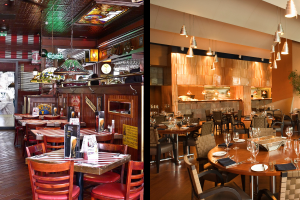
The big reason why ’90s restaurants were loud and fun and now everything is beige

Literature

Eric Idle says this classic Beatles moment shows they were ‘just as funny’ as Monty Python