For many women in the U.S. and around the world, motherhood comes with career costs.

Raising children tends to lead to lower wages and fewer work hours for mothers – but not fathers – in the United States and around the world.

As a sociologist, I study how family relationships can shape your economic circumstances. In the past, I’ve studied how motherhood tends to depress women’s wages, something social scientists call the “motherhood penalty.”

I wondered: Can government programs that provide financial support to parents offset the motherhood penalty in earnings?

A ‘motherhood penalty’

I set out with Therese Christensen, a Danish sociologist, to answer this question for moms in Denmark – a Scandinavian country with one of the world’s strongest safety nets.

Several Danish policies are intended to help mothers stay employed.

For example, subsidized child care is available for all children from 6 months of age until they can attend elementary school. Parents pay no more than 25% of its cost.

But even Danish moms see their earnings fall precipitously, partly because they work fewer hours.

Losing $9,000 in the first year

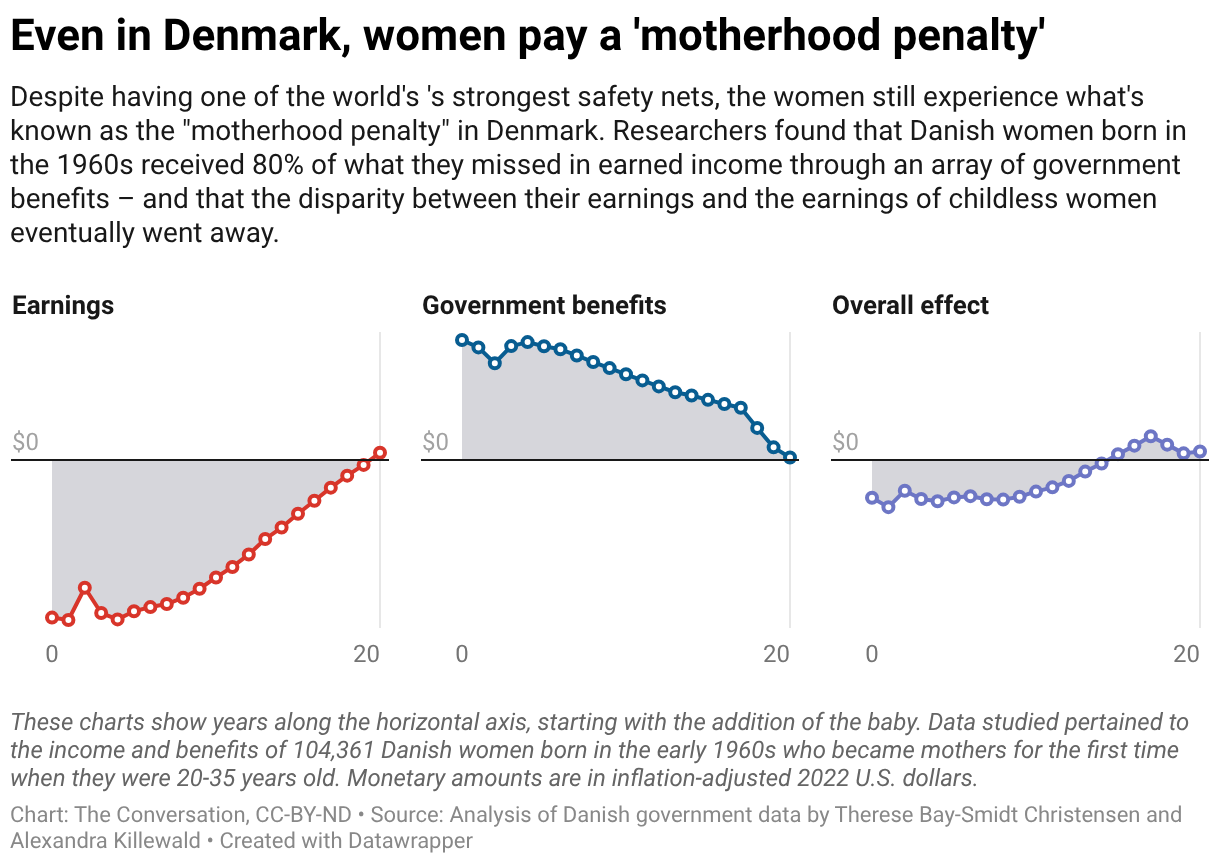
In an article to be published in an upcoming issue of European Sociological Review, Christensen and I showed that mothers’ increased income from the state – such as from child benefits and paid parental leave – offset about 80% of Danish moms’ average earnings losses.

Using administrative data from Statistics Denmark, a government agency that collects and compiles national statistics, we studied the long-term effects of motherhood on income for 104,361 Danish women. They were born in the early 1960s and became mothers for the first time when they were 20-35 years old.

They all became mothers by 2000, making it possible to observe how their earnings unfolded for decades after their first child was born. While the Danish government’s policies changed over those years, paid parental leave and child allowances and other benefits were in place throughout. The women were, on average, age 26 when they became mothers for the first time, and 85% had more than one child.

We estimated that motherhood led to a loss of about the equivalent of US$9,000 in women’s earnings – which we measured in inflation-adjusted 2022 U.S. dollars – in the year they gave birth to or adopted their first child, compared with what we would expect if they had remained childless. While the motherhood penalty got smaller as their children got older, it was long-lasting.

The penalty only fully disappeared 19 years after the women became moms. Motherhood also led to a long-term decrease in the number of the hours they worked.
Motherhood, Safety net, Income inequality, Denmark, Gender inequality, Scandinavia, Government benefits, Mothers Day, Mother's Day, motherhood penalty
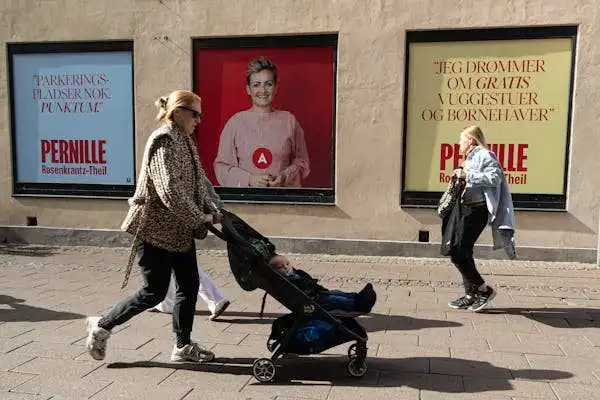
The u2018motherhood penaltyu2019 is largest in the first year after a momu2019s first birth or adoption. Kristian Tuxen Ladegaard Berg/NurPhoto via Getty Images

Studying whether government can fix it

These annual penalties add up.

We estimated that motherhood cost the average Danish woman a total of about $120,000 in earnings over the first 20 years after they first had children – about 12% of the money they would have earned over those two decades had they remained childless.

Most of the mothers in our study who were employed before giving birth were eligible for four weeks of paid leave before giving birth and 24 weeks afterward. They could share up to 10 weeks of their paid leave with the baby’s father. The length and size of this benefit has changed over the years.

The Danish government also offers child benefits – payments made to parents of children under 18. These benefits are sometimes called a “child allowance.”

Denmark has other policies, like housing allowances, that are available to all Danes, but are more generous for parents with children living at home.

Using the same data, Christensen and I next estimated how motherhood affects how much money Danish moms receive from the government. We wanted to know whether they get enough income from the government to compensate for their loss of income from their paid work.
Motherhood, Safety net, Income inequality, Denmark, Gender inequality, Scandinavia, Government benefits, Mothers Day, Mother's Day, motherhood penalty

We found that motherhood leads to immediate increases in Danish moms’ government benefits. In the year they first gave birth to or adopted a child, women received over $7,000 more from the government than if they had remained childless. That money didn’t fully offset their lost earnings, but it made a substantial dent.

The gap between the money that mothers received from the government, compared with what they would have received if they remained childless, faded in the years following their first birth or adoption. But we detected a long-term bump in income from government benefits for mothers – even 20 years after they first become mothers.

Cumulatively, we determined that the Danish government offset about 80% of the motherhood earnings penalty for the women we studied. While mothers lost about $120,000 in earnings compared with childless women over the two decades after becoming a mother, they gained about $100,000 in government benefits, so their total income loss was only about $20,000.

Benefits for parents of older kids

Our findings show that government benefits do not fully offset earnings losses for Danish moms. But they help a lot.

Because most countries provide less generous parental benefits, Denmark is not a representative case. It is instead a test case that shows what’s possible when governments make financially supporting parents a high priority.

That is, strong financial support for mothers from the government can make motherhood more affordable and promote gender equality in economic resources.

Because the motherhood penalty is largest at the beginning, government benefits targeted to moms with infants, such as paid parental leave, may be especially valuable.

Child care subsidies can also help mothers return to work faster.

The motherhood penalty’s long-term nature, however, indicates that these short-term benefits are not enough to get rid of it altogether. Benefits that are available to all mothers of children under 18, such as child allowances, can help offset the long-term motherhood penalty for mothers of older children.

This article originally appeared on The Conversation. You can read it here.

  • Overpackers love this simple ‘5-4-3-2-1’ packing rule that makes travel way easier
    An obvious overpack for travel.Photo credit: Canva
    ,

    Overpackers love this simple ‘5-4-3-2-1’ packing rule that makes travel way easier

    When it comes to travel, packing efficiently is a skill acquired through experience. Lifestyle and content creator Alison Lumbatis shares a helpful 5-4-3-2-1 method designed to take the stress out of packing for both seasoned travelers and first-timers. Trying to pack light while still remembering everything you need can feel a little daunting. A simple…

    When it comes to travel, packing efficiently is a skill acquired through experience. Lifestyle and content creator Alison Lumbatis shares a helpful 5-4-3-2-1 method designed to take the stress out of packing for both seasoned travelers and first-timers.

    Trying to pack light while still remembering everything you need can feel a little daunting. A simple trick is knowing exactly what’s necessary, making your bag lighter and more practical.

    @alisonlumbatis

    Calling all overpackers—this one’s for you! ✈️🧳 The 5-4-3-2-1 packing method is one of my favorites because it’s totally customizable. Prefer dresses? Swap a top and bottom for a dress. Love skirts? Sub them in for pants! These pieces should last you 1-2 weeks, depending on your access to laundry. 🔗’s to everything in bio! #outfitformulas #packinglight #styleconfidence #wardrobemadeeasy #travelcapsule #dailyoutfits #closetconfidence #vacationstyle #fashionover40 #smartstyle

    ♬ original sound – Alison Lumbatis

    Putting The ‘5-4-3-2-1 Packing Method’ Into Action

    In her trending TikTok post, Lumbatis shares a packing system she claims to be “as easy as it sounds.” Here are the basics of the 5-4-3-2-1 packing method:

    • 5 TOPS
    • 4 BOTTOMS
    • 3 SHOES
    • 2 LAYERS
    • 1 MISCELLANEOUS

    Lumbatis explains, “So all you got to do is pick out 5 tops, 4 coordinating bottoms, 3 pairs of shoes, 2 layering pieces, and 1 of anything else. Like a dress, pajamas, a hat, a belt, or any other accessories that you might need. And then of course pack as many undergarments and toiletries as you need.”

    The strategy isn’t just about simplifying and maximizing the number of items you bring on a trip. It’s also about function. “The key is to pick versatile pieces that can mix and match so you can pair them up for whatever activities you have planned for your trip.”

    minimalism, versatile pieces, functionality, packing
    Packing the necessary items
    Photo credit Canva

    Taking Pictures Can Help Plan Ahead

    Another helpful step is taking photos of your outfits to remember how everything fits together. Lumbatis offers, “You can even take pictures of the outfits with you wearing them or flat lays of the pieces and keep them on your phone or in your Notes App — So you can refer back to it on your trip.”

    Is the 5-4-3-2-1 packing method effective? These were some of the thoughts in the comments from readers hopeful to put the plan into action:

    “Great tip for me. Hate packing and never wear all the clothes I bring.”

    “Heading to Japan and I was just going to my closet to put it together. I overpack so this is sooo helpful.”

    “I’m dreading how to not over pack for such a variety of occasions, heat, and limited washing facilities. Ugh.”

    “I struggle with under packing so this is super helpful!”

    travel, adventure, alleviate stress, preparation
    Soaking up the adventure.
    Photo credit Canva

    The Science Behind Good Preparation

    Traveling is a great way to alleviate the stress and burdens of our daily lives. A 2025 study in Springer Nature Link showed travel helped people improve their long-term resilience by creating positive emotions while ecouraging self reflection. National Geographic found the benefits of travel begin even before the trip begins.

    However, preparation can have a powerful effect on the simple stresses a person might acquire during traveling. A 2025 study revealed that planning reduced anxiety and helped people prepare for delays or unexpected changes. Research in 2025 reported by AP News found that even making a simple checklist reduced anxiety and helped make for smoother trips.

    Lumbatis claims, “If you struggle with overpacking and want to create a great capsule wardrobe packing list, you’ve got to try this method.”

    People hope that traveling will relieve stress more than generate it. The 5-4-3-2-1 packing method offers a clear and simple way to pack just what you need. Careful preparation helps prevent last-minute chaos and produces a more enjoyable trip. Hopefully, this method can help you spend less time worrying and more time soaking in the adventure.

    Watch this YouTube video on incredible vacation destinations to inspire your next trip:

  • Video of 3rd grade classroom’s poetic stuffed animals display is bringing people to tears
    A cute pile of stuffed animals.Photo credit: Canva
    ,

    Video of 3rd grade classroom’s poetic stuffed animals display is bringing people to tears

    When 3rd-grade teacher Kelsie Lynn posted a video of her classroom during recess, these stuffed animals on display brought people near tears. The video struck a powerful chord of nostalgia, landing thousands of plays. In her post, she shares that the magic of childhood can come alive through stuffed animals in a classroom. This call…

    When 3rd-grade teacher Kelsie Lynn posted a video of her classroom during recess, these stuffed animals on display brought people near tears. The video struck a powerful chord of nostalgia, landing thousands of plays.

    In her post, she shares that the magic of childhood can come alive through stuffed animals in a classroom. This call to happy memories inspired heartwarming reactions and a powerful sense of connection among viewers.

    A Room Of ‘Stuffies’

    After Kelsie Lynn gave the children an opportunity to vote for a class reward, they chose to bring their ‘stuffies,’ stuffed animals. As the TikTok video moves through the classroom, the stuffies sit respectfully in chairs awaiting students to return from recess.

    In an interview with People, Lynn explained, “They all chose to put their stuffies in their seats up to their desk as if they were working. It was so cute and innocent and just really reminded me how little third graders still are.”

    Lynn used the viral post to highlight the importance of childhood. She describes the special role treasured toys and a safe, inviting classroom can play. “These moments are not just about fun; they are essential in nurturing emotional connections and fostering a sense of community within the classroom. By allowing students to express themselves through their cherished toys, teachers create a welcoming environment where children feel valued and heard.”

    empathy, social connection, grandma, prosocial behavior
    Heartwarming, nostalgic moment for grandma.
    Photo credit Canva

    Classroom Video Stirs Nostalgic Emotions

    The simple classroom video of stuffed animals struck a surprisingly emotional chord. These are some of the thoughts from the comments:

    “Awww each one is waiting patiently for their person to come back. Love how some of them look a little love worn.”

    “I could cry this is so wholesome”

    “As a father this hits hard beyond words take a look at that room the innocence of every child telling us a little story about each and every one of them.”

    “This is the sweetest thing I’ve seen all month!”

    “i wish i was allowed to do this. my mom use to say she had to pry stitch out my hands till i was 4.”

    “Me at 31 watching this with my stuffy”

    “All 3 of my daughters are in elementary school and I can confirm each one of those stuffies means the world to each of them. Sometimes I have to stop and remind myself they’re still so little”

    children, happy moments, inspired, community
    Mom watches a child chew happily on a toy.
    Photo credit Canva

    The Science Behind Nostalgia

    Nostalgia is the warm feeling you get when remembering happy moments from the past. It can change how people treat others and invoke more empathy. A 2022 study in the National Library of Medicine found that nostalgia helps people feel more hopeful and inspired while adding meaning to their lives.

    Science suggests that people usually remember emotional moments more strongly than ordinary ones. A 2025 journal in Nature reports that these intense emotions allow the brain to connect different systems together, making memories easier to remember.

    love, emotional connection, friendship, cute content

    Social Media Loves A Happy Memory

    When people feel moved or touched by a post, it creates warm emotional reactions. Those feelings help explain why cute content becomes so popular on social media. A 2023 study in Frontiers created new ways to measure what makes content cute. They found posts that feel “kama muta,” moved by love, create the strongest reaction, increasing connection and virality.

    Seeing a classroom of stuffed animals during recess reminds viewers of simpler moments when beloved toys felt like a best friend. That glimpse of nostalgia mixed with the sweetness of 3rd graders creates an emotional connection people can’t help but share. The video resonates so strongly because it taps into something we recognize immediately: comfort and love.

    Here’s a fun video looking back at some nostalgic childhood moments:

  • A woman complained to her upstairs neighbor about  a strange noise in the middle of the night. His wholesome response was perfect.
    A woman reads a note from her neighborPhoto credit: Canva

    She had never actually met the man who lived above her. She knew him only as the source of the noise coming through her ceiling at 12:30 in the morning, the night after Super Bowl LIX. She pulled herself out of bed, went upstairs, and asked him through his Ring camera to please turn it down. He was polite. She went back to sleep.

    The next morning, there was a bottle of wine outside her door.

    The woman, who goes by u/operarose on Reddit, posted the photo to r/MadeMeSmile , and it pulled in 84,000 upvotes, as Newsweek reported. The caption was simple: “Had to get out of bed and go ask the upstairs neighbor (whom I’ve never actually met) to turn it down at about 12:30 am this morning. Found this outside my door when I woke up.”

    Attached to the bottle was a handwritten note. “I got too carried away watching recaps from the Superbowl and I didn’t realize how loud my TV was,” it read. “I’m so sorry for not being considerate with the volume. In positive news, the cookies you made for Christmas were amazing. Please allow me to return the favor.”

    That last part is what made the story. He already knew who she was. She’d baked Christmas cookies and apparently given some to neighbors she’d never formally met. He’d received them, remembered, and now here he was, months later, referencing them in an apology note attached to a bottle of wine.

    neighbors, kindness, apology, community, apartment living
    Plate of holiday cookies. Image source: Canva

    She reported back in the comments that the wine was good. “Never had this brand before, but I definitely recommend it,” she wrote.

    Etiquette expert Jo Hayes told Newsweek the neighbor had essentially done everything right. “A clear, sincere apology is necessary, and he did exactly this. Plus a kind word about the Christmas cookies. Plus a gift, as a token gesture of said apology, is the icing on the cake. This would have flooded the downstairs neighbor with warm fuzzies.”

    The comments filled with people who seemed almost relieved. “It’s insane just how hard it is to find people who can just be considerate and move on,” one user wrote. “Congratulations to both of you for spontaneously demonstrating how to be an adult,” said another. “This is how you neighbor,” someone summed up simply.

    The whole exchange took about two minutes of awkwardness and produced something neither of them had before the night started: a neighbor they actually know.

    This article originally appeared earlier this year.

Explore More Culture Stories

Culture

A woman complained to her upstairs neighbor about a strange noise in the middle of the night. His wholesome response was perfect.

Culture

He threw a message in a bottle into the ocean as a teen. It washed up 49 years later with a response.

Culture

Restaurant owner turns a fake 1-star tamale review into a social media frenzy

Well-being

These seven simple phrases could be the secret to deepening trust and romance in your relationship