The bank had confused them with the previous owner, who actually did have an outstanding loan. A quick check of their own records would have cleared this up. According to the Nyerges’ attorney Todd Allen, it would have taken about 15 minutes. Nobody checked. The foreclosure went through.
Warren called branch managers. He wrote certified letters to the bank’s president. Nothing came back. He eventually hired Allen, who got the foreclosure reversed within two months. The court also agreed that Bank of America should pay Warren’s legal fees of about $2,500. The bank was notified. Five months went by. No payment.
At that point, reports ABC News, Warren went back to court and obtained a writ of execution: a court order giving him the legal authority to seize Bank of America’s assets to satisfy the debt. On June 3, 2011, he showed up at the local branch with two sheriff’s deputies and a moving truck.
The deputies delivered the message to the branch manager: pay the $2,500, or they start loading furniture. After a call to superiors, the bank produced a check. They misspelled Warren’s name on it.
Attorney Allen noted that Bank of America apologized for the payment delay but never for the wrongful foreclosure itself. A spokesperson eventually issued a statement: “We’re truly sorry for the series of unfortunate circumstances that Mr. Nyerges experienced.”
The moving truck left empty. The deputies left with a check. Warren and Maureen still own their home.
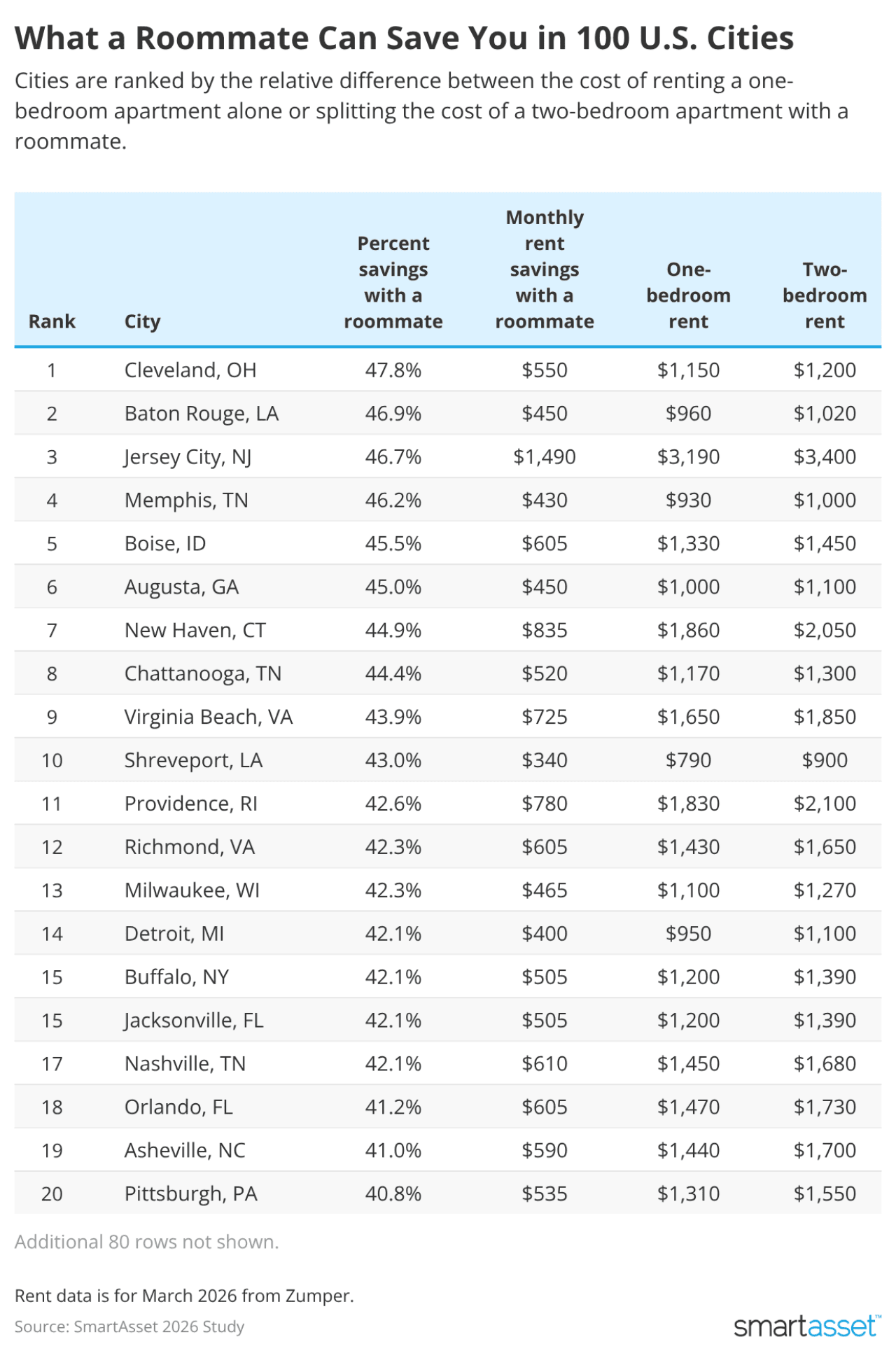
What a roommate can save you in 100 US cities: 2026 study
New college grads, transplants from other cities, and others might find myriad advantages in including a roommate in their housing plan — one of those being cost savings. Particularly in high cost-of-living areas, an extra cushion in the budget could make a big difference in discretionary spending, paying off debt, or investing for the future. Across large U.S. cities, splitting a two-bedroom apartment with a roommate versus living alone in a one-bedroom apartment could save the average renter about $541 per month, or nearly $6,500 per year. In many cities, the average savings climb much higher.
With this in mind, SmartAsset ranked 100 of the largest U.S. cities based on the percentage of monthly rent saved by sharing an apartment with a roommate.
Key Findings
Adding a roommate gets you the best value in Cleveland, Ohio. Splitting a two-bedroom with another person saves you nearly 48% compared to renting a one-bedroom alone. The average cost of one-bedroom rent in Cleveland currently sits at $1,150, nearly identical to the average two-bedroom rent of $1,200.
The average rent for a two-bedroom apartment is only $900 in this city. Shreveport, Louisiana, has the lowest two-bedroom rent out of 100 large cities. With an average one-bedroom price of $790, it ranks 10th overall with a savings of 43% with a roommate, or $340 rent savings per person per month.
In NYC, a roommate saves you $1,730 per month. The average one-bedroom rent in New York City is $4,380, while two roommates could split the average $5,300 two-bedroom rent for $2,650 each. Neighboring Jersey City, New Jersey has the second-highest raw monthly dollars saved with a roommate at $1,490 — or 46.7% savings over living alone.
A roommate saves you the least in the cities. Relative to local housing costs, sharing your space is least cost effective in Scottsdale, Arizona, where splitting a two-bedroom nets you a 26.0% discount, or a $440 monthly discount. Seattle (28.2% savings; $550 per month) and El Paso, Texas (29.4% savings; $250 per month), also are most budget-friendly to singletons.
Top 10 Cities With the Most Savings With a Roommate
Cities are ranked based on the percent saved in rent between splitting the average two-bedroom apartment with a roommate and living in a one-bedroom apartment alone.
Cleveland, OH
Percent savings with a roommate: 47.83%
Monthly rent savings with a roommate: $550
One-bedroom rent: $1,150
Two-bedroom rent: $1,200
Baton Rouge, LA
Percent savings with a roommate: 46.88%
Monthly rent savings with a roommate: $450
One-bedroom rent: $960
Two-bedroom rent: $1,020
Jersey City, NJ
Percent savings with a roommate: 46.71%
Monthly rent savings with a roommate: $1,490
One-bedroom rent: $3,190
Two-bedroom rent: $3,400
Memphis, TN
Percent savings with a roommate: 46.24%
Monthly rent savings with a roommate: $430
One-bedroom rent: $930
Two-bedroom rent: $1,000
Boise, ID
Percent savings with a roommate: 45.49%
Monthly rent savings with a roommate: $605
One-bedroom rent: $1,330
Two-bedroom rent: $1,450
Augusta, GA
Percent savings with a roommate: 45.00%
Monthly rent savings with a roommate: $450
One-bedroom rent: $1,000
Two-bedroom rent: $1,100
New Haven, CT
Percent savings with a roommate: 44.89%
Monthly rent savings with a roommate: $835
One-bedroom rent: $1,860
Two-bedroom rent: $2,050
Chattanooga, TN
Percent savings with a roommate: 44.44%
Monthly rent savings with a roommate: $520
One-bedroom rent: $1,170
Two-bedroom rent: $1,300
Virginia Beach, VA
Percent savings with a roommate: 43.94%
Monthly rent savings with a roommate: $725
One-bedroom rent: $1,650
Two-bedroom rent: $1,850
Shreveport, LA
Percent savings with a roommate: 43.04%
Monthly rent savings with a roommate: $340
One-bedroom rent: $790
Two-bedroom rent: $900
Top 10 Cities Where It’s Most Cost Effective to Live Alone
Cities are ranked based on the percent saved in rent between splitting the average two-bedroom apartment with a roommate and living in a one-bedroom apartment alone.
Scottsdale, AZ
Percent savings with a roommate: 26.04%
Monthly rent savings with a roommate: $440
One-bedroom rent: $1,690
Two-bedroom rent: $2,500
Seattle, WA
Percent savings with a roommate: 28.21%
Monthly rent savings with a roommate: $550
One-bedroom rent: $1,950
Two-bedroom rent: $2,800
El Paso, TX
Percent savings with a roommate: 29.41%
Monthly rent savings with a roommate: $250
One-bedroom rent: $850
Two-bedroom rent: $1,200
Albuquerque, NM
Percent savings with a roommate: 29.47%
Monthly rent savings with a roommate: $280
One-bedroom rent: $950
Two-bedroom rent: $1,340
Denver, CO
Percent savings with a roommate: 29.69%
Monthly rent savings with a roommate: $475
One-bedroom rent: $1,600
Two-bedroom rent: $2,250
St Louis, MO
Percent savings with a roommate: 30.11%
Monthly rent savings with a roommate: $280
One-bedroom rent: $930
Two-bedroom rent: $1,300
Dallas, TX
Percent savings with a roommate: 30.28%
Monthly rent savings with a roommate: $430
One-bedroom rent: $1,420
Two-bedroom rent: $1,980
San Francisco, CA
Percent savings with a roommate: 30.47%
Monthly rent savings with a roommate: $1,155
One-bedroom rent: $3,790
Two-bedroom rent: $5,270
Fort Lauderdale, FL
Percent savings with a roommate: 30.85%
Monthly rent savings with a roommate: $580
One-bedroom rent: $1,880
Two-bedroom rent: $2,600
St Petersburg, FL
Percent savings with a roommate: 31.33%
Monthly rent savings with a roommate: $470
One-bedroom rent: $1,500
Two-bedroom rent: $2,060
Data and Methodology
This study examined data from 100 U.S. cities, comparing the average rents for one-bedroom and two-bedroom apartments between March 2025 and March 2026 based on data from Zumper. Specifically, the cost of a one-bedroom was compared with half the cost of a two-bedroom for each city, assuming each roommate pays equal rent.
People who shop at the more than 8,700 farmers markets operating in the U.S. either year-round or seasonally generally fall into six distinct groups. Three of them are more interested in farmers markets than the others. I study local food systems as a strategic communications scholar, and that’s the main takeaway from a study that I conducted with several colleagues.
As we explained in the March 2026 edition of British Food Journal, people who fall into those groups have different levels of interest in farmers markets but also have some things in common. Most people who shop at them are motivated to go because they want healthy, fresh food, they support local farmers and they think going to the farmers market is fun.
For both studies, we pulled survey data from a nationally representative sample of 5,141 U.S. consumers that was conducted Aug. 2-11, 2023. It had a margin of error of plus or minus 1.8 percentage points.
Researchers define farmers markets and local food in different ways. So we asked respondents to simply think of farmers markets as places where they can buy food directly from more than one vendor and where all or most of the items are locally grown, raised or made. We defined local food as being grown in their state or 250 miles or less from their homes.
Highly engaged, health-focused and emerging interest
We determined that about 18% of those surveyed are “highly engaged” farmers market shoppers. They care a lot about food and enjoy buying, preparing and eating fresh food. They are excited about many aspects of farmers markets, which are places where this group shops for a variety of reasons, such as supporting local farmers, buying nutritious, delicious food and connecting with community.
Nearly 65% of these shoppers were women. This group was the most diverse, with 27% of respondents identifying as Hispanic, 20% Black and 4% multiracial. They also had significantly lower average annual household incomes than other groups, averaging US$40,000-$50,000.
We found that another 18% of the people surveyed were “health-focused.” Like the highly engaged shoppers, they make buying and eating healthy food a high priority. However, this group doesn’t enjoy cooking as much. The health-focused group tends to avoid genetically modified foods, as well as convenient options like takeout food, frozen dinners and microwave-ready meals.
About 58% of them were women and their average age was 57, making them the oldest of the groups. Roughly 70% of the health-focused group was white, making it less diverse than the highly engaged group but more diverse than some of the other groups.
Finally, about 19% of the respondents were what we called “emerging interest” farmers market shoppers. They value convenience and learning about food. This group was the most likely to see going to the farmers market as a fun activity.
Emerging interest shoppers were nearly evenly split by gender, with 52% women. Their average age was 44 years old, making them the youngest of the groups.
We also identified three groups of consumers who were less interested in farmers markets than the highly engaged, health-focused and emerging interest shoppers, even if some of them do occasionally shop at the markets anyway.
About 16% of farmers market shoppers are people we identified as “convenience” shoppers. They are more likely to eat frozen dinners and buy takeout. They rarely cook meals from scratch using produce and other fresh ingredients.
About 43% of them say they never or rarely shop at a farmers market. Around 59% of them are men and 37% are people of color.
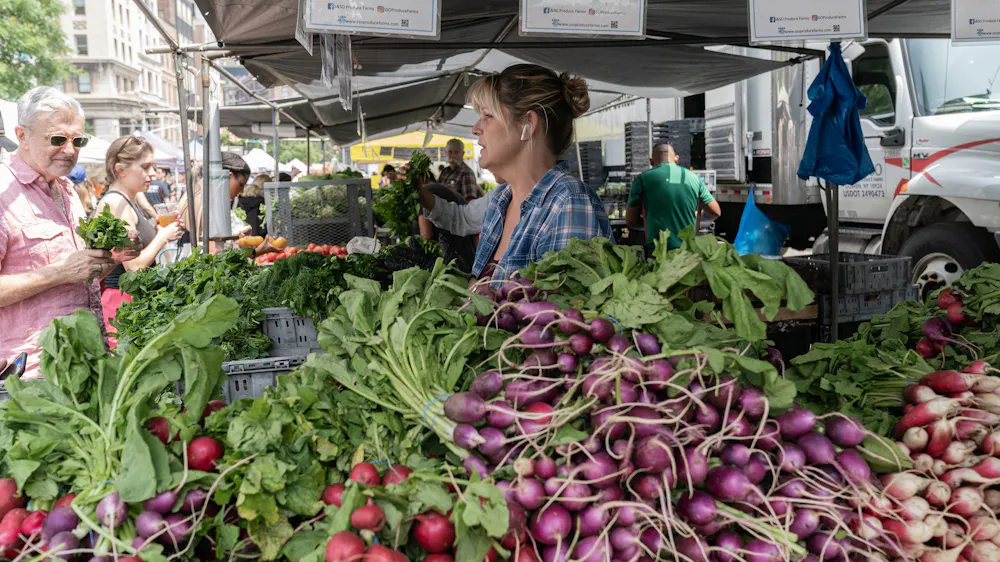
Tashana Small sells mac and cheese ‘cupcakes’ topped with pulled pork, Buffalo chicken tenders and Cajun shrimp at a farmers market on Long Island in 2023. Erica Marcus/Newsday RM via Getty Images
Roughly 17% of these shoppers fall into a “practical” category. They methodically plan their grocery shopping and are among the least interested in farmers markets, with more than half saying that they either rarely or never shop at them.
Practical consumers were close to evenly split by gender; 53% were women. Their income tended to be the highest of the groups, typically in the $60,000-$75,000 range.
We called the 12% of the shoppers in the final group we surveyed “uninvolved.” This group showed very little interest in farmers markets or any other food-related activities. About 3 in 4 rarely or never go to farmers markets. Nearly 70% of uninvolved farmers market shoppers were men and 76% were white.
When someone in the uninvolved group goes to a farmers market, they may be going out of happenstance or because someone in their life wants them to go – not due to any personal interest.
If you forget, you’ll miss it
We believe this information could help farmers markets better serve their customers and perhaps attract more shoppers.
People can, of course, go to farmers markets for more than one reason, and not everybody fits neatly into one of these categories. And everyone we surveyed had something in common: Forgetting to go was the biggest reason shoppers of all kinds didn’t make a trip to the farmers market in a given week.
To truly understand the context of a household’s income, it must be compared to local costs and long-term goals, which both may fluctuate over time. For most people, the same pillars will make up the biggest nonnegotiables in their budget. These include basic necessities like housing, groceries, utilities, and transportation, and likely some discretionary spending on hobbies, activities, and other enrichment. In an attempt to secure this lifestyle for the future, many households aim to save some of their income for emergencies, investments, retirement, education, and other long-term goals. A common budgeting technique that encapsulates these three pillars is called the 50/30/20 rule: 50% of your post-tax income goes to needs, 30% to your wants, and 20% gets set aside for the future.
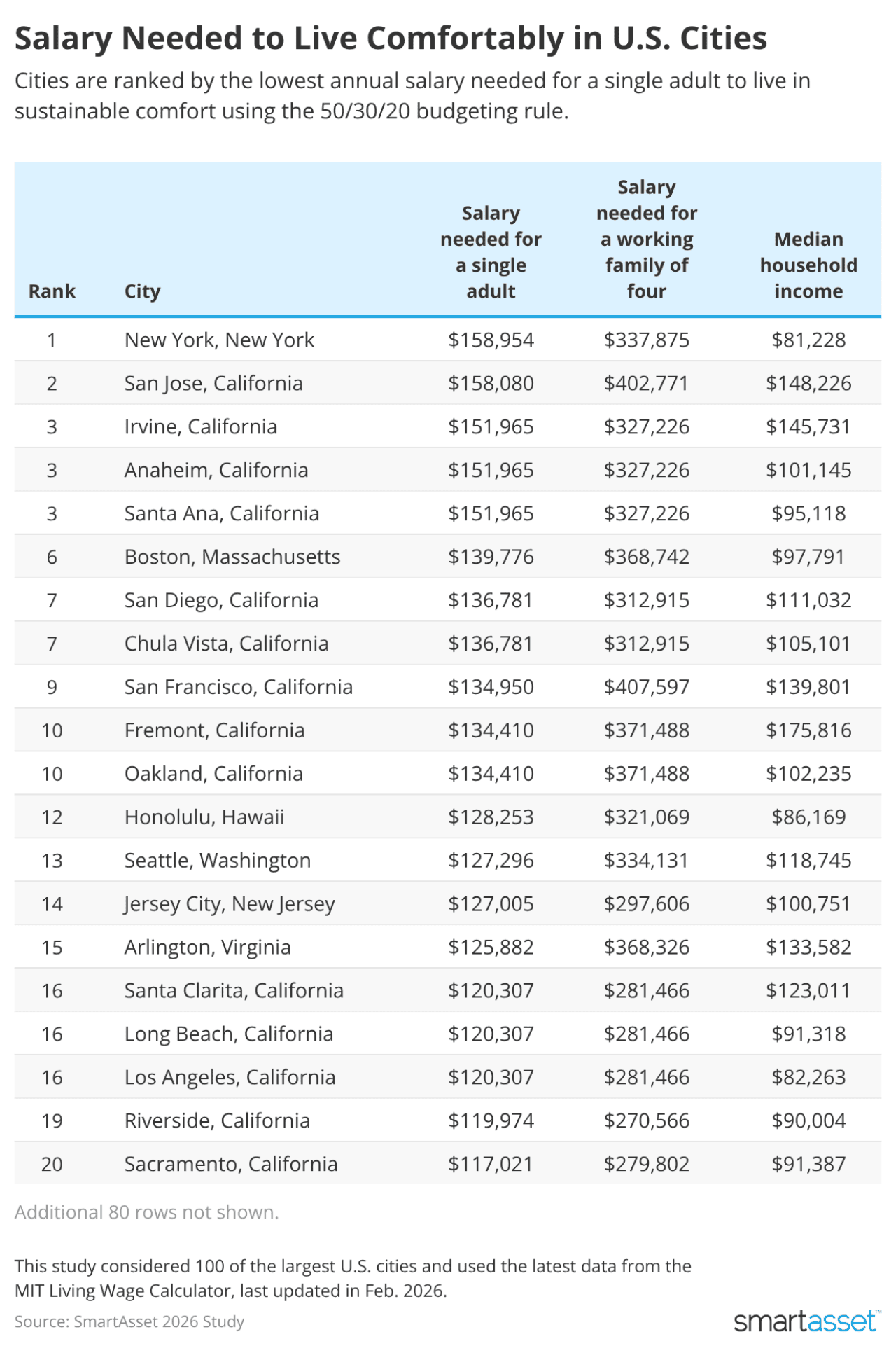
With this in mind, SmartAsset assessed the salary needed to reach this 50/30/20 ideal — designated as a comfortable salary — based on the local costs in 100 of the largest U.S. cities.
Key Findings
A single adult needs to earn $150,000 to live comfortably in these places. New York has the highest individual salary needed to live comfortably at $158,954. San Jose, California, follows closely at $158,080. Orange County cities Irvine, Anaheim, and Santa Ana require an estimated $151,965 in income for a single adult.
These cities have the lowest salary needed to live comfortably. San Antonio has the lowest salary threshold for both single adults and families of four at $83,242 and $192,608, respectively. New Orleans has the second-lowest salary needed for a single adult to live comfortably at $84,406, followed by Memphis, Tennessee, at $86,320.
The Bay Area is the most expensive place for a family to live comfortably. Bay Area cities make up the top four of the five places with the highest salary needed for a family of four to live comfortably. Incomes across two parents are projected at $407,597 in San Francisco, $402,771 in San Jose, and $371,488 in both Fremont and Oakland. Boston rounds out the top five at $368,742.
Families in these Texas cities are closest to a comfortable salary. In Frisco, the median household earns $145,444 — substantially higher than the national median of $83,730. This figure also accounts for 63.1% of the $230,464 income a family of four in Frisco needs to live comfortably. In McKinney, the $124,177 median household income accounts for 53.9% of the $230,464 needed.
10 Cities With the Highest Salary Needed to Live Comfortably
1. New York, New York
Salary needed for a single adult: $158,954
Salary needed for a working family of four: $337,875
Median household income: $81,228
2. San Jose, California
Salary needed for a single adult: $158,080
Salary needed for a working family of four: $402,771
Median household income: $148,226
3. (tie) Irvine, California
Salary needed for a single adult: $151,965
Salary needed for a working family of four: $327,226
Median household income: $145,731
3. (tie) Anaheim, California
Salary needed for a single adult: $151,965
Salary needed for a working family of four: $327,226
Median household income: $101,145
3. (tie) Santa Ana, California
Salary needed for a single adult: $151,965
Salary needed for a working family of four: $327,226
Median household income: $95,118
6. Boston, Massachusetts
Salary needed for a single adult: $139,776
Salary needed for a working family of four: $368,742
Median household income: $97,791
7. (tie) San Diego, California
Salary needed for a single adult: $136,781
Salary needed for a working family of four: $312,915
Median household income: $111,032
7. (tie) Chula Vista, California
Salary needed for a single adult: $136,781
Salary needed for a working family of four: $312,915
Median household income: $105,101
9. San Francisco, California
Salary needed for a single adult: $134,950
Salary needed for a working family of four: $407,597
Median household income: $139,801
10. (tie) Fremont, California
Salary needed for a single adult: $134,410
Salary needed for a working family of four: $371,488
Median household income: $175,816
10. (tie) Oakland, California
Salary needed for a single adult: $134,410
Salary needed for a working family of four: $371,488
Median household income: $102,235
10 Cities With the Lowest Salary Needed to Live Comfortably
San Antonio, Texas
Salary needed for a single adult: $83,242
Salary needed for a working family of four: $192,608
Median household income: $66,176
New Orleans, Louisiana
Salary needed for a single adult: $84,406
Salary needed for a working family of four: $197,766
Median household income: $58,821
Memphis, Tennessee
Salary needed for a single adult: $86,320
Salary needed for a working family of four: $193,939
Median household income: $52,679
Oklahoma City, Oklahoma
Salary needed for a single adult: $86,861
Salary needed for a working family of four: $213,325
Median household income: $70,040
Baltimore, Maryland
Salary needed for a single adult: $87,485
Salary needed for a working family of four: $224,224
Median household income: $64,778
Louisville, Kentucky
Salary needed for a single adult: $88,234
Salary needed for a working family of four: $212,742
Median household income: $67,251
Tulsa, Oklahoma
Salary needed for a single adult: $88,317
Salary needed for a working family of four: $215,238
Median household income: $60,930
Winston-Salem, North Carolina
Salary needed for a single adult: $88,442
Salary needed for a working family of four: $205,421
Median household income: $57,758
Tucson, Arizona
Salary needed for a single adult: $88,899
Salary needed for a working family of four: $218,400
Median household income: $60,483
Fort Wayne, Indiana
Salary needed for a single adult: $88,982
Salary needed for a working family of four: $233,126
Median household income: $61,436
Data and Methodology
SmartAsset used MIT Living Wage Calculator data to gather the basic cost of living for an individual with no children and for two working adults with two children. Data includes the cost of necessities, including housing, food, transportation, and income taxes. It was last updated to reflect the most recent data available on Feb. 15, 2026.
Applying these costs to the 50/30/20 budget for 100 of the largest U.S. cities, MIT’s living wage is assumed to cover needs (i.e., 50% of one’s budget). From there, the total annual wage was extrapolated for individuals and families to spend 30% of the total on wants and 20% on savings or debt payments. Median household income data for cities comes from the U.S. Census Bureau’s 1 Year American Community Survey for 2024.