Mansfield Frazier slides a cigar into his mouth, climbs into his pickup truck, and drives it from his house, in the inner-city Cleveland neighborhood of Hough, directly across the street to his vineyard, Chateau Hough. Set on three-quarters of an acre between an abandoned home, a long-shuttered library, and a vacant corner store are 14 rows of vines breeding Frontenac (a cold, hearty Minnesota red grape) and Traminette (a floral, white varietal developed in upstate New York) on the site of a former crack house. As Frazier exits the truck, he is greeted by his crew for the day: five parolees from a nearby halfway house who are responsible for the immaculately pruned vines.

“How are they treating you up there?” Frazier, a stout African-American man in his early 70s, shouts to the pruners. Eyes roll. One man has just finished serving a year for burglary, another five years for assault with a firearm. None have even stepped foot in a vineyard before. “Well, they didn’t treat me so well when I was there, but that was a few years ago,” Frazier says.


Frazier took a circuitous route into the world of winemaking. In his late 20s, he peddled strippers and prostitutes in Toronto and Miami, and he claims to have run high-end brothels and escort services in Los Angeles and New York under the street name Bae. “There was a year in my life where you name it, I did it,” Frazier recalls. “I’d buy kilos of cocaine with counterfeit money, then sell them.” In 1992, he was sentenced to three years in federal prison for credit card fraud. While behind bars, Frazier wrote From Behind the Wall, a book on the prison system and race in America that he later published. When he was released, he returned to Cleveland and leveraged his writing and community connections to become a powerful voice in the black community. He regularly contributes to Cool Cleveland, a local online publication; hosts a local radio show; and publishes Reentry Advocate, a magazine focused on the successful return of prisoners to society.

Chateau Hough, one of the first American vineyards set on reclaimed urban land, was started in 2010 with a $15,000 grant from the city and about $8,000 of Frazier’s own cash. Frazier’s main objectives were to beautify the lot across from his house (hopefully raising its value) and help out parolees, who often have trouble finding work. But he also wanted to see if Cleveland’s most notorious neighborhood could maybe make a pretty damn good wine.

The democratization of winemaking technology and expertise has made growing fine wine a reality in parts of the world that most drinkers would have previously considered unfit for even the worst plonk. But now regions from Michigan to Mexico and even China are producing locally grown wines that are not only drinkable but occasionally even great, from the rounded pinot noirs of Le Clos Jordanne near Canada’s Niagara Falls to the crisp sauvignon blanc from Kenya’s Rift Valley Winery.

Chateau Hough’s grapes may be grown on the terroir of a former crack house that Frazier had the city tear down, but his process is not much different than that of many upstart winemakers today. His right-hand man at Chateau Hough is Manny Calto, an Italian-American construction broker and streetwise former Teamsters official who resembles a bald Buddha in Crocs and learned about wine by supplying Ohio’s vineyards with labor crews, often ex-offenders. Calto first heard about the vineyard from a pamphlet Frazier had distributed to churches. “I thought, ‘Chateau Hough, what is this, a rib joint?’” Calto says. The two became fast friends. Calto walks the vines with Frazier regularly, helping him research techniques and troubleshoot problems. When the vineyard released its first vintage this past fall, it was the fruits of four years of daily effort by a reformed street hustler leading dozens of former convicts through the monotonous chores of pruning weeds, trimming vines, and tending a vineyard with the patience of monks.

[quote position=”full” is_quote=”true”]Frazier took a circuitous route into the world of winemaking. In his late 20s, he peddled strippers and prostitutes in Toronto and Miami, and he claims to have run high-end brothels and escort services.[/quote]

White and prosperous during the 19th and early 20th centuries, Hough became increasingly dense during the Depression as its grand houses were carved up for boarders. Following World War II, blacks from the South moved into the area in large numbers, as did working-class white Clevelanders displaced by highway construction. Overcrowding and racial tension made bad bedfellows, and on July 18, 1966, just a few blocks east of the vineyard, Hough erupted in riots for six nights, spreading bullets, blood, and flames. Though many residents held on, Hough never recovered, and its name is forever associated with the riots.

“My earliest memories of my street was that it was a beautiful street adorned with houses that were fully occupied,” recalls Tim Tramble, who was born after the riots and is now the executive director of Burten, Bell, Carr (BBC) Development, a nonprofit neighborhood development organization. “By the time I graduated and went to college (in the 1980s), every house on the opposite side of the street … and 50-60 percent of the houses on my side of the street had been demolished.”

Since the financial crisis, tens of thousands of foreclosures have occurred in Cleveland, along with what one non-profit estimated were 6,000 demolitions of abandoned buildings between 2009 and 2013 (with plans to destroy another 6,000). There are nearly 4,000 acres of vacant land in Cleveland, half of which are held by the city. Under the administration of Mayor Frank Jackson, Cleveland has responded to the housing crisis by aggressively promoting sustainable land use, leasing land, and funding some 250 projects around the city, from small parks to rows of commercial greenhouses in vacant schoolyards. “Our policy is not a shrinking city policy,” said Mayor Jackson in late 2012, insinuating Detroit, which has all but abandoned certain areas to large-scale farming. Eventually, Cleveland would like to see all its empty lots developed, but “right now the highest and best use for that particular piece of land is agriculture,” said Jackson, “and we use it that way.”

Frazier built his house in Hough in 2000, consulted on the construction of other houses nearby, and invested $200,000 in a six-home development in 2007, right before the housing market tanked and stopped Hough’s revival in its tracks. Frazier came up with the idea of building a winery across the street from his house to raise his home’s value. He began devouring books on viticulture and seeking out advice from Ohio’s winemaking experts, such as those who work for the state’s agricultural authorities and academics at Kent State University. They taught Frazier how to focus on grapes that would best thrive in Hough’s terroir—a mix of trucked-in topsoil, crushed concrete, and God knows what else—as well as how he should design the vineyard and how to install the trellises, right down to the specific way the wires should be stapled to the wooden posts to maintain proper tension.

[quote position=”full” is_quote=”true”]These wines may not have the well-rounded body of a Bordeaux, but they come with a narrative that justifies the price.[/quote]

Chateau Hough’s winemaking process has been largely inspired by the French garagiste movement, a collective of small, experimental winemakers with a DIY ethos that emerged in Bordeaux in the 1990s and has since become a catch-all for young, flavor-forward, micro-lot wines, often made, as the name hints, in garages. Frazier and Calto didn’t shy from the symbolism of associating their Cleveland vineyard with French winemaking. The name, etched into a wooden sign standing prominently at the corner, presents a luxurious, deliberately contrary image to the surrounding streetscape, with its abandoned liquor stores and burned-out buildings. Calling it Chateaux Hough is a big middle finger to all that, and Frazier’s quick to acknowledge that with a tone of mockery for those offended by it.

“ ‘Chateau Hough? How dare you call it Chateau Hough? You can’t do that!’ ” he says, in a high-pitched tone. “Well, I don’t need your permission. I could call it Royal Chateau Hough if I wanted to.”

Global wine drinkers, especially younger ones, have been moving away from marquee European varietals for several years, first to Australia and South America, and now into uncharted territories that touch nearly every part of the world. “I’ve been in restaurants where you hardly recognize the grapes,” said Kara Nielsen, a food and beverage trend analyst in Colorado who works for the advertising agency Sterling-Rice Group. “Even the pinot they have is coming from the Czech Republic. The sommelier comes by, they give you a taste, and you realize, ‘Hey, that’s pretty good. It’s not the pinot I used to drink, but it’s good and interesting.’” Nielsen now sees this new wine frontier merging with the evolving local food and DIY spirits trend, which has placed a microbrewery in every neighborhood and a locally distilled whiskey behind each bar.

The front lines of this are the wine lists of locally focused, hip restaurants, where young sommeliers are trying to define themselves with quirky, eclectic selections that surprise diners with unexpected grape varietals and geographic provenance. These wines may not have the well-rounded body of a Bordeaux, but they come with a narrative that justifies the price.

Jonathon Sawyer, the owner of downtown Cleveland’s popular farm-to-table restaurant Green House Tavern, sees Chateau Hough’s wine fitting perfectly on a menu where even his vinegar is distilled in-house. “[Frazier’s] not going for an upper echelon wine. He’s going for a good table juice,” says Sawyer. “Our house wine is our No. 1 seller. If we can source that within two and a half miles, you’re talking about your dream goal of being carbon neutral. … There’s something incredibly Cleveland about Mansfield. It’s a broad-shouldered city. We love to prove people wrong. … Cleveland’s never going to be Chicago or New York, but it sure as hell can be Portland.”

Around Cleveland there are now hundreds of urban farms that have appeared over the past decade, often on abandoned plots distributed by the city, and Frazier, a skilled gardener, could have chosen to plant anything on the plot he acquired from the city. But a vineyard also delivers a powerful message about an area’s worth. It’s a landmark of wealth and privilege rarely found in poor areas like Hough. “If I’d planted bell peppers, you wouldn’t be standing here,” he says, flashing a Cheshire cat’s grin. “The land we occupy in Hough is just as valuable as the land in Honey Valley,” he adds, referring to a nearby wealthy suburb rife with horse farms. “People stop and do a double take.”

Last spring, the first vintage of Chateau Hough was bottled and auctioned off to help support the vineyard. Both varietals had been mixed with grapes brought in from California to mellow out some of the harsher tannins in the red and the sweetness of the white. “It’s a B headed for a B-plus,” said Frazier, noting that they had recently added oak chips to the red, which was shaping up to taste like a medium-bodied syrah, while the white almost had the characteristics of a fruity Moscato. Later that summer, the white won a second prize ribbon at Cleveland’s county fair.

Frazier talks big about what all his little corner could become: The abandoned library to the west of the vines will house the winery, and a block away, in a decommissioned fire station, Calto and Frazier will build their own wine bar and restaurant, which will employ local youth and formerly incarcerated individuals. The two speak of tourists, students, wine lovers, and foodies making pilgrimages to Hough, which today lacks even a single restaurant. “They’re going to scream bloody murder when I ask for it,” Frazier says of the fire station, which the city still owns. But in his eyes, Hough is already becoming his own personal Napa. “I’ve always been a first-class hustler,” Frazier says with pride. “You’d better learn how to hustle, or we won’t have any wine.”


  • New York passes SAFE for Kids Act to protect children from social media addiction
    Photo credit: CanvaNew York hopes to improve children's usage of social media.
    ,

    New York passes SAFE for Kids Act to protect children from social media addiction

    New York hopes to curb social media’s access to young kids.

    “Kids and their phones these days” has been a complaint ever since the first cellular phone was introduced. However, there has been growing concern over the amount of time children spend not just on their phone, but scrolling through social media. The state of New York is hoping to address this issue through their finalized SAFE for Kids Act.

    The Stop Addictive Feeds Exploitation (SAFE) for Kids Act aims to hold social media companies more accountable for the time children spend on their apps. It also seeks to limit kids’ exposure to their algorithms. Officials believe that constantly scrolling through social media feeds negatively impacts a child’s sleep and overall mental health.

    What are the restrictions?

    The new law requires social media companies to obey the following rules:

    • No addictive, algorithm-driven feeds for minors without explicit parental consent
    • No notifications about addictive feeds to minors between midnight and 6 a.m. without parental consent
    • No tricky website designs, called “dark patterns,” that manipulate or nag parents into giving consent
    • No degrading service, increasing prices, or retaliating against minors who don’t have parental consent for addictive feeds
    • Use certified age-assurance methods to distinguish minors from adults
    • Immediately encrypt data collected for age verification, use it only for age determination, and delete it immediately after use
    • Hire an accredited, independent third party to test and certify age-assurance methods every year

    Social media companies have until January 25, 2027 to comply. Failure to do so may result in a $5,000 fine per violation.

    New York Governor Kathy Holchul and Attorney General Letitia James made a public announcement to social media companies affected by this law, specifically Instagram, TikTok, YouTube, Facebook, Snapchat, and X.

    “What changes is the default,” said James. “Platforms cannot automatically place minors into feeds engineered to maximize engagement. This is not a question of privacy, this is a question about content. This is not about the First Amendment. Again, this is about protecting children.”

    “Social media companies, you’re now on notice,” said Holchul. 

    Critics and the issues that still need to be addressed

    There are some criticisms of this law, particularly around age-verification. The law offers the option of using government-issued identification along with another proof of identity (such as an email address or an uploaded photo of the user). This complicates things aside from First Amendment rights. It would require millions of adults to share private information to scroll and post on social media after hours. While the law states that the companies must encrypt and erase such information upon age verification, that’s not guaranteed. This is especially concerning as social media companies already deal with users’ private information being hacked and leaked.

    Governor Holchul still believes this criticism isn’t a governmental issue but a business one that social media companies need to resolve.

    “Social media companies tell me, ‘We have no way of knowing whether someone’s under 18 or not,’” Holchul claimed. “I said, ‘You’re smart people. Use [artificial intelligence] to figure it out. Ask how you do it.’ And you’re not supposed to allow underage gaming anyhow—sports betting—so you must have some metric. So don’t tell me you can’t do it. Figure it out.”

    How parents can help their children on social media

    Regardless of where people stand on this law, experts offer some advice for parents who feel social media is negatively affecting their children. They recommend setting personal screen time limits for their children and taking advantage of built-in parental controls on their platforms. Parents limiting their own social media use can also influence how kids use it, too.

    Psychologists also recommend talking with children about how and why they use social media. Specifically, discuss the fantasy that social media showcases from influencers versus the real lives of those people. Talk about why there was a social media post (advertisement, sharing joy, hoping for engagement, etc.) along with the content of it. Asking how they feel after watching or reading content in their feed helps as well. Such practices, along with limiting exposure, creates trust between child and parent without judgement.

    Though how we fix screen and social media addiction is still largely in the air, take comfort knowing brilliant minds are exploring methods to address the growing issue.

  • New Russian research suggests that the human lifespan could be up to 156 years
    Photo credit: CanvaResearchers found what's preventing us from living longer.
    ,

    New Russian research suggests that the human lifespan could be up to 156 years

    Humans can live much longer if certain barriers are addressed.

    According to the Guinness Book of World Records, the oldest person lived to the ripe age of 122 years old. Such a lifespan is an incredible feat, but what if the average person could beat that record by 34 years? Recent research done in Russia has led scientists to believe that the average human lifespan could be up to 156 years.

    The researchers at Skoltech Biomed Technologies Center developed a mathematical model that allowed them to “switch on” a variety of aging mechanisms. This allowed them to calculate a human’s lifespan where mortality risk never increased with age. After experimenting with different scenarios and conditions, they found the biggest barriers to longevity were caused by non-renewable tissues and somatic mutations.

    What are these barriers against longer life?

    Somatic mutations are DNA changes within a cell. They accumulate over time during a human’s life and cannot be reversed with any existing therapy. These DNA errors that pile up in our cells contribute to the aging process.

    Many human organs like the liver and skin continually replace cells and regrow damaged portions of themselves. However, there are two organs that can’t do this: the brain and the heart. Brain tissue (neurons) and heart tissue (cardiomyocytes) cannot regenerate. This proves to be the most prominent biological limit that shortens our lifespans. This explains why issues like dementia and heart disease are prominent causes of death and morbidity later in life. Since those organs’ tissues don’t replace damaged cells, they’re prone to irrevocably decline over time.

    “The key finding of the study is the discovery of substantial differences between tissue types. Neurons and cardiomyocytes, which lack the ability to divide, turned out to be the main limiting factors: when all other causes of aging are eliminated, somatic mutations alone reduce the theoretical median lifespan from 1,759 years (for a hypothetical non-aging human organism) to 156 years,” said Evgeny Efimov, a research intern at the Skoltech Biomed Technologies Center, researcher at AIRI, and one of the key authors of the study.

    This suggests that somatic mutations and DNA damage is what ultimately prevents humans from living indefinitely, even if our brains and hearts regenerated cells like other organs.

    So what’s next?

    Now knowing these biological limitations, the researchers hope to study other areas of aging impacting the human lifespan that could plausibly be reversed. This includes mitochondrial dysfunction, telomere shortening, epigenetic drift, and loss of proteostasis. 

    The hope is to have a clearer priority list of issues for future therapies to tackle. This is not just to possibly extend life, but to improve lives in general. By developing a fully comprehensive theory of aging, Skoltech hopes to pinpoint which aspects of aging are within our scope to address. After all, thoroughly studying each puzzle piece that makes up human life gives us a better understanding of the whole.

    Of course, other impactful factors in a person’s lifespan can be addressed today. As most know, things like diet, sleep, and exercise are among them. A person’s living environment can also negatively impact their lifespan if it doesn’t have clean air, access to clean water, and so on.

    For now, the best method for living long is to follow instructions from your physician. Whether you make it to 156 years or not, living well is best for whatever time you’re given.

  • Woman documents her nephew’s late night culinary quests as the viral ‘Midnight Chef’
    Photo credit: @midnightchef_amir on InstagramAmir Jackson's late night cooking is going viral.
    ,

    Woman documents her nephew’s late night culinary quests as the viral ‘Midnight Chef’

    A 15-year-old cooking late night snacks is inspiring the Internet.

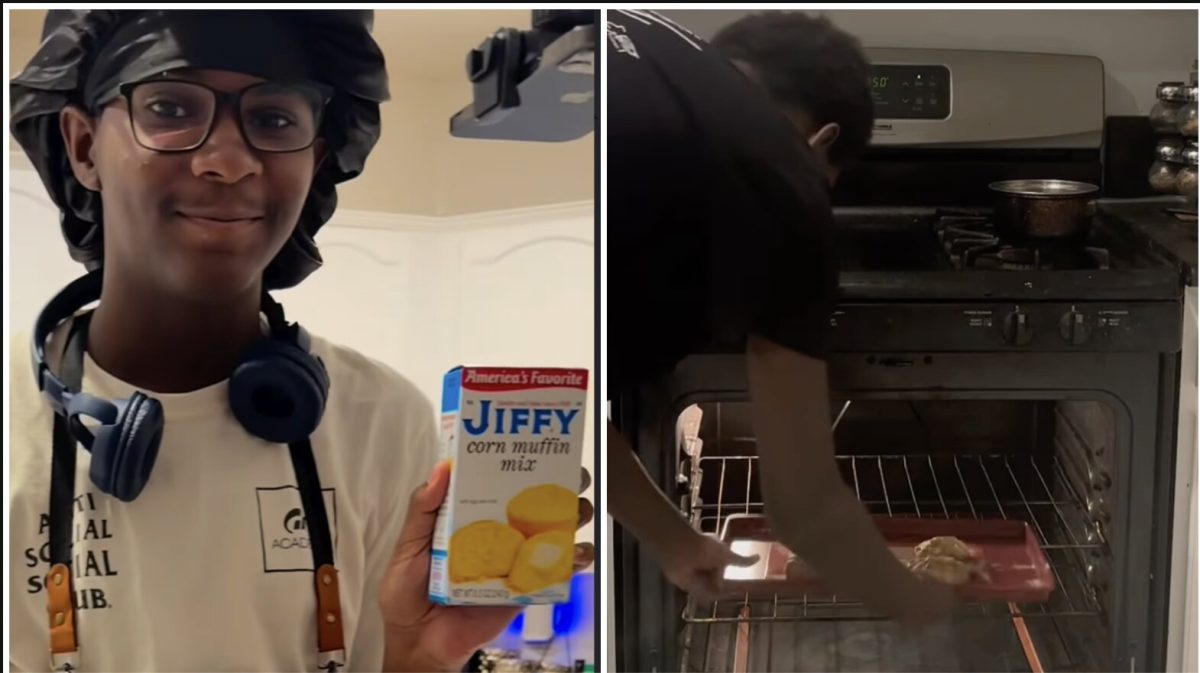
    One night in Apple Valley, California, Morgan Graham rose in the middle of the night. A smell had woken her up. It was pleasant, but at 11:28 p.m. she wasn’t expecting to smell delicious cooking. She went down into the kitchen to see her 15-year-old nephew, Amir Jackson, baking cookies.

    This was the first of several viral videos of Graham’s nephew cooking up a storm late at night. Jackson, who has been staying with his aunt during the summer, is taking advantage of her kitchen to whip up some sumptuous snacks.

    Birth of a Midnight Chef

    Nearly every night, Graham wakes up around midnight to the smell of cookies, cornbread, tacos, or whatever her nephew wants to prepare.

    “I don’t care,” said Graham in the initial video. “He’s very responsible. He’s not gonna burn the house down, so therefore, cook whatever you want.”

    Graham further explained in the video that Jackson looks at recipes daily. He also rummages through her pantry during the day to search for ingredients for his nightly cooking fest. 

    “In his world, he’s having the time of his life. In my world, I just want to stop waking up close to midnight to the smell of food,” Graham joked.

    Graham’s videos featuring her nephew have racked up millions of views on TikTok and Instagram. The commenters soon bestowed the nickname “Midnight Chef” upon Jackson, to general delight. In another video, Jackson explained he liked the peace and quiet of the night while preparing his dishes.

    “I was like, ‘Man, I could go for some cookies right now.’ I saw they had cookie dough, so I started just making them, just randomly,” Jackson told TODAY. “I was trying to make sure nobody was up. My thought process was just like, ‘Man, why not?’”

    Graham is encouraging her nephew to keep cooking even though it wakes her. In fact, Graham set up Jackson’s own Midnight Chef Instagram page for him to post his latest recipes.

    “I just want to experiment while I still got the chance to experiment. I’ll maybe like branch into different fields,” said Jackson. “Explore what I can do while I still got time to.”

    Why do we indulge in late night snacking?

    Jackson’s popularity has brought up a commonly asked question: Why do we crave food randomly in the middle of the night?

    Well, there’s actually a bit of science behind it. Turns out that late night snacking is a result of our circadian rhythm system. As part of our now-defunct survival mechanism, our ancestors would eat large meals at night to store energy in times of famine. This is also why most midnight snackers crave foods higher in fat, salt, and sugar compared to what they’d usually eat during the day. While there’s nothing inherently wrong with late night snacking, it could curb certain health goals if a person is trying to trim down.

    If you find yourself getting up in the middle of the night with a hankering for a snack, it may be worth taking a peek at Jackson’s videos. Who knows what kind of late night cooking it can inspire? Perhaps you’ll become a Midnight Chef yourself.

Explore More Stories

World

After 40 years in a Portuguese circus, elephant retires to become the first resident of a new sanctuary

Public Good

Oakland officials open ‘play-lending library’ to offset the cost of equipment for youth sports

Public Good

After a field trip for 100 low-income kids was canceled, police officer rents a whole movie theater for them

Local

14-year-old Montana kid rescues a drowning man with his lasso and rodeo skills