When Julie J glides into Gran Torino in Brooklyn, she wears a silken headscarf and a Missy Elliott sweatshirt and has Alexis Bittar hoops dangling from her ears. Many might recognize the drag artist, writer, and actress from her journey through the “Bittarverse” over the last year and half, playing the long-suffering Hazel/Jules to Patricia Black’s Upper East Side terror Margeaux in Bittar’s wildly successful social media series. Over the last several years, however, Julie has developed an abiding role as a beloved performer and community organizer in Brooklyn.

As a drag artist, Julie has also been featured by Maybelline, on MSNBC, and in The Washington Post, to name a few. She has received artist fellowships from La MaMa Experimental Theatre. She won Miss Bushwig in 2023 at the country’s largest drag festival of the same name, and Entertainer of the Year at New York’s Glam Awards in 2024, which honors achievements in nightlife performance and programming. Since March 2023, she has been the founder and co-producer, with Aaron Hock, of marathon drag benefit Stand Up NYC, which has since raised over $110,000 for organizations like Advocates for Trans Equality, Black Trans Femmes in the Arts, the Hetrick-Martin Institute, and many others.
Julie J, drag, drag queen, entertainment, stand up NYC
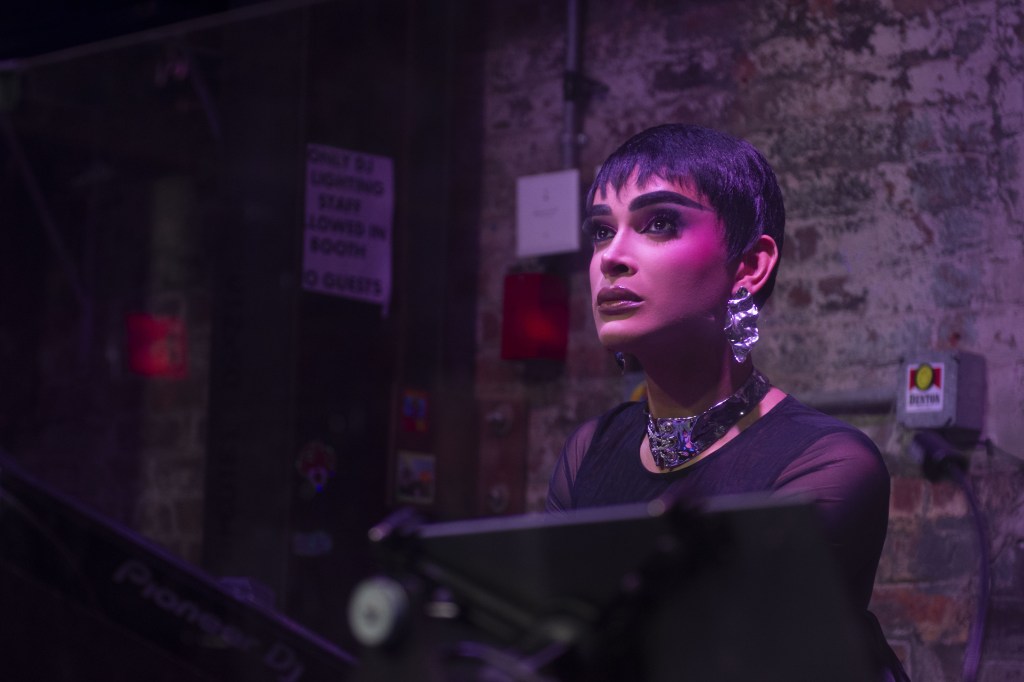
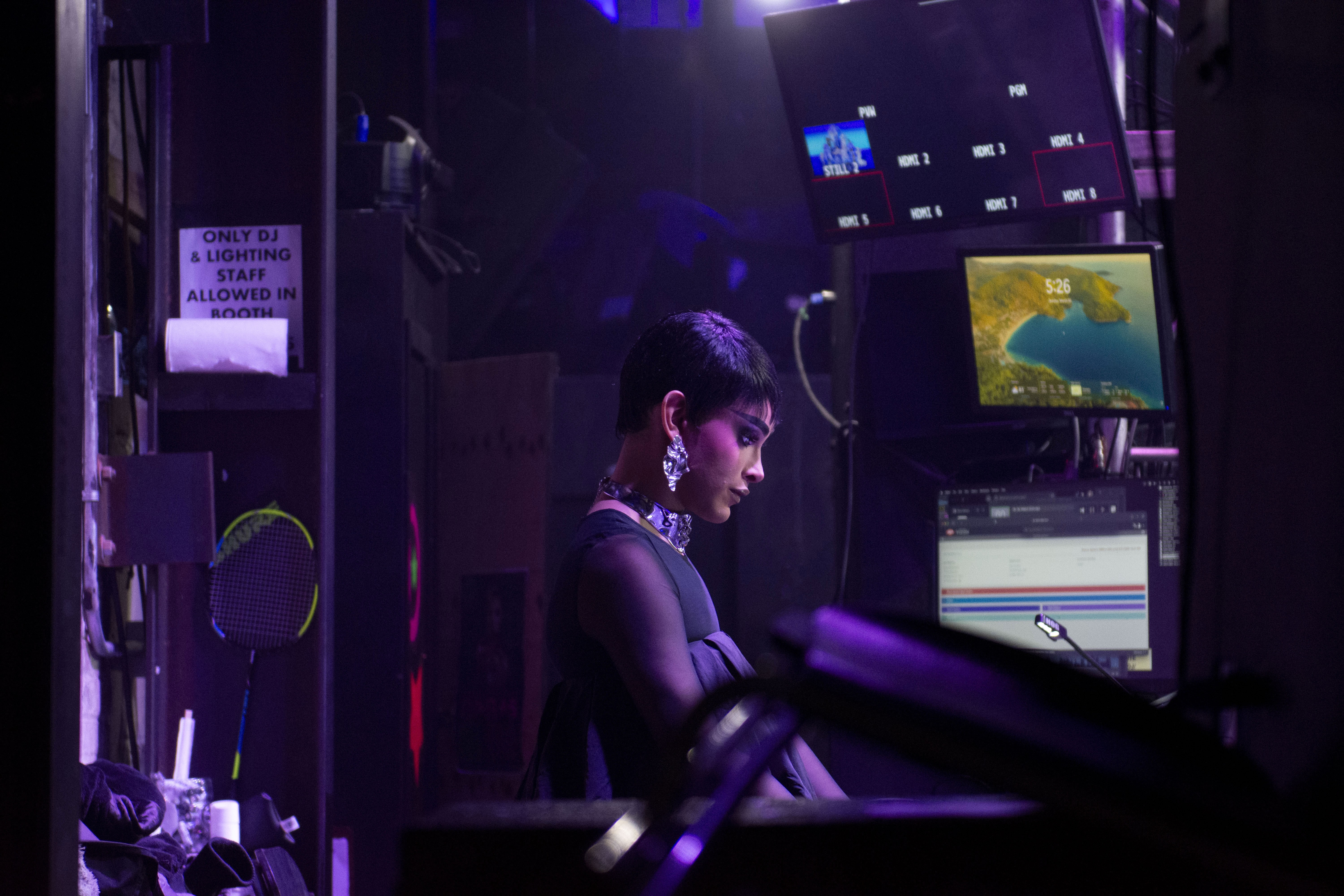
On March 30, Julie J gets organized in the DJ booth before Stand Up NYC begins at 3 Dollar Bill in Brooklyn. Elyssa Goodman

In March 2023, Tennessee governor Bill Lee signed the “Adult Entertainment Act” into law, which made it “a Class A misdemeanor offense for a person to engage in an adult cabaret performance on public property or in a location where the adult cabaret performance could be viewed by a person who is not an adult,” the bill wrote, and “establishe[d] that a second or subsequent such offense is a Class E felony.” “Adult cabaret” was defined “as a performance in a location other than an adult cabaret that features topless dancers, go-go dancers, exotic dancers, strippers, male or female impersonators who provide entertainment that appeals to a prurient interest, or similar entertainers, regardless of whether or not performed for consideration.” Because the strokes around “male and female impersonation” were so broad and left undefined, the language also challenged the existence of transgender individuals. “The language is vague enough that it leaves it in the hands of each individual jurisdiction to define what counts as a ‘male or female impersonator,’” Dahron Johnson, of the Tennessee Equality Project, told The New York Times. In a cultural moment where transgender individuals and drag artists were (and are still) already fighting for their rights and their lives, many were scared of what this meant for their futures.

That month, Julie J woke up with the urge to do something about it. “There was this electrifying feeling, this fire, that something needs to be done. We need to make something now, we need to put something together, because if we don’t do it now, things are going to start getting much worse,” she says when we meet, a few days before the next Stand Up NYC event. “I imagine it’s how people feel when they write books or when they decide to run for public office, this feeling of, someone else could do it, but they’re not, so I have to do it. This story hasn’t been told, so I have to tell it, or people aren’t paying attention to this, so I have to make the noise about it.”

Stand Up NYC was born in March 2023 and that single show raised over $25,000 for the ACLU of Tennessee, Black Trans Liberation, and the Trans Formations Project. Several times a year since then, Stand Up NYC gathers together drag artists from across New York to raise money for organizations in need.

Julie J, drag, trans activist, LGTBQ+ rights, Stand Up NYC
Julie J in the DJ booth. Elyssa Goodman

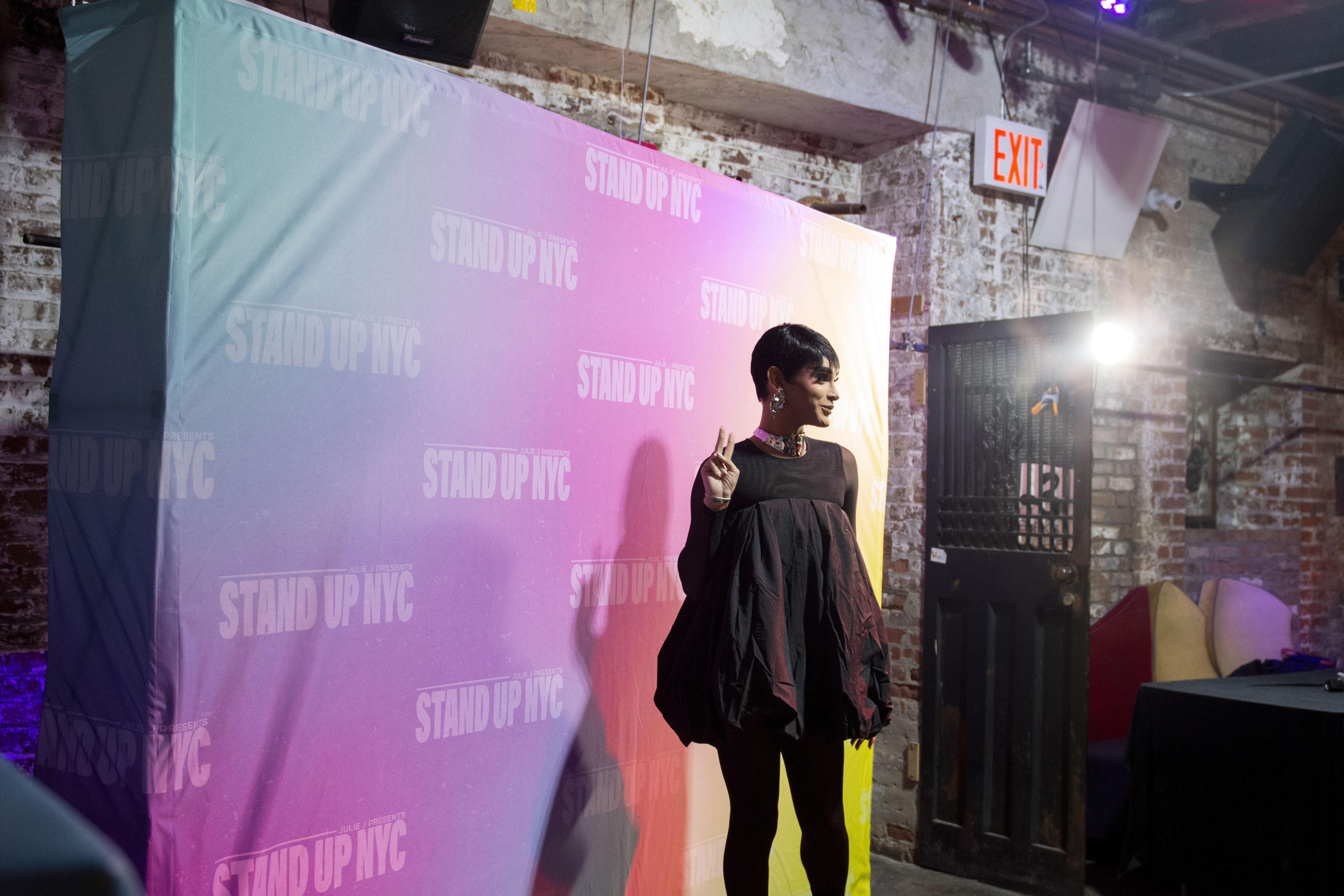
It’s March 2025 and another Stand Up NYC show is upon us. It’s a little after 5 p.m. on Sunday, March 30 when Julie and Aaron arrive at 3 Dollar Bill in Brooklyn. There’s a long night ahead of them as co-producers of their latest show, which is set to start at 7 p.m. (or thereabouts). In a short black wig and long lashes, Julie’s eyes glimmer. She wears a black cocktail dress and boots, and it’s time to get to work. Julie, who carries herself with an energy and grace not unlike Diahann Carroll or Audrey Hepburn, works on the show’s tech in the DJ booth, carries a ladder, arranges seats, discusses the event with Aaron and co-host Mariyea, and greets everyone who’s volunteering that day with genuine gratitude accompanied by a hug or a loving handshake. She knows people don’t have to show up the way they do.

“Specifically with Stand Up and starting it, I have learned the power of community, of what it means to bring a group of people together for a shared goal,” she says. “In the past, because I come from a theater background, it was kind of separate. It was like, I’m doing a task, or I am expressing myself, and these people are receiving it,” she says. “The more I got involved in community organizing spaces and even had the desire to make an impact, it was like, I can make an impact as an individual, but it’s much different when you can have other people with you.”

This is also a lesson she says she’s learned from drag, which itself has a storied tradition of mutual aid and activism that dates back centuries in the U.S., not to mention the rest of the world. “You can try to be a drag queen, drag king, drag thing, alone. It’s very hard to do. And I think something that I quickly learned is that, especially in queer spaces, and especially in drag spaces, there’s always going to be someone that’s like, do you need me to zip you up? Do you need a safety pin? Do you need this? Do you need that?” she says. “And there will always be someone that has it or that can do it. That is not always a shared thing in other spaces.”
Julie J, Stand Up NYC, entertainer, community, drag
Julie J poses for pictures prior to the show's start. Elyssa Goodman

Julie’s relationship to community organizing actually starts long before Stand Up NYC, back to growing up in Texas. “My great grandparents grew up in segregation and the Jim Crow South. So, my understanding of life has always been informed by people who have had to prove their humanity or their talent or their ability,” she says. “There was always the expectation of, you need to do well in school. You need to stand up for not only yourself, but for other people who are less fortunate or have less than you do.” Understanding the relationship between civil rights, queer history and activism in college, she was further reminded of her family’s fight for rights as well. “When the opportunity presents itself, it’s like my mind and my soul can’t help but act on it and can’t help but lean into it,” she says.

As a young queer teen, Julie remembers making a point to find other queer teens and let them know she had their backs; she remembers little queer community to speak of beyond that. In college, she found herself shaped by witnessing student activism at Sarah Lawrence College, where she studied Theatre and Literature. “When I got out of college, it was like, well, how can I keep that same momentum going? My mom has always told me, you always want to be of service to people, that’s just a part of who you are,” she says. Coming from a family of teachers is also a part of it, she believes–”this kind of lineage of care, of education, of information is ingrained in my personhood,” she says.

This makes me think of an interview Andy Warhol did with Dolly Parton in 1984.

“You could be a great preacher,” he says.
“What do you mean?” Parton says. “I am a great preacher.”

Maybe it’s the same with Julie, I wonder, but with being a teacher. Being a drag artist is not unlike being a teacher, after all. She sees it this way, too. “Especially now, whether we want to or not, [we] are teaching people that gender expansiveness is not to be feared, that it’s not something that is rooted in evil,” Julie says. Rather, it’s the opposite. “It’s a celebration, it’s joy, it’s rooted in appreciation…we’re teaching how to express joy, how to celebrate individuality.”
Julie J, drag, drag queen, activism, Stand Up NYC
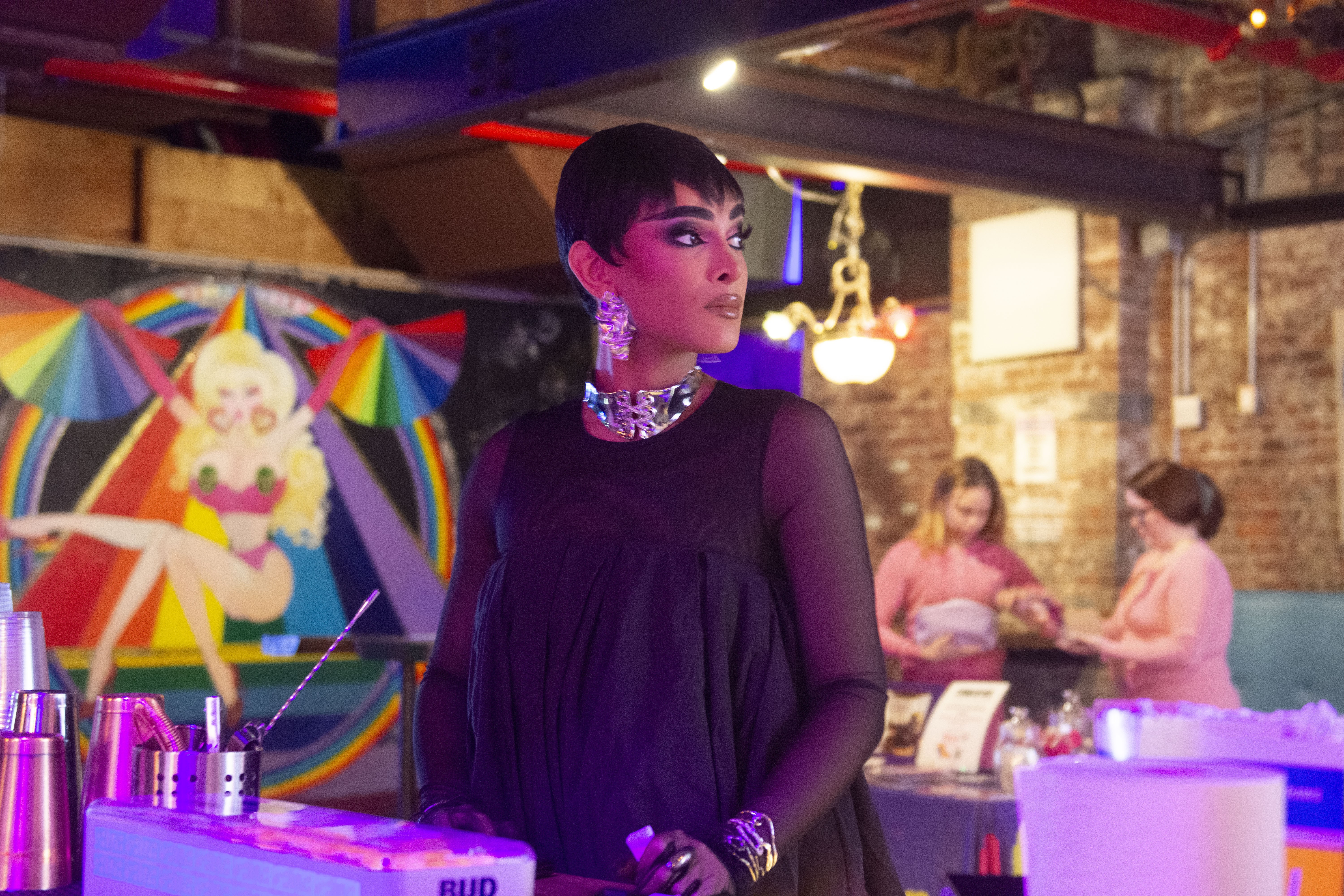
Julie J at 3 Dollar Bill before Stand Up NYC begins. Elyssa Goodman

To create space for people to do this onstage and raise funds for charitable organizations in a cultural moment such as this is its own act of radicality and love. Doing all of this for other people as you navigate your own life and a burgeoning career is another matter. And while it’s a successful career, it’s not always easy to balance, Julie says: “I think that a lot of a lot of community organizers and activists will relate to this, that there is sometimes a point in time when the the the darkness or the thing that you’re fighting so hard against, feels really close, and it feels like you’re taking a really big risk doing the things that you’re doing.” She continues, “I felt that way about when I spoke at MSNBC. Like, oh gosh, I’m making myself a target for the right-wing media and this side of the world that has no desire to see someone like me in a public place.” But doing Stand Up NYC made her think back to her childhood in Texas, and what she would have wanted then as an openly queer child in Catholic school. “There is someone who is that age now, who is looking to me and is saying, well, if she can do it, then I can, too. And I always have wanted to be the person that younger Julie wanted to look towards.”

Julie’s celebrated turn as Hazel will continue into the immediate future, and in the meantime it’s created opportunities for her at New York Fashion Week, in the upcoming campy Tina Romero horror film Queens of the Dead; and in essay contributions to the forthcoming HarperOne book No Tea, No Shade: Life as a Drag Queen. She also continues to co-produce Sylvester, “The All Black Experimental Drag Variety Show,” with Voxigma Lo and Paris Alexander. The next Stand Up NYC will be June 19. Julie’s solo show, as yet untitled, will run at lauded off-off-Broadway theatre La MaMa in 2026.

“Not that my work has ever been specifically about being a Black trans person, [but] I think I’m more intentional now about making work that just speaks to my human experience. When I’m making work now I’m saying, ‘I am a human being that happens to be x, y and z,’ rather than ‘I am x y and z and and I need to validate my humanity,’” she says. “My humanity is not up for question, that part of it is guaranteed. There are some parts of it that are decorated or that might be more unique than, say, your humanity, but they are just as valid.”

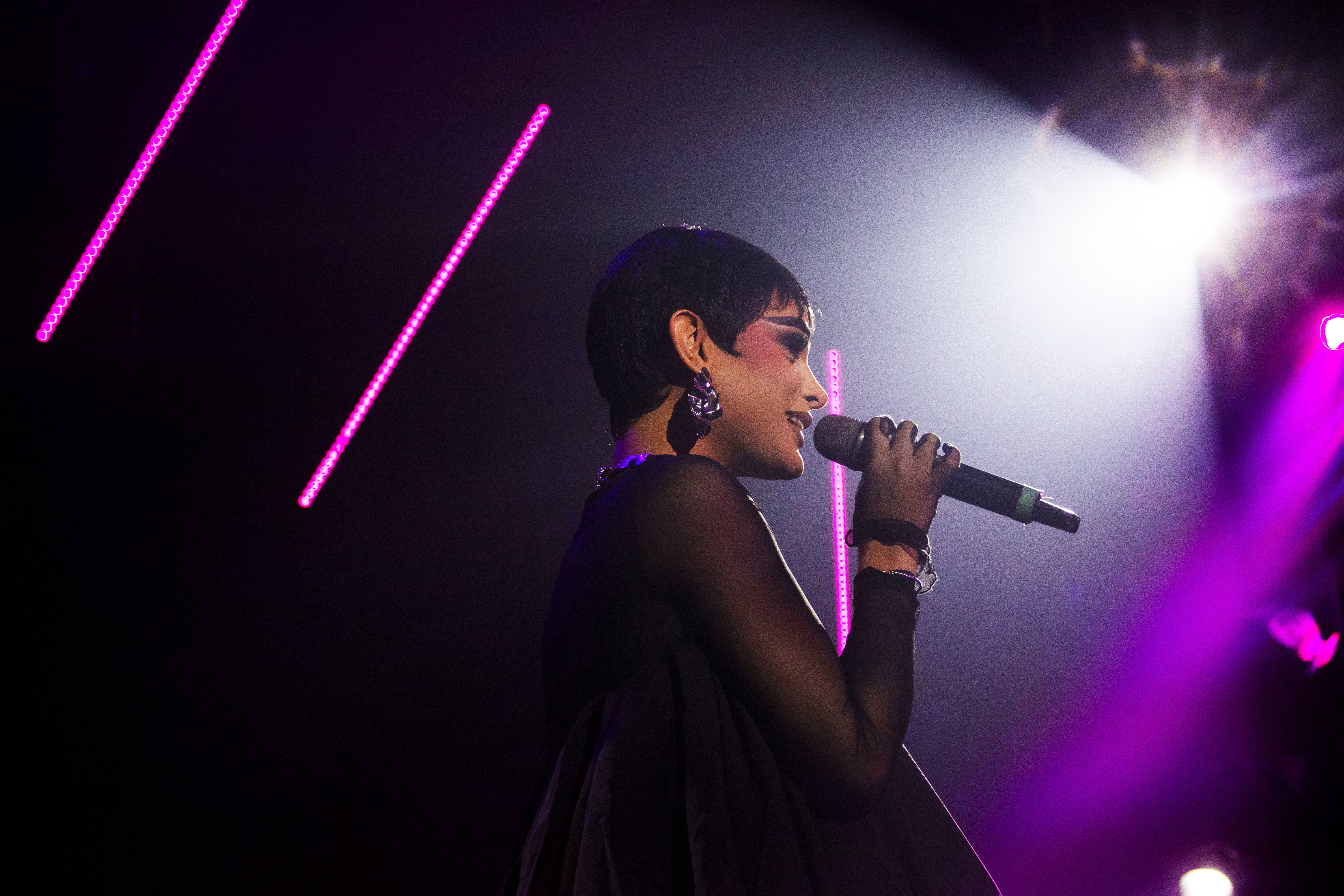
When the lights come up at Stand Up NYC, Julie and co-host Mariyea introduce the show, its mission, and soon, its bevy of performers. Throughout the night there are wild cheers. Money’s thrown and litters the stage like green confetti. People applaud, and at least one wears Julie J merch.

Partway through the evening, the performer Dawn takes the stage with a mix of Chappell Roan songs, and encourages the audience to sing along. The lyrics to “Pink Pony Club” and “Good Luck, Babe!” pour out of mouths. The feeling is of being swathed in joy, in love, in community.

As a writer, I regularly crawl into my own little cave, isolated from people, to do my work. Tonight, though, I understand the word community a little better. Because of Stand Up NYC, we all have the opportunity to know what it looks like, too.
Julie J, stand up NYC, drag, queer spaces, activism
Julie J on stage co-hosting Stand Up NYC. Elyssa Goodman

  • These seven simple phrases could be the secret to deepening trust and romance in your relationship
    A happy couple enjoys coffee togetherPhoto credit: Canva
    , , ,

    These seven simple phrases could be the secret to deepening trust and romance in your relationship

    If you want a more secure relationship a Harvard expert recommends using these seven phrases.

    Maintaining a deep sense of connection and trust in a long term relationship is often easier said than done. Even for couples who have been together for years, the daily grind can sometimes dull the spark of romance. However, Dr. Cortney Warren, a psychologist trained at Harvard Medical School, has identified a specific set of verbal habits that distinguish highly successful, trusting couples from those who struggle.

    Dr. Warren recently shared seven phrases that secure partners use every day to reinforce their commitment. These small shifts in language are designed to foster vulnerability, safety, and a sense of shared purpose.

    The first few phrases focus on the core of any partnership: the belief that your partner is on your side.

    @drcortneywarren

    Feeling that twinge of jealousy or insecurity in your relationship? It happens to all of us, but how you respond can make all the difference. Instead of immediately reacting, try this: pause and ask yourself: What does my reaction to this situation say about me? Is it about fear of being unloved? A belief that you’re “not enough”? Often, our strongest emotional reactions are more about our own insecurities than about our partner’s actions. Taking the time to reflect on your triggers, where they come from, and how you can strengthen your self-esteem can help you communicate with your partner in a healthier, more productive way. This clip is from my recent conversation with Shanenn Bryant on the Top Self Podcast. #SelfAwareness #EmotionalIntelligence #HealthyRelationships #JealousyTriggers #TopSelfPodcast #RelationshipAdvice

    ♬ original sound – DrCortneyWarren – DrCortneyWarren

    1. “I trust you.”

    Simple, to the point, and clear. This communicates that you know your partner and that you believe they have your best interest in heart, even if you get into an argument. It also allows them to feel safe making some decisions on both of your behalf.

    2. “You see me as I am.”

    This not only tells your partner that they know all there is to know about you without fear of hiding parts of yourself, but that you’re comfortable being vulnerable should a difficult subject come up. It communicates that you trust your partner will respond with compassion, not judgment, while implying that they can trust you to do the same in return.

    Dr. Cortney Warren, relationship advice, Harvard psychologist, building trust, healthy communication, romance tips, non-verbal cues, marriage success, intimacy, partnership
    A couple on a romantic date. Credit: Canva

    3. “We’ll get through this.”

    Arguments, fights, and conflicts happen in even the most solid relationships. However, saying this phrase reinforces that while things still need to be sorted out, there is no intention of breaking the relationship over the disagreement. It allows more open communication and reiterates that it is you and your partner against the problem, not each other.

    4. “Go have fun with your friends/Thanks for giving me space!”

    If your relationship is solid, time apart shouldn’t be a threat. Alone time is natural and, frankly, healthy. Respecting your partner’s independence in turn respects yours.

    Dr. Cortney Warren, relationship advice, Harvard psychologist, building trust, healthy communication, romance tips, non-verbal cues, marriage success, intimacy, partnership. Credit: Youtube

    5. “I miss you.”

    As a counterbalance to the previous phrase, “I miss you” isn’t an indicator of being too clingy unless you’re not offering your partner the trust to have space. It’s just a nice way of saying that you look forward to being together and builds upon that when you reunite, whether it’s after a long business trip or later in the evening after work.

    6. “Let’s make a plan!”

    A growing relationship means mutually planning and investing in each other’s futures to further turn “your plans” and “my plans” into “our plans.” This phrase relays to your partner that you want them around for the long haul.

    7. “Can we talk?”

    Communication issues are one of the primary reasons relationships fail. Asking this simple and direct question accompanied with the previous phrases as foundations in your relationship will allow trust for you to ask and be asked when something troubling occurs with either of you.

    While verbal communication is important in sustaining relationships, it’s good to incorporate non-verbal gestures of support, love, and trust, too.

    Now, pairing these loving wordless gestures that expertscounselors, and psychologists recommend with the previous seven phrases could help your relationship develop deeper connection and trust.

    1. Eye contact

    Seeing eye-to-eye literally helps you both see eye-to-eye better when discussing a difficult topic or when you want to express loving attention to your partner.

    2. Smile

    Smiling is a nonverbal cue to reiterate that your partner’s presence is welcomed and safe. It also reminds your partner that you’re both okay, too.

    3. Supportive touch

    Caressing a shoulder, a peck on the forehead, holding hands, or a tight hug—any of these and all of these are ways to provide comfort and reassurance along with your words. It could also be a way to indicate your interest in further intimacy.

    4. Mirroring

    Matching your partner’s posture and pose helps foster connection while also indicating you’re absorbing what they’re verbally communicating to you. So, when you adjust your posture to meet theirs when they’re discussing something important to them, they’ll know you think it’s important, too. On the other end, if you match their relaxed pose, they’ll in turn feel more relaxed, too.

    5. Enjoy quiet time together

    Being able to enjoy the silence in the same room bolsters feelings of safety and comfort. It shows that you and your partner don’t feel panicked or stressed about the other feeling bored, awkward, and you don’t cary the pressure of needing to be entertained/entertaining. Shared silence is precious in a relationship.

    6. Handwritten notes

    Okay, this might be a cheat technically, but written notes and letters can be left for your partner to find when they wake up after you have left for work early, on the kitchen table, or on a bathroom mirror as ways to express those previous seven phrases. For some people, written communication is much easier for them than speaking, too, so there’s that factor to consider.

    7. Acts of service

    This is a bit of a grab bag as what acts of service are depends on who you are in the relationship with. It could be making them coffee each morning the way they like it so they don’t have to. It could be doing a chore they hate doing. It could be cooking them their favorite food after finding out that they had a long day. These acts remind your partner that they’re known and safe with you.

    This article originally appeared last year.

  • Local governments provide proof that polarization is not inevitable
    Local officials get to participate in events such as ribbon cuttings, celebrating projects they may have helped make happen.Photo credit: NHLI/Eliot J. Schechter via Getty Images
    ,

    Local governments provide proof that polarization is not inevitable

    From potholes to parks, shared priorities are bringing people together where they live.

    When it comes to national politics, Americans are fiercely divided across a range of issues, including gun control, election security and vaccines. It’s not new for Republicans and Democrats to be at odds over issues, but things have reached a point where even the idea of compromising appears to be anathema, making it more difficult to solve thorny problems.

    But things are much less heated at the local level. A survey of more than 1,400 local officials by the Carnegie Corporation and CivicPulse found that local governments are “largely insulated from the harshest effects of polarization.” Communities with fewer than 50,000 residents proved especially resilient to partisan dysfunction.

    Why this difference? As a political scientist, I believe that lessons from the local level not only open a window onto how polarization works but also the dynamics and tools that can help reduce it.

    Problems are more concrete

    Local governments deal with concrete issues – sometimes literally, when it comes to paving roads and fixing potholes. In general, cities and counties handle day-to-day functions, such as garbage pickup, running schools and enforcing zoning rules. Addressing tangible needs keeps local leaders’ attention fixed on specific problems that call out for specific solutions, not lengthy ideological debates.

    By contrast, a lot of national political conflict in the U.S. involves symbolic issues, such as debates about identity and values on topics such as race, abortion and transgender rights. These battles are often divisive, even more so than purely ideological disagreements, because they can activate tribal differences and prove more resistant to compromise.

    When mayors come together, they often find they face common problems in their cities. Gathered here, from left, are Jerry Dyer of Fresno, Calif., John Ewing Jr. of Omaha, Neb., and David Holt of Oklahoma City. AP Photo/Kevin Wolf

    Such arguments at the national level, or on social media, can lead to wildly inaccurate stereotypes about people with opposing views. Today’s partisans often perceive their opponents as far more extreme than they actually are, or they may stereotype them – imagining that all Republicans are wealthy, evangelical culture warriors, for instance, or conversely being convinced that all Democrats are radical urban activists. In terms of ideology, the median members of both parties, in fact, look similar.

    These kinds of misperceptions can fuel hostility.

    Local officials, however, live among the human beings they represent, whose complexity defies caricature. Living and interacting in the same communities leads to greater recognition of shared interests and values, according to the Carnegie/CivicPulse survey.

    Meaningful interaction with others, including partisans of the opposing party, reduces prejudice about them. Local government provides a natural space where identities overlap.

    People are complicated

    In national U.S. politics today, large groups of individuals are divided not only by party but a variety of other factors, including race, religion, geography and social networks. When these differences align with ideology, political disagreement can feel like an existential threat.

    Such differences are not always as pronounced at the local level. A neighbor who disagrees about property taxes could be the coach of your child’s soccer team. Your fellow school board member might share your concerns about curriculum but vote differently in presidential elections.

    Mayors can find themselves caught up in national debates, as did Minneapolis Mayor Jacob Frey over the Trump administrationu2019s immigration enforcement policies in his city. AP Photo/Kevin Wolf

    These cross-cutting connections remind us that political opponents are not a monolithic enemy but complex individuals. When people discover they have commonalities outside of politics with others holding opposing views, polarization can decrease significantly.

    Finally, most local elections are technically nonpartisan. Keeping party labels off ballots allows voters to judge candidates as individuals and not merely as Republicans or Democrats.

    National implications

    None of this means local politics are utopian.

    Like water, polarization tends to run downhill, from the national level to local contests, particularly in major cities where candidates for mayor and other office are more likely to run as partisans. Local governments also see culture war debates, notably in the area of public school instruction.

    Nevertheless, the relative partisan calm of local governance suggests that polarization is not inevitable. It emerges from specific conditions that can be altered.

    Polarization might be reduced by creating more opportunities for cross-partisan collaboration around concrete problems. Philanthropists and even states might invest in local journalism that covers pragmatic governance rather than partisan conflict. More cities and counties could adopt changes in election law that would de-emphasize party labels where they add little information for voters.

    Aside from structural changes, individual Americans can strive to recognize that their neighbors are not the cardboard cutouts they might imagine when thinking about “the other side.” Instead, Americans can recognize that even political opponents are navigating similar landscapes of community, personal challenges and time constraints, with often similar desires to see their roads paved and their children well educated.

    The conditions shaping our interactions matter enormously. If conditions change, perhaps less partisan rancor will be the result.

    This article originally appeared on The Conversation. You can read it here.

  • His memory resets every 30 seconds. A look inside his 1990 diary shows what he never forgot.
    An older man writes in his journalPhoto credit: Canva
    ,

    His memory resets every 30 seconds. A look inside his 1990 diary shows what he never forgot.

    He was a brilliant musician until a viral infection left him with a memory span of only 30 seconds.

    In 1985, the life of British musicologist Clive Wearing changed forever. After contracting herpesviral encephalitis, a rare virus that attacked the memory-forming regions of his brain, Wearing was left with what is considered the most extreme case of amnesia ever recorded. For four decades, his life has been lived in a loop lasting between seven and 30 seconds.

    Recently, a page from Wearing’s diary dated January 13, 1990, surfaced online via Diaries of Note, offering a haunting and beautiful look into a mind that cannot retain the past. The diary is filled with entries made just minutes apart, each one declaring that he has just woken up for the very first time.

    At 7:46 am, he wrote, “I am awake for the first time.” Just one minute later, at 7:47 am, he crossed that out and wrote again, “This illness has been like death till NOW. All senses work.” Because he cannot trust his own handwriting or remember writing the previous line, his diary is a chaotic map of scratched-out sentences and desperate attempts to grasp consciousness.

    A Rare Neurological Intersection

    Wearing’s condition is unique in the world of neurology because he suffers from both retrograde and anterograde amnesia simultaneously. According to Study.com, most patients only experience one form. Because he cannot retain any new information (anterograde) and has lost most of his past (retrograde), he lives in a perpetual state of confusion.

    Currently residing in an assisted living facility, Wearing understands his immediate surroundings but has no idea how he arrived there. Tragically, while he knows he has children, he cannot remember their names or faces. He knows he was a musician, yet he cannot recall ever playing or hearing a single piece of music—though, remarkably, his muscle memory remains intact, allowing him to play the piano and conduct with the same brilliance he possessed before the illness.

    The Bond That Defied Science

    While the virus destroyed his ability to form new memories, it failed to erase his connection to his wife, Deborah. Through decades of “restarting” his conscious mind, his first instinct upon seeing her is always one of pure joy and recognition.

    Deborah has documented their life in her memoir, Forever Today: A Memoir Of Love And Amnesia. She describes their relationship as a “story of a marriage, of a bond that runs deeper than conscious thought.” According to Historic Flix, she has worked closely with the Amnesia Association to help the NHS develop better rehabilitation protocols for those with severe brain injuries.

    In an interview with The Guardian, Deborah shared a perspective that challenges our traditional understanding of the human brain. She explained that even when her husband was in his most acute state, his love for her remained the one constant.

    “I realized that we are not just brain and processes. Clive had lost all that and yet he was still Clive,” she told the publication. “Even when he was at his worst… he still had that huge overwhelming love for me. That was what survived when everything else was taken away.”

    This article originally appeared two years ago.

Explore More Literature Stories

Literature

In 1964, Wizard of Oz co-stars Judy Garland and Ray Bolger reunited for a profound interview

Literature

Bestselling author shares the liberating freedom of letting others be wrong about you

Literature

The big reason why ’90s restaurants were loud and fun and now everything is beige

Literature

Eric Idle says this classic Beatles moment shows they were ‘just as funny’ as Monty Python