You vacuum it, sweep it and wipe it off your furniture. But do you know what it actually is – and how it may affect your health?
Don’t feel bad if you’re clueless about your dust. Scientists are not that far ahead of you in terms of understanding the sources and health risks of indoor air and particles.
That’s an issue, because people spend a lot of time indoors. Indeed, the average American stays within four walls for almost 90% of their day. So knowing more about how your indoor environment affects your health is vital.
To better quantify environmental influences on health, researchers have begun using an “exposome” approach, which considers every last environmental exposure an individual experiences over a lifetime. Your own exposome includes everything from secondhand smoke when you were a baby to lead exposure in your childhood to particulate matter if you grew up near a major roadway or industrial facility.
Dust is a big component of the exposome. What particles are you inhaling and ingesting as you go about your day?

I’m a geochemist, and my lab studies environmental health at the household level. Along with environmental scientist Mark Taylor at Macquarie University and other international partners, I’m conducting a research project on the indoor exposome.
Instead of dumping their vacuum canister into the trash, citizen-scientists put it into a sealable bag and send it off to our lab for analysis. This project, called 360 Dust Analysis, is one of a number of recent efforts that are starting to crack the code on indoor dust.
The dust is coming from inside
About one-third of household dust is created inside your home. The components differ depending on the construction and age of your home, the climate and the cleaning and smoking habits of occupants, so there’s no standard formula for dust.
First, you and your pets generate some of that detritus. Sloughed off human skin cells are part of the debris. So are pet skin cells, called dander, and dust mites that feed on skin – both of which are strong human allergens.
Overall, you can be sure that your dust also includes some decomposed insects, food debris (especially in the kitchen), fibers from carpet, bedding and clothes, and particulate matter from smoking and cooking. We hope our 360 Dust Analysis program will help solve more of the riddle of just what else goes into dust.
So far, so gross. And there are humanmade chemicals in the mix as well. For decades, manufacturers have chemically treated clothing and furniture with flame retardants and surface protectants. In fact, for some time, the flame retardants were required by law in furniture and children’s sleepwear.
But then researchers started identifying them in human blood and tissue, and even newborns showed evidence of exposure in utero. How did these molecules end up in people’s bodies? Mostly via inhalation or ingestion of indoor dust.
Health concerns about what we put in our homes
Here’s one place new science and new techniques are starting to raise serious health red flags. A flurry of research is currently underway to determine the potential toxicity of these chemicals in the human system. Scientists are also developing new techniques using wearables, such as silicone wrist bands, to determine the relationship between these dust sources and how much of them winds up in a person’s body.
A pet-free and fiber-free indoor environment would be one way to reduce the amount and potential toxicity of indoor dust. But there’s an additional concern that’s emerged from recent research: the rise of antimicrobial resistance.
Research has linked several indoor disinfection products to antimicrobial resistance. At least one study found that elevated levels of triclosan, a common antimicrobial agent in hand soaps, were correlated with high levels of antibiotic-resistant genes in dust, presumably from bacteria that live in your home and dust. This relationship is due to repeated partial, but not complete, destruction of bacteria and other microbes that go on to grow and proliferate, carrying resistant genes.
The dust that comes in from outside
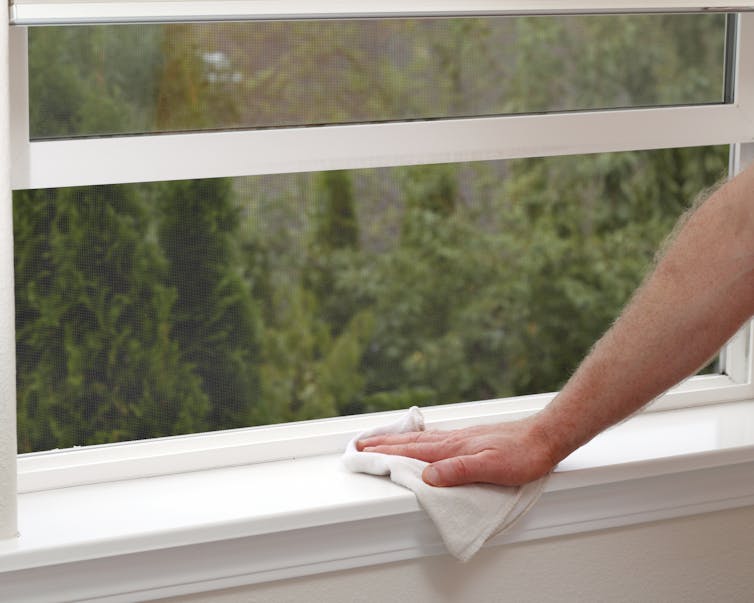
To get a full picture of dust sources and hazards, you need to consider the other two-thirds of the indoor dust load, which actually come from outside. This dirt and dust is tracked in on shoes and on the feet and fur of pets. It blows in through open windows and doorways and vents. And it ranges in size and composition from gritty silt to irritating pollen to the finest of soil particles.
One of the most widespread health issues related to outdoor sources is lead. This potent neurotoxin has accumulated to sometimes extremely high levels in soils and dust after a century of emissions from industrial sources, vehicles burning leaded gasoline and degraded lead-based paints. The hazard is particularly great in cities and near mining or other industrial point sources of lead.
Lead-contaminated soils, and dust generated from them, are tightly linked to lead poisoning of children. Owing to their active neural development, lead can permanently disable exposed children.
In the drive to prevent lead poisoning, scientists have focused on what they call point sources: relatively easily identifiable things like peeling paint and lead water pipes. Soil and dust exposures are less well known.
Researchers have recently found correlations between lead in air and blood lead levels in children. Now several lab groups are taking a careful look not just at exposures in outdoor settings but also at how lead may seep into homes and become part of the indoor exposome.
Limit what you can
Much as Freon in refrigerants and other products caused the degradation of Earth’s protective stratospheric ozone layer and bisphenol A, a plasticizer used in bottles and other consumer products ended up in people’s bodies, there’s concern among scientists that “better living through chemistry” might result in a string of unintended human health consequences in the realm of dust.
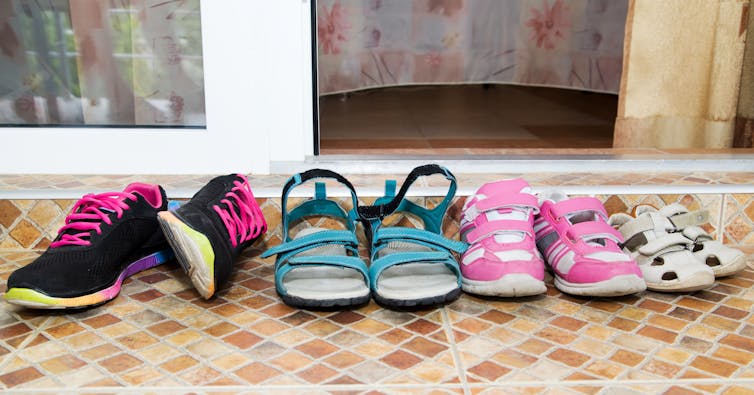
Taking off outdoor clothing like jackets and adopting a shoeless household policy is one way to reduce indoor exposure to outdoor pollutants. Shoe bottoms are gross: 96% of shoes have traces of feces bacteria on their soles, including the antimicrobial resistant C. diff, and over 90% of these bacteria are transferred to floors. Add in cancer-causing toxins from asphalt road residue and endocrine-disrupting lawn chemicals, and the recommendation becomes even clearer – no outdoor shoes inside.
Gabriel Filippelli is Professor of Earth Sciences and Director of the Center for Urban Health, IUPUI.
This article originally appeared on The Conversation. You can read it here.