
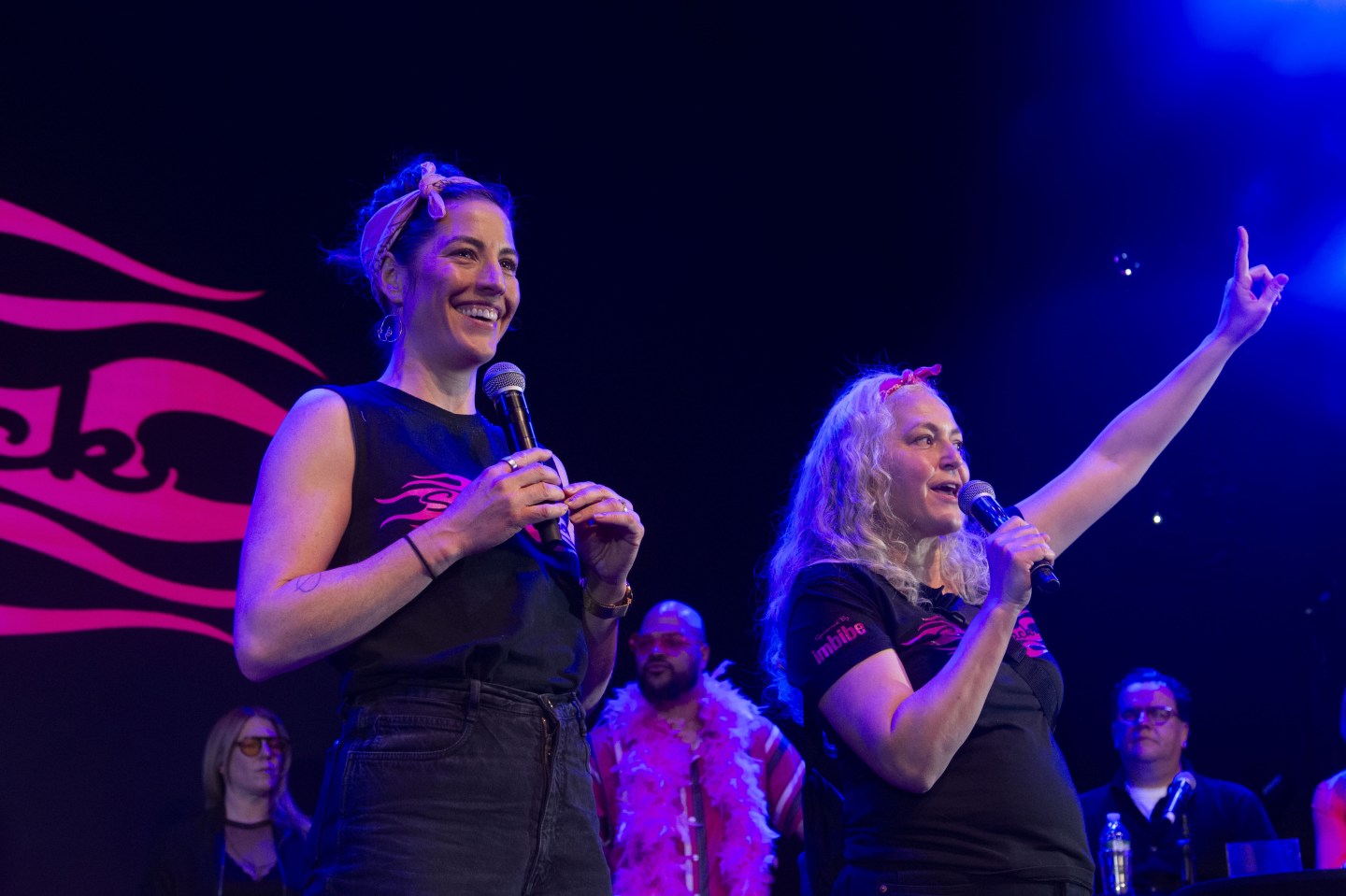
“We have no women bartenders, where are all the women?” Lynnette Marrero remembered.

The decorated bartender and mixologist worked a cocktail festival many years ago where some 30 women put it together behind the scenes. But when it came time for a film crew to record female bartenders, they were at a loss. She didn’t want it to happen again and neither did fellow renowned bartender Ivy Mix. “It was an a-ha moment, of what can we do to showcase these women?”

Their answer became Speed Rack, the world’s first and only all-female and femme speed bartending competition–a speed rack is also part of a bar to place liquor for quick handling. Now in its thirteenth year, Speed Rack, featuring “Women shaking up the cocktail world,” is part of a larger movement ensuring nobody else wonders where the female bartenders are: they’re right there behind the bar. Marrero and Mix had witnessed too many women and femme identified individuals not getting the credit they deserved or not being able to break through into craft cocktails. Speed Rack became a way to help change that. “It was just about creating a platform and a pedestal for these women to be seen doing what they do every day,” Marrero says. Plus, all proceeds from every Speed Rack event support charities dedicated to breast cancer research like The Pink Agenda. Since it began, Speed Rack has raised over two million dollars for these organizations.
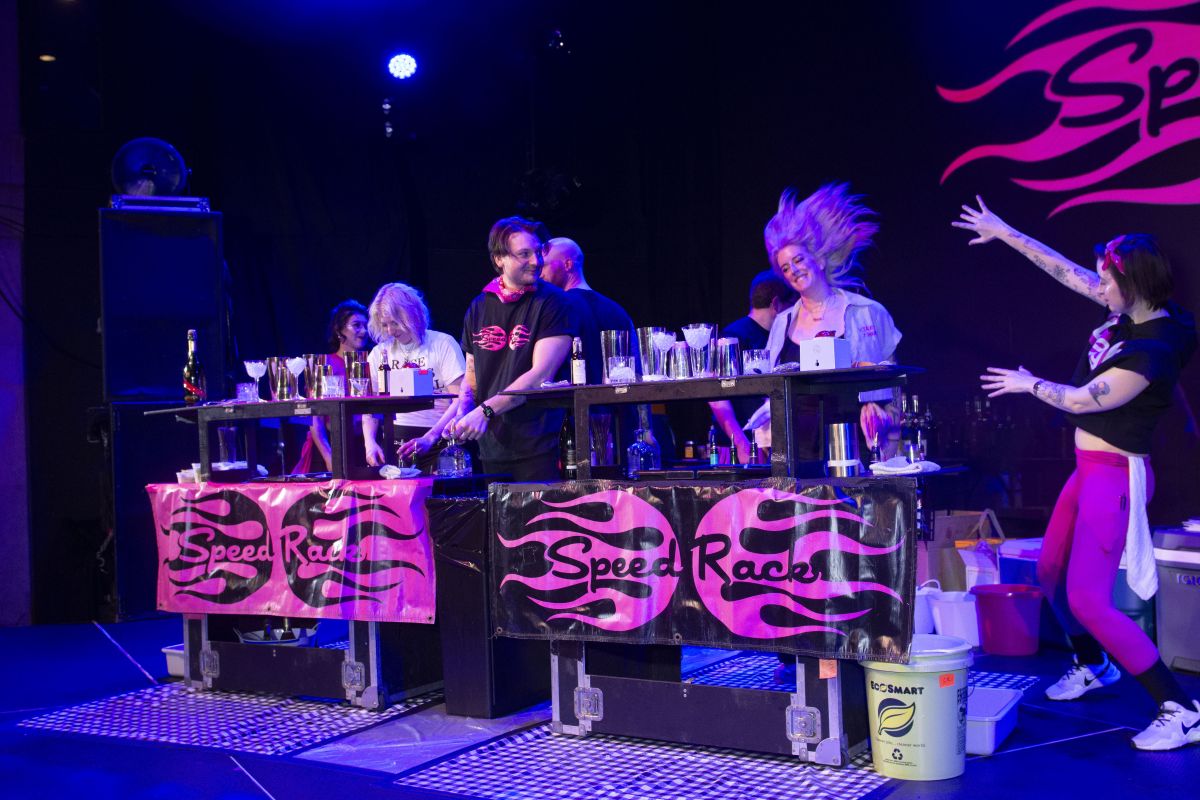
Competitors Sam Smagala, of the bar Joyface, and Miranda Midler, Head Bartender of Dear Irving's Broadway location,u00a0shake it off before Round 1 begins. Elyssa Goodman

On February 17 2025, the eight top bartenders in New York’s regional Speed Rack competition arrived at Melrose Ballroom in Queens for the city’s regional finals. By that point, the field had already been narrowed from some 85 online applications with video submissions to a preliminary competition of 20-25 to tonight’s eight participants. They came from across the city’s cocktail bars–Mister Paradise, The Crane Club, The Portrait Bar, and others–and had to be working at least four shifts a week to qualify.

In a round-robin, bracket-style competition, participants will have to make four perfect cocktails in a matter of minutes–it’s a competition that’s ultimately about speed and accuracy. The drinks will then be delivered to the judges, who will deliberate and give feedback–errors will add time to a competitor’s score. The winner of each round proceeds until there are only two left and a winner is chosen.

The winner will proceed to the National Finals in July at the annual Tales of the Cocktail conference, this year in New Orleans. There, winners from events in Chicago, Denver, Portland, OR, Washington, D.C., and Puerto Rico will join her, as will winners from Fast Track competitions in Nashville, San Francisco, Houston, Louisville, and Orlando. By the time finalists get to Nationals, they’ll have been training for at least two months, selected for teams sponsored by some of the biggest alcohol brands in the world.
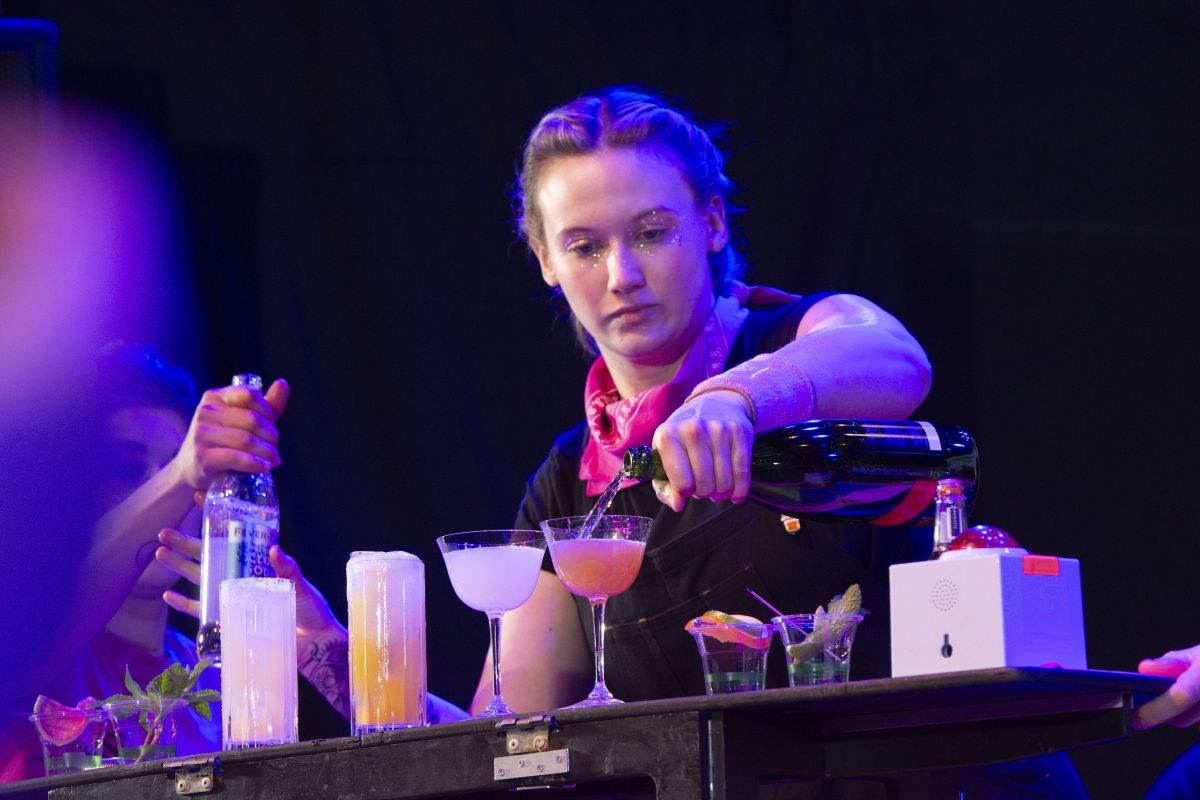
Competitor Hope Rice of The Crane Clubu00a0finishes up the final cocktail of her round, an Old Cuban, with a pour of G.H.Mumm Champagne. The Old Cuban is a drink created by legendaryu00a0bartender Audrey Saunders. Elyssa Goodman

At Nationals, between 16-18 people will compete for a scholarship to the Beverage Alcohol Resource’s 5-Day Program, featuring an opportunity for certification with the “Curriculum for the World’s Most Comprehensive Distilled Spirits & Mixology” held at once a year at the Culinary Institute of America in Hyde Park, New York, not to mention countless brand and networking opportunities. Marrero says that Mix usually speaks to contestants beforehand and reminds them that “everyone knows you competed.This is a job interview, so go out there and network, do your best, because whether you’re the winner or not, there’s opportunities that come from this.” Later this year, Speed Rack will also return to Canada and Australia.

Speed Rack becomes not just a way to bring awareness to the gender gap in bartending and the beverage industry, it’s how the gap starts to close. Build a community, reward people for doing a good job, and give them the resources to continue pursuing their education in the field. So it’s fitting that even before the audience starts to arrive at Melrose Ballroom, there’s something electric happening. What’s at stake is not just about cocktails.The venue’s two floors will eventually fill up entirely, and over $14,000 will go to charity. The hot pink fireballs of Speed Rack’s logo and matching pink lights cast a glow across the venue, where sponsors of the event, including brands like Cointreau and Patron, among many others, have set up booths and started mixing cocktails of their own for guests. It’ll be a night full of industry folks, though anyone is welcome to attend.
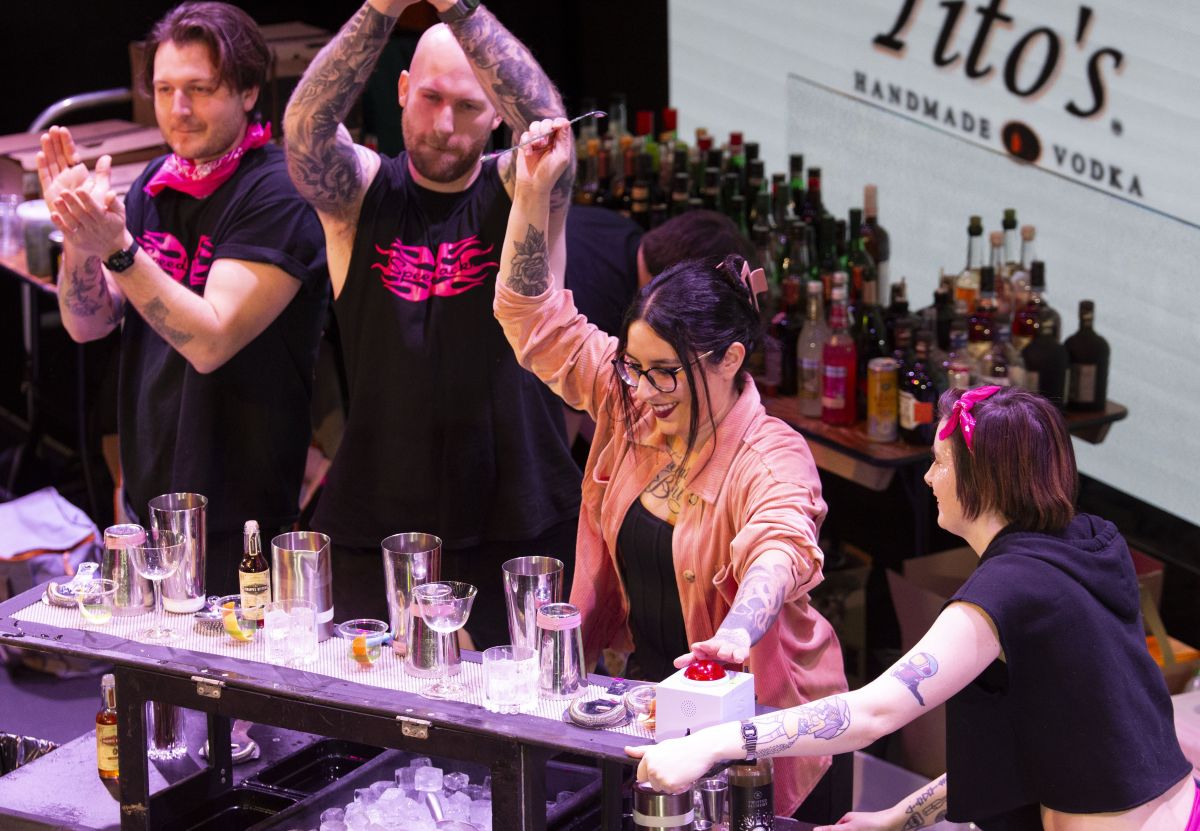
Competitor Ileana Hernandez just before her round begins. Ileana works at Greenwich Village restaurant Llama San. Elyssa Goodman

Contestants start to mill about the space–they’ve dotted their faces with pink glitter, tied hot pink Speed Rack bandanas around their necks, spotted clothing with pink rhinestones, painted on thick cat eye liner, donned olive cocktail rings, and more. Hugs are thrown with abandon.

“We have so many fresh new faces, I just wanna let y’all know drinking culture in New York is in great hands,” Marrero says, to uproarious applause as she and Mix begin the event. With volunteer barbacks, the first contestants prepare their stations. Ice fills glassware, and sponsors’ bottles are lined up behind the bars for easy access. The host tonight is Vance Henderson, lauded National Brand Ambassador for Hendricks Gin, decked out in hot pink sunglasses and a matching feather boa. He introduces the judges, who are also deeply respected in the beverage industry: Ignacio “Nacho” Jimenez, Operating Partner of cocktail bar Superbueno; Iain Griffiths, co-founder of Bar Snack; Charlotte Voisey, Tales of the Cocktail’s Executive Director; and Amy Racine, Beverage Director and Partner of JF Restaurants.

Full of friends and industry professionals, the audienceu00a0cheers for the annualu00a0New York Regional Speed Rack competition. Elyssa Goodman

I feel jitters just hearing their credentials, but it’s part of the bartenders’ presentation tonight to remain calm and poised. The event, Marrero says later, “showcases what happens on a Friday night, Saturday night, when you’re in a craft cocktail bar and you’re working service, and then four cocktail luminaries walk in and ask for a round, and you have to make that round perfectly, beautifully and fast, really fast.” The drinks must be “balanced, look beautiful and be made with grace behind the bars,” Speed Rack says in its competition notes. The event is intense–the opportunities it gives participants could really change their lives if they want it to–but the mood remains high: Henderson introduces each contestant not unlike fighters in a boxing match, and volunteer barbacks, also industry people, are personal hype folks throughout the night, waving fans and cheering on participants.

With each round, contestants will be given four classic cocktails to produce, one selected by each judge, and the round will be over in a matter of minutes–never longer than five, and even four would be pushing it. The bartenders become a choreography of shaking and stirring and pouring and tasting (and, at least once, egg separating) and when they’ve finished all four beverages, they slap a buzzer to stop their clock. Bensonhurst, Suffering Bastard, Whiskey Sour, Cosmopolitan, Nippon and other cocktails course over the bar through the evening, and soon the judges weigh in. Was it perfect? Too much tequila? Too herbaceous? Was the garnish placed appropriately? Did the drink need to be more diluted? While they wait for final scores, bartenders high five friends like they’re autographing headshots at a movie premiere, they pour shots into mouths, they can’t believe they did it again. With final scores, the winners advance.

As the night goes on, more and more people push toward the front. People cheer on their friends, bang on the stage, a flamboyant chorus of “WOOOOOOO” and “GIRLS! GIRLS! GIRLS!” and the girl next to me who looks a contestant dead in the eyes and says “Rachel, you’re a bad bitch. BAD. BITCHES. ONLY,” with a half-empty cocktail in her hand.
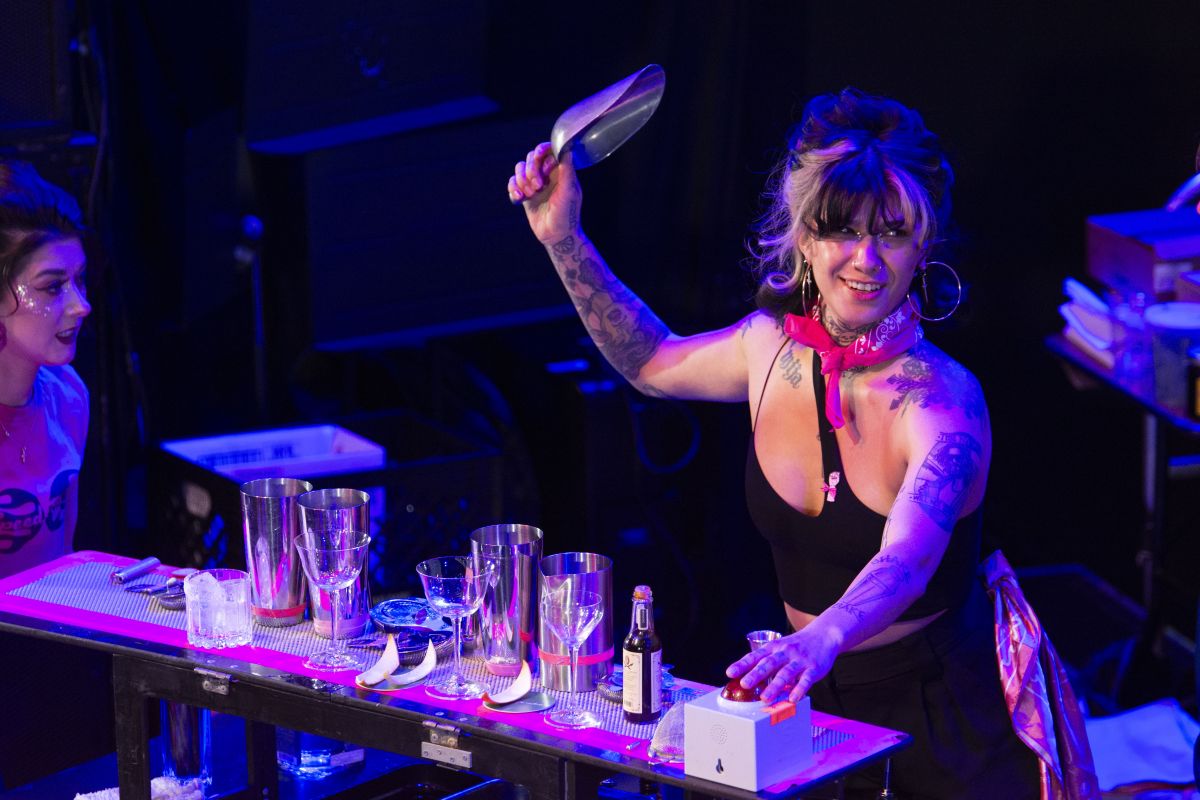
Competitor Rachel Prucha, of Mister Paradise and Hawksmoor,u00a0ready to take on her round. Elyssa Goodman

The music gets louder. In the last round, the finalists are indeed the aforementioned Rachel, Prucha of Mister Paradise and Hawksmoor, and Lana Epstein of The Portrait Bar. Taking their places behind the bar, all they have to do now is make four perfect cocktails while a few hundred of their closest friends and industry professionals scream and chant and applaud. It’s another dance, of whiskey and raspberries and straws and tonic and ice and god knows what else, into jiggers, into shakers, into mixing glasses, until that buzzer is banged for the last time and the cocktails are out, in front of the judges. The deliberation feels endless. It’s some four hours from when we started and nerves are askew. More shots! More cheering! Lana, Lana! Rachel, Rachel!

Lana wins, and then something amazing happens–a swirl of friends and bartenders who competed rush the stage to cheer her on, her name chanting from their lips as they embrace her in a giant hug and pink petals fall from the ceiling. People put her on their shoulders, they take pictures, they pour bubbly into her mouth like it’s the Super Bowl. The joy is genuine, and to me it’s the most moving part of the evening because it’s ultimately what Speed Rack is actually about: women supporting women.
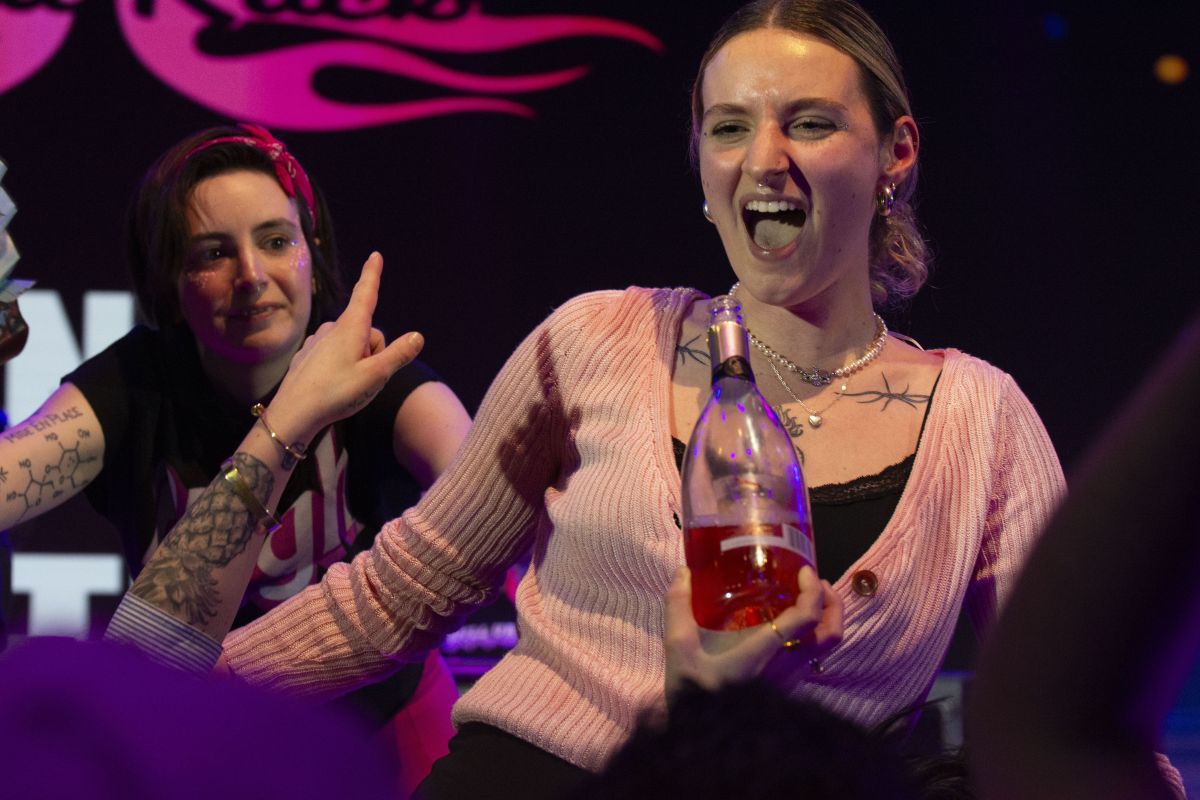
Bartender Lana Epstein, of The Portrait Bar,u00a0wins Speed Rack's New York Regional competition. Friends and fellow competitors raise her up and offer bubbly to celebrate. Elyssa Goodman

“The community vibe of, ‘it’s not just one of us, it’s all of us,’ is really important,” Marrero says. She believes Speed Rack can keep regenerating itself because it really is an event for the community. There’s an understanding that the platform represents inclusivity, she continues, giving basic training to everyone and sharing foundational knowledge, and this helps people move up in the industry and continue sharing.

Marrero doesn’t remember a lot of men helping her with this when she started–it was women. She hopes in the future there will be even more women and femme identified individuals in ownership, partnership, and leadership positions throughout the beverage industry. While she says many people come to the industry for a flexible work life as they pursue an artistic endeavor, she already sees Speed Rack’s impact making space for the next generation. “The future is in, the more people that we continue to recruit to stay in the industry,” she says. “The rest of us can then go on to get funding, open places, and give those folks a spot to grow and and really, light the world on fire one cocktail at a time.”

Stay up to date with Speed Rack on Instagram, and buy the Speed Rack cocktail book A Quick Drink: The Speed Rack Guide to Winning Cocktails for Any Mood, published in 2024. A portion of Marrero and Mix’s royalties also go to breast cancer charities.

And if you’re interested in competing, learn more here.

  • Despite all the likes, literallys and dropped g’s, English isn’t decaying before our eyes
    Photo credit: LisaStrachan/iStock via Getty Images Fear not: There isn’t anything that needs saving.

    As a linguistics professor, I’m often asked why English is decaying before our eyes, whether it’s “like” being used promiscuouslyt’s being dropped deleteriously or “literally” being deployed nonliterally.

    While these common gripes point to eccentric speech patterns, they don’t point to grammatical annihilation. English has weathered far worse.

    Let’s start with something we can all agree on: Old English, spoken from approximately A.D. 450 to 1100, is pretty unintelligible to us today. Anyone who’s had the pleasure of reading “Beowulf” in high school knows how different English back then used to sound. Word endings did a lot more grammatical work, and verbs followed more complicated patterns. Remnants of those rules fuel lingering debates today, such as when to use “whom” over “who,” and whether the past tense of “sneak” is “snuck” or “sneaked.”

    The language went on to experience centuries of tumult: Viking invasions, which introduced Old Norse influence; Anglo-Norman French rule, which shifted the language of the elite to French; and 18th-Century grammarians, who dictated norms with their elocution and grammar guides.

    In that time, English has lost almost all of the more complex linguistic trappings it was born with to become the language we know and – at least, sometimes – love today. And as I explain in my new book, “Why We Talk Funny: The Real Story Behind Our Accents,” it was all thanks to the way that language naturally evolves to meet the social needs of its speakers.

    From dropping the ‘l’ to dropping the ‘g’

    The things we tend to label as “bad” or sloppy English – for instance, the “g” that gets lost from our -ing endings or the deletion of a “t” when we say a word like “innernet” – actually reflect speech habits that are centuries old.

    Take, for example, “often.” Originally spoken with the “t,” that pronunciation gradually became less favored around the 15th century, alongside that “l” in “talk” and the “k” in know. Meanwhile, the “s” now stuck on the back of verbs like “does” and “makes” began as a dialectal variant that only became popular in 16th-century London. It gradually replaced “th” whenever third persons were involved, as in “The lady doth protest too much.”

    While dropping the “l” in talk may have been initially frowned upon, today it would be strange if you pronounced the letter. And the shift makes sense: It smoothed out some linguistic awkwardness for the sake of efficiency.

    If people learned to look at language more like linguists, they might come around to seeing that there is more than one perspective on what good speech consists of.

    And yes, that absolutely is a sentence ending with a preposition – something many modern grammar guides discourage, even though the idea only took hold after 18th-century grammarian Robert Lowth intimated it was a less elegant choice based on the model of Latin.

    Though Lowth voiced no hard and fast rule against it, many a grammar maven later misconstrued his advice as an admonition. Just like that, a mere suggestion became grammatical law.

    The rise of the grammar sticklers

    Many of today’s ideas about what constitutes correct English are based on a singular – often mistaken – 19th-century view of the forces that govern our language.

    In the late 18th century, the English-speaking world began experiencing class restructuring and higher literacy rates. As greater class mobility became possible, accent differences became class markers that separated new money from old money.

    Emulation of upper-crust speech norms became popular among the nouveau riche. With literacy also on the rise, grammarians and elocutionists raced to dictate the terms of “proper” English on and off the page, which led to the rise of usage guides and dictionaries that were eager to sell a certain brand of speech.

    Another example of grammarian angst reconfiguring the view of an otherwise perfectly fine form is the droppin’ of the “g.” It became so tied to slovenly speech that it was branded with an apostrophe in the 19th century to make sure no one missed its lackadaisical and nonstandard nature.

    Up until the 19th century, however, no one seemed to care whether one pronounced it as “-in” or “-ing.”

    Evidence suggests that -ing wasn’t even heard as the correct form. Many elocution guides from the 18th century provide rhyming word pairs like “herring/heron,” “coughing/coffin” and “jerking/jerkin,” which suggest that “-in” may have been the preferred pronunciation of words ending with “-ing.” Even writer and satirist Jonathan Swift – a frequent lobbyist for “proper” English – rhymes “brewing” with “ruin” in his 1731 poem “Verses on the Death of Dr. Swift, D.S.P.D..”

    Embrace the change

    Language has always shifted and evolved. People often bristle at changes from what they’ve known to what is new. And maybe that’s because this process often begins with speakers that society usually looks less favorably on: the young, the female, the poor, the nonwhite.

    But it’s important to remember that being disliked and bad are not the same thing – that today’s speech pariahs are driven by the same linguistic and social needs as the Londoners who started going with “does” instead of “doth” or dropped the “t” in often.

    So if you think the speech that comes from your lips is the “correct” version, think again. Thou, like every other English speaker, art literally the product of centuries of linguistic reinvention.

    This article originally appeared on The Conversation. You can read it here.

  • 10 boys and 10 girls were left alone in separate houses and the different results are just wild
    Photo credit: Canva(L) Kids wrestling in the yard; (R) young children playing chess

    It sounds like the plot of William Golding’s Lord of the Flies. However, in the mid-2000s, it was a very real and very controversial reality television experiment.

    Footage from the UK Channel 4 documentary Boys and Girls Alone is captivating audiences all over again. It offers a fascinating and chaotic look at what happens when you remove parents from the equation.

    The premise was simple but high stakes. Twenty children, aged 11 and 12, were split into two groups by gender. Ten boys and ten girls were placed in separate houses and told to live without adult supervision for five days.

    The Setup

    While there were safety nets in place, the day-to-day living was entirely up to the kids. A camera crew was present but instructed not to intervene unless safety was at risk. The children could also ring a bell to speak to a nurse or psychiatrist.

    The houses were fully stocked with food, cleaning supplies, toys, and paints. Everything they needed to survive was there. They just had to figure out how to use it.

    The Boys: Instant Chaos

    In the boys’ house, the unraveling was almost immediate. The newfound freedom triggered a rapid descent into high-energy anarchy.

    They engaged in water pistol fights and threw cushions. In one memorable instance, a boy named Michael covered the carpet in sticky popcorn kernels just because he could.

    The destruction eventually escalated to the walls. The boys covered the house in writing, drawing, and paint. But the euphoria of freedom eventually crashed into the reality of consequences.

    “We never expected to be like this, but I’m really upset that we trashed it so badly,” one boy admitted in the footage. “We were trying to explore everything at once and got too carried away in ourselves.”

    Their attempts to clean up were frantic and largely ineffective. Nutrition also took a hit. Despite having completed a cooking course, the boys survived mostly on cereal, sugar, and the occasional frozen pizza. By the end of the week, the house was trashed, and the group had fractured into opposing factions.

    The Girls: Organized Society

    The girls’ house looked like a different planet.

    In stark contrast to the mayhem next door, the girls immediately established a functioning society. They organized a cooking roster, with a girl named Sherry preparing their first meal. They baked cakes. They put on a fashion show. They even drew up a scrupulous chores list to ensure the house stayed livable.

    While their stay wasn’t devoid of interpersonal drama, the experiment highlighted a fascinating divergence in socialization. Left to their own devices, the girls prioritized community and maintenance. The boys tested the absolute limits of their environment until it broke.

    The documentary was controversial when it aired, with critics questioning the ethics of placing children in unsupervised situations for entertainment. But what made it so enduring, and why footage keeps resurfacing years later, is what it reveals about how kids are socialized long before anyone puts them in a house together. The boys weren’t born anarchists and the girls weren’t born organizers. They arrived at those houses already shaped by years of being told, implicitly and explicitly, what boys do and what girls do. Whether that’s a nature story or a nurture story is the question the documentary keeps asking without quite answering, which is probably why people are still watching and arguing about it nearly two decades later.

    This article originally appeared two years ago. It has been updated.

  • 9-year-old girl asks Steph Curry why his shoes aren’t in girls’ sizes. The response was perfect.
    Photo credit: Wikicommons(L) A young girl's letter to Steph Curry asking about women's shoe sizes; (R) Steph Curry.
    ,

    9-year-old girl asks Steph Curry why his shoes aren’t in girls’ sizes. The response was perfect.

    “… it seems unfair that the shoes are only in the boys,” Riley Morrison wrote, starting a chain reaction of positive change.

    Nine-year-old Riley Morrison from Napa, California is a huge basketball fan. She roots for the Golden State Warriors and her favorite player is four-time NBA champion Steph Curry. Morrison loves to play basketball so she went online to pick up a pair of Curry’s Under Armour Curry 5 shoes, but there weren’t any available in the girls’ section of the site.

    But instead of resigning herself to the fact she wouldn’t be able to drive the lane in a sweet pair of Curry 5’s, she wrote a letter to the man himself. Her father posted it on social media:

    “My name is Riley (just like your daughter), I’m 9 years old from Napa, California. I am a big fan of yours. I enjoy going to Warriors games with my dad. I asked my dad to buy me the new Curry 5’s because I’m starting a new basketball season. My dad and I visited the Under Armour website and were disappointed to see that there were no Curry 5’s for sale under the girls section. However, they did have them for sale under the boy’s section, even to customize. I know you support girl athletes because you have two daughters and you host an all girls basketball camp. I hope you can work with Under Armour to change this because girls want to rock the Curry 5’s too.”

    “I wanted to write the letter because it seems unfair that the shoes are only in the boys’ section and not in the girls’ section,” Riley told Teen Vogue. “I wanted to help make things equal for all girls, because girls play basketball, too.”

    The letter got to Curry and he gave an amazing response on X (formerly Twitter).

    Many might be surprised that a megastar like Curry took a nine-year-old’s letter seriously, but he’s long been a vocal supporter of women’s issues.

    That August, Curry wrote an empowering letter that was published in The Player’s Tribune where he discussed closing the gender pay gap, hosting his first all-girls basketball camp, and what he’s learned from raising two daughters.

    In the essay he shared a powerful lesson his mother taught him. “Always stay listening to women to always stay believing in women, and — when it comes to anyone’s expectations for women — to always stay challenging the idea of what’s right,” he wrote.

    Curry clearly practices what he preaches because when a nine-year-old girl spoke up, he was all ears.

    Steph Curry and Under Armour didn’t just fix the girls’ sizing issue, they launched a special edition Curry 6 “United We Win” co-designed by Riley, created a $30K annual scholarship for girls, and shifted to unisex sizing across Curry Brand shoes.

    Since then, Curry has stayed active in promoting gender equity: he’s hosted girls’ camps, added girls to his elite training programs, mentored players like Azzi Fudd, and launched the Curry Family Women’s Athletics Initiative to fund 200+ scholarships at Davidson College.

    Riley and Steph bumped into each other at an event where they caught up and took photos. She is now a high school athlete at Vintage High School in Napa, still playing basketball. And yes, still rocking Currys.

    This article originally appeared seven years ago. It has been updated.

Explore More Culture Stories

Culture

Despite all the likes, literallys and dropped g’s, English isn’t decaying before our eyes

Culture

10 boys and 10 girls were left alone in separate houses and the different results are just wild

Media

9-year-old girl asks Steph Curry why his shoes aren’t in girls’ sizes. The response was perfect.

Art

Why Michelangelo’s ‘Last Judgment’ endures