STAYcation
Cities could organize and provide enough replenishment that citizens stay put. That would include play of all kinds, both alone and collectively; spiritual discovery, meditation, experience, and guidance anytime, anywhere; emotional support such that everyone has someone to lean on and to laugh with; sanctuary space to provide peace, in the sense of a place that feels fresh, free, and uncomplicated; moments to appreciate time to oneself, comforted by the community around us, even when we need to retreat within and simply not interact and engage; nature and ample green spaces to satisfy all the senses—enjoy the sounds, smells, tastes, touch and sight of wild things over the man-made concrete jungle; adventure and exploration to discover the unexpected, challenge oneself, take-risks without fear, learn, and grow (become a top chef for a day, climb a tree, spelunk the subways); hobbies that our citizens enjoy such as art and culture, educational lessons, volunteerism, and pop-up wellness opportunities including nutritionists, life coaches, spas, sitting massages on the subways and buses. These services would be equally accessible to people of all socio-economic backgrounds.

This is part 43 of a continuing brainstorm on the future of cities, inaugurated at the CEOs for Cities Velocity conference in September, 2009. We’ll post a new idea each day until we run out, at which point we’re counting on you to come up with something smart. Do you have a good idea for improving your city? Add it in the comments below, or tweet it to @GOOD with hashtag #cityideas—we’ll publish the best ones. Tomorrow’s idea: Show City.

  • Probability underlies much of the modern world – an engineering professor explains how it actually works
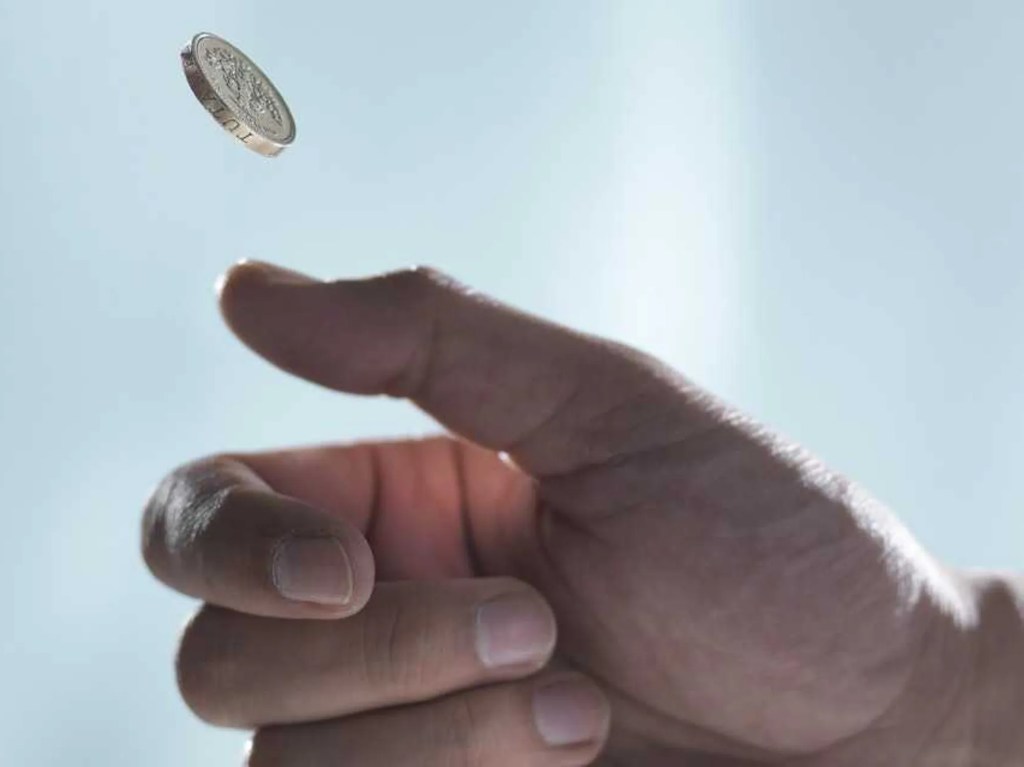
    ​Probability can explain why a coin flip has a 50/50 chance of landing heads versus tails, but it also can be used for more powerful applications.Photo credit: Monty Rakusen/DigitalVision via Getty Images
    Zachary del Rosario

    Zachary del Rosario

    Probability underpins AI, cryptography and statistics. However, as the philosopher Bertrand Russell said, “Probability is the most important concept in modern science, especially as nobody has the slightest notion what it means.”

    I teach statistics to engineers, so I know that while probability is important, it is counterintuitive.

    Probability is a branch of mathematics that describes randomness. When scientists describe randomness, they’re describing chance events – like a coin flip – not strange occurrences, like a person dressed as a zebra. While scientists do not have a way to predict strange occurrences, probability does predict long-run behavior – that is, the trends that emerge from many repeated events.

    Mathematics, Education, Explainer, Statistics, Probability, Frequency, Doing science
    We may say ‘random’ to describe strange occurrences (person dressed as zebra), but probability describes chance events (a coin flip).Photo credit: Zebras in La Paz, Bolivia by EEJCC, Own Work CC A-SA 4.0; CC BY-SA

    Modeling with probability

    Since probability is about events, a scientist must choose which events to study. This choice defines the sample space. When flipping a coin, for example, you might define your event as the way it lands.

    Coins almost always land on heads or tails. However, it’s possible – if very unlikely – for a coin to land on its side. So to create a sample space, you’d have two choices: heads and tails, or heads, tails and side. For now, ignore the side landings and use heads and tails as our sample space.

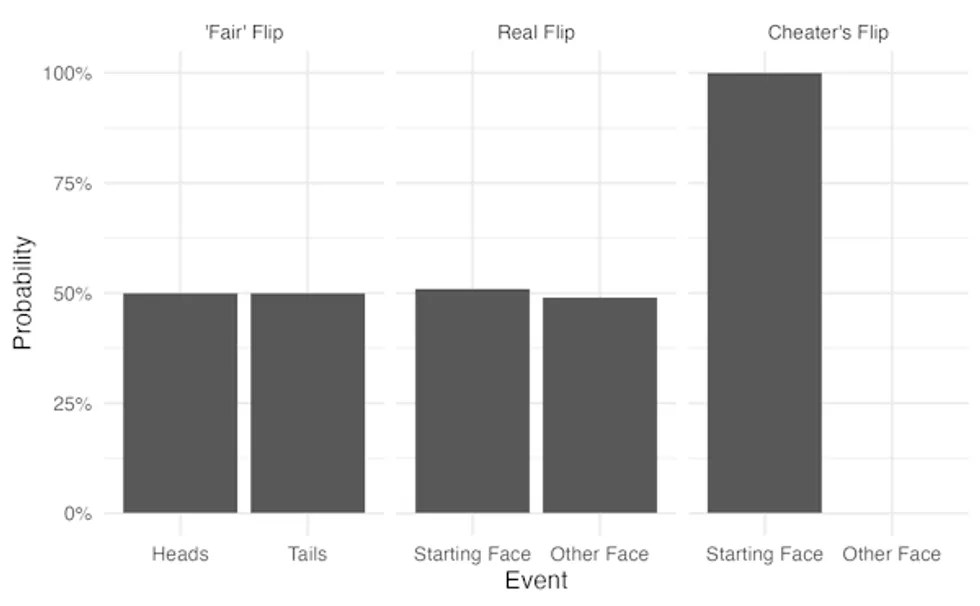
    Next, you would assign probabilities to the events. Probability describes the rate of occurrence of an event and takes values between 0% and 100%. For example, a fair flip will tend to land 50% heads up and 50% tails up.

    To assign probabilities, however, you need to think carefully about the scenario. What if the person flipping the coin is a cheater? There’s a sneaky technique to “wobble” the coin without flipping, controlling the outcome. Even if you can prevent cheating, real coin flips are slightly more probable to land on their starting face – so if you start the flip with the coin heads up, it’s very slightly more likely to land heads up.

    In both the cheating and real flip cases, you need an appropriate sample space: starting face and other face. To have a fair flip in the real world, you’d need an additional step where you randomly – with equal probability – choose the starting face, then flip the coin.

    Mathematics, Education, Explainer, Statistics, Probability, Frequency, Doing science
    The probabilities for different coin-flipping scenarios.Photo credit: Zachary del Rosario, CC BY-SA

    These assumptions add up quickly. To have a fair flip, you had to ignore side landings, assume no one is cheating, and assume the starting face is evenly random. Together, these assumptions constitute a model for the coin flip with random outcomes. Probability tells us about the long-run behavior of a random model. In the case of the coin model, probability describes how many coins land on heads out of many flips.

    But instead of using a random model, why not just solve the coin toss using physics? Actually, scientists have done just that, and the physics shows that slight changes in the speed of the flip determine whether it comes up heads or tails. This sensitivity makes a coin flip unpredictable, so a random model is a good one.

    Frequency vs. probability

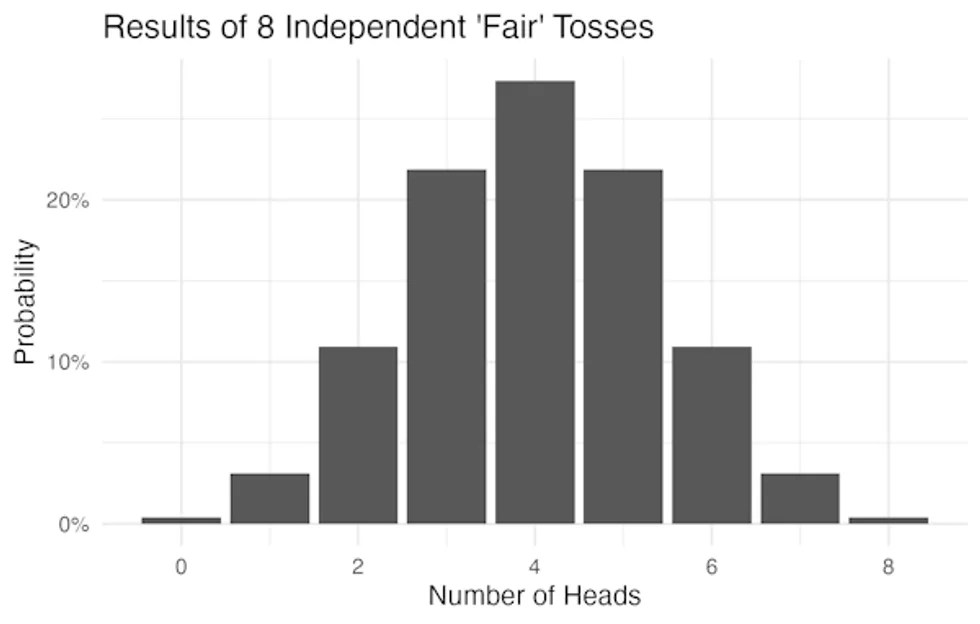
    Probability differs from frequency, which is the rate of events in a sequence. For example, if you flip a coin eight times and get two heads, that’s a frequency of 25%. Even if the probability of flipping a coin and seeing heads is 50% over the long run, each short sequence of flips will come out different. Four heads and four tails is the most probable outcome from eight flips, but other events can – and will – happen.

    Frequency and probability are the same in one special setting: when the number of data points goes to infinity. In this sense, probability tells us about long-run behavior.

    Mathematics, Education, Explainer, Statistics, Probability, Frequency, Doing science
    Probabilities for all possible outcomes of eight ‘fair’ coin flips.Photo credit: Zachary del Rosario, CC BY-SA

    Applications to AI, cryptography and statistics

    Probability isn’t just useful for predicting coin flips. It underlies many modern technological systems.

    For example, AI systems such as large language models, or LLMs, are based on next-word prediction. Essentially, they compute a probability for the words that follow your prompt. For example, with the prompt “New York” you might get “City” or “State” as the predicted next word, because in the training data those are the words that most frequently follow.

    But since probability describes randomness, the outputs of a LLM are random. Just like a sequence of coin flips is not guaranteed to come out the same way every time, if you ask an LLM the same question again, you will tend to get a different response. Effectively, each next word is treated like a new coin flip.

    Randomness is also key to cryptography: the science of securing information. Cryptographic communication uses a shared secret, such as a password, to secure information. However, surprising randomness isn’t good enough for security, which is why picking a surprising word is a bad choice of password. A shared secret is only secure if it’s hard to guess. Even if a word is surprising, real words are easier to guess than flipping a “coin” for each letter.

    You can make a much stronger password by using probability to choose characters at random on your keyboard – or better yet, use a password manager.

    Finally, randomness is key in statistics. Statisticians are responsible for designing and analyzing studies to make use of limited data. This practice is especially important when studying medical treatments, because every data point represents a person’s life.

    The gold standard is a randomized controlled trial. Participants are assigned to receive the new treatment or the current standard of care based on a fair coin flip. It may seem strange to do this assignment randomly – using coin flips to make decisions about lives. However, the unpredictability serves an important role, as it ensures that nothing about the person affects their chance to get the treatment: not age, gender, race, income or any other factor. The unpredictability helps scientists ensure that only the treatment causes the observed result and not any other factor.

    So what does probability mean? Like any kind of math, it’s only a model, meaning it can’t perfectly describe the world. In the examples discussed, probability is useful for describing long-term behaviors and using unpredictability to solve practical problems.

    This article originally appeared on The Conversation. You can read it here.

  • GLP‑1 drugs may fight addiction across every major substance, according to a study of 600,000 people
    With GLP-1 drugs becoming more accessible and affordable, they could also be within reach for substance use treatment.Photo credit: Michael Siluk/Universal Images Group via Getty Images
    ,

    GLP‑1 drugs may fight addiction across every major substance, according to a study of 600,000 people

    A massive study of veterans suggests these medications may quiet cravings far beyond food.

    A patient of mine, a veteran who had tried to quit smoking for over a decade, told me that after he started a GLP-1 drug for his diabetes, he lost interest in cigarettes. He didn’t use a patch. He didn’t set a quit date. He simply lost interest. It happened without effort.

    Another patient on one of these drugs for weight loss told me that alcohol had lost its pull – after years of failed attempts to quit.

    People struggling with many addictions, ranging from opioids to gambling, are reporting similar experiences in clinics, on social media and around dinner tables. None of them started these drugs to quit. This pattern of people losing their cravings across a broad range of addictive substances has no precedent in medicine.

    But my patients were giving me an important clue. People taking GLP-1 drugs often talk about “food noise” vanishing: the constant mental chatter about food that dominated their days simply goes quiet. But my patients were reporting that it wasn’t just food: They were noticing that the preoccupation with smoking, drinking and using drugs that drives people back despite their best intentions to stop was going quiet too.

    As a physician whose patients are often on GLP-1 drugs, and as a scientist who works on answering pressing public health questions – from long COVID to medication safety – I saw a problem hiding in plain sight: Many addictions have no approved treatment. The few medications that exist are massively underutilized, and none works across all substances. The idea that a drug already taken by millions might do what no addiction treatment has done before was too important to ignore.

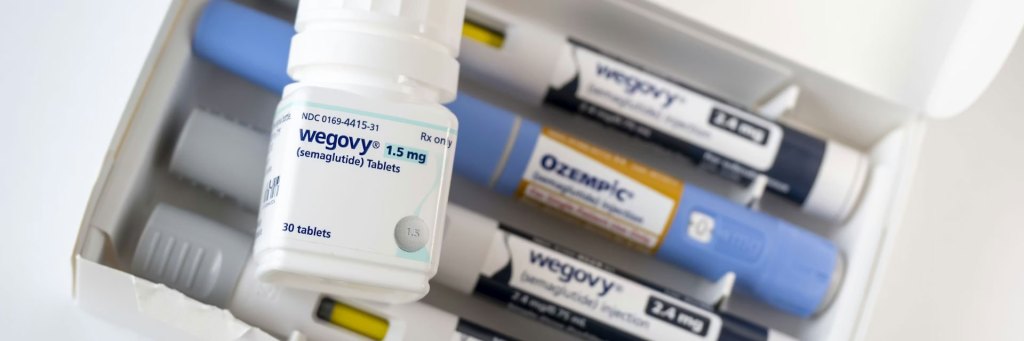
    My team and I set out to test whether GLP-1 drugs – medications like semaglutide (Ozempic and Wegovy) and tirzepatide (Mounjaro and Zepbound), originally developed for diabetes and then approved for obesity – could do what no existing addiction treatment does: curb craving itself.

    Our evidence strongly suggests they can.

    Biological basis of cravings

    The hormone that these drugs mimic – GLP-1 – is not only produced in the gut. It is also active in the brain, where the receptors it binds to cluster in regions governing reward, motivation and stress – the same circuitry that gets hijacked by addiction. At therapeutic doses, GLP-1 drugs cross the blood-brain barrier and dampen dopamine signaling in the brain’s core reward center, making addictive substances less rewarding.

    GLP-1 drugs seem to inhibit cravings for several different substances in multiple animal models. For instance, rodents given GLP-1 drugs drink less alcoholself-administer less cocaine and show less interest in nicotine. When researchers gave semaglutide to green vervet monkeys – primates that voluntarily drink alcohol much like humans do – the animals drank less without showing signs of nausea or changes in water intake. This suggests the drug lowered the reward value of alcohol rather than making the animals feel sick.

    From animals to people

    To find out whether these drugs have a similar effect on people, we turned to the electronic health records of more than 600,000 patients with Type 2 diabetes at the U.S. Department of Veterans Affairs – one of the largest health care databases in the world.

    We designed a study that applied the rigor of randomized controlled trials – the gold standard in medicine – to real-world data. We compared people who started GLP-1 drugs to people who did not, adjusting for differences in health history, demographics and other factors, and followed both groups for three years.

    My team and I asked two questions: For people already struggling with addiction, did the drugs reduce overdoses, drug-related hospitalizations and deaths? And for people with no prior substance use disorder, did GLP-1 drugs reduce their risk of developing one across all major addictive substances: alcohol, opioids, cocaine, cannabis and nicotine?

    What we found was striking. In the group already struggling with addiction, there were 50% fewer deaths due to substance use among those taking GLP-1 drugs compared with those who were not. We also found 39% fewer overdoses, 26% fewer drug-related hospitalizations and 25% fewer suicide attempts. Over three years, this translated to roughly 12 fewer serious events in total per 1,000 people using GLP-1 drugs – including two fewer deaths.

    Reductions of this magnitude are rare in addiction medicine – and what’s remarkable is that the finding came from drugs initially designed for diabetes, later repurposed for obesity and never intended to treat addiction.

    The drugs also appeared to prevent addiction from developing in the first place. Among people with no prior substance use disorder, those taking GLP-1 drugs had an 18% lower risk of developing alcohol use disorder, a 25% lower risk of opioid use disorder and an approximately 20% lower risk of cocaine and nicotine dependence. Over three years, this translated to roughly six to seven fewer new diagnoses per 1,000 GLP-1 users.

    With tens of millions of people already using GLP-1 drugs, the reductions in deaths, overdoses, hospitalizations and new diagnoses could translate into thousands of prevented serious events each year.

    Converging evidence

    Our findings align with a growing body of evidence.

    A Swedish nationwide study of 227,000 people with alcohol use disorder found that those taking GLP-1 drugs had 36% lower risk of alcohol-related hospitalizations. This is more than double the 14% reduction that the same study found with naltrexone, which was the best-performing medication approved for treatment of alcohol use disorder in that analysis. Other observational studies have linked GLP-1 drugs to lower rates of new and recurring alcohol use disorderreduced diagnoses and relapse in cannabis use disorderfewer health care visits for nicotine dependence and lower risk of opioid overdose.

    Meanwhile, randomized controlled trials that directly test whether these drugs help people with addiction also show promise. In one trial, semaglutide reduced both craving and alcohol consumption in people with alcohol use disorder. In another, dulaglutide reduced drinking. More than a dozen additional trials are already underway or actively enrolling, and several more are planned.

    The future of addiction treatment

    GLP-1 drugs are the first type of medication to show potential benefit across multiple substance types simultaneously. And unlike existing addiction medications, which are prescribed by specialists and remain vastly underused, GLP-1 drugs are already prescribed at enormous scale by primary care doctors. The delivery system to reach millions of patients already exists.

    The consistency of GLP-1 effectiveness across alcohol, opioids, cocaine, nicotine and cannabis suggests these drugs may act on a shared vulnerability underlying addiction – not on any single substance pathway. If confirmed, that would represent a fundamental shift in how society understands addiction and how doctors treat it.

    Some unanswered questions remain, though, about how these drugs would affect addiction. Many people who take GLP-1 drugs to treat obesity or diabetes discontinue them; afterward, their appetite typically returns and they regain the weight they lost. Whether the same rebound would occur with addiction, and what it would mean for someone in recovery to face the roar of craving again, is unknown. Nor is it clear whether the benefits persist over years of continuous use, or whether the brain adapts in ways that dampen those effects.

    Also, because GLP-1 drugs engage the brain’s reward circuitry – the same system that governs not just craving but everyday motivation – prolonged use could, in theory, dampen motivational drive in some people. Whether that might affect real-world outcomes, such as initiative, competitive drive or performance at work, remains an open question.

    What comes next

    GLP-1 drugs have not been approved for addiction, and there is not yet enough evidence to prescribe them solely for that purpose. But for millions of people already weighing whether to start a GLP-1 drug for diabetes, obesity or another approved indication, it is one more factor worth considering.

    A patient living with diabetes who is also trying to quit smoking might reasonably choose a GLP-1 drug over another glucose-lowering medication, not because it is approved for smoking cessation, but because it may help them quit, a benefit that other diabetes drugs do not offer. Similarly, for people living with obesity who also struggle with alcohol, the potential for benefit beyond weight loss could be one more reason to consider a GLP-1 drug.

    If additional trials confirm that they effectively curb cravings across addictive substances, these drugs could begin to close one of the most consequential treatment gaps in medicine. And the most promising lead in addiction in decades will have come not from a deliberate search but from patients reporting a benefit no one anticipated. Like my patient who quit smoking after a lifetime of trying, it happened without effort.

    This article originally appeared on The Conversation. You can read it here.

  • Persuasion expert shares the one strategy that’s actually effective at changing people’s minds
    A woman is unsure how to respond.Photo credit: Canva
    ,

    Persuasion expert shares the one strategy that’s actually effective at changing people’s minds

    It’s nearly impossible to change someone’s mind. So let them do it for you.

    Learning how to communicate effectively and change people’s minds rarely succeeds by forcing your opinion. People are far more likely to adopt beliefs when they feel like they came up with them. Understanding this can make parenting, leading a team, or even trying to win an argument with a friend more effective.

    Chase Hughes, a former United States Navy chief and behavioral expert, told The Diary of a CEO podcast why self-persuasion is an effective strategy for influencing others. He believes it’s “maybe the most dangerous persuasion skill there is.”

    Changing people’s minds

    The most effective communicators influence others by offering small pieces of information that allow the other person to connect the dots themselves. Ideas we feel are our own carry far more weight in decision-making than those given to us by others. Hughes explains the simple approach behind changing people’s minds:

    “I’m gonna put a LEGO right here on the table in front of you. [He points to the right of the table.] And I’m going to put another LEGO right here in front of you. [He points to the left of the table.] And I’m just going to keep having the conversation until eventually your brain is going to go, ‘Oh, I bet those things go together.’ So the idea came from you.”

    Hughes further explains the pattern:

    “I’m going to give you one piece of information and another piece of information, but I will never put them together for you. And the reason is that any idea that you think came from your own mind, you have no ability to resist it.”

    conversations, debate, advocacy, direct persuasion
    Crafting a convincing idea.
    Photo credit: Canva

    Self-persuasion in a real-world situation

    The idea Hughes refers to is called self-persuasion. This form of psychological influence stems from the fact that people are more likely to adopt new beliefs when they feel those beliefs come from within. They are far less likely to be persuaded by external pressure.

    Hughes’ example of placing two LEGO bricks offers a clear visual explanation, but what would a real-life scenario look like? Hughes explains:

    “Let’s say you’re watching the news and they say, ‘Local Austin woman has been reported missing. Neighbors said that earlier this day, people saw her arguing with her boyfriend. Details after the break.’ And your brain is like, ‘I know what happened.’”

    In this example, it’s easy to infer that the boyfriend is likely involved in her disappearance.

    change minds, motivation, inoculation theory, effective strategies
    A couple attempts to convince a skeptical woman.
    Photo credit: Canva

    Self-persuasion is effective at changing people’s minds

    Self-persuasion is powerful because it creates a self-generated process. Individuals feel more personally connected, and even justified. A 2022 study found that people are more influenced when arguments align with their values and beliefs. Messages they may know little about can feel true and even self-driven when they aren’t imposed on them.

    A 2022 study examined self-persuasion as an influence on social norms. When people were given options that aligned with their values, the messages felt more personal and were therefore more convincing.

    Another 2022 study found that when people were asked to argue one side of a debate, they eventually came to believe that side was correct—even if they didn’t believe it at first. This form of self-persuasion can make disagreements harder to resolve because people naturally feel more confident in their own perspective.

    work, mental health, framing effects, conclusions, narrative
    That’s a brilliant idea.
    Photo credit: Canva

    People rarely resist their own conclusions

    Self-persuasion works because it changes who is doing the persuading. Telling a child what to do is very different from a parent explaining why it matters. In business, people are more motivated when they help generate ideas than when they’re given even simple instructions.

    The most effective communication isn’t about delivering perfect arguments. When people connect the dots on their own, the idea doesn’t just land—it sticks. Hughes suggests letting a person’s brain fill in the gaps. Once they do, the conclusion feels like their own. Studies show that this sense of ownership is a powerful motivator for changing minds.

    Watch the full interview with Chase Hughes:

Explore More Stories

Exploration

Study reveals startling truth: Intelligence lowers our empathy toward other people

Technology

Tech company helps dementia patients live independently with memory-prompting smart glasses

Well-being

Expert shares ancient monk’s mindset for keeping your composure when life ‘bumps’ you

Society

Want to reconnect with someone but aren’t sure what to say? Try this simple, no-risk way to reach out.