

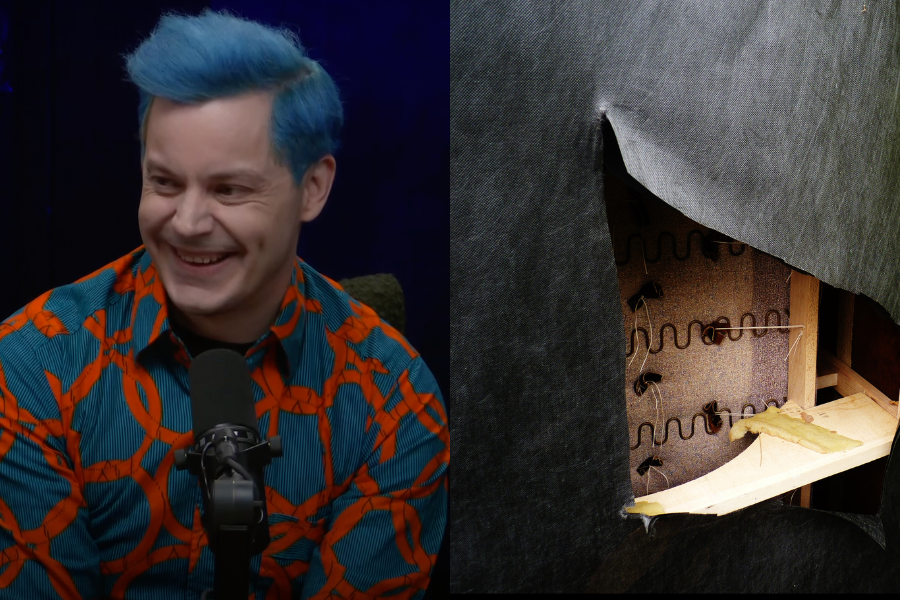
Few rock stars know how to build mystique like Jack White—from playing super obscure vintage guitars to color-coding his various musical projects. The coolest example dates back to 2004, when he recorded a single, pressed 100 vinyl copies, and hid them all inside random pieces of furniture.

Before we dive in, let’s tackle some backstory. Prior to his music career, White worked as a professional upholsterer in his native Detroit—first as a teenage apprentice, assisting friend and future bandmate Brian Muldoon. White opened his own shop, Third Man Upholstery, at age 21 and made enough money to pay the bills. But he also turned that business into a kind of art project, likely alienating potential repeat customers with his unique style.

“I was so strange with it,” he recalled during an interview on Conan O’Brien Needs a Friend. “I was doing sculpture as well. Everything became an art form with me—I was filling the inside of the furniture with poetry, and the bills I was writing in crayon. It would be yellow paper with black crayon: ‘You owe me $300.’ I would present it to them, and I’d deliver the piece in a yellow-and-black uniform in a yellow van that was an old Detroit fire-department van. People were like…”What?’

Speaking to NPR in 2011, White said that he and Muldoon even started passing along notes to fellow upholsterers inside the pieces. “We’re the only ones who see the insides of this furniture,” he said. “‘We should have so many inside jokes and things we could write.’ You know, ‘This guy was a jerk. He wouldn’t pay for this.’ We should be telling each other what was the story on these couches.”

He and Muldoon formed the fittingly named garage-punk duo The Upholsterers in 2000 and released one official single, “Makers of High Grade Suites,” that year (it’s since become a major collector’s item: As of this writing, record-resale site Discogs lists a price range of $250 to $1,500, with a median of $1,066.65). But that wasn’t the band’s only recording: The Upholsterers reportedly celebrated the 25th anniversary of Muldoon’s shop by recording those 100 copies of a second single and stuffing the vinyl into furniture.

“We even made it on clear vinyl with transparency covers—we thought you couldn’t even X-ray it to see if it was in there,” he told NPR. “I’m talking about—really, you could rip open a couch and think it’s not there ’cause it’s inside the foam—sliced inside the foam and slid in there. I mean, we really went to great lengths to make sure possibly no one would ever hear our record! But it’s there. It’s so great. It’s there. There’s [100] pieces of furniture out there that have those records, and maybe one day someone will find them.”

According to White’s Third Man Records label, that miracle long-shot came true in 2014, when two people claimed they’d found separate copies of Your Furniture Was Always Dead … I Was Just Afraid To Tell You.

After White’s music career took off via The White Stripes—followed by his solo work, along with The Raconteurs and The Dead Weather—he wasn’t able to focus as much on upholstery. But he’s never quit that pursuit. “While White may have stopped doing upholstery as a ‘job’ he’s never stopped his actual practice of the trade,” reads a note on the Jack White Art and Design site. “In the intervening 20+ years Jack has always kept an operational upholstery shop in his house or on his property. Third Man Upholstery is now located in Nashville, TN.”

That skill has been a big part of his life in recent years, including in the early pandemic year of 2020, when, as he told O’Brien, he “worked on nothing but furniture, really.” As he explained on the podcast, he even offered to redo the comedian’s furniture back when he launched Conan in 2010.

“I don’t have a lot of regrets in life,” O’Brien said, “[but] one is: When we were doing our show at TBS, you contacted me, and I had no idea you were serious. You said, ‘I’d like to do the upholstery. I’d like to make you your talk-show couch.’ I was like, ‘That’s so hilarious, man. That’s great.’ Later on, you were like, ‘No, no, I was serious!’…I felt like it was such a lost opportunity to have a talk show where Jack White made my talk-show couch.”

This article originally appeared in May.

  • Why Michelangelo’s ‘Last Judgment’ endures
    Photo credit: Sistine Chapel collection via Wikimedia CommonsMichelangelo’s 16th-century fresco ‘The Last Judgment.’
    ,

    Why Michelangelo’s ‘Last Judgment’ endures

    A restored masterpiece still provokes awe and debate.

    Michelangelo’s fresco of “The Last Judgment,” covering the wall behind the altar of the Sistine Chapel in Vatican City, is being restored. The work, which started on Feb. 1, 2026, is expected to continue for three months.

    The Sistine Chapel is one of the great masterpieces of Renaissance art. As the setting where the College of Cardinals of the Catholic Church meets to elect a new pope, it was decorated by the most prestigious painters of the day. In 1480, Pope Sixtus IV commissioned Domenico Ghirlandaio, Sandro Botticelli, Pietro Perugino and Cosimo Rosselli to paint the walls. On the south are six scenes of the “Life of Moses,” and across on the north are six scenes of the “Life of Christ.”

    In 1508, Pope Julius II commissioned Michelangelo to paint the ceiling. The theme is the Book of Genesis, the first book of the Bible. The images show God creating the world through the story of Noah, who was directed by God to shelter humans and animals on an ark during the great flood. The ceiling’s most famous scene may be “God Creating Adam,” where Adam reaches out his arm to the outstretched arm of God the Father, but their fingers fail to meet.

    At the sides, the artist juxtaposed the male Hebrew prophets and the female Greek and Roman sybils who were inspired by the gods to foretell the future. It was completed in 1512; then in 1536, Michelangelo was asked to create a painting for the wall behind the altar. For this immense work of 590 square feet (about square meters), filled with 391 figures, he labored until 1541. He was then nearly 67 years old.

    As an art historian, I have been aware how, from the beginning, Michelangelo’s “The Last Judgment” sparked controversy for its bold and heroic portrayal of the male nude.

    Many layers of meaning

    Michelangelo liked to consider himself primarily a sculptor, expressing himself in variations of the nude male body. Most famous may be the Old Testament figure of David about to slay Goliath, originally made for the Cathedral of Florence.

    The artist’s ceiling for the Sistine Chapel had included 20 nude males as supporting figures above the prophets and sibyls. Originally, Michelangelo’s Christ of “The Last Judgment” was entirely nude. A later painter was hired to provide drapery over the loins of Christ and other figures.

    “The Last Judgment” scene also contains multiple references to pagan gods and mythology. The image of Christ is inspired by early Christian images showing Christ beardless and youthful, similar to the pagan god of light, Apollo.

    A section of a fresco shows a naked man bound by a coiling snake, and donkey's ears, surrounded by beastlike figures.
    Group of the damned with Minos, judge of the underworld. Sistine Chapel Collection, Michelangelo via Wikimedia Commons

    At the bottom of the composition is the figure of Charon, a personage from Greek mythology who rowed souls over the river Styx to enter the pagan underworld. Minos, the judge of the underworld, is on the extreme right.

    Giorgio Vasari, a fellow artist and historian who knew Michelangelo personally, later recounted the criticism by a senior Vatican official, Biagio da Cesena. The official stated that it was disgraceful that nude figures were exposed so shamefully and that the painting seemed more fit for public baths and taverns.

    Michelangelo’s response was to place the face of Biagio on Minos, the judge of the underworld, and give him donkey’s ears, symbolizing stupidity.

    A painted scene shows a bearded man holding a knife in one hand and a flayed skin with a human face in the other, while another figure sits just behind him.
    A detail of a scene connected to the Apostle Bartholomew in ‘The Last Judgment.’ Sistine Chapel Collection via Wikimedia

    Michelangelo included a reference to his own life in a detail connected to the Apostle Bartholomew, who is located to the lower right of Christ. The apostle was believed to have met his martyrdom by being flayed alive. In his right hand, he holds a knife and, in his left, his flayed skin whose face is a distorted portrait of the artist.

    Michelangelo thus placed himself among the blessed in heaven, but also made it into a joke.

    Thought-provoking imagery

    The Last Judgment is a common theme in Christian art. Michelangelo, however, pushes beyond simple illustration to include pagan myths as well as to challenge traditional depiction of a calm, bearded judge. He uses dramatic imagery to provoke deeper thought: After all, how does anyone on Earth know what the saints do in heaven?

    In these decisions, Michelangelo displayed his sense of self-confidence to introduce new ideas and his goal to engage the viewer in new ways.

    A digital reproduction of the painting will be displayed on a screen for visitors to the Sistine Chapel during this period of restoration. Behind the screen, technicians from the Vatican Museums’ Restoration Laboratory will work to restore the masterpiece.

    This article originally appeared on The Conversation. You can read it here.

  • Students go for a world record with group drumming rendition of “Beggin”
    Photo credit: CanvaA music teacher plays drums with a student.

    Drum instructor Patrick Abdo doesn’t simply direct a children’s recital—he launches into a full-body celebration of music. In an Instagram post gaining widespread attention, he leads 10 children, ages 5 to 10, in a drumming rendition of the Måneskin song “Beggin’.”

    As the kids bang the drums in rhythmic unison and parents watch, beaming with pride, the room pulses with energy. But what makes the performance all the more magnetic isn’t simply the precision of the young drummers—it’s Abdo’s infectious excitement.

    Abdo guides kids to an impressive musical moment

    In the video, captioned “A record like no other!,” the 10 kids each have their own drum kit arranged in a circle around a large room. As the music starts, Abdo takes the lead, instructing the young musicians and wildly raising his arms to the rhythm. He keeps perfect time with his air drumming, and the kids follow.

    These young drummers do a fantastic job, fully committed and bringing the focus and skill needed to pull off such a high-octane song. Yet it’s nearly impossible not to have your attention drawn to the teacher. Abdo radiates an infectious belief in every child in the room.

    This type of wholehearted encouragement feels increasingly rare, and it’s wonderful to watch. As proud parents smile from the sidelines, he moves through the room, connecting with each student. With each burst of encouragement, the recital transforms into something special.

    There is little publicly available information about Abdo’s background. His breakout visibility appears tied to short-form drum lesson videos posted on his Instagram page. His profile lists Dubai as his location, and his bio reads, “My dream is to recreate School Of Rock MENA [Middle East North Africa] version.”

    The good-vibes energy inspires people

    The video quickly became impossible to scroll past. Views steadily increased, and so did the comments. The appreciation for both the synchronized performance and Abdo’s teaching style offers a moving example of mentoring at its best. As much as viewers loved the kids’ musical showcase, many seemed even more inspired by Abdo’s uplifting and engaging style:

    “They shut it down for real !!!The instructor deserves an applause”

    “I love the teacher !! So enthusiastic, motivating and you can tell he loves these kids!!!”

    “well done to that teacher and all the children — luv this”

    “This teacher has incredible enthusiasm which inspires all the kids to work so hard to get it!”

    “Wow, the instructor’s patience and passion for his work are truly admirable!”

    “This is called perfection.”

    “The teacher’s passion! The talented, focused kids!”

    Great teachers and mentorship matter

    There is simply no denying the value of great teachers and mentors. Everyone benefits from guidance and encouragement, especially young people. Research in 2025 found that mentored youth were 20% more likely to attend college, earn higher incomes, and exhibit better behavior. A 2023 trial conducted by Big Brothers Big Sisters of America found measurable improvements in social and emotional well-being.

    A 2022 study found that mentorship increased retention and promoted success. The benefits extend to mentors as well, offering opportunities to build enduring relationships that evolve and provide value over time.

    The music recital had the Internet buzzing over its great energy and the joy of watching kids go for it. Inspiring mentorship may be the real power behind Abdo’s musical instruction. Whether viewers remember a beloved teacher or recognize the one they wish they’d had, the right mentor can stay with a child long after the music stops.

  • A BBC crew broke ‘cardinal rule’ of nature documentaries to save trapped penguins
    Photo credit: CanvaPenguins jumping off a glacier into the water.
    ,

    A BBC crew broke ‘cardinal rule’ of nature documentaries to save trapped penguins

    Even the show’s narrator, David Attenborough, supported the controversial decision to step in.

    Nature documentaries operate on a single, golden rule: observe, record, but never interfere. The goal is to capture the raw, unscripted reality of the natural world, even when that reality is brutal. But during the filming of the BBC Earth series Dynasties, a situation arose that was so dire, the crew felt compelled to break that cardinal rule.

    The incident, which took place in November 2018, involved a colony of Emperor penguins in Antarctica. A massive storm had hit, dropping temperatures to minus 50 degrees Celsius (minus 76 degrees Fahrenheit) and trapping a large group of mothers and chicks in a steep, icy ravine.

    Separated from the safety of their rookery, the birds were helpless. The mothers, cradling their chicks, were unable to climb the slick, vertical slopes.

    Emperor penguins, BBC Earth, David Attenborough, Antarctica, nature documentary
    Penguins march across the ice. Photo credit: Canva

    The situation was desperate. Some chicks had already been abandoned and frozen to death in the gully, while predators circled the survivors. The emotional toll on the crew was immense. As one cameraman told Country Living, “I know it’s natural, but it’s bloody hard to watch.”

    Faced with the potential extinction of the entire group, the team made a controversial choice.

    “It was not a straightforward decision by any stretch of the imagination,” director Will Lawson explained in an interview with Lorraine. “You just have to look at the facts that are in front of you before you make a decision like that.”

    Once the storm broke, the crew decided to intervene, but they did so “passively.” They didn’t lift the birds; instead, they used their tools to dig a shallow ramp into the ice, creating a path the penguins could potentially use to escape on their own.

    “Once we’d dug that little ramp, which took very little time, we left it to the birds. We were elated when they decided to use it,” Lawson told Country Living, noting that there is simply no “rule book” for such extreme scenarios.

    The footage of the penguins waddling up the man-made ramp to safety became a defining moment for the series. Even Sir David Attenborough, a staunch defender of non-intervention, backed the move.

    “It’s very rare for the film crew to intervene. But they realize that they might be able to save at least some of these birds, simply by digging a few steps in the ice,” Attenborough said.

    Producer Mike Gunton agreed, framing it as a moral imperative rather than a documentary breach. “We have a rule that interfering is a very dangerous thing to do. But these penguins were going to die through a freak act of nature if nothing happened,” he said. “How would this conversation be going if you said you saw them there and did nothing? I think you have to do it.”

    The intervention was passive, but the result was profound. The colony survived, and the crew walked away with clear consciences. As Attenborough concluded, “To have done anything else would only make matters worse and distort the truth.” 

    This article originally appeared two years ago. It has been updated.

Explore More Media Stories

Media

A BBC crew broke ‘cardinal rule’ of nature documentaries to save trapped penguins

Media

20 hilarious pics of animals playing around in the wild

Media

Terrifying footage inside of Egyptian pyramids has people ‘panicking’

Media

She worked at NASA. Her Hinge date asked if she was the receptionist. Her response is legendary.