

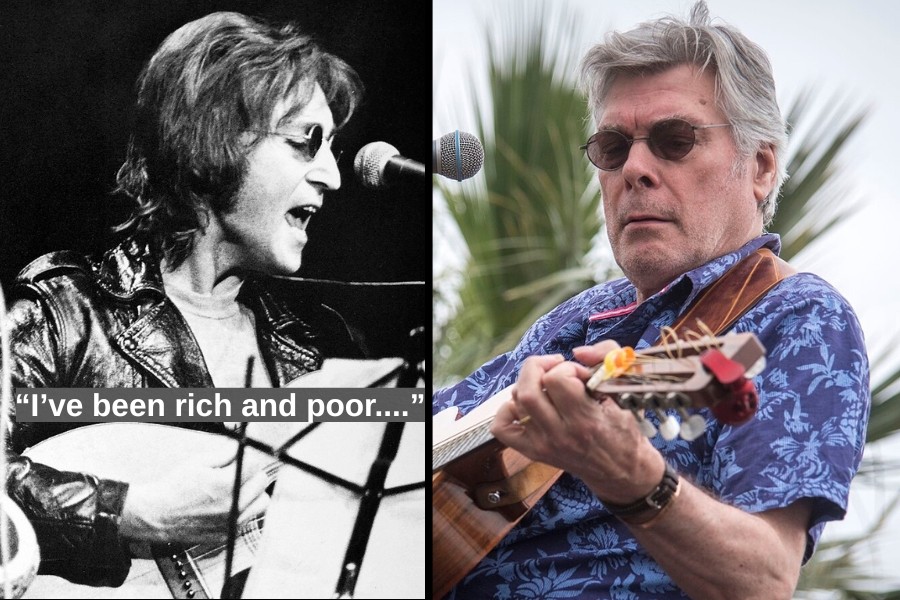
John Lennon had a distinctively droll sense of humor, a wealth of insights from a career defined by unfathomable success and public scrutiny, and, yes, a charmingly rough handwriting style. If a letter from the musician showed up in your mailbox, you could probably figure out the source without even glancing at the return address. And for most aspiring folk artists, receiving such a note would have been life-changing—that is, if it was even delivered.

That scenario is now forever linked to Steve Tilston, a British singer-songwriter who shared his experience in 2010. It all dates back to an interview with underground music magazine ZigZag from 1971, conducted shortly after the release of his debut LP, An Acoustic Confusion. As Tilston recalled to the BBC in 2010, the ZigZag interviewer asked the 21-year-old artist “whether, if I received untold wealth and fortune, it would have a detrimental effect on my songwriting.” He added, “I thought it was bound to, but obviously John Lennon disagreed, and he wrote to me to point out the error of my ways.”

The letter itself, which included the former Beatle’s phone number, is both thoughtful and gently snarky—classic Lennon. “Being rich doesn’t change your experience in the way you think,” he wrote. “The only difference, basically, is that you don’t have to worry about money—food, roof, etc. But all other experiences—emotions, relationships—are the same as anybody’s. I know. I’ve been rich and poor. So has [wife] Yoko [Ono] (rich—poor—rich). So whadya think of that.” The message is signed “Love, John & Yoko,” accentuated by self-portrait doodles.

The exact origins of the letter are reportedly unclear, but Tilston said he was contacted in 2005 with a request to confirm its authenticity. “I got an e-mail from the man who now owns it. I don’t know how he came upon it,” he told the BBC. “He bought it in America, and he asked me to verify if I was the Steve Tilston who the letter was addressed to.” The musician only revealed his incredible tale in 2010, when a journalist asked him to share something about his life that people didn’t know. “So I said, ‘Oh, there was this letter John Lennon sent me with his phone number on it,’” he told The Guardian in 2015.

Of course, Lennon was tragically murdered in 1980, so Tilston was never able to continue a correspondence. But the letter left a major impact nonetheless: “I was in a maelstrom of emotions,” he admitted. “Here was this road not traveled that could have been so significant in my life, and it had been taken [from me] without me even being aware of it.”

In a suitable final twist of a saga that feels tailored for Hollywood, this anecdote ended up loosely inspiring the 2015 dramedy film Danny Collins. Al Pacino, who stars as the titular folk singer, earned a nomination for Best Actor—Motion Picture Musical or Comedy at that year’s Golden Globe Awards. Tilston, meanwhile has continued a long and prolific career, having released over 20 studio albums.

One of Lennon’s other famous letters is from April 1962, during The Beatles’ first residency in Hamburg, when the burgeoning rock star wrote to his future wife, Cynthia Powell, in a spirit of both romance and lust. According to CNN, that note is expected to be sold for up to £40,000 (or $54,000) during an auction at Christie’s in London on July 9, 2025.

This article originally appeared in June.

  • 10 boys and 10 girls were left alone in separate houses and the different results are just wild
    Photo credit: Canva(L) Kids wrestling in the yard; (R) young children playing chess

    It sounds like the plot of William Golding’s Lord of the Flies. However, in the mid-2000s, it was a very real and very controversial reality television experiment.

    Footage from the UK Channel 4 documentary Boys and Girls Alone is captivating audiences all over again. It offers a fascinating and chaotic look at what happens when you remove parents from the equation.

    The premise was simple but high stakes. Twenty children, aged 11 and 12, were split into two groups by gender. Ten boys and ten girls were placed in separate houses and told to live without adult supervision for five days.

    The Setup

    While there were safety nets in place, the day-to-day living was entirely up to the kids. A camera crew was present but instructed not to intervene unless safety was at risk. The children could also ring a bell to speak to a nurse or psychiatrist.

    The houses were fully stocked with food, cleaning supplies, toys, and paints. Everything they needed to survive was there. They just had to figure out how to use it.

    The Boys: Instant Chaos

    In the boys’ house, the unraveling was almost immediate. The newfound freedom triggered a rapid descent into high-energy anarchy.

    They engaged in water pistol fights and threw cushions. In one memorable instance, a boy named Michael covered the carpet in sticky popcorn kernels just because he could.

    The destruction eventually escalated to the walls. The boys covered the house in writing, drawing, and paint. But the euphoria of freedom eventually crashed into the reality of consequences.

    “We never expected to be like this, but I’m really upset that we trashed it so badly,” one boy admitted in the footage. “We were trying to explore everything at once and got too carried away in ourselves.”

    Their attempts to clean up were frantic and largely ineffective. Nutrition also took a hit. Despite having completed a cooking course, the boys survived mostly on cereal, sugar, and the occasional frozen pizza. By the end of the week, the house was trashed, and the group had fractured into opposing factions.

    The Girls: Organized Society

    The girls’ house looked like a different planet.

    In stark contrast to the mayhem next door, the girls immediately established a functioning society. They organized a cooking roster, with a girl named Sherry preparing their first meal. They baked cakes. They put on a fashion show. They even drew up a scrupulous chores list to ensure the house stayed livable.

    While their stay wasn’t devoid of interpersonal drama, the experiment highlighted a fascinating divergence in socialization. Left to their own devices, the girls prioritized community and maintenance. The boys tested the absolute limits of their environment until it broke.

    The documentary was controversial when it aired, with critics questioning the ethics of placing children in unsupervised situations for entertainment. But what made it so enduring, and why footage keeps resurfacing years later, is what it reveals about how kids are socialized long before anyone puts them in a house together. The boys weren’t born anarchists and the girls weren’t born organizers. They arrived at those houses already shaped by years of being told, implicitly and explicitly, what boys do and what girls do. Whether that’s a nature story or a nurture story is the question the documentary keeps asking without quite answering, which is probably why people are still watching and arguing about it nearly two decades later.

    This article originally appeared two years ago. It has been updated.

  • 9-year-old girl asks Steph Curry why his shoes aren’t in girls’ sizes. The response was perfect.
    Photo credit: Wikicommons(L) A young girl's letter to Steph Curry asking about women's shoe sizes; (R) Steph Curry.
    ,

    9-year-old girl asks Steph Curry why his shoes aren’t in girls’ sizes. The response was perfect.

    “… it seems unfair that the shoes are only in the boys,” Riley Morrison wrote, starting a chain reaction of positive change.

    Nine-year-old Riley Morrison from Napa, California is a huge basketball fan. She roots for the Golden State Warriors and her favorite player is four-time NBA champion Steph Curry. Morrison loves to play basketball so she went online to pick up a pair of Curry’s Under Armour Curry 5 shoes, but there weren’t any available in the girls’ section of the site.

    But instead of resigning herself to the fact she wouldn’t be able to drive the lane in a sweet pair of Curry 5’s, she wrote a letter to the man himself. Her father posted it on social media:

    “My name is Riley (just like your daughter), I’m 9 years old from Napa, California. I am a big fan of yours. I enjoy going to Warriors games with my dad. I asked my dad to buy me the new Curry 5’s because I’m starting a new basketball season. My dad and I visited the Under Armour website and were disappointed to see that there were no Curry 5’s for sale under the girls section. However, they did have them for sale under the boy’s section, even to customize. I know you support girl athletes because you have two daughters and you host an all girls basketball camp. I hope you can work with Under Armour to change this because girls want to rock the Curry 5’s too.”

    “I wanted to write the letter because it seems unfair that the shoes are only in the boys’ section and not in the girls’ section,” Riley told Teen Vogue. “I wanted to help make things equal for all girls, because girls play basketball, too.”

    The letter got to Curry and he gave an amazing response on X (formerly Twitter).

    Many might be surprised that a megastar like Curry took a nine-year-old’s letter seriously, but he’s long been a vocal supporter of women’s issues.

    That August, Curry wrote an empowering letter that was published in The Player’s Tribune where he discussed closing the gender pay gap, hosting his first all-girls basketball camp, and what he’s learned from raising two daughters.

    In the essay he shared a powerful lesson his mother taught him. “Always stay listening to women to always stay believing in women, and — when it comes to anyone’s expectations for women — to always stay challenging the idea of what’s right,” he wrote.

    Curry clearly practices what he preaches because when a nine-year-old girl spoke up, he was all ears.

    Steph Curry and Under Armour didn’t just fix the girls’ sizing issue, they launched a special edition Curry 6 “United We Win” co-designed by Riley, created a $30K annual scholarship for girls, and shifted to unisex sizing across Curry Brand shoes.

    Since then, Curry has stayed active in promoting gender equity: he’s hosted girls’ camps, added girls to his elite training programs, mentored players like Azzi Fudd, and launched the Curry Family Women’s Athletics Initiative to fund 200+ scholarships at Davidson College.

    Riley and Steph bumped into each other at an event where they caught up and took photos. She is now a high school athlete at Vintage High School in Napa, still playing basketball. And yes, still rocking Currys.

    This article originally appeared seven years ago. It has been updated.

  • Why Michelangelo’s ‘Last Judgment’ endures
    Photo credit: Sistine Chapel collection via Wikimedia CommonsMichelangelo’s 16th-century fresco ‘The Last Judgment.’
    ,

    Why Michelangelo’s ‘Last Judgment’ endures

    A restored masterpiece still provokes awe and debate.

    Michelangelo’s fresco of “The Last Judgment,” covering the wall behind the altar of the Sistine Chapel in Vatican City, is being restored. The work, which started on Feb. 1, 2026, is expected to continue for three months.

    The Sistine Chapel is one of the great masterpieces of Renaissance art. As the setting where the College of Cardinals of the Catholic Church meets to elect a new pope, it was decorated by the most prestigious painters of the day. In 1480, Pope Sixtus IV commissioned Domenico Ghirlandaio, Sandro Botticelli, Pietro Perugino and Cosimo Rosselli to paint the walls. On the south are six scenes of the “Life of Moses,” and across on the north are six scenes of the “Life of Christ.”

    In 1508, Pope Julius II commissioned Michelangelo to paint the ceiling. The theme is the Book of Genesis, the first book of the Bible. The images show God creating the world through the story of Noah, who was directed by God to shelter humans and animals on an ark during the great flood. The ceiling’s most famous scene may be “God Creating Adam,” where Adam reaches out his arm to the outstretched arm of God the Father, but their fingers fail to meet.

    At the sides, the artist juxtaposed the male Hebrew prophets and the female Greek and Roman sybils who were inspired by the gods to foretell the future. It was completed in 1512; then in 1536, Michelangelo was asked to create a painting for the wall behind the altar. For this immense work of 590 square feet (about square meters), filled with 391 figures, he labored until 1541. He was then nearly 67 years old.

    As an art historian, I have been aware how, from the beginning, Michelangelo’s “The Last Judgment” sparked controversy for its bold and heroic portrayal of the male nude.

    Many layers of meaning

    Michelangelo liked to consider himself primarily a sculptor, expressing himself in variations of the nude male body. Most famous may be the Old Testament figure of David about to slay Goliath, originally made for the Cathedral of Florence.

    The artist’s ceiling for the Sistine Chapel had included 20 nude males as supporting figures above the prophets and sibyls. Originally, Michelangelo’s Christ of “The Last Judgment” was entirely nude. A later painter was hired to provide drapery over the loins of Christ and other figures.

    “The Last Judgment” scene also contains multiple references to pagan gods and mythology. The image of Christ is inspired by early Christian images showing Christ beardless and youthful, similar to the pagan god of light, Apollo.

    A section of a fresco shows a naked man bound by a coiling snake, and donkey's ears, surrounded by beastlike figures.
    Group of the damned with Minos, judge of the underworld. Sistine Chapel Collection, Michelangelo via Wikimedia Commons

    At the bottom of the composition is the figure of Charon, a personage from Greek mythology who rowed souls over the river Styx to enter the pagan underworld. Minos, the judge of the underworld, is on the extreme right.

    Giorgio Vasari, a fellow artist and historian who knew Michelangelo personally, later recounted the criticism by a senior Vatican official, Biagio da Cesena. The official stated that it was disgraceful that nude figures were exposed so shamefully and that the painting seemed more fit for public baths and taverns.

    Michelangelo’s response was to place the face of Biagio on Minos, the judge of the underworld, and give him donkey’s ears, symbolizing stupidity.

    A painted scene shows a bearded man holding a knife in one hand and a flayed skin with a human face in the other, while another figure sits just behind him.
    A detail of a scene connected to the Apostle Bartholomew in ‘The Last Judgment.’ Sistine Chapel Collection via Wikimedia

    Michelangelo included a reference to his own life in a detail connected to the Apostle Bartholomew, who is located to the lower right of Christ. The apostle was believed to have met his martyrdom by being flayed alive. In his right hand, he holds a knife and, in his left, his flayed skin whose face is a distorted portrait of the artist.

    Michelangelo thus placed himself among the blessed in heaven, but also made it into a joke.

    Thought-provoking imagery

    The Last Judgment is a common theme in Christian art. Michelangelo, however, pushes beyond simple illustration to include pagan myths as well as to challenge traditional depiction of a calm, bearded judge. He uses dramatic imagery to provoke deeper thought: After all, how does anyone on Earth know what the saints do in heaven?

    In these decisions, Michelangelo displayed his sense of self-confidence to introduce new ideas and his goal to engage the viewer in new ways.

    A digital reproduction of the painting will be displayed on a screen for visitors to the Sistine Chapel during this period of restoration. Behind the screen, technicians from the Vatican Museums’ Restoration Laboratory will work to restore the masterpiece.

    This article originally appeared on The Conversation. You can read it here.

Explore More Music Stories

Music

Students go for a world record with group drumming rendition of “Beggin”

Music

Therapist shares why Justin Bieber’s duet with 13-year-old self was so incredibly moving

Music

If a song moves you, does it matter who made it?

Culture

During one of Peter Gabriel’s final Genesis shows, a roadie got naked for one amazing prank