Many folks feel pressured to be more productive or believe they should always be doing more. After all, no one wants to be perceived as lazy. However, a decades-old quote that celebrates the value of being “lazy,” along with a recent scientific study, suggests that doing less might actually be the smarter move.
During 1947 testimony before the U.S. Senate, Clarence Bleicher, a Chrysler executive and president of the company’s DeSoto division, offered an unexpected perspective on “lazy” workers:
“I have taught my foremen this for some months now—if you get a tough job, one that is hard, and you haven’t got a way to make it easy, put a lazy man on it, and after ten days he will have an easy way to do it, and you perfect that way and you will have it in pretty good shape.”
Over time, the quote was shortened to: “I will always choose a lazy person to do a difficult (or hard) job because a lazy person will find an easy way to do it.” For decades, the saying was misattributed to several prominent figures, including billionaire Bill Gates.
Study supports Bleicher’s point
Regardless of the quote’s origin, its central idea received scientific support in a 2026 study. Led by psychologist Nathalie André at the University of Poitiers, the neuroscience researchers found that people and animals behave according to the “principle of least effort.” In other words, what we often call “laziness” may simply reflect a natural tendency to seek the easiest path to a reward while avoiding unnecessary effort or punishment.
While they may appear inactive, their brains are constantly weighing whether the effort is worth the reward. That cost isn’t limited to physical exertion. It can also include the time required, mental fatigue, frustration, or anxiety a task may bring.
The researchers found that “lazy” people aren’t opposed to challenges. Instead, they’re selective about how they invest their mental and physical energy. That may explain why a student is labeled a “slacker” by a math teacher but “studious” by an advanced English professor. The brain naturally gravitates toward tasks that feel the most rewarding while also trying to accomplish them with the least amount of effort needed to succeed.
Energy exerted differently
While being hardworking is admirable, a 2016 study by psychologist Todd McElroy supports the findings of the newer research. McElroy found that people with a greater need for cognition tended to devote more energy to mentally solving problems than to physical action. In other words, the people often labeled “lazy” weren’t avoiding effort—they were simply directing their energy differently.
He also found that both cognitive and physical problem solvers performed better when they got more sleep. The point is that if your body is telling you to take an afternoon nap, it may not be laziness motivating you. Instead, it could be your body’s way of restoring the mental and physical reserves needed to be more innovative and efficient afterward.
So if you’re focused on a problem or task yet aren’t physically doing anything, know that your “laziness” may simply be your brain searching for the most efficient use of your effort. Who knows? You may stumble upon a solution that’s more efficient than the one everyone else eventually adopts.
Still, I could not have imagined how significantly his leave would end up affecting our family and our connections with community.
During his leave time, my spouse took our oldest child to playdates and birthday parties. He quickly became connected with our small-town network of families with kids close in age. I witnessed my spouse becoming more comfortable being the “main” parent in public, going to kid-centered community events and connecting with other parents.
Our family is still seeing the benefits of those few weeks 10 years later.
This diversity in leave policies can make it hard to assess the impact of leave for the non-birthing parent. But existing research suggests that extended leave for birthing parents and moderate leave for non-birthing partners positively impact infant well-being and reduce postpartum mental health challenges.
Children also benefit from paternity leave. When a father takes significant leave – meaning at least two weeks – children report experiencing more father-child closeness and better communication in the relationship up to nine years later. And overall child health tends to improve when fathers take paternity leave.
Paternity leave is an opportunity for fathers to become comfortable in their parenting role and connect with other parents.SolStock/E+ via Getty Images
Family balance
Allowing both parents to have sufficient time off to bond and adjust to their new roles can also have longer-term benefits within the family unit and contribute toward more equity in child rearing. Even in 2026, mothers are often considered the “default” parent, with fathers taking a more secondary role.
As I experienced in my own family, when fathers have ample time off, it sets up the dynamic to be more balanced between parents. This helps reduce the strain on recovering mothers and redistributes some of the care work that goes into raising children.
Home economics
What’s more, paid leave policies have been shown to help families’ financial health. Pay rates during leave can vary widely depending on your company, organization or country. Without full or close to full pay, many families cannot afford to take leave.
In the U.S., for example, the Family and Medical Leave Act allows time off, but not in all circumstances, nor is that time required to be paid. Many families cannot afford to take the full allowable time off, using up sick or vacation time if available. Many parents in the U.S. end up going back to work sooner than seems healthy.
New parents in the U.S. often find themselves in an economic bind – they can’t afford to take leave, nor can they afford to rely on a single income to have a parent stay home. But many also can’t afford the childcare rates for newborns, which tend to be particularly high. National averages for infant care at childcare centers are nearly US$200 more per month than toddler care. While rates vary significantly depending on where you live and what type of care you choose, infant care remains the most expensive.
Despite the lack of a paid U.S. federal leave policy for parents, both domestic and multinational companies have noticed that their workers care about parental leave policies. Some have begun to offer leave for supporting parents in order to recruit and retain workers.
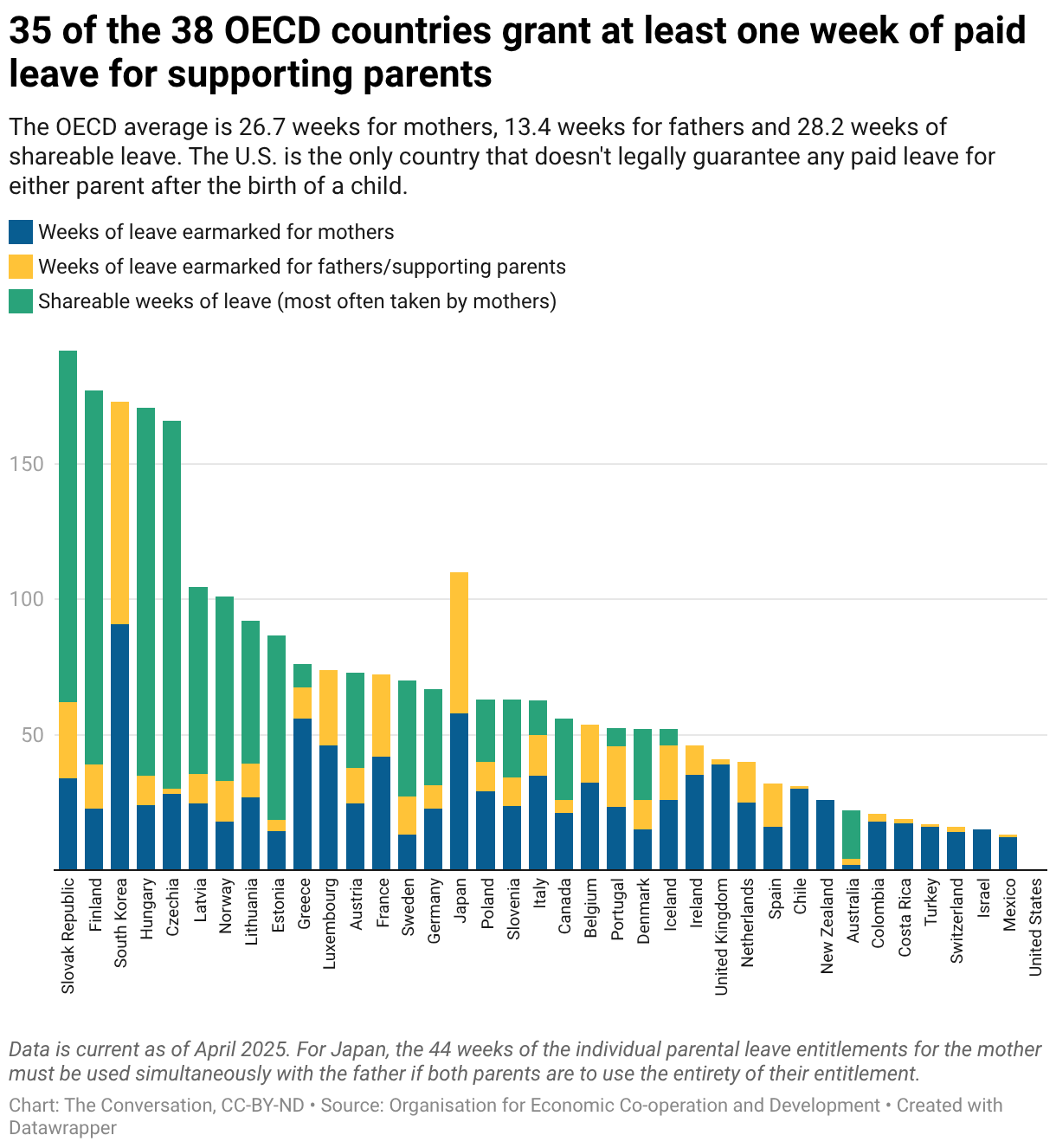
U.S. leave policies consistently rank at or near the bottom when compared with other similarly developed countries, like the 38 members of the Organization for Economic Cooperation and Development, or OECD.
Some countries follow a “use-it-or-lose-it” model of parental leave, where fathers in particular are encouraged to take a more substantial role in childcare. Sweden and Norway, for example, earmark 90 days of leave for each parent, and it cannot be transferred to or split with the other parent. This encourages both parents to take time off.
There are many options across countries with parental leave policies. Flexibility and defined expectations seem to be key contributors to getting the most out of the parental leave that is offered.
Cultural adoption
When non-birthing parents are men, another barrier to taking leave is the perceived social acceptability within their communities. Even when paid paternity leave is available, many men struggle to take it because of how traditional gender roles and expectations of masculinity frame childcare as women’s work.
To offset these kinds of social pressures, countries like Japan and Austria offer incentives such as bonus leave time for families when fathers actually take their available leave. Germany offers a similar bonus, and it has found improved couple relationship satisfaction when fathers take more of their leave time.
Beyond improvements in maternal and infant health, both parents taking leave can create a more equitable workplace environment. Disparities and discrimination that come when only women take leave after birth can lessen when fathers and other supporting parents also take leave. Childbearing women are then less likely to be penalized, formally or informally, for taking parental leave.
Paid parental leave policies that provide leave for all parents, regardless of gender, also can help reduce structural inequality in the workplace across race and class. In the U.S., Hispanic and Black workers often have less access to paid leave policies and may experience increased pressure to return to work earlier than their white counterparts.
As more states, countries and corporations adopt more flexible and inclusive leave policies, researchers will continue to learn how parental leave benefits both parents and children. What they’ve found so far leads me to believe that, just like we’ve seen with prenatal care and early education programs, parental leave will prove to be an early investment in healthy children and families that pays dividends in the long term.
“Kids and their phones these days” has been a complaint ever since the first cellular phone was introduced. However, there has been growing concern over the amount of time children spend not just on their phone, but scrolling through social media. The state of New York is hoping to address this issue through their finalized SAFE for Kids Act.
The Stop Addictive Feeds Exploitation (SAFE) for Kids Act aims to hold social media companies more accountable for the time children spend on their apps. It also seeks to limit kids’ exposure to their algorithms. Officials believe that constantly scrolling through social media feeds negatively impacts a child’s sleep and overall mental health.
New York Governor Kathy Holchul and Attorney General Letitia James made a public announcement to social media companies affected by this law, specifically Instagram, TikTok, YouTube, Facebook, Snapchat, and X.
“What changes is the default,” said James. “Platforms cannot automatically place minors into feeds engineered to maximize engagement. This is not a question of privacy, this is a question about content. This is not about the First Amendment. Again, this is about protecting children.”
“Social media companies, you’re now on notice,” said Holchul.
Critics and the issues that still need to be addressed
There are some criticisms of this law, particularly around age-verification. The law offers the option of using government-issued identification along with another proof of identity (such as an email address or an uploaded photo of the user). This complicates things aside from First Amendment rights. It would require millions of adults to share private information to scroll and post on social media after hours. While the law states that the companies must encrypt and erase such information upon age verification, that’s not guaranteed. This is especially concerning as social media companies already deal with users’ private information being hacked and leaked.
Governor Holchul still believes this criticism isn’t a governmental issue but a business one that social media companies need to resolve.
“Social media companies tell me, ‘We have no way of knowing whether someone’s under 18 or not,’” Holchul claimed. “I said, ‘You’re smart people. Use [artificial intelligence] to figure it out. Ask how you do it.’ And you’re not supposed to allow underage gaming anyhow—sports betting—so you must have some metric. So don’t tell me you can’t do it. Figure it out.”
How parents can help their children on social media
Regardless of where people stand on this law, experts offer some advice for parents who feel social media is negatively affecting their children. They recommend setting personal screen time limits for their children and taking advantage of built-in parental controls on their platforms. Parents limiting their own social media use can also influence how kids use it, too.
Psychologists also recommend talking with children about how and why they use social media. Specifically, discuss the fantasy that social media showcases from influencers versus the real lives of those people. Talk about why there was a social media post (advertisement, sharing joy, hoping for engagement, etc.) along with the content of it. Asking how they feel after watching or reading content in their feed helps as well. Such practices, along with limiting exposure, creates trust between child and parent without judgement.
Though how we fix screen and social media addiction is still largely in the air, take comfort knowing brilliant minds are exploring methods to address the growing issue.
Playing sports has been a common childhood experience that has led to lifelong hobbies, exercise, and forming lasting friendships. However, it’s gotten less common in recent years. Sign-up fees, uniforms, and many other expenses have led to most low-income families unable to afford to have their kids play. With that in mind, the city of Oakland, California believes they found a solution: a library. No, not the book kind.
Officials are letting children check out soccer balls, footballs, yoga mats, tennis equipment, and other sports supplies at their newly opened Park Play Lending Library. Kids can also check out board games and card games like UNO as well. Using this library located at the Larry E. Reid Sports Center is absolutely free to anyone.
“Every child deserves the opportunity to play, learn, and thrive,” said Maribel Lopez, City of Oakland Recreation Supervisor said in a press release. “The Park Play Lending Library is an investment in our community and a step toward ensuring that all Oakland residents have access to the recreational resources they enjoy, regardless of their financial situation.”
Encouraging kids to socialize, play, and grow
Oakland residents and officials welcome this sports equipment library for a myriad of reasons. It’s not just to allow access to certain activities, but to help address the lack of third places and areas for children to play overall. Whether it’s through sports or games, face-to-face playing helps children’s social skills, combats loneliness, and expands the immediate world around them.
“We’re aware that sports can lead to social mobility,” Lopez told SFGate. “When kids are familiar with golf, tennis, soccer, and other, you know, games or sports that are more socially mobile, then they have access to different communities, different friend groups, different neighborhoods, and we want to be a vehicle for that. We want kids to be able to speak each other’s language and connect through sports.”
Expenses in youth sports has become a federal government issue
Children being priced out of local sports programs due to expense has been a rising issue across the country. It’s to the point where the federal government is looking to intervene.
Representatives of both Congress and the Senate have introduced the Let Kids Play Act bill to their peers. The purpose of the bill, according to Congressman Pat Ryan and Senator Chris Murphy among other authors, is to limit or outright remove private equity firms’ involvement in youth sports. The representatives state that the cost to participate in youth sports rose by 46% over the last five years. They also claim that many families are paying more than $5,000 per kid so they can play. By removing private equity involvement, the hope is to cut down on junk fees, stay-to-play schemes, data mining, and other issues that are making it harder for families to allow their kids to participate in local organized youth sports.
While the federal government debates on this issue, a local library or park allowing children access to sports equipment to have pick-up games may be a great first step to renew what was a common American childhood experience.