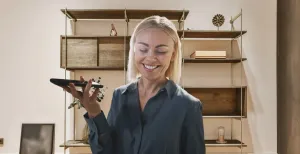
Here’s the pitch: For somewhere between $30-35 a week, you can text all day, every day, with a licensed mental health professional. This is the promise of BetterHelp and TalkSpace, two mobile phone apps that want to make therapy as accessible as a Snapchat filter.
These apps are certainly not the first of their kind; app stores are already full of all kinds of games and programs designed to address therapeutic needs. Optimism is a mood-charting app for people with bipolar disorder or depression. Headspace teaches users to meditate and guides them through the process. But BetterHelp and TalkSpace are the only apps that give you a direct line to a living, breathing human for a reasonable weekly fee. BetterHelp’s plans start at $35 a week. TalkSpace, which advertises its service on all your favorite podcast shows, charges $32 a week for a basic texting plan. Users can pay more for video chats with their therapist.
[quote position=”right” is_quote=”true”]If I could establish intimacy with strangers on Twitter, why couldn’t I have a digital relationship with my therapist as well?[/quote]
These rates are significantly cheaper than your average therapy session, which could cost upwards of $100 for every one-hour session. That’s a pretty steep price, especially for a generation (between the ages of 16 and 34) of workers who make an average of $30,000 a year (men make an average of $35,000, because systemic inequality will always favor the dudes). Even if you do have insurance that covers mental health care, a study by the National Alliance on Mental Illness found that insured Americans still faced major barriers accessing treatment: high co-pays and deductibles, as well as difficulty finding providers who accepted their plans.
That may explain why young people are far more likely to suffer from depression, anxiety and other mental illnesses, but also less likely to get help for it. This is the demographic apps like Talk Space and BetterHelp are appealing to—specifically, millennials for whom traditional therapy is either too expensive or too time-consuming.
In other words, me.
So I thought I’d try BetterHelp. I have plenty of online relationships—friends, acquaintances, and colleagues I may never have met IRL, but with whom I interact daily on the internet. If I could establish intimacy and honesty with people I’d only ever exchanged Twitter DMs with, why couldn’t I have a digital relationship with my therapist as well? I signed up.
“Hi Tasbeeh,” wrote “Arthur,” beginning what would become a week-long text correspondence. “Thank you for sharing a little information about yourself and your current situation. I’m glad you’ve reached out for help.”
Arthur, the therapist assigned to me by BetterHelp, was responding to a short survey I had filled out during BetterHelp’s application process. You’re likely thinking what I was thinking: Arthur sounds like a bot. There was a formality to his texting, which continued throughout the next week, that made it difficult for me to let loose in the messaging app.
[quote position=”left” is_quote=”true”]This was generic, platitudinous advice I could find cross-stitched on a pillow on Etsy.[/quote]
This is a problem that Andrew Gerber, a professor of psychiatry at Columbia University and the medical director of the Austen Riggs Center, identifies when I ask him about the efficacy of text therapy. “The question becomes, what are we losing by moving to a text format?” says Gerber. “You lose all those other ways we interact with people when we are face-to-face. Tone of voice, facial expressions. All of these things are intrinsic to the way we’ve been doing psychotherapy.”
Colloquial language helps breed familiarity, and the Internet’s digital lingo is rife with emoji and shorthand. My own texting habits trade “you” for “u” and make excessive use of exclamation marks and the “thinking face” emoji. Arthur, however, did not emote textually in this way, which meant that it often felt like I was talking to an especially advanced version of Siri.
I was also surprised that they had matched us at all. I had asked specifically for a therapist from an immigrant background, preferably a non-white woman. Arthur, however, appeared to be a white man. “For some reason, they connected us!” he wrote in his introductory text. “Maybe it was meant to be… Although, I am not from your cultural background, I do work with folks experiencing anxiety, as well as family and relationship issues.”
I could appreciate Arthur’s willingness to try, anyway, but I was concerned he would be unintentionally insensitive to the more culturally specific issues I wanted to address. I was also afraid of exposing myself to the racism and/or sexism of a stranger I just met on the internet. This is one of the more obvious shortcomings of apps like TalkSpace and BetterHelp, which UCLA psychology professor Gerald Goodman calls “brokers.” “The broker’s capacity for matching a patient to a therapist is inadequate,” he says. If you find your therapist through your insurance plan, for example, you could filter providers based on gender, ethnicity, and specialty.
[quote position=”right” is_quote=”true”]My own texting habits make excessive use of exclamation marks like the ‘thinking face’ emoji. Arthur, however, did not emote textually in this way.[/quote]
These apps, however, also provide an immediacy that other forms of appointment-based, face-to-face therapy cannot furnish. “[Some patients have] the sense… that ‘I’m in crisis now. I need intimacy now,’” Goodman says. “So I’ll write and my therapist may not respond until the next day or maybe wakes up in the middle of the night and types something back and I’ll feel connected, and what more do I need?”
The app did provide a platform for instant catharsis. During a particularly stressful day, I texted Arthur: “I feel so overwhelmed…like I’m never going to finish everything I need to do.” The simple act of writing this down, of giving words to the things that were distressing me, provided a kind of immediate emotional release. It was like journaling.
But Arthur didn’t respond until a few hours later. When he did, it wasn’t a satisfying answer. “Absolutely, you’re not! Because that to-do list is neverending,” he wrote. “’Everything’ is definitely overwhelming. You do not need to do everything. You just need to do something.” Arthur had warned me at the beginning of our relationship that his responses might be delayed. But it also felt like Arthur was phoning it in. This was generic, platitudinous advice I could find cross-stitched on a pillow on Etsy.
At one point, in order to help me calm my anxiety, Arthur instructed me to use one of my five senses to bring myself into the “present moment” and out of my thoughts. “For example, stare at the carpet and see everything—the colors, the fibers, the dirt, the ants… or listen to every sound you can hear—the A/C, traffic outside…” he wrote. “Each of these will help you be in the moment, if only for a few seconds.” Again, I wondered whether he was aggregating this advice from a WikiHow article on self-care and meditation. But what I could I really expect from Arthur, a therapist who’d known me for fewer than 10 text message exchanges? At any rate, just a few exchanges later—on the day my free trial was about to end—I deleted the app.
My experience might not be representative; it’s possible I just had bad luck getting matched with a therapist. Goodman, for one, is reluctant to write off text-based therapy, and says that at least it might be “better than nothing.” Gerber, however, has his doubts. “For some patients, particularly ones with mild disorders who are not at any severe risk, texting could be beneficial,” says Gerber. “That’s my clinical intuition. For patients with severe disorders, texting therapy might be worse than no therapy at all.”
The problem, Gerber says, is that text therapy is so new, it hasn’t been properly studied. There’s no research that proves its efficacy (or lack thereof). “I would never take a medicine that hasn’t proven to be effective, but people will willingly go into a form of therapy that hasn’t been tested,” he says.