Trillions, plural. Trillions of dollars-between two and three, actually. That’s how much Congress has spent annually since the Bush administration set up shop in the White House and started writing checks. Given how little we know about certain activities we aren’t meant to know about, it’s hard to get even the slightest grasp on how much of those trillions are flushed down our federal toilet, which is presumably outfitted with one of Reagan’s fabled $640 toilet seats.If anyone can get a grip on it, though, it’s the nation’s top accountant, David Walker, 56, the GAO’s comptroller general, whose job it is to audit, oversee, and report on every penny Congress spends. So incensed is he by the numbers that he’s mobilized a national campaign to sound the alarm. In fact, he is the alarm.”What we have here is a fiscal cancer,” says Walker, referring to America’s bloated national debt and deficit. Perched on a couch in his office, Walker-despite the urgency of his message-has the smooth tone of a man whose frankness buttresses his professional objectivity. “The question is, What are we going to do to treat it? Are we going to change our behavior? Are we going to engage in some meaningful treatments in order to create a more positive future and be the first republic to stand the test of time? Or are we just going to continue the status quo?”With the costs of Medicare and Social Security about to skyrocket in light of the coming era of Baby Boomer retirement, the question Walker raises is not whether we’ll need to raise taxes and cut spending, but where and by how much. According to GAO estimates, at the current rate of spending, by 2040, the government will be able to do little more than pay interest on the federal debt; spending on entitlement programs-Social Security, Medicare, and Medicaid-will by then consume all federal government revenues. By 2051, the economy could be in ruins. It’s a simple equation: The bigger the debt, the slower the economy grows; the slower the economy grows, the slower wages climb. Add reduced retirement benefits and higher payroll taxes, and the outlook is, in a word, bleak. “That is … going to affect [Americans] in a very real, pocketbook kind of way,” Walker told the Senate Budget Committee in January.“People are shocked when they hear the numbers. Absolutely shocked,” says Walker, who is spending a good part of his time on the road explaining those numbers. Since September, 2005, he has been headlining the Fiscal Wake-Up Tour, the hottest ticket in public finance and fiscal responsibility on the face of the planet, engaging the public in a realistic dialogue about the United States’s financial future, with the hope of fostering an understanding of the dire path we’re on and what needs to be done to change course.As head of the GAO, Walker works in downtown D.C., in the office headquarters, a federal building largely indistinguishable from those surrounding it. A paragon of bureaucracy, it has chrome and wood-grain accents in the lobby, giving it a decidedly 1940s feel, a sense of a proud world war victor’s monument to civil-service efficiency. Like every other building in the area, it was built so as not to eclipse the Washington Monument in height, sprawling horizontally rather than vertically. From where Walker is sitting, he says he can already see America speeding toward a national crisis.”We’re in the transparency, performance, and accountability business,” he says of the GAO. “We’re in the business to state the facts and speak the truth, and not just do oversight, but provide insight and foresight to try to help others to see the way forward.” That means that the GAO’s reports are open for partisan interpretation. A chief proponent of oversight, Representative Henry Waxman, Democrat of California, has used GAO reports to launch investigations into nearly every nook and cranny of the executive branch, including alleged improprieties by the Environmental Protection Agency (for its 2005 reversal of a statement that said an energy facility off the coast of California needed to meet clean-air standards) and the State Department (the allegedly false claim regarding Saddam Hussein’s government’s alleged purchase of uranium from Niger). Waxman is also looking into the White House’s “loss” of emails that related to contacts with the Department of Justice regarding the recent firings of U.S. Attorneys.Today, Waxman is animated, talking with me in a room in the Capitol where lobbyists and politicians gather around chestnut tables to do business as the latter make their way to and from their voting duties on the adjacent House floor. “The work done by [the GAO] points us in the direction where our oversight is most needed,” he says. “In addition to looking at waste, fraud, and abuse of taxpayer dollars, I think it’s important for us to look at government agencies and whether they’re serving the public purposes for which they were created, or whether they’re becoming dominated by politics or becoming ineffective for other reasons.”“When one party controls the Senate, the House, and the White House-and it really doesn’t make any difference what party it is-that’s generally not good for transparency, accountability, and fiscal responsibility,” says Walker. But with Democrats taking control of both chambers of Congress after six years of Republican leadership and ever-surfacing misdeeds, oversight has quickly become a buzzword on Capitol Hill. The freshman Democratic senator Claire McCaskill, Missouri’s former state auditor, told the Kansas City Star upon her election that the “GAO is going to love me as a senator” and vowed to have the “GAO’s products permeate everything I do in my job.” Senator Joe Lieberman, an Independent from Connecticut, at a GAO press conference in February, spoke of how a hearing on Hurricane Katrina recovery led him to see just how concerned the American people are with accountability: “None of the witnesses asked for more money. They all wanted to talk about how the money there is being spent.”More recently, Congress has put additional pressure on the inspectors general-the internal auditors of executive agencies-to ramp up their efforts, especially in light of findings such as the Department of the Interior’s discovery that its Minerals Management Service might end up forfeiting more than $7 billion in royalties from oil companies over the next five years due to errors in leases signed in the 1990s, despite having discovered those errors in 2000.

Quote:
The government is owned by the people, and the people should know what their government is doing.

In fact, oversight has become so significant that Waxman decided to add the word to the official name of the committee he chairs. Now called the Committee on Oversight and Government Reform, it holds sweeping investigative power over matters of Congressional interest, and Waxman has put those powers-and the GAO-to use in a manner that would have been considered anathema to Congressional Republicans and the Bush administration during their halcyon “What checks and balances?” days-and for precisely that reason. “The administration should recognize that … they don’t own the government,” says Waxman. “The government is owned by the people, and the people should know what their government is doing.”As the federal budget has ballooned in recent years, many of the recipients of government funds have retreated from the constraints of accountability. One particularly troubling area for both the GAO and the new Congress has been the escalating reliance on contractors to do the work of the government. In February, The New York Times reported that the total annual value of federal contracts doubled from $207 billion in 2000 to approximately $400 billion last year. Meanwhile, “contract actions,” defined as both new contracts and payments on existing ones, have become increasingly easy to get: In 2001, 21 percent of government contracts were handed out without hearing other bids. In 2005, a shocking 52 percent were awarded without competition.At the same time as that report was published, the GAO released its biennial update on areas of the federal government at high risk of waste, fraud, and abuse. Not surprisingly, several agencies’ contracting and procurement operations made the list, including those of the Department of Defense. In a follow-up report, the GAO revealed that a contract with a Kuwaiti company to provide food service to troops in Iraq for $3 a meal was inexplicably re-awarded to Halliburton, which was paid $5 a meal by the government and which then subcontracted the service back to the Kuwaiti company at the original rate. (The $2-a-meal profits were subsequently recovered from Haliburton.)”In Iraq, we’re using contractors in new and unprecedented ways, in numbers that we’ve never seen before in our history,” says Walker. “If we decide that it makes sense to contract for something, what are we doing to make sure that we’re being very clear about what we’re asking the contractors to do, so that we can hold them accountable for results? And what mechanisms do we have in place to provide adequate oversight to ensure that the taxpayers are going to get good value for their money?”The reconstruction efforts in Iraq have not only highlighted the challenges of keeping government contractors accountable-they have shown how difficult it can be to have meaningful inspection of a government that has displayed outright disdain for oversight. Just before the election last fall, Republicans slipped a provision into a defense spending bill that would eliminate the office of the Special Inspector General for Iraq Reconstruction by October, 2007. After a public outcry-and an election that spoke volumes about the public’s mistrust of the government’s management of the war and reconstruction-legislation was passed to keep the SIGIR office open at least through the fall of 2008. No wonder Republicans wanted that office shut down: In March, it released a scathing report on the government’s failure to provide a strategy, structure, or even an understanding of potential problems faced in the reconstruction.The GAO has met similar resistance in its attempts to oversee the government’s work in Iraq. Early this year, the State Department refused to grant the GAO’s request for accommodations in the department’s Green Zone facilities for three auditors at a time over a six-month period, stating that it lacked the resources to facilitate such a stay. On behalf of the GAO, a group of 21 Democratic senators sent a letter to Secretary of State Condoleezza Rice expressing their concern about the administrators of a war costing taxpayers $280 million a day, who can’t seem to find the resources to put up three additional people.Iraq is, of course, not the only major area of concern for the GAO today, though it’s certainly one of the biggest. As Walker’s nationwide tour shows, there is one area that the GAO has been urging Congress itself to examine more closely: the nation’s increasingly imbalanced long-term fiscal outlook.”Where we’re at right now, we’re running large deficits in the short term, and people’s efforts are to reduce or eliminate that,” says the comptroller general. “But the real problem’s not the short term: The real problem’s the long range. We’ve gone from $20 trillion in liabilities and unfunded commitments in 2001 to $50 trillion in 2006, and those numbers are going up 2 to 4 trillion a year just due to the passage of time.”

Quote:
If something doesn’t change, Generation X and Generation Y, and ultimately their kids and grandkids, will have to pay off this [national debt]-with compounded interest. I don’t think that’s right, and I’m trying to make sure that we’re doing something about it.

To Walker, the numbers are less important than the moral issues behind them. Such a mounting deficit could spell a financial disaster in the not-so-distant future: Spending on entitlement programs would be cut drastically, to the point where anyone under 30 today would be unlikely to receive much, if any, of what he or she is currently paying into those programs; taxes would skyrocket, threatening to completely eliminate the middle class in the United States; and if the United States were forced to default on its loans, interest rates would soar and economic growth would stagnate for at least a decade, leading to a long-term national depression.Beyond that, though, we can only speculate on what might happen. Will we be forced to pawn our national supply of bicycles to China? Will Canada create a wall along its border to prevent cheap Minnesotan labor from flooding into Manitoba? Will the hipster youth of tomorrow be forced to do their freelance graphic-design work from the discomfort of Wi-Fi-equipped boxcars? Hopefully, we’ll never find out.”If something doesn’t change,” Walker adds, “Generation X and Generation Y, and ultimately their kids and grandkids, will have to pay off this bill-with compounded interest. I don’t think that’s right, and I’m trying to make sure that we’re doing something about it.”


  • Facebook group helps families without a ‘village’ find surrogate grandparents
    Photo credit: CanvaSurrogate grandparents laughing with small child.

    Raising kids today doesn’t match the historical “it takes a village” experience many grew up with. Not because people don’t care, but because life doesn’t seem to line up that way anymore. Families are spread out across the country and sometimes the world. Few grandparents live just up the street. There’s no built-in help for childcare and no extra sets of hands when things get overwhelming.

    In response to that missing piece in raising kids, some people have looked for other ways to create something similar. One path is Surrogate Grandparents – USA, a Facebook-based community that connects older adults with families.

    surrogate grandparents, chosen family, connecting seniors, programs
    An older man helps a boy water the plants.
    Photo credit Canva

    Missing out on grandparents nearby, some find new ones online

    Founded in 2015, Surrogate Grandparents – USA offers a platform that works like a community bulletin board. The goal is to bring together families bereft of nearby grandparents with older adults looking to share that kind of family role.

    Over 14,000 members hope to make a surrogate family connection and the possibility of building real love. They describe the opportunity on their Facebook page as follows:

    “A surrogate grandparent is a volunteer or mentor who forms a supportive, grandparent-like relationship with a child or family who may not have local grandparents. These relationships can begin online or in person, often through platforms designed to connect families and older adults.”

    The typical online pattern might look like a family posting on the page that their children don’t have nearby grandparents and would love a consistent older presence in their lives. Someone responds. They all start talking. Then, they meet in person.

    Those introductions can turn into something steady with regular check-ins. Children receive the face-to-face guidance and experience that an older generation can offer. The surrogate grandparents gain a sense of purpose they hadn’t anticipated at this stage of their lives.

    support system, children bonding, mentorship, extended family
    A family picnic.
    Photo credit Canva

    Surrogate grandparent success stories

    One success story was shared in Newsweek. In 2019, Deborah Whatley, then aged 64, joined the Facebook group with her husband. Hoping to fill a need within their own lives, they connected with the Nelsons, and a beautiful relationship quickly blossomed.

    The families share photos, meet in person about every month, and text regularly. “We’ve met up more times than I can count,” explained Whatley. “I just wanted to feel included. I have the time, the energy, and the desire. Discovering the surrogate grandparents group instantly brought light back into a part of my life that had turned dark,” she added.

    CBS News reported that Anteres Anderson Turner and Louis Turner wished to extend their own family while raising twin boys. Janet Firestein Daw welcomed the idea of grandchildren in her life, saying, “I was getting older and I wanted to get down on the floor and play Legos and trains and read books.”

    After meeting through the Facebook group, the relationship between the two families really worked. Daw continued, “It’s indescribable for me, because I haven’t had that experience before to be that grandparent, and I love it.”

    Facebook closes the page

    Earlier this year, the Facebook group became inaccessible. There haven’t been any publicly reported reasons from Facebook itself. However, an administrator for the page shared, “Surrogate Grandparents-USA group was unfortunately erroneously removed by Meta. We are actively working to have it reinstated.”

    Thankfully, the page was reopened in time. In an Instagram post dated April 11, 2026, they said, “This morning, my Surrogate Grandparents-USA group was officially reinstated.” The post continues, “What a journey this has been—stressful, emotional, and at times incredibly disheartening. But I never stopped believing in the purpose of this community…and the power of speaking up when something isn’t right.”

    community, kindness, parenting support, family structures
    An extended family at the park.
    Photo credit Canva

    A shift in how family works

    The structures that used to hold families together aren’t as automatic as they once were. For a long time, grandparents lived nearby. Neighbors remained for decades. Communities were tighter, and lives were more interwoven. Support existed from a simple proximity.

    But families move. Relationships change. Career and circumstance have stretched people farther apart. Places like Surrogate Grandparents – USA fill roles that certain families are missing. It may not work for everyone, but for many, it’s a chance to build community in a whole new way.

  • Italian man claims to be ‘human cheetah’ with lightning-fast reflexes
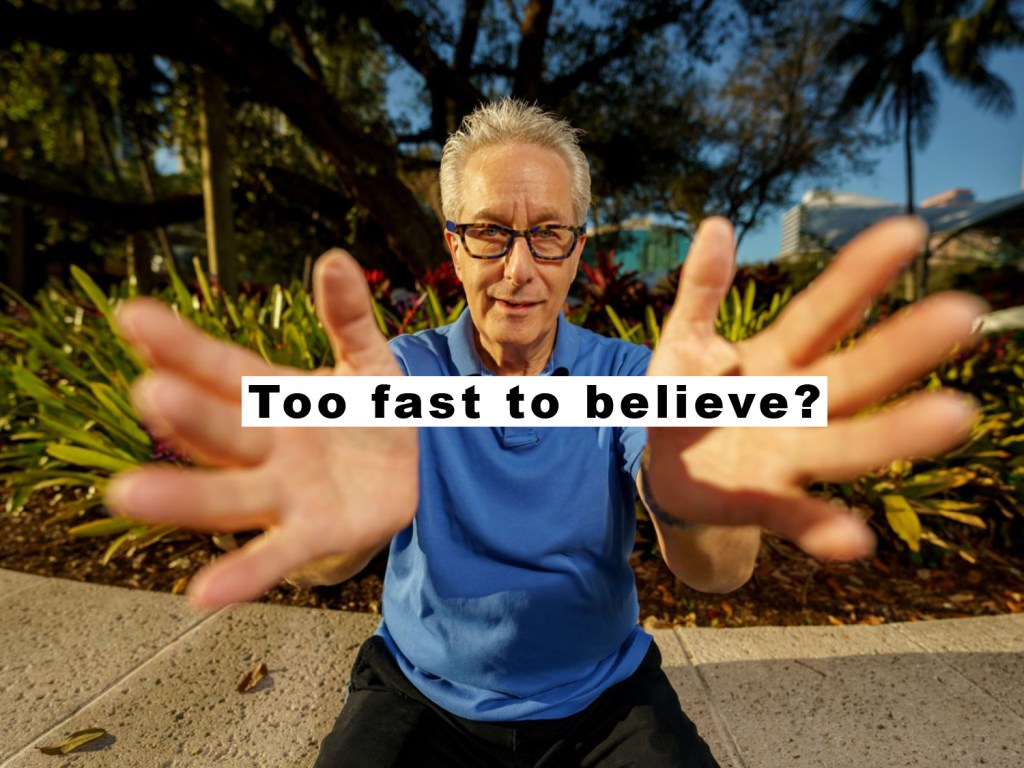
    Photo credit: CanvaA man with fast reflexes.

    At first glance, this probably looks like a camera trick. Ken Lee, an Italian content creator, has built a massive online following by doing something that doesn’t quite feel real. Viewers refer to him as the “human cheetah” because it appears he has near-instant reflexes.

    Grabbing objects out of the air with uncanny precision, flicking clothespins and lighters, and throwing a blur of punches and kicks at impossible speeds, it is easy to call him unbelievable. Half the audience thinks his viral speed videos are fake. The other half is just as convinced they are watching something incredibly rare.

    Hands so fast they blur time

    In the video above, a timer runs to confirm its authenticity. In what looks like half a second, he reaches out and snags the lighter from the table. To prove it is real, he does it twice.

    Having amassed millions of followers on his TikTok page, the identity behind the mysterious influencer remains largely unknown. Active since around 2022, with almost 100 million accumulated likes, Lee has cultivated a fandom around his self-proclaimed “Superhero per Hobby!”

    Do you believe it is real? Is this person the fastest human alive? Many followers cannot wait for the next video to be posted. Plenty of his fervent fans are Italian, so sifting through the remarks takes a bit of hunting. Here are some comments that sum up how much people enjoy the fun and the spectacle:

    “Ken lee the fastest and the best”

    “Most dangerous human”

    “Is this what the lighter sees before my homie steals it”

    “It was sped up during he grabbed the lighter, if u count up with the timer u would be off by like 0,5 seconds whenever he grabs the lighter.”

    “If the flash were human”

    “How is it possible to get such powers ?”

    “I blinked and I missed it”

    People love good entertainment

    The awe of peak performance attracts people to watch elite athletes, musicians, or even dancers. There is something that deeply satisfies all of us when a human appears to push a skill to its limit. Whether it is real or fake seems to matter less than the opportunity to chime in on some good entertainment.

    How far could any of us go by practicing and repeating a particular motion over and over until it is mastered? Beneath the flashy nickname and his viral speed videos, Lee’s content has a way of drawing people in. This is not a superpower. Just repetition. Focus. Obsession. And maybe some digital wizardry.

    Testing the science of speed

    If you wish to question the validity of Lee’s performances, maybe some basic science can help. Human reaction time is not just a reflex. A 2024 study found that the nervous system can fine-tune responses in real time. Practice can make movements appear almost automatic.

    It has been well established in research that the gap between seeing something and responding has a limit. A 2025 study concluded that the most elite extremes allow for reaction times of 100 milliseconds. At that speed, the human brain can barely process that something has happened.

    Science explains Lee is not necessarily moving as fast as we might perceive him to be. And therein lies all the fun of it. We cannot prove it is real, nor can we actually prove that it is fake.

    Maybe Lee is the “fastest man alive” or the so-called “human cheetah.” Or maybe he is just a remarkable entertainer. Either way, he has clearly tapped into something strange and fascinating: a blend of human ability and fantasy that people do not want to miss.

    To give context to Lee’s videos, watch this performance on Tú Sí Que Vales:

  • Why some health professionals are recommending pet ownership for better health
    A dog rests on its owner's lap as they pet its head.

    Christine Abdelmalek for Pink Papyrus

    Research suggests that pet ownership is associated with higher life satisfaction, with some studies estimating its impact as comparable to that of a substantial increase in income. According to the paper The Value of Pets by Michael W. Gmeiner and Adelina Gschwandtner, this comparison reflects a modeled relationship between life satisfaction and income rather than a literal financial gain.

    Beyond the obvious companionship and social benefits, having a dog (or any other pet) waiting for you at home can also improve your health. Studies show that just 10 minutes of petting a dog while making eye contact can significantly reduce stress levels.

    The growing body of research is convincing enough that more U.S. health professionals are beginning to recommend pet ownership as part of treatment plans.

    Pink Papyrus explores research on the health benefits of pet ownership and why some professionals recommend it.

    Why Are Health Professionals ‘Prescribing’ Pets?

    A recent Human Animal Bond Research Institute (HABRI) report found that 1 in 5 pet owners say a doctor or therapist has recommended pet ownership to support their health. This reflects patient-reported experiences rather than a direct measure of how widely health professionals recommend pets.

    The Science Behind the Data

    Petting a dog for five to 10 minutes triggers the release of oxytocin, also known as the love hormone. At the same time, cortisol (the primary stress hormone) levels drop, leaving you feeling calmer and happier.

    The effect goes both ways: dogs also experience increased oxytocin levels during petting. And if you make eye contact with your pet while stroking their fur, the feeling of calm and general positivity can be even stronger.

    A study meta-analysis by the American Heart Association also shows that dog owners have a 31% lower risk of mortality from cardiovascular disease compared to those who don’t own dogs. This is largely due to increased physical activity (walks, play, grooming) and lower autonomic stress.

    Dog Walks Help Combat Loneliness

    Dog walks are great for more than just getting your daily steps; they’re a natural way to meet other dog owners and spend time outside, surrounded by people. For anyone feeling a bit isolated, that alone can make a real difference.

    Dog walking has quietly become a gateway into online communities, where people share routines, tips, and even creative spins on their daily outings.

    One trend that’s gained traction among more style-conscious pet parents is coordinating outfits with their dogs using playful accessories. Some brands have helped fuel this movement, turning a simple walk into a form of self-expression and something people love to share and bond over online.

    Emotional Support Animals

    While any pet can be an emotional support animal, dogs are usually on the front lines. These are not service dogs, trained to perform specific activities; their job is to provide therapeutic benefit through their presence alone.

    Due to our deep bond, dogs can act as a physiological regulator. Besides petting and mutual gazing, many owners practice deep pressure therapy, in which the dog lies across the owner’s lap or chest. This weight triggers the parasympathetic nervous system, helping to ground a person during a panic attack or high-anxiety episode.

    Furthermore, the daily routine of feeding, walking, grooming, bathroom breaks, etc., is beneficial for people who struggle with depression or anxiety. If you don’t have the motivation to get out of bed in the morning, you will do it for your dog.

    Seniors also feel that their pets provide a sense of purpose, which helps keep both mind and body engaged. Having a pet depend on you can provide a powerful sense of self-worth.

    The $22B Answer

    Further research from HABRI highlights another angle: the economic impact on the U.S. healthcare system. According to its latest report, pet ownership saves an estimated $22.7 billion annually in medical costs.

    On average, pet owners visit the doctor less frequently. Dog owners, in particular, tend to be more physically active, contributing to lower rates of obesity and cardiovascular disease.

    The benefits extend beyond physical health. Many seniors find meaningful companionship in their pets or use them as a bridge to connect with other pet owners, helping reduce the risks associated with social isolation. Veterans living with PTSD also benefit from emotional support animals, which can lower long-term treatment costs.

    A Healthier, Less Lonely Future

    Pets play a meaningful role in our well-being. As both companions and sources of emotional support, they deliver proven benefits for physical and mental health.

    The data also points to a measurable impact on public health. That said, these benefits depend on responsible ownership. Health professionals must weigh the advantages against an individual’s ability to provide a stable home and consistent veterinary care.

    This story was produced by Pink Papyrus and reviewed and distributed by Stacker.

Explore More Stories

Society

10 conversation starters that actually work, according to communication experts

Voices

Husband steals the spotlight picking up PR packages for wife who became an influencer at 80

Public Good

The evidence points to a crisis in teaching, yet Gen Z is still choosing to show up in the classroom

Environment

America’s next big critical minerals source could be coal mine pollution – if we can agree on who owns it