Sometimes it can feel like you know something is present without seeing it or touching it. A scientific study just investigated our ability to “feel” things without contacting them. This isn’t a science fiction movie. It’s reality, and they’re calling it “remote touch.”

A 2025 study explored humans’ abilities to sense objects in sand. Participants were asked to detect hidden cubes by sifting their hands through sand without touching them. Subjects successfully discovered the objects with 70% accuracy. The research demonstrates that humans can detect objects buried in the sand before physical contact, indicating a form of “remote touch” previously believed to be exclusive to shorebirds.
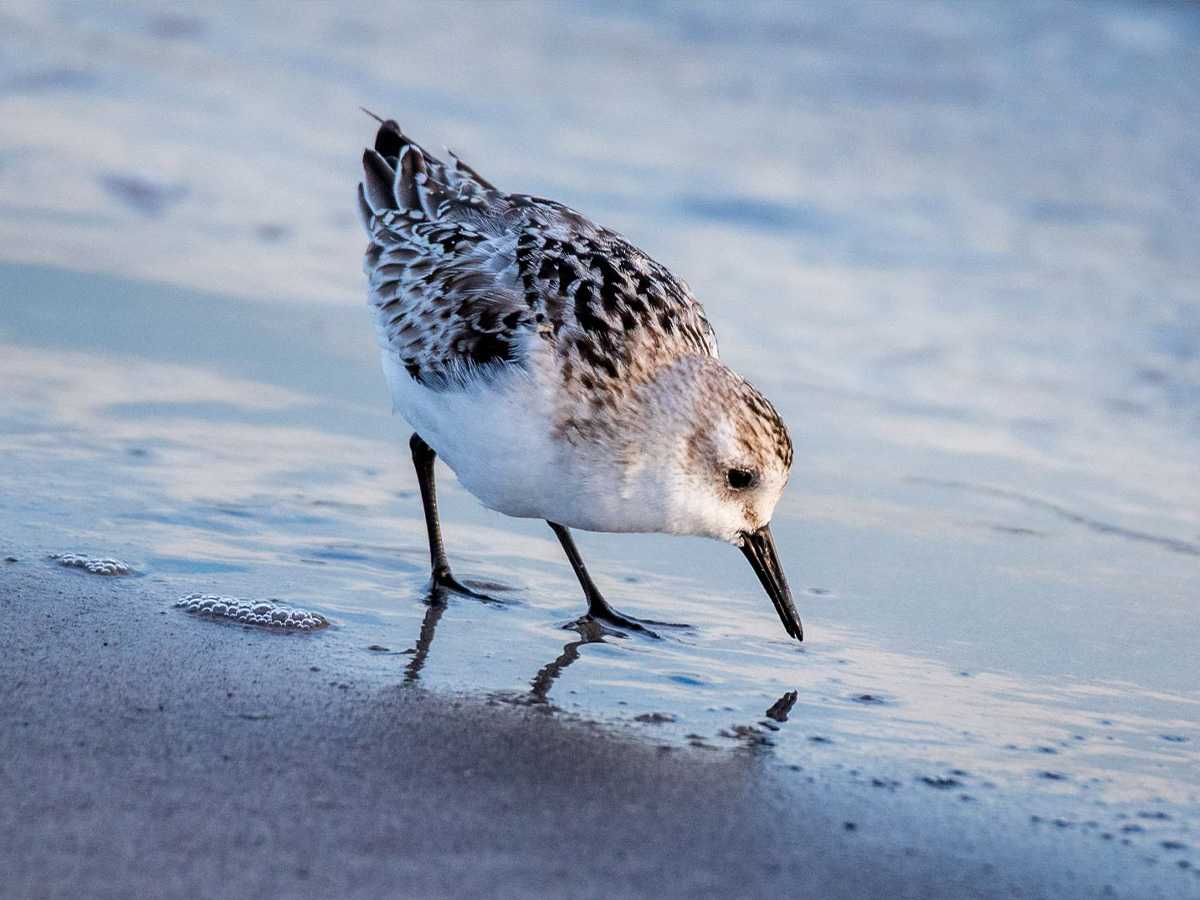
birds, food, sandy beach, unique skills, biology, biological skills, Red Knot, pressure ripples
Bird searches for food on a beach. Photo credit Canva

A unique skill robots try to mimic

Dr. Elisabetta Versace, a senior lecturer in psychology at Queen Mary University of London, led the study. In an article on Earth.com, when talking about the experiment, she said, “It’s the first time that remote touch has been studied in humans and it changes our conception of the perceptual world.” Measuring the human performance against a robotic system, people outperformed the machines designed for that very same task.

Perceiving the tiniest things and detecting the subtlest signs by moving close to an object buried in sand reveals a detailed biological skill. As the grains shift, even if only a little, there’s a pressure change that spreads out like ripples. The results suggest that humans are far more sensitive to their surroundings than we realize.

Scientists have been studying birds that find hidden food under sand. The Red Knot is a bird that searches for food and feels those tiny pressure changes with the tip of its beak. The skill can be amplified when the sand is wet, but it can also be made more difficult when things like blades of grass get in the way of those tiny pressure ripples.
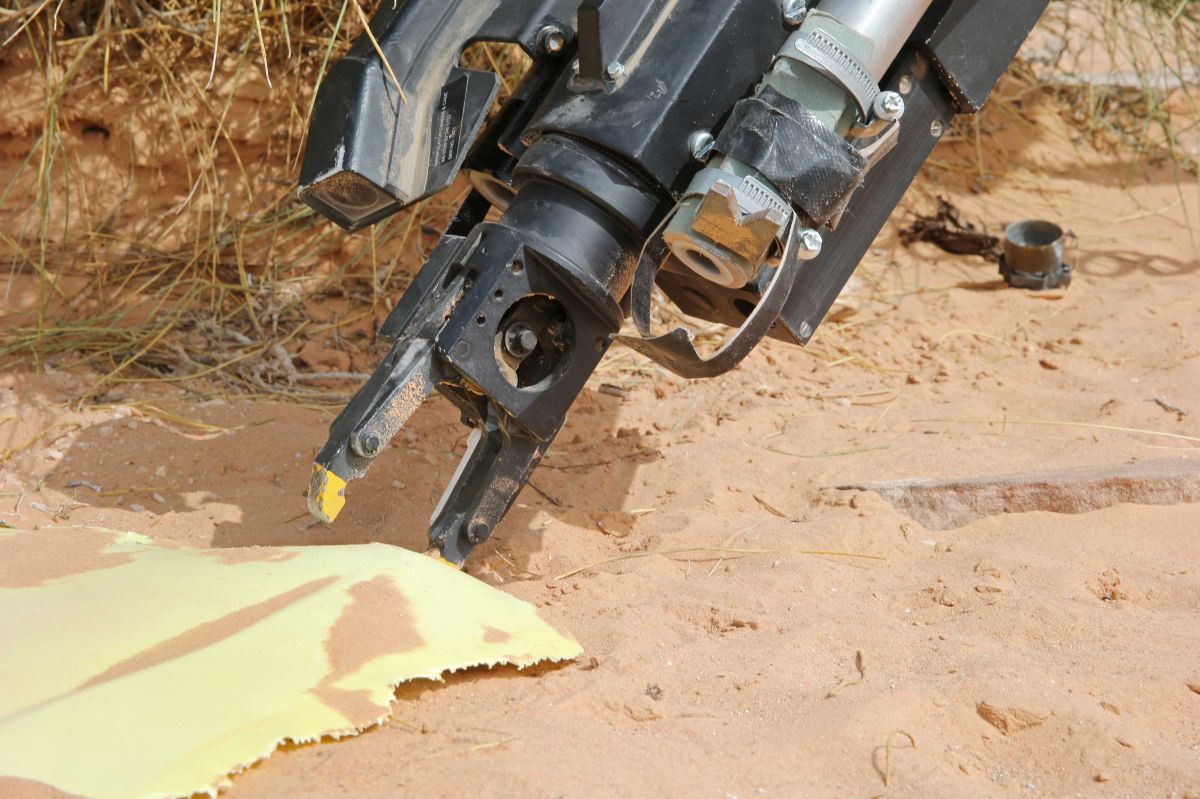
robotic arm, peripersonal space, zone, mechanical devices, minesweepers, proximity sensors, grains of sand, patterns
Articulating arm in sand. Graeme Main/ Wikimedia Commons

Why remote touch is important to understand

This study challenges traditional views of touch being effective only with direct contact. It opens questions about sensory evolution and what our actual perception thresholds are. How do our brains interpret the indirect signals it receives from the environment? A 2022 study on multisensory adaptation suggests humans are very good at noticing things close to their bodies. Calling the zone peripersonal space (PPS), they determined that our bodies actually increase this size and space depending on what’s happening in the environment around us.

Having a better understanding of how humans use these skills can influence the design of mechanical devices. Things like minesweepers and proximity sensors can be evolved to work with physical vibrations instead of visual or chemical reactions. A 2024 study at Cornell University examined the very expensive machines designed to locate landmines. They created a simpler and cheaper tool that sifts through the sand and detects how the grains push back. Teaching the computer to recognize patterns and notice the sand reacting differently, they were able to “feel” hidden objects underground more effectively.

A 2021 study in MIT News reported on a robotic digger finger. The aim was to teach robots to distinguish between the things that are important versus the things that are not. The advancing technology models the abilities and evolutionary adaptations that humans have developed over thousands of years.

people, environment, animal behavior, evolving tech, vision, robots, sensors, nature
Woman arms stretched. Photo credit Canva

These findings reveal that touch, vision, and other human senses work together in complicated ways. Studying them will not only improve our understanding of human perception and animal behavior, but also help evolving technologies like robots and sensors to work better. We are constantly interacting with our environment, even when we don’t see or feel it directly. Studies into “remote touch” through the localization in granular media, hands and robot fingers sifting in sand, will help us better understand it.

You can learn a little bit more about nature and the evolution of the Red Knot as it hunts for food on sandy beaches:


  • America’s next big critical minerals source could be coal mine pollution – if we can agree on who owns it
    Photo credit: Jake C/Wikimedia Commons, CC BY-SAAcid mine waste turns rocks orange along Shamokin Creek in Pennsylvania.

    Across Appalachia, rust-colored water seeps from abandoned coal mines, staining rocks orange and coating stream beds with metals. These acidic discharges, known as acid mine drainage, are among the region’s most persistent environmental problems. They disrupt aquatic life, corrode pipes and can contaminate drinking water for decades.

    However, hidden in that orange drainage are valuable metals known as rare earth elements that are vital for many technologies the U.S. relies on, including smartphones, wind turbines and military jets. In fact, studies have found that the concentrations of rare earths in acid mine waste can be comparable to the amount in ores mined to extract rare earths.

    Scientists estimate that more than 13,700 miles (22,000 kilometers) of U.S. streams, predominantly in Pennsylvania and West Virginia, are contaminated with acid mine discharge.

    We and our colleagues at West Virginia University have been working on ways to turn the acid waste in those bright orange creeks into a reliable domestic source for rare earths while also cleaning the water.

    Experiments show extraction can work. If states can also sort out who owns that mine waste, the environmental cost of mining might help power a clean energy future.

    Rare earths face a supply chain risk

    Rare earth elements are a group of 17 metals, also classified as critical minerals, that are considered vital to the nation’s economy or security.

    Despite their name, rare earth elements are not all that rare. They occur in many places around the planet, but in small quantities mixed with other minerals, which makes them costly and complex to separate and refine.

    A mine and buildings with mountains in the background.
    MP Materials’ Mountain Pass Rare Earth Mine and Processing Facility, in California near the Nevada border, is one of the few rare earth mines in the U.S. Tmy350/Wikimedia CommonsCC BY-SA

    China controls about 70% of global rare earth production and nearly all refining capacity. This near monopoly gives the Chinese government the power to influence prices, export policies and access to rare earth elements. China has used that power in trade disputes as recently as 2025.

    The United States, which currently imports about 80% of the rare earth elements it uses, sees China’s control over these critical minerals as a risk and has made locating domestic sources a national priority.

    The U.S. Geological Survey has been mapping locations for potential rare earth mining, shown in pink.
    The U.S. Geological Survey has been mapping locations for potential rare earth mining, shown in pink. But it takes years to explore a locations and then get a mine up and running. USGS

    Although the U.S. Geological Survey has been mapping potential locations for extracting rare earth elements, getting from exploration to production takes years. That’s why unconventional sources, like extracting rare earth elements from acid mine waste, are drawing interest.

    Turning a mine waste problem into a solution

    Acid mine drainage forms when sulfide minerals, such as pyrite, are exposed to air during mining. This creates sulfuric acid, which then dissolves heavy metals such as copper, lead and mercury from surrounding rock. The metals end up in groundwater and creeks, where iron in the mix gives the water an orange color.

    Expensive treatment systems can neutralize the acid, with the dissolved metals settling into an orange sludge in treatment ponds.

    For decades, that sludge was treated as hazardous waste and hauled to landfills. But scientists at West Virginia University and the National Energy Technology Laboratory have found that it contains concentrations of rare earth elements comparable to those found in mined ores. These elements are also easier to extract from acid mine waste because the acidic water has already released them from the surrounding rock.

    Metals flowing from acid mine waste make a creek look orange.
    Acid mine drainage flowing into Decker’s Creek in Morgantown, West Virginia, in 2024. Helene Nguemgaing

    Experiments have shown how the metals can be extracted: Researchers collected sludge, separated out rare earth elements using water-safe chemistry, and then returned the cleaner water to nearby streams.

    It is like mining without digging, turning something harmful into a useful resource. If scaled up, this process could lower cleanup costs, create local jobs and strengthen America’s supply of materials needed for renewable energy and high-tech manufacturing.

    But there’s a problem: Who owns the recovered minerals?

    The ownership question

    Traditional mining law covers minerals underground, not those extracted from water naturally running off abandoned mine sites.

    Nonprofit watershed groups that treat mine waste to clean up the water often receive public funding meant solely for environmental cleanup. If these groups start selling recovered rare earth elements, they could generate revenue for more stream cleanup projects, but they might also risk violating grant terms or nonprofit rules.

    To better understand the policy challenges, we surveyed mine water treatment operators across Pennsylvania and West Virginia. The majority of treatment systems were under landowner agreements in which the operators had no permanent property rights. Most operators said “ownership uncertainty” was one of the biggest barriers to investment in the recovery of rare earth elements, projects that can cost millions of dollars.

    Not surprisingly, water treatment operators who owned the land where treatment was taking place were much more likely to be interested in rare earth element extraction.

    A map shows many acid mine drainage sites, largely in the column from the southwest to the northeast.
    Map of acid mine drainage sites in West Virginia. Created by Helene Nguemgaing, based on data from West Virginia Department of Environmental Protection, West Virginia Office of GIS Coordination, and U.S. Geological Survey

    West Virginia took steps in 2022 to boost rare earth recovery, innovation and cleanup of acid mine drainage. A new law gives ownership of recovered rare earth elements to whoever extracts them. So far, the law has not been applied to large-scale projects.

    Across the border, Pennsylvania’s Environmental Good Samaritan Act protects volunteers who treat mine water from liability but says nothing about ownership.

    A map shows many acid mine drainage sites, particularly in the western part of the state.
    Map of acid mine drainage sites in Pennsylvania. Created by Helene Nguemgaing, based on data from Pennsylvania Spatial Data Access

    This difference matters. Clear rules like West Virginia’s provide greater certainty, while the lack of guidance in Pennsylvania can leave companies and nonprofits hesitant about undertaking expensive recovery projects. Among the treatment operators we surveyed, interest in rare earth element extraction was twice as high in West Virginia than in Pennsylvania.

    The economics of waste to value

    Recovering rare earth elements from mine water won’t replace conventional mining. The quantities available at drainage sites are far smaller than those produced by large mines, even though the concentration can be just as high, and the technology to extract them from mine waste is still developing.

    Still, the use of mine waste offers a promising way to supplement the supply of rare earth elements with a domestic source and help offset environmental costs while cleaning up polluted streams.

    Early studies suggest that recovering rare earth elements using technologies being developed today could be profitable, particularly when the projects also recover additional critical materials, such as cobalt and manganese, which are used in industrial processes and batteries. Extraction methods are improving, too, making the process safer, cleaner and cheaper.

    Government incentives, research funding and public-private partnerships could speed this progress, much as subsidies support fossil fuel extraction and have helped solar and wind power scale up in providing electricity.

    Treating acid mine drainage and extracting its valuable rare earth elements offers a way to transform pollution into prosperity. Creating policies that clarify ownership, investing in research and supporting responsible recovery could ensure that Appalachian communities benefit from this new chapter, one in which cleanup and clean energy advance together.

    This article originally appeared on The Conversation. You can read it here.

  • Humans nearly vanished 800,000 years ago, revealing a quiet truth: most family lines disappear
    Photo credit: CanvaA group of people hiking in the mountains.

    There was a moment in human history when our entire existence may have desperately clung to a thousand or so people. A DNA-based study found that between 800,000 and 900,000 years ago, our ancestors experienced a severe population crash.

    This wasn’t humans dealing with a giant meteor like the one that wiped out the dinosaurs. It was a much slower stretch during which humanity teetered on the brink of disappearing completely. This bottleneck in the human gene pool, comprising roughly 1,280 breeding individuals, lasted about 117,000 years.

    population, genomes, Ice Age, Early-Middle Pleistocene
    Removing representation of a human population group.
    Photo credit: Canva

    Human population levels plummet

    According to Scientific American, the study analyzed modern human genomes to piece together what the early human population looked like. By constructing a complex family tree of genes from present-day humans, researchers were able to identify important evolutionary events.

    During the Early-Middle Pleistocene, a period within the Ice Age, humans faced severe weather and intense glacial cycles. Most human ancestors may have died out, clearing the path for a new human species to take their place.

    Focusing on Africa, the study showed that 813,000 years ago, human populations began to recover and grow again. With an estimated two-thirds of genetic diversity potentially lost, traits like brain size appear to have been among the important features that survived. “It represents a key period of time during the evolution of humans,” population geneticist and study co-author Ziqian Hao said. “So there are many important questions to be answered.”

    DNA, genomes sequence, human existence, heredity
    DNA genome sequences.
    Photo credit: Canva

    Understanding evolution and ancestry

    What we know about evolution reveals a different story than a simple, continuous line of human improvement. Over time, genetic lines disappear—not dramatically all at once. It’s a slow and steady change, generation after generation.

    Human existence isn’t inevitable. Species strength or technical advancement doesn’t guarantee the future or explain our past. It’s contingent on narrow, accidental circumstances. A 2021 study showed that human evolution is better seen as a continuous flow of incremental fragments over time. Categorizing people into races and groups oversimplifies human history.

    species strength, evolutionary improvement, genetic lines, technical advancement
    A diverse group of wooden figures.
    Photo credit: Canva

    What does the bottleneck study say about us?

    The study reveals humanity didn’t simply decline; it nearly collapsed. With over 98% of our genetic diversity erased, entire branches of the human family tree permanently ceased to exist.

    It’s quite possible that if even a few more of those genetic lines had ended, human history could have vanished with them. Most branches of life don’t continue. What we witness today reflects biological persistence and countless moments that could have gone another way.

    A 2024 study conducted five billion simulations, revealing that as a species’ population shrinks, its risk of extinction rises. Even stable groups can quickly collapse if their numbers suddenly drop low enough.

    A 2025 study found that small populations erode genetic diversity. Isolation increases inbreeding and elevates the risk of extinction. Once a lineage shrinks, recovery becomes vastly more challenging over time. Long-term survival is an exception, not the guiding rule.

    Humanity likes to think of itself as the result of an incredibly unique progression. Perhaps studies like these suggest that we are actually what remains when everything else disappears. The reason any of us live today comes down to a small group of ancient outlasters: persevering individuals whose genetic lines are the building blocks of every human living today.

  • Don’t just plant trees, plant forests to restore biodiversity for the future
    Photo credit: Mickey Pullen/Smithsonian Environmental Research Center A long-running experiment is testing tree mixes to develop the healthiest forests.

    Around the world, people plan to plant more than 1 trillion trees this decade in an ambitious effort to slow climate change and reduce biodiversity loss. But if the past is prologue, many of those planted trees won’t survive. And if they do, they could end up as biological deserts that lack the richness and resilience of healthy forests.

    It doesn’t have to be this way.

    The United Nations declared 2021-2030 the Decade on Ecosystem Restoration to encourage efforts to repair degraded ecosystems. Tree planting has become a centerpiece of that effort, championed by initiatives such as the Bonn Challenge and the Trillion Trees Campaign.

    However, many tree-planting commitments have a critical flaw: They rely too heavily on monoculture plantations – vast areas planted with just a single tree species.

    Rows of white birch trees with low grasses below and not much else.
    A grove of commercially grown poplar trees, planted in lines with not much active beneath them. Mint Images via Getty Images

    Monoculture plantations are generally one-way tickets to producing wood. But these high-yield plantations are high risk and can be surprisingly fragile. When drought, pests, or forest fires strike, entire monoculture plantations can fail at once. In one example, nearly 90% of 11 million saplings planted in Turkey died within three months due to drought and lack of maintenance.

    Forests are more than just timber factories. They regulate water, store carbon, provide habitat for wildlife, cool the landscapes around them and even provide human health benefits.

    Rather than gambling on a single species and hoping for the best, science now points to a smarter path that captures both ecological and economic benefits while minimizing risk: mixed-species plantings that mirror the biodiversity of a natural forest, ultimately creating forests that grow faster and are more resilient in the face of constant threats.

    An artist's rendering of the diversity found in mixed-species plots compared to monoculture shows larger trees, more shade and cooling and more species below.
    The long-running BiodiversiTREE study compares forest plots containing several tree species with single-species monocultures. The results, illustrated here, show that mixed-species plots, right, produce 80% larger trees compared with monocultures, left, resulting in denser canopy growth that creates cooler understory microclimates, leading to more abundant and species-rich communities of insects, spiders and birds. Sergio Ibarra/Smithsonian Environmental Research Center

    We are community and landscape ecologists at the Smithsonian Environmental Research Center. Since 2013, we and our colleagues have been rigorously testing this idea in a large, ecosystem-scale experiment called BiodiversiTREE. The verdict is striking: Trees in mixed forests don’t just survive – they outgrow their monoculture counterparts and support dramatically more biodiversity.

    Trees with diverse neighbors grow larger

    Thirteen years ago, we teamed up with volunteers to plant nearly 18,000 tree seedlings on 60 acres of fallow fields on the Smithsonian Environmental Research Center campus near the Chesapeake Bay.

    We didn’t plant just a single species. We planted 16 different native species from all walks of tree-life. Some species were fast-growing timber species, some were mid-story species, and some were slow-growing species that might not reach full size for a century or more.

    Some plots we planted with just a single species – homogenous rows of the same species over and over again. But others were planted with random allotments of four and 12 species, reflecting the middle and upper ends of tree diversity in similar-sized areas of our local forests.

    We asked a simple question: What would happen if we tried to mirror nature and plant a mixture of species instead of a monoculture?

    A photo of tree plots with dashed lines show the diversity in mixed plots.
    A drone image shows some of the BiodiversiTREE plots, including monocultures, outlined in white, and mixture plantings, outlined in green. Mickey Pullen/Smithsonian Environmental Research Center

    The differences over a decade later are striking.

    The monoculture plots – those that survived – resemble traditional plantation forestry that historically has dominated rural lands in the Southeast and Pacific Northwest in the U.S. They contain rows of tall, narrow trees with sparse canopies and little life below.

    The mixed-species plots, by contrast, are layered, complex and dynamic, with foliage filling the canopy and a diversity of plants and animals thriving underneath.

    These visual contrasts reflect real ecological gains. Trees grown in mixtures, including important timber species like poplar and red oak, are up to 80% larger than the same species when grown alone. Mixed plots supported fewer leaf pathogens, more abundant caterpillar communities that provide food for birds, and increased phytochemical diversity in their leaves. We hypothesize that these leaf chemicals, some of which deter animals from eating them, reduced browsing damage from hungry deer, ultimately leading to higher tree growth in the mixed plots.

    Plots with several tree species also had much fuller, denser leaf canopies, leading to cooler, shadier conditions that help understory plants flourish and support up to 50% more insectsspiders and birds.

    An area that looks like a natural forest, with trees of different sizes, some undergrowth and a canopy of tree cover to keep conditions cooler.
    The fuller canopy of 12-species forest plots like the one above supports more insects and birds than the monoculture plots. John Parker/Smithsonian Environmental Research Center
    Trees all of the same species in a line with little canopy to provide shade or cover for birds, insects and other wildlife.
    A sycamore monoculture plot at the BiodiversiTREE project provides little canopy cover. John Parker/Smithsonian Environmental Research Center

    This pattern isn’t unique to our site. The BiodiversiTREE project is part of TreeDivNet, a global network of large-scale experiments spanning more than 1.2 million trees and hundreds of species. Across continents and climates, the results are consistentForests with a mix of species tend to grow larger, store more carbon and better withstand stress from drought, pests and disease.

    So why are monocultures still common?

    Despite decades of evidence, mixed-species plantings remain relatively rare in practice. Most commercial forestry operations still rely on monocultures, and these plantations are counted toward international planting campaigns aimed at slowing climate change and reversing biodiversity loss.

    The reasons are generally practical: Mixed plantings can be more complex to design, more expensive to establish and harder to manage. Crucially, until recently, there has been limited evidence that they can match or exceed the economic returns of conventional plantations.

    A woman holds a tall pole as she walks through a field with trees on one side.
    Technician Shelley Bennett uses high-resolution GPS to lay out plots for an experiment at the Smithsonian Environmental Research Center in Maryland. Regan Todd/Smithsonian Environmental Research Center

    A new experiment at the Smithsonian Environmental Research Center called “Functional Forests” aims to bridge some of the gaps between science and practice. We’re developing intentionally designed combinations of trees to test whether specific mixtures of species can contribute ecological benefits while also providing timber and other services that humans need to support a thriving, sustainable economy.

    Each of the 20 tree species in the Functional Forests project was chosen to provide one or more benefits, including timber, wildlife habitat, food for people, resistance to deer and climate resilience. But no single species provides all of these benefits.

    Some of the nearly 200 plots will contain a single species, while others include carefully selected combinations of five species assembled based on the functions they provide. Some plots are protected from deer browsing, while others are left exposed.

    A tree with large green fruit.
    The Functional Forests project includes trees with edible fruits like the pawpaw (Asimina triloba), one of 20 different tree species being planted there. Jamie Pullen/Smithsonian Environmental Research Center

    By comparing these approaches, we can test how different planting strategies perform across a range of goals, from timber production to food production and from biodiversity to climate resilience.

    Landowners and communities have different priorities, whether that’s producing wood, supporting wildlife or creating forests that can withstand a changing climate. The idea behind Functional Forests is to design plantings that can deliver these multiple benefits all at once, rather than optimizing for just one, essentially leveraging the positive effects of biodiversity to achieve real-world goals.

    Planting 1 trillion trees wisely

    The stakes are high. Restoration has become a major global investment, with hundreds of billions of dollars already being spent annually. Getting it wrong means wasted resources and missed opportunities to address some of the most pressing environmental challenges of our time.

    If the world is going to plant a trillion trees, we believe it needs to do more than just put seedlings in the ground. It needs to rethink what a forest should be.

    The goal isn’t just to grow trees. It’s to grow forests that last.

    This article originally appeared on The Conversation. You can read it here.

Explore More Science Stories

Science

Humans nearly vanished 800,000 years ago, revealing a quiet truth: most family lines disappear

Science

Don’t just plant trees, plant forests to restore biodiversity for the future

Environment

Plastic pollution in drinking water could be solved by a simple seed from a ‘Miracle Tree’

Environment

Ancient teeth reveal clues to the environment humans’ early ancestors evolved in millions of years ago