

The existence of God has been a point of debate for centuries, examined through both religious beliefs and scientific inquiry. Theoretical physicist Stephen Hawking, known for his groundbreaking work in cosmology, addressed this question in his final book, Brief Answers to the Big Questions.

Although Hawking’s book was mostly completed before he passed, his family and academic colleagues helped finish it posthumously. In it, Hawking explored his thoughts on God’s existence, a topic he often faced as a scientist. Reflecting on his own disability, he remarked, “For centuries, it was believed that disabled people like me were living under a curse that was inflicted by God. Well, I suppose it’s possible that I’ve upset someone up there, but I prefer to think that everything can be explained another way, by the laws of nature.” His words reflect a belief in science as a way to understand the universe without needing to invoke divine forces.
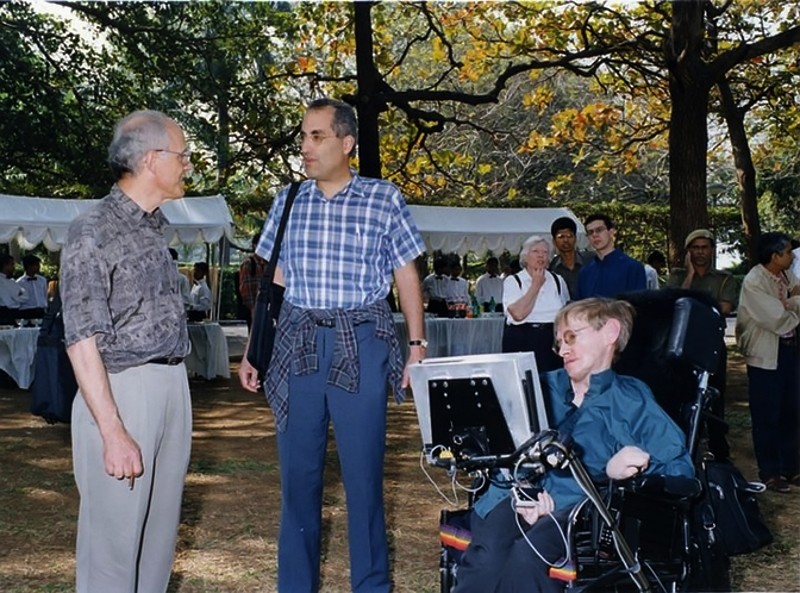
Stephen Hawking
Stephen Hawking Stephen Hawking (Wikicommons)
Image Source: Professor Stephen Hawking attends the gala screening of “Hawking” on the opening night of the Cambridge Film Festival held at Emmanuel College on September 19, 2013 in Cambridge, Cambridgeshire. (Photo by Karwai Tang/Getty Images)

He added that people like him, who believe in science, “believe that there are certain laws that are always obeyed. If you like, you can say the laws are the work of God, but that is more a definition of God than a proof of his existence.”

via GIPHY

Hawking refused to acknowledge the existence of God with his most direct, personal answer as he outrightly said, “It’s my view that the simplest explanation is that there is no God. No one created the universe and no one directs our fate.”

The late astrophysicist had a prestigious career and made enormous contributions to science. He was commended for his work on the physics of black holes. Hawking proposed that black holes emit subatomic particles until they eventually explode. He also proposed the multiverse theory, which states that our universe is one of many parallel universes existing in a fractal-like multiverse, published in the Journal of High Energy Physics.

via GIPHY

The genius scientist struggled with health complications throughout his adult life. At 21, he was diagnosed with Amyotrophic Lateral Sclerosis (ALS), which is a type of motor neuron disease. Despite the life-threatening disease, Hawking managed to live much of his life in a motorized wheelchair, communicating mostly with the assistance of a portable system mounted on its arms.

The renowned scientist passed away at the age of 76 on March 14, 2018, in his home. A year before that, he said he was thankful for his extended life. “I never expected to reach 75, so I feel very fortunate to be able to reflect on my legacy,” he said in an interview with BBC.


This article originally appeared last year.

  • A Texan moved to England and shared 3 things nobody warned her about. The one about cereal is painfully relatable.
    Photo credit: CanvaA young woman shops for groceries.
    ,

    A Texan moved to England and shared 3 things nobody warned her about. The one about cereal is painfully relatable.

    Ashley Jackson traded South Texas sunshine for South Manchester drizzle. She has notes.

    Ashley Jackson (@themossycactus) spent twenty years in Texas before packing up and moving to South Manchester, England with her British husband and their two kids. The decision, she told Newsweek, came down to practical realities: affordable healthcare, family support, safer gun laws, and the kind of walkable community life that’s harder to find in Texas, where she said “you drive everywhere and these opportunities aren’t there.”

    She’s been documenting the adjustment on TikTok under the handle @themossycactus, and a February video laying out her “3 harsh truths” for Americans considering a similar move has struck a nerve.

    A Texan’s three warnings for Americans in England

    Truth number one: the weather. “It’s cold, it’s rainy, it’s hot… there is no AC, and sometimes it’s all in the same day,” Jackson said. Coming from Texas, where the sun is a reliable constant, the erratic grey of northern England takes getting used to. Interestingly, Jackson said she has actually come around on the weather personally, but she still complains about it, because complaining about the weather is practically a requirement of British social life.

    Truth number two: the humour. “You are never going to be as funny or sarcastic as they are,” she said. “You can strive, but they will probably always be one up.” British sarcasm is its own dialect, and Jackson said you just have to accept that you will never fully master it.

    @themossycactus

    What’s the best way to “blend” in with you guys? Let me know in the comments. ⬇️✨ #britishculture #uk #americanintheuk #texaninengland

    ♬ original sound – Ashley

    Truth number three: the cereal aisle. “You won’t have 99 choices of cereal, but your life will be better for it. You’ll get about a quarter of that.” The American supermarket experience complete with, wall-to-wall options and twelve varieties of the same thing doesn’t really exist in the same way in the UK, and Jackson said adjusting to less choice is actually a net positive once you stop expecting it.

    The habits she picked up to blend in

    To go with the harsh truths, Jackson shared three habits she’s adopted to blend in: eating a sausage sandwich once a week, using understatements as a communication style, and moaning about the weather even when she secretly doesn’t mind it.

    She’s not alone on this

    Jackson’s experience reflects a broader trend. A Harris Poll survey found that 52% of Americans believe they can achieve a higher quality of life abroad, with 49% citing lower cost of living, 48% citing dissatisfaction with the political climate, and 35% citing security concerns as reasons to leave.

    For Jackson, the surprises weren’t all hard ones. “In many ways, it was better than I expected,” she told Newsweek. “I wasn’t expecting the community support we have found.”

    She tried to prepare for everything. The sausage sandwich, nobody warned her about.

    You can follow Ashley Jackson (@themossycactus) on TikTok for more lifestyle content.

  • Career expert shares polite but effective way to reclaim credit when someone steals your idea
    Photo credit: CanvaYou can get the credit you deserve without looking defensive.

    Having your ideas stolen or not getting proper credit for your work brings on a terrible and sadly common feeling. It puts you in an awkward spot because you deserve the recognition or reward, but don’t want to come off as weak, defensive, or needy when trying to correct and reclaim what was yours. It’s frustrating. Fortunately, a former lawyer and career expert has a great solution.

    On social media, former attorney and business professional Dr. Shadé Zahrai shared a way to reclaim your idea with poise. It’s a great option for those times when you share an idea with a group that gets mostly ignored…until someone else gets the credit for repeating it.

    @shadezahrai

    How to reclaim credit for your idea when it was initially ignored.

    ♬ original sound – Dr. Shadé Zahrai

    How to reclaim credit for your idea and work

    First, she recommends “building forward” in the conversation. This means you continue going with the flow of the conversation, building onto it and transitioning while re-anchoring the idea to you without sounding territorial. 

    Next, Zahrai recommends becoming curious. Simply asking the person who took your idea where they came up with it allows them the opportunity to naturally return credit to you without being confrontational. It also provides space for them to add input or ideas onto your own. As a bonus, asking these types of questions can help others who have been overshadowed reclaim credit.

    Examples of how it can work for you

    Let’s say that colleague or friend, whether intentionally or not, repeated your idea. Let’s call that person “Hank.” Examples of Zahrai’s technique could look something like:

    – “Hank, it’s great to see we’re aligned with what I shared earlier. Maybe in addition we could…”

    – “You know, Hank, that’s what I brought up before and I’m glad we’re thinking alike. How about this…”

    – “That’s like I was saying earlier, Hank, what drew you to the same conclusion? Perhaps we can..”

    – “Great suggestion, Hank! That’s what I was saying before. Where did you come around to that idea? Maybe a way to extend that is…”

    – “Thank you, Hank, this is what I was talking about last week. Since you’re down for that, maybe we should..”

    – “Good thought, Hank. It sounds like what Lilith was talking about earlier. We could add to her idea by…”

    It’s a good method to get the credit you deserve without causing conflict. After all, the “Hank” in your situation could have accidentally taken your idea or unintentionally left you out. Plus, the focus on the conversation is now on your idea rather than you having the idea.

    @graceforpersonalityhires

    Replying to @Kristel Parsons you absolutely do not call it out now or later. You take note of it and use it as information to guide your steps and what you want out of a career #careeradvice #softskills

    ♬ original sound – grace mccarrick

    Other things to consider

    It’s also important to take a step back to see if your idea is actually stolen. For example, if your boss is taking credit for an idea you had, it may be smarter to let it go, especially if the idea was formed during a think-tank session at work. There may also be a clause in your job contract stating that any idea made at work is the company’s anyway, so you wouldn’t be credited in the first place.

    That said, there are ways to make your mark on your idea and possibly avoid the awkward credit conversation entirely. If you had the idea before a meeting or any form of public announcement, document it in some way via an email, written presentation, or other work with your name on it. Another way is to lead with your idea in conversation, and follow it up with execution methods that include your colleagues or friends.

    This means an idea like “Let’s order pizza from Franco’s” could be “Here’s my idea. Let’s order pizza from Franco’s. I have a coupon we can use, it’s near Aaron’s apartment, and it has gluten-free options for Linda.” The more specific and detailed the idea, the more likely others will remember that the idea was yours.

    A good idea is a good idea, and acknowledging your involvement matters.

  • Seeing women govern encourages support for women in politics – with no apparent backlash among men
    Photo credit: Simon Maina/AFP via Getty ImagesSupporters of the South West Africa People’s Organization gather at a campaign rally in Windhoek, Namibia, on Nov. 24, 2024.

    Quotas designed to bring gender parity to parliaments have an overall positive impact on support for female political leadership – especially after women members of parliament take office. Furthermore, there is no evidence of a backlash among men.

    That’s what I found in a study published in October 2025 looking at the impact of gender-parity quotas in Namibia, in sub-Saharan Africa.

    In 2013, Namibia’s dominant political party, the South West Africa People’s Organization, or SWAPO, quietly rewrote its internal rules. From that point forward, every spot on its parliamentary candidate list would alternate between a man and a woman.

    Most prior research on measures to encourage gender parity in politics focuses on national or legislative policies rather than voluntary party quotas. Namibia offers an unusually “clean” case in that SWAPO is electorally dominant and did not face grassroots pressure to adopt its quota policy. That makes it possible to isolate the effects of the quota itself, rather than any preexisting trend in public attitudes.

    And the impact on the subsequent 2014 election was clear. Women’s representation in the National Assembly nearly doubled overnight, rising from 21% to 41%.

    But the more surprising story unfolded outside Parliament. Using several waves of nationally representative surveys from 2006 to 2017, I traced how ordinary Namibians reacted when women suddenly became far more visible in national politics.

    Support for female leaders increased after SWAPO quotas were brought in. But the biggest increase was after more women became MPs in early 2015.
    Support for female leaders increased after SWAPO quotas were brought in. But the biggest increase was after more women became MPs in early 2015. Vladimir ChloubaCC BY-SA

    The findings are striking. Women who lived in SWAPO strongholds, the communities where the surge in female MPs was most evident, became more supportive of women’s right to hold political office. Their attitudes tilted upward by about four-tenths of a standard deviation on a four-point scale of support for female leadership. Put simply, women were more likely to endorse the statement “women should have an equal chance to be elected to political office” over “men make better leaders” when asked to pick one of the two claims.

    Just as striking is what did not happen. Men did not move in either direction. They did not become more supportive of women in politics, but they did not become less supportive, either.

    The absence of backlash is as important as the positive change among women. It suggests that the fear that quotas will inflame male resentment – a common concern in culturally conservative settings – did not materialize in this case.

    Perhaps the most striking point is the timing. Public opinion did not shift when the quota was announced. It shifted only after women actually took office and became plainly visible as political leaders.

    Why it matters

    Around the world, women hold fewer than 3 in 10 parliamentary seats. In sub-Saharan Africa, the average share of women in parliaments is 27%. However, this masks wide variation. A handful of trailblazers, such as Rwanda, pull the figure up, while women remain severely underrepresented in many countries across the continent.

    In many countries, deeply entrenched cultural norms cast politics as a male domain and lead citizens to doubt women’s capacity to lead. Yet exposure to women who defy stereotypes can begin to challenge these assumptions, reshaping what people believe is possible.

    The case of SWAPO in Namibia shows that quotas, introduced voluntarily by a political party rather than imposed by law, can challenge people’s gender bias without triggering the backlash many observers predict.

    What still isn’t known

    This study shows that voluntary quotas shift attitudes, but several questions remain. First, we do not yet know how durable these changes are. Do they last only as long as female leaders remain highly visible in Parliament, or do they persist across election cycles?

    Second, visibility is almost certainly not the only mechanism encouraging change. The next step is to examine how media coverage, local campaigning and community-level engagement shape perceptions of women leaders.

    It is also important to think about how these effects might vary country to country. Namibia is in some ways a special case. SWAPO has dominated Namibian politics for over three decades. Whether my findings travel to more competitive environments or to regions beyond Africa is a question worth pursuing.

    What this study does make clear is that quotas adopted voluntarily, without legal coercion, can change how ordinary citizens think about leadership.

    Sometimes the most convincing argument for women in politics may simply be watching women govern. The symbolic impact is too often overlooked, and in places where formal reforms are politically difficult, it may be the most promising starting point.

    This article originally appeared on The Conversation. You can read it here.

Explore More Voices Stories

Ideas

Professional speaker offers 5 polite yet effective ways to prevent people from interrupting you

Ideas

A bride collapsed during her own rehearsal dinner toast. The detective who burst in explained everything.

Ideas

A couple sat in an Olympian’s seat and asked her to swap. She has a name for exactly what they were doing.

Ideas

A 6-year-old girl thought skateboarding was just for boys. One stranger at the skate park spent an hour proving her wrong.