When a teacher gives a test, he or she is trying to measure students’ ability to recall and apply information learned over a particular period of time. The exams make it relatively straightforward: Did the student get an answer right or wrong? Was mastery of skills demonstrated?

But how is creative or critical thought defined and taught? And by what assessment can we measure it, if at all?


Critical thinking is, among many things, the ability to understand and apply the abstract, the ability to infer and to meaningfully investigate. It’s the skills needed to see parallels, comprehend intersections, identify problems, and develop sustainable solutions. According to the Foundation for Critical Thinking, sound critical thinking is imperative to social progress. It is with our thoughts that we shape the world: Thinking creatively shapes social and cultural structures. It affects the way blame is placed, the way ideas of right and wrong are developed, the way leaders are elected, and the way we understand our place in the world as individuals and as a collective. It helps define, or complicate, who “we” are in the first place.

Teaching critical and creative thought, however, is challenging: First, critical thinking may mean different things to different instructors, principals, and/or districts. Second, it can be hard to know what students are taking away from lessons and curricula designed to cultivate critical thinking skills.

There are ways to navigate through these obstacles: Cultivating critical thinking may be accomplished with modeling. A teacher may explicitly show students how to make connections between their experiences and those of others, show them how to link pieces of literature, or explain the relationship between a piece of modern music infused with metaphor and the poetry lesson from last month. Particular curricula, ones that ask students not just when and where things happened, but why and how, and what contemporary parallels can be drawn, can enhance these skills.

Critical thinking can also be elicited in less directive ways: School trips, service learning requirements, and various other kinds of hands-on situations allow students to make connections at their own pace. In any case, critical thinking skills are probably best infused over months and years, the result of both direct and more subtle instruction, during which teachers suggest, and insist, that students investigate further, making—but more importantly, justifying—inferences and conclusions.

Students at Codman Academy Charter Public School in Dorchester, Massachusetts, engage in so-called “expeditionary learning” projects, which are designed around a topic (for example, botany or urban renewal in a particular city) selected by the students or their teachers. Through research, participating in service learning, talking with seasoned professionals within a particular industry, fieldwork, and by preparing presentations and papers on their topics to share with their schoolmates and the larger community, students build critical and problem solving skills that will serve them for life.

So, if it is possible to teach this type of thinking, how then can we measure if students are developing these skills? This is likely the more confounding question. It’s hard to design test questions that effectively measure a child’s ability think creatively. One way may be to scaffold questions that increase in complexity and demand, which may allow students the opportunity to reiterate, to explain, and then to synthesize information they’ve gathered. Asking students to make connections between different strands of a curriculum may also be a good way to measure these skills. Assessments may also come in more spontaneous moments, when a child responds to a question or a moment with quiet brilliance or sensitivity. (It may be, however, that the most meaningful measurement takes place once a student is launched into the adult world.)

At the heart of teaching critical and creative thought is the ability to ask the right questions to students. In turn, they need to be able answer in a way that demonstrates their ability to see the parallels and intersections; perceive linkages between historical moments, between the period and the art, between the circumstances then and now; to comprehend the relationship between “us” and “them”, between “we” and “they,” and, ultimately, whether dichotomies like “we” and “they” are useful—and, if so, how.

Illustration by Will Etling

Zoe Burgess has been working in education for seven years. She is a Teach For America alumnus, and currently works as an education consultant, research assistant, and writer.


  • A bride collapsed during her own rehearsal dinner toast. The detective who burst in explained everything.
    Bride gives a speech at her rehearsal dinnerPhoto credit: Canva
    ,

    A bride collapsed during her own rehearsal dinner toast. The detective who burst in explained everything.

    She planned a prank for the rehearsal dinner and cast herself as the victim. The groom had no idea.

    Alexandra Lahde had been a couple of things on the night of her rehearsal dinner: a bride, a hostess, and, briefly, a corpse.

    The 28-year-old barista from Canada had spent months planning the evening at Fairmont Banff Springs, one of the most storied hotels in the country. The decor was themed around old Hollywood glamour and detective fiction, with a vintage typewriter welcome sign, magnifying glass name tags, and moody florals and candles throughout the room. If any of her 30 guests noticed the clues, they kept quiet about it. When Alexandra clinked her wine glass to give a toast, nobody suspected a thing.

    “I just wanted to take a second and thank you all so much for coming here,” she began. Then she started to cough. She tried to continue. She coughed again, clutched the counter beside her, and said, “Oh my God” before dropping to the floor. Two guests who had been in on it from the start called out, “She’s dead. She’s DEAD!” Her husband Ian rushed toward her. Before anyone else could react, a man in a detective costume burst through the doors, flashing a badge. “Nobody move! My name is Bert Hammel. I’m from a bad police department. I’ve been told there’s a murder,” he announced, before looking down at Alexandra’s motionless body. “I can’t feel a pulse. The bride has been poisoned.”

    A dining table at a wedding reception with champagne bottles and flowers.
    Table arrangement at a rehearsal dinner. Photo credit: Canva

    The evening was underway. The actor, Eric from the improv company THEY Improv, had been hired by Alexandra with help from her wedding planner Melissa Alison Events. The murder plot was tied to the Fairmont Banff itself, which has its own legendary ghost bride story. Selected guests had been pulled into a separate room before dinner, briefed on the plot, and given character roles to play. After the faux detective questioned them in front of the group, guests split into teams to solve the mystery.

    Alexandra told People magazine that she had only learned the full script about 15 minutes before her guests arrived, which suited her perfectly. “I find I work best when I have little to no plan, so I went into it pretty blind,” she said, “only having practiced my expression and fall in the bathroom a few times before!”

    The video, captured by videographer Alesia Hardy (@alesiafilms) of Alesia Films, has since gone massively viral. Viewers were particularly impressed by one logistical detail: the detective appeared within seconds of Alexandra hitting the floor, giving the groom and guests no time to spiral into genuine panic. “The fact that the detective was virtually immediate to signal that she was okay and it was a game is the PERFECT way to pull this off,” one commenter wrote.

    This article originally appeared earlier this year.

  • British engineer uses 500 disposable vape batteries to power up electric car
    Combined vape pen batteries can deliver real horsepower.Photo credit: Chris Doel/YouTube

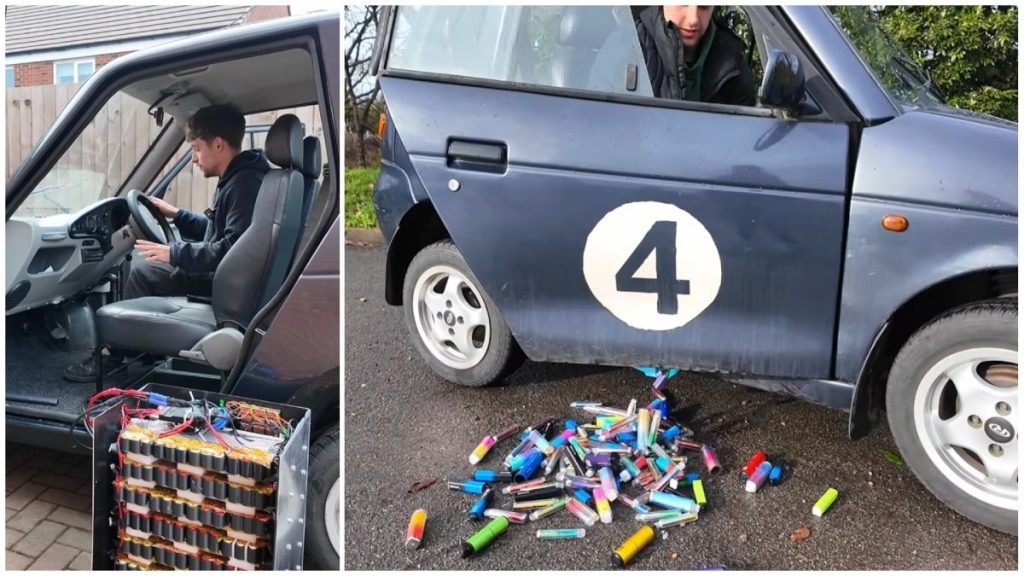
    A British engineer-turned-YouTuber turned heads with a recent invention he created from trash. After building power banks and powering e-bikes with discarded disposable vape pens, Chris Doel transformed 500 vapes into a power source capable of driving a car up to 40 miles per hour.

    On his YouTube channel, Doel documented the experiment. He recovered 500 discarded vape pens and used 3D printing to combine their batteries into a single 50-volt, 2.5-kilowatt battery pack. He then modified it to power a Reva G-Wiz, an early-2000s low-powered electric car. The vape battery pack didn’t just start the G-Wiz; it powered the car enough to travel 18 miles and reach speeds of up to 40 mph.

     “I can’t believe this car has just accepted this crazy Frankenstein battery that I’ve just slapped in it,” Doel said in the video.

    The engineer points out a problem with single-use electronic products

    Doel’s feat wasn’t just a display of ingenuity; it also highlighted a growing problem—specifically, the mounting burden of landfill waste. According to a 2024 report by Wired, 137 billion pounds of e-waste, including vape pens, are generated each year. Only one quarter of that waste is recycled.

    As Doel pointed out, much of this waste isn’t just metal and materials going to waste, but also a loss of reusable energy.

    “Unfortunately we seem to live in some crazy dystopia where buying these single use devices and then chucking them away is totally normalized, despite them having fully rechargeable lithium ion cells inside them,” Doel said.

    @sustainabilitymattersva

    E-waste will continue to become a bigger issue in the future. Be sure to do you part to mitigate the problem by properly disposing of your old electronics📱 #ewaste #landfills #landfill #waste #trash #recycle #wastedisposal #electronics

    ♬ original sound – Sustainability Matters

    Cumulative e-waste isn’t just environmentally harmful; it also poses risks to human health. The World Health Organization warns that much of this waste releases toxic chemicals and materials into soil and water. Prolonged exposure can negatively affect the health of children, pregnant women, and others.

    To reduce the amount of e-waste filling landfills, it’s important to dispose of these products properly. After deleting all personal information, consider donating your electronics to a friend or an organization. Items with lithium-ion batteries, such as vape pens, shouldn’t be thrown in the regular trash.

    You can search online to find a proper e-waste facility in your area. More information on how to properly dispose of or recycle e-waste is available on the United States Environmental Protection Agency website.

  • Woman at airport quietly pays for dad who couldn’t afford toddler’s $700 ticket
    A woman pays at the counterPhoto credit: Canva
    ,

    Woman at airport quietly pays for dad who couldn’t afford toddler’s $700 ticket

    Debbie Bolton didn’t introduce herself or ask for thanks, she just handed over her card.

    He had done the math when he booked the flight. His daughter was under two, which meant she could sit on his lap for free. By the time they got to the check-in counter at Omaha’s Eppley Airfield, she was two, which meant she couldn’t.

    The ticket agent broke it to him simply: his daughter needed her own seat, and that seat would cost $749. The man stepped away from the counter, hugged his daughter, and started making calls. He’d told the agent he couldn’t afford to rebook his own ticket, let alone buy a second one. A fellow traveler who witnessed the scene, Kevin Leslie, later described what happened next on Facebook: “He was hit with emotion. He mentioned he couldn’t afford to rebook this flight or get her the ticket with such short notice. He stepped aside and tried to make a few calls. Hugging his daughter and grabbing his head, you could tell he was heartbroken.”

    That’s when the woman standing behind him in line spoke up.

    airport, line, airplane tickets, luggage
    Travelers wait in line at the airport. Photo credit: Canva

    “I wanna buy her ticket,” she told the agent, pointing to the little girl. The agent, caught off guard, double-checked: “You know how much this ticket costs, right?” The woman said yes. She pulled out her credit card and told the agent to charge it.

    The man asked for her name so he could pay her back. She told him not to worry about it and walked away.

    Leslie posted about what he’d seen, and the photo he’d taken began circulating on Facebook, eventually racking up tens of thousands of shares. People wanted to know who the woman was. Within hours, she was identified: Debbie Bolton, co-founder and Global Chief Sales Officer of Norwex, a sustainable cleaning products company.

    The story resurfaced in a big way in November 2025, when TikTok creator Bo Grant (@marriedtoalunatic) shared a video about it that went viral all over again, introducing the moment to millions of people who’d never heard it.

    @marriedtoalunatic

    Woman Identified as Debbie Bolton after interaction with a stranger and his 2 year old child is caught on camera #karma #kindnessmatters #norwex #heartwarming #debbiebolton

    ♬ original sound – Bo Grant

    Bolton, who spoke with Newsweek about the incident, said she noticed the father growing increasingly distressed at the counter and felt she had to do something. “He seemed like he couldn’t afford it and was traveling to visit family,” she said. She described the decision as straightforward. “I always ask myself every day, ‘Whose miracle can I be today?’” she said. “That day I was given the opportunity to be a miracle for someone else and I took action.”

    She said she hadn’t expected the story to travel as far as it did. “I honestly didn’t expect the story to resonate with so many people,” she told Newsweek. “My only intention was to help someone in need.” When Norwex confirmed her identity to CBS News at the time, the company’s chief marketing officer Amy Cadora said they were “very proud” of her. “She’s kind, caring and generous,” Cadora said. “That’s why none of us was a bit surprised.”

    @norwex

    “In a world full of Karens, be a Debbie!” Today, our Co-Founder Debbie Bolton is sharing a special message straight from the heart. 💚 We want to thank you for the incredible outpouring of kindness, messages, and support after her airport story touched so many this past weekend. As we head into the busiest time of year, we challenge you to look for simple opportunities to show kindness. It’s woven into everything we do at Norwex, from our home office to our Consultant community that Debbie has helped nurture since 1994. One person alone can’t change the world…but together? Together we can create something extraordinary. 💚 #norwex #sustainability #cleanhome #cleanliving #thankyou

    ♬ original sound – Norwex

    This article originally appeared earlier this year.

Explore More Stories

Internet

Teacher spots suspicious bare feet under a school bench, but the ‘lockdown’ scare has a surprising explanation

Health

Doctors couldn’t explain the pain in her daughter’s foot. Then a nurse looked closer and spotted something that led to a devastating diagnosis.

Ideas

A couple sat in an Olympian’s seat and asked her to swap. She has a name for exactly what they were doing.

Ideas

History teacher is trying to break the ‘Gamification’ of education