
Toddlers are known for their adorable antics, and one might think that they aren’t too mindful of their surroundings. But the truth is that children start adapting to their environment early on and often regulate their behavior to avoid angering adults. A study conducted by researchers at the University of Washington has discovered that even 15-month-olds can observe and understand whether people in their vicinity are angry or displaying extreme emotions.

baby development, parenting study, emotional intelligence, toddler emotions, developmental psychology
Kids know the good adults from the bad. Canva

The study, published in the October-November issue of the journal Cognitive Development, revealed that experts detected the first signs of toddlers using multiple cues from their surroundings to understand the mood of people around them. “At 15 months of age, children are trying to understand their social world and how people will react,” lead author of the study, Betty Repacholi, who is also a faculty researcher at UW’s Institute for Learning and Brain Sciences and an associate professor of psychology, said. She also added, “In this study, we found that toddlers who aren’t yet speaking can use visual and social cues to understand other people–that’s sophisticated cognitive skills for 15-month-olds.”

via GIPHY

A video was shared by the YouTube channel of the Institute for Learning and Brain Sciences (UW I-LABS), where the study was conducted on a 15-month-old toddler. The footage from 2014 shows a toddler sitting on his mom’s lap as someone pulls out a box and extends it toward him. “There’s something inside. Can you see what’s inside the box?” the other woman asks, prompting the toddler to remove the lid. Then she asks if there is anything in the box or not. The toddler finds a green comb inside the box. “There’s a green comb!” the woman exclaims, as the toddler flashes a smile. “You want to put it back inside the box?”


via GIPHY

“I’m going to put the lid back on the box and close it up,” the woman says before taking away the box as the toddler goes back to his formal neutral state, and the smile fades away. The woman shows the toddler how to play with a strand of beads that makes noise when it’s dropped into a plastic cup. The toddler continues fiddling with it until another lady named Kelly enters the room, settles on a seat, and says, “I am going to sit here and read a magazine.” The toddler becomes aware of the new person in the room as they look at each other.


Next time, when the toddler drops the beads in the cup and it makes a noise, Kelly expresses her displeasure by calling it “aggravating” and “annoying.” The toddler senses the shift in mood around him and refrains from playing with the beads, even though he could do so freely. The shift in the toddler’s behavior indicates how he is using emotional information to regulate his own behavior. On the University of Washington’s website, it was mentioned that the experiment was conducted on 150 toddlers at the age of 15 months, who watched as a person sitting at a table repeated the same process with each of them.

This article originally appeared last year.
  • 11-year-old Kentuckian rescues man drowning in apartment complex pool
    Photo credit: CanvaA young hero rises to the occasion.

    An 11-year-old boy in Kentucky is being praised for rescuing a man from drowning in a pool at an apartment complex.

    Avory Woolery spotted the man at the bottom of the pool. The man appeared distressed and that’s when Woolery dove into action.

    “There was this man in the pool, like unconscious underwater, almost shaking, maybe, and my adrenaline kicked in,” Woolery told WKYT-TV.  “I went underwater, I grabbed him up, his friend, I believe, put him on the floor and started doing CPR on him to try and save him the best he could, until somebody called 9-1-1.”

    ‘He’s a human being’

    When asked why he took initiative, Woolery said that he dove in to get the man because no one else appeared to notice the drowning man’s plight.

    “No one was doing anything, so I put on my goggles. I went underwater,” Avory said. “I grabbed him up and I just felt really bad because there was no way that I was going to let another man die today. He’s a human being. He should be treated as such.”

    As Woolery noted, another person performed CPR on the man until paramedics arrived. The Lexington Fire Department said the man was taken to a local hospital and is still in serious condition. While still hospitalized, worse could’ve occurred if young Avory didn’t intervene.

    Fatherly pride

    Sean Woolery, Avory’s father, was proud of how his son was able to calmly and quickly react to the situation.

    “I’m proud of him. Somebody, when I was walking up here, somebody said, ‘Thank you, you taught him how to swim,’” he said.

    A life was saved thanks to young Avory being able to notice signs of drowning and staying calm under pressure during a dangerous situation.

    How to spot a drowning victim

    While many public pools and beaches have lifeguards, it’s still important to recognize the signs someone is drowning so you can get them the proper help. After all, that’s what Avory did.

    But the signs of someone drowning don’t necessarily match the ones that are seen on television or film. Many drowning victims are unable to yell for help, loudly splash, or grab attention since water is gathering into their lungs.

    The Red Cross offers some more accurate signs of someone drowning along with tips to help them. A distressed swimmer/drowning victim will look like they’re having trouble making forward progress in the water. They’ll likely appear vertical and unable to tread water. They may look like they’re struggling to keep their mouth and nose above water. They could also appear motionless and face down in the water.

    What to do if you see someone drowning

    Should you see these signs, yell at the person to see if they can respond. Alert the lifeguards (if present) and have someone call 911 immediately. If there is no lifeguard, it’s recommended to get the person out of the water the safest way possible without going in. This means offering flotation devices like life jackets or buoys for the drowning person to grab. 

    There’s a reason why it’s usually not recommended to swim to rescue a drowning person. It’s because if they are conscious, the drowning person could instinctually grab at you. They could accidentally pull you down underwater with them. While Avory did swim to save that man, the victim was unconscious. It was an extreme situation in which trained professionals weren’t present. 

    If swimming is the only option, it’s recommended to swim to the victim with a flotation device in hand for them to grab onto without touching them. This can allow you both to stay afloat with less struggle. That said, it is always best to wait for water safety professionals to act first if at all possible. The Red Cross has some other water safety tips to follow that could save lives and prevent common drowning incidents.

  • Australia produces so much solar power that they’re giving three hours of it away each day for free
    Photo credit: CanvaSolar energy surpluses during the day offers Aussies free energy.

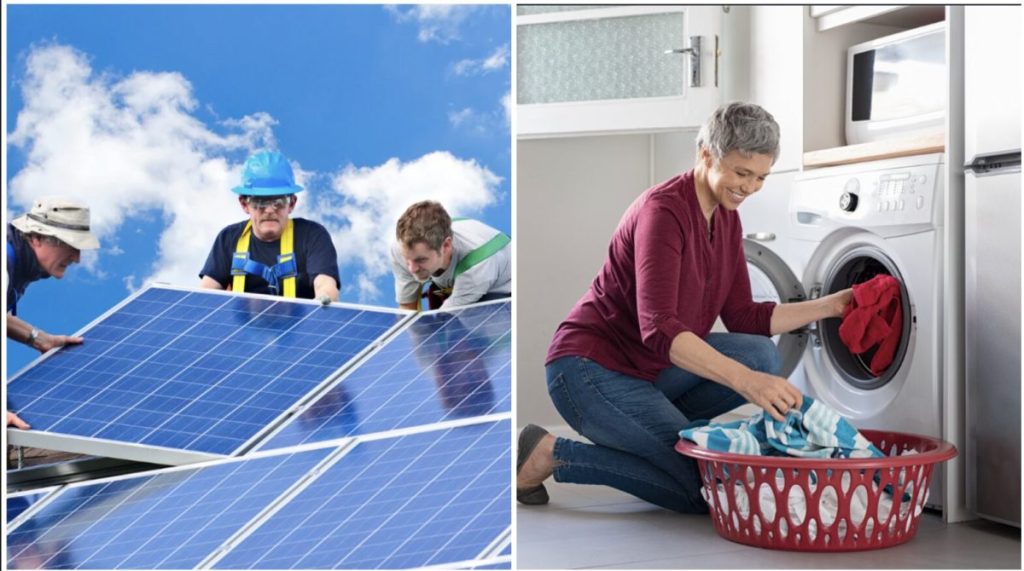
    In a time when energy costs are rising, Australia is taking a different approach. The country has acquired so much solar power that they’re giving it away. In fact, those who sign up for the program will get three free hours of energy each day.

    This comes from a government-run offer dubbed Solar Sharer. It offers a free three-hour period for those who sign up. This period runs from 11:00 a.m. to 2:00 p.m. in Queensland, Victoria and New South Wales. The period runs from noon to 3:00 p.m. in South Australia. 

    Free, but not unlimited, power

    While the power is free for those who are eligible and have a smart meter, there is a daily cap of 24 kilowatt-hours (kWh). Any amount above that will be charged. However, the energy cap is based on the Australian Energy Regulator’s assessment of what a five-person household uses each day. 

    While that free period each day provides a great window to use major appliances or charge electric cars, there are some catches. Solar Sharer isn’t yet available to residents outside those areas, but energy brokers are making similar offers. There is also no guarantee that electricity rates won’t get higher outside of those free periods either.

    Who benefits?

    The program is designed for those who are a part of a solar power grid. It also benefits people who work from home the most. If the people in the household are at their job or the office, they likely won’t be able to take advantage of the deal.  

    While Energy Consumers Australia supports this offer, they are concerned about how governments and retailers relay the information to customers. In short, they don’t want people to be surprised if their electricity rates are charged higher during the non-free periods. They’re also concerned that, by their measure, only three in 10 eligible people were aware of this offer.

    “We don’t want to have people signing up to these plans assuming it will decrease their bills, when in fact it could do the opposite,” the consumer advocacy group said to The Guardian.

    There is a chance that rates won’t get higher if more people are able to take advantage of Solar Sharer. Since most electricity use is during the evening when more people are home from work, changing up the usage towards daytime hours can benefit everyone. It would still be an uphill battle as electric light is mostly used in the evening and nighttime when it’s dark.

    Similar programs elsewhere

    While there are catches, this isn’t the first program of its type. There are similar successful free energy programs in other nations. Areas such as Germany and the Nordic countries create so much green energy through wind farms that they make similar free power offers. California has also offered government programs for low-income households and farmworkers housing cheap-to-free solar energy.

    While kinks definitely need to be sorted out, creating so much generated energy to the point that it can be given freely is a good problem to have.

  • Motorcyclist trapped under a 3,300 pound car saved by Australian car salesmen
    Photo credit: @ACurrentAffair9 on YouTubeA man was saved from being crushed under a car.

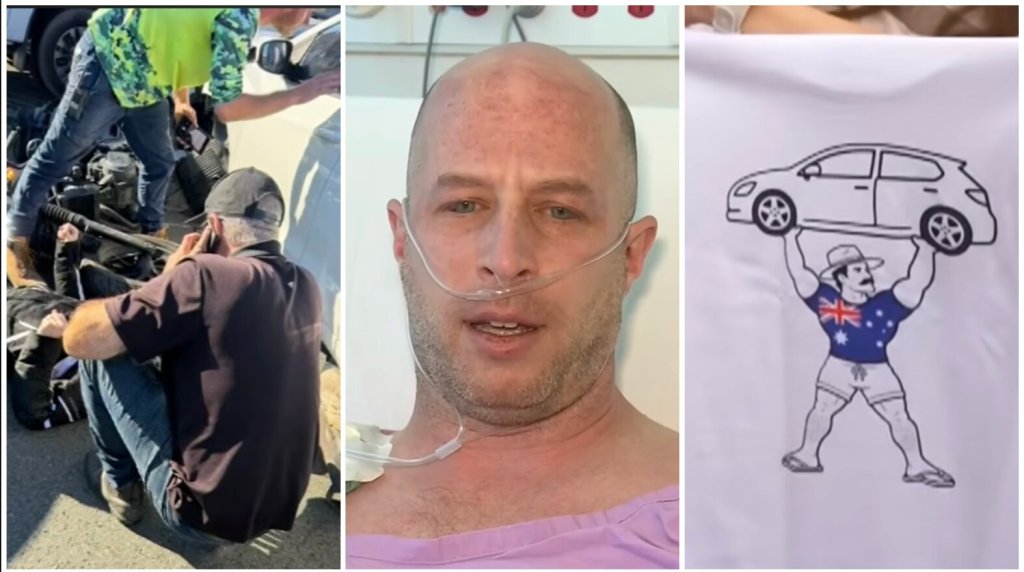
    Tyler Wiebe was on his way to work on his motorcycle in Brisbane, Australia. Then a car approached in the wrong way in traffic, colliding with another car that then hit Wiebe. The accident threw Wiebe off his bike and under a car. He was trapped under the 3,300-lb. vehicle, doomed until a group of salesmen and onlookers came to his rescue.

    “I was being dragged and when it stopped, my head and chest were under the car,” Wiebe said to the Australian Broadcasting Corporation. The crash and being pinned down under the vehicle gave Wiebe several injuries. He suffered broken ribs, a broken collarbone, and a collapsed lung.

    But that would be diagnosed later. At the time, the car’s weight was crushing Wiebe to the point that he couldn’t breathe. His heart was also unable to beat, the pressure causing his eyes, mouth, and nose to bleed.

    “Initially it was ‘can I get out?’ and then it was ‘man I am dying, this is it,’” recalled Wiebe. “[My] wife and two kids are not here, and this is it.”

    Hope comes in the form of a car salesman

    After being stuck for two minutes under the car, help arrived from the nearby Auto Request Kedron, a used car dealership.

    “I was in the office at the time, so I heard the bang [and] came running to the doors,” Mick, one of the employees, said to A Current Affair.

    “I realized there was someone trapped under the car,” fellow employee Rob added.

    They rushed into action, recruiting other coworkers to help.

    “[I] saw Rob running and he was just whistling out saying, ‘Hey, boys, hurry up,’ ” Corbin recalled. “I remember seeing him, just like two legs. They weren’t moving at that time.”

    The salesmen tried to lift the vehicle up to get Wiebe to safety, but the car wouldn’t budge.

    “We tried to lift it off. We couldn’t, and then on the second attempt, we had a couple of other good Samaritans come and help us,” said Brian, another employee of Auto Request Kedron.

    Reportedly 15 people were finally able to lift the car and free Wiebe underneath. He was rushed to the hospital where he went under emergency operations. Under hospital care, Wiebe’s condition stabilized and he survived. Had he been under that car any longer, the worst would have happened.

    Wiebe was humbled and grateful to the salesmen and others who stepped up to save him.

    “I get more time with my daughters, I get more time with my family and a second lease on life, so just thank you, thank you,” Wiebe said in his hospital bed.

    Certified legends

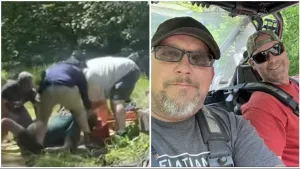
    When he was discharged from the hospital, Wiebe set up a reunion with the employees of the used car dealership. He was able to introduce his family to his rescuers and thank them face-to-face. Wiebe presented them with matching t-shirts, each one with a logo reading “Certified Legend” on the front and an illustration of a person lifting a car over their head on the back.

    “You guys are legends, but now you’re certified legends,” Wiebe said to his heroes.

    A father and husband was saved thanks to the alertness and quick action of the nearby community.

Explore More News Stories

World

Australia produces so much solar power that they’re giving three hours of it away each day for free

World

Motorcyclist trapped under a 3,300 pound car saved by Australian car salesmen

Local

Ohio local news viewers spring into action after seeing an elderly woman threatened with jail time

Local

Iowa teen bike riders save injured elderly woman that was stranded outside for 16 hours