According to parents and physicians alike, physical touch and contact with infants and toddlers provide important benefits for both the mind and body. Even without scientific evidence, cuddle time, hugs, and other forms of physical affection between mother and child simply feel good. That said, a study in China suggests that maternal touch during those early years may benefit children well into their teenage years.
The study, authored by Kuo Zhang and Jinlong Su, examined whether there were links between early childhood maternal touch and prosocial behavior later in life. In the study, maternal touch was defined as physical contact initiated by the mother toward her child, including cuddling, skin-to-skin contact, holding, and gentle stroking.
Early maternal touch may encourage sympathy and helping behaviors in adolescence | Vladimir Hedrih, PsyPost
A study in China found that junior high school students who recall more maternal touch in childhood tend to manifest more prosocial behavior. Attachment to mothers might… pic.twitter.com/Ocfkwc5mbE— Owen Gregorian (@OwenGregorian) February 3, 2026
Because previous studies had already shown that maternal touch can influence an infant’s cognitive, physical, emotional, and social development, the study’s authors wanted to explore whether its benefits extended beyond early childhood. They hypothesized that because maternal touch supports early attachment formation and fosters positive relational experiences so early in life, it could later impact a person’s capacity for empathy, social connection, and emotional regulation.
The researchers studied 572 students aged 12 to 16 from a public junior high school, with approximately 50 percent of participants being boys and 61 percent coming from rural areas. This age group was chosen because adolescence is a key period for the development of prosocial behaviors such as cooperation, sharing, helping, and showing empathy toward others.
Students completed assessments measuring their early experiences with maternal touch, prosocial behavior, empathetic concern, and mother-child affective attachment. The results showed that teens who reported frequent maternal touch in early childhood—such as being held, having their hands held, or being patted to sleep—demonstrated higher levels of empathy, greater willingness to cooperate and socialize, and lower levels of attachment anxiety and avoidance compared with peers who did not report early maternal touch experiences.
In short, teens who experienced more physical affection from their mothers as babies tended to be more caring, helpful, and socially stable than their classmates. While further studies are needed, especially ones that do not rely on a person’s subjective experiences and ability to recall past memories, these initial findings could reinforce affectionate parenting practices for long-term benefits alongside immediate ones.
“Our findings provided an initial empirical support for the touch-scaffolded prosociality model and suggested the importance of tactile interactions between mothers and children in daily parenting practice,” the study’s authors wrote.
?Your feel good research of the day: Gentle as a mother’s touch: C-tactile touch promotes autonomic regulation in preterm infants by I Püschel, J Reichert, Y Friedrich, J Bergander, K Weidner, I Croy (2022) ♬ original sound – Hannah Fry
This research pairs nicely with several other studies suggesting that touch benefits both children and adults physically and mentally. The feel-good endorphins and immune system boosts associated with human touch can do you good, whether it’s affection from your mother, a kiss from your sweetie, or an appointment with your massage therapist. With that in mind, give your little one, your partner, or a friend an extra hug today. It won’t just boost them, it’ll boost you, too.
In 2024, 51% of families read aloud to their very young children, while 37% read aloud to their kids between the ages of 6 and 8 years old.
Some parents have said they stop reading aloud to their school-age children because their kids can read on their own.
I’m a neuroscientist with four children, and I wondered whether children might be losing more than just the pleasure of listening to books read aloud. In particular, I wondered whether it affected their empathy and creativity.
A simple idea from the literature
I have studied and written about empathy and creativity as part of my personal effort to better understand how to be a good parent. I have found that empathy and creativity aren’t talents you’re born with or without. They are skills that respond to practice, just like learning to play piano.
And creativity is essential for self-control and problem-solving. It’s much easier to regulate your behavior if you can imagine multiple solutions to a problem instead of fixating on the one thing you’re not supposed to do.
About 10 years ago, I started making some changes at home to ensure that my children got these skills.
Setting aside 15 minutes at night was sometimes the only one-on-one time I had with each kid, with bedtimes of 7:30, 7:45, 8:00 and 8:15 p.m. It was precious to me. I wondered whether using conflicts in bedtime stories as teachable moments would help them develop more empathy for others and boost their creativity.
I wrote in 2016 about how I think my children became more empathetic when we paused at times during a book to ask: “How do you think this character feels?” and “What would you do?”
But no one had tested this experiment on a broader scale.
Testing the idea
Beginning in 2017, four colleagues and I recruited 38 families in central Virginia with children ages 6 to 8, which is an age when kids are navigating social relationships and experiencing intense brain development. All of the children in our study were somewhat independent beginning readers or they could read independently. In our study, caregivers read one storybook nightly for two weeks.
They were about, among other characters, a polar bear cub who becomes separated from his mother in the snow, and a boy who hid his teeth from the tooth fairy.
Half the families in our study read a book each night straight through without pausing. The other half paused at one conflict point per story to ask two reflection questions. For example, when the tooth fairy stole the tooth Nathan desperately wanted to keep, they asked, “How would you feel if you were Nathan?” If the child answered, parents just listened. If not, they waited 30 seconds before continuing.
Before and after two weeks, we tested children’s empathetic ability to understand what others might be thinking and how they are feeling. We also tested creativity using the alternative uses task, which asked kids to generate creative ideas, such as thinking of unusual uses for a paper clip or listing things with wheels.
A boost in empathy either way
After just 14 bedtimes with books, we found – as our 2026 research shows – that children whose parents paused for questions got better at understanding others’ perspectives. But so did children whose parents just read straight through.
We found that what scientists call cognitive and overall empathy improved significantly in both groups between childen’s initial visit and our follow-up visit two weeks after they read the books for a week.
This may be because it is easier to quickly develop cognitive empathy – meaning when you put yourself in someone else’s shoes – as compared to developing emotional empathy, or feeling what others feel. Emotional empathy involves different brain regions and likely requires longer to change deeply rooted emotional processing patterns.
A creative approach
After two weeks of bedtime reading, children in both groups got better at creative thinking. We used a standard creativity test that measures the number and the originality of responses when children were asked to think of uses for everyday objects. For example, if asked about a brick, a common answer would be to build a wall, while a more original response might be to grind it up to make red chalk.
But the children whose parents paused for questions generated significantly more ideas overall.
Their responses delighted me: They suggested using a paper clip as wire in a potato clock, to help put on a doll’s shoes, or to simply see what sound it makes hitting the floor.
We also noticed that the younger kids came up with more original ideas than the older ones. This matches other research showing that creativity may fade as children grow up and they prioritize fitting in with others more than thinking differently.
What we still need to learn
Our study had limitations: We did not have a comparison group that did not read at all. And most families had a higher income, with 92% of families earning more than $50,000 per year.
Future research could address this gap and also investigate whether the benefits we found persist past two weeks – and whether they translate into real-world kindness.
But importantly, we found no gender differences in our study. The practice works equally well for boys and girls. And even though the majority of our families said they already read regularly to their children, this practice still worked to boost empathy and creativity.
Children who read bedtime stories with their parents are likely to benefit from a boost in creativity u2013 especially if they consider questions about the books. Anastasiia Krivenok/Getty Images
Bedtime stories are about more than routine
As a neuroscientist, I know the elementary school years are a particularly powerful window when children experience intense formation of new brain connections.
These 15 minutes of reading aren’t just about preparing kids to sleep or teaching them to decode words. They’re building neural pathways for understanding others and imagining possibilities. With repeated practice, these connections strengthen, just like practicing piano.
In a world designed to pull families toward screens, bedtime reading remains a refuge where parent and child share the same imaginative space.
But the pressure’s off for parents: You don’t have to read in any special way. Just read.
Parenting is arguably the most challenging job in the world, particularly on those days when it feels like your children simply aren’t listening. It is easy for frustration to boil over, leading to a cycle of repetitive arguments that leave both parents and children feeling exhausted.
If this sounds like what’s happening between you and your child, maybe it’s because you’re saying an ineffective phrase or two. On top of that, you might be missing out on some “magic” phrases that help better communicate and connect with your child.
Luckily, child psychologists have found five of the least effective yet common phrases parents use on their kids and offer some quality alternatives that work. There are also five phrases provided by child psychologists that parents can use to help their children and strengthen their relationships. Let’s get started.
Least effective: “How many times do I have to tell you?”
More effective: “I’ve asked about this many times now, what is making this hard for you?”
Saying “How many times do I have to tell you?” just showcases your frustration and implies to the child that they’re intentionally defiant when they could be missing the mark because they’re confused or there’s a disconnect rather than intentional incompetence. The more effective phrasing allows you to figure out where the problem is rather than peg the child themselves as the problem.
Least effective: “You know better than that.”
More effective: “I know you can do this, let’s figure out what the trouble is.”
“You know better than that” is more confrontational and makes the child worry more about punishment rather than getting the result you ultimately want. The alternate phrasing allows your child to solve the issue as a team and reinforces the idea that you’re there to help them.
Least effective: “If you don’t ____, I’ll take away ____.”
More effective: “When you’re ready to ____, we can do ____.”
This type of phrasing just puts the child into a defensive mode and feels like picking a fight over power dynamics rather than just getting them to put their toys away, get ready for bed, etc. The alternative option allows you to keep the boundary you’ve set while allowing your child to have a feeling of agency.
Least effective: “Stop crying, you’re fine.”
More effective: “Tell me what is happening that is making you this upset.”
Telling a child to just stop feeling an emotion doesn’t help in two ways. One, it tells the child that their feelings are wrong or too much for themselves or others to handle. Two, it tells them that you’re not a person that is concerned about their feelings and it limits their ability to trust you. Getting your child to share why they’re feeling in such big ways will calm them down faster, allow you to alleviate their fears or concerns, and grow trust between you.
Least effective: “Because I said so.”
More effective: “I know you don’t like this, but let me explain and then we’ll move on.”
Be honest, has that phrase ever worked without you feeling resentment toward your parents? “Because I said so” just shuts down any communication, telling your child that blind obedience is expected and closes them off from feeling understood or heard. The alternative phrase lets them know that their feelings are heard and that you’ll make attempts at mutual understanding, but that the subject itself isn’t open for debate or negotiation.
With all of those alternatives given, there are some phrases the child psychologists recommend parents say often in order to strengthen bonds with their children to the point that they’ll likely make life as a parent much easier for you and them. Here are a few of them:
Most effective: “How can I help you ____?”
Being a parent means reminding your child that you’re there to guide them when they need you. Offering to help isn’t the same as offering to “rescue” them or to do something for them instead, but to provide that guidance and assistance. “How can I help you clean up?”, “How can I help you understand this math problem?,” “How can I help you remember to feed the dog?,” and other such phrasing puts the responsibility and ability on them while allowing them room to learn how to accomplish the tasks should they require it.
Most effective: “What I know is…”
Even the best kids are mistaken or, frankly, lie. But calling them out on their mistakes or lies could lead to tantrums and arguments that don’t really get you anywhere. Instead, pointing out the facts of the situation (“What I know is that there were five cookies before I left you with them and now there are only two…”) spells out the facts at hand without accusation and leaves your child to either admit their mistakes or to point out information that you might not know. In either case, the truth will reveal itself.
A parents words are powerful. We can use our words to build into break. To mold. To encourage. To build esteem and identity. Self-worth courage. Bravery. Grit. Kindness. As we all know, our kids can sometimes bring out the worst in us. We can say horrible things sometimes. But we can also say beautiful things. Things that will change the way that they see themselves, and see the world. If you are struggling with your parenting, your emotions, or what comes out of your mouth. Or if you have a really challenging kid that you cannot seem to get through to… I can help. I’ve been helping parents like you for over two decades. Go to my website and read more about my parent coaching and book a free call with me.
Most effective: “I understand why you’re angry/sad about this, what can we do now?”
Emotions can be difficult for even adults to manage, so it’s beneficial to help your child manage theirs and teach them some healthy ways to express them while they’re young. Saying that you understand reminds the child that their feelings are valid and normal, and asking what you two can do offers both agency to the child and reminds them that you’re there to help them as a team.
Most effective: “I’m sorry, I made a mistake.”
Apologizing and owning up if you make an error or lose your temper can be huge for a child. It reinforces the fact that they’re people deserving of respect and that they too should apologize when they’re in the wrong. It also builds trust that you will give them similar grace if they share that they made a mistake and apologize for it, rather than hide it or try to cover it up to prevent themselves from getting into further trouble.
“Thank you for putting your toys away without me asking.” “Thank you for being nice and playing with your baby brother.” “Thank you for listening to me.” It feels good to be thanked regardless of age, and it lets your child know that their actions are seen, appreciated, and matter. This encourages good behavior and lets them know that what they are doing is making a difference.
Communication is key in any relationship, but without practice, it can easily break down between parent and child given children’s overall inexperience in life. However, with the right mindset and words used by the adults in their lives, children can grow and learn in a healthy environment while also being less of a headache for their parents who just want what’s best for them. With proper communication they can really grow in amazing ways, and they may even learn to not leave their shoes at the bottom of the stairs for the 112th time.
Photo credit: Hill Street Studios/iStock/Getty Images – Schools with phone bans are often giving students the option of placing their devices in a locked case or a box.
Cellphones are everywhere – including, until recently, in schools.
Since 2023, 29 states, including New York, Vermont, Florida and Texas, have passed laws that require K-12 public schools to enforce bans or strict limits on students using their cellphones on campus.
Another 10 states have passed other measures that require local school districts to take some kind of action on cellphone usage.
Approximately 77% of public schools now forbid students from having their phones out during class – an increase from the 66% of schools that forbade students from using phones at school in 2015.
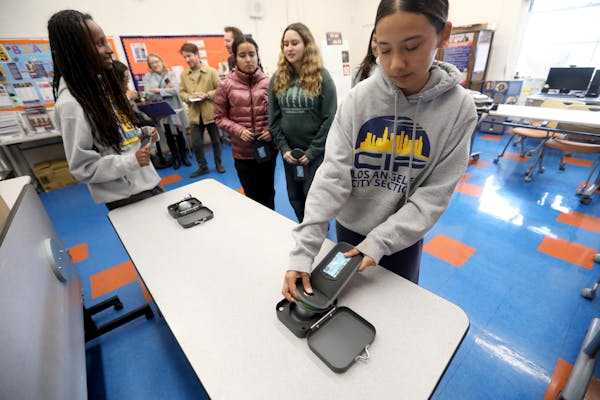
Schools across the country are finding different ways to enforce no-phone policies. Some schools have students lock their phones in pouches that only open at the end of the day. Others use simple classroom bins or lockers.
As a scholar of educational leadership, I believe that school is about more than just classes – it’s where young people learn how to get along with others. When phones are put away, students actually start looking at each other and talking again. School hallways and the lunchroom turn into spaces where students learn to resolve conflicts face-to-face and make human connections.
A high school senior shows how to unlock a magnetic pouch that holds her smartphone at University High School Charter in Los Angeles in March 2025. Genaro Molina/Los Angeles Times via Getty Images
Putting phones away in Ohio
Ohio is an example of a state that has clamped down on students’ cellphone usage over the past 18 months.
In May 2024, Ohio went from suggesting some cellphone guidelines for different schools to adopt to requiring that all public districts limit students’ phone use during class. School districts could choose to allow phones at lunch or between classes.
Many schools began using lockable pouches, plastic bins or lockers to keep phones out of sight. They still needed to allow some students to have phones for medical reasons, like monitoring blood sugar on an app.
Ohio then adopted an even stricter cellphone use policy in 2025. This new law required all Ohio public school boards to adopt policies by Jan. 1, 2026, that prohibit phone use during the entire school day, including lunch and the time between classes.
A needed break
In the fall of 2025, I surveyed 13 Ohio public school principals from rural, urban and suburban districts. Principals reported that the partial phone bans increased students’ social interactions and reduced peer conflicts:
• 62% of principals described more verbal, face-to-face socializing during recess, at lunch time and between classes.
• 68% noted that students can stay on one task for more than 20 minutes without seeking a quick digital break.
• 72% observed a shift from heads-down scrolling to active conversation in common areas such as the cafeteria.
• 61% reported fewer online social conflicts spilling over into the classroom.
A tension for students
In late January 2026, I also surveyed and spoke with 18 Ohio high school students about the new phone bans in place at their schools as part of research that has not yet been published.
Their responses revealed a complex tension between understanding the need for the phone ban and feeling a significant loss of personal safety and autonomy.
A few students said they felt safe knowing a phone in the main office is available for emergencies.
Some students said they felt anxious about not being reachable if there is an emergency – like if a relative were in an accident, or if the younger siblings they care for required their help.
Finally, 13 out of 18 students argued that they should be learning the self-discipline required to balance technology with focus. Students said that phone bans made them feel as though they were children who could not make responsible decisions – rather than young adults preparing for professional environments.
Some students also said that not having their phones made it impossible to fill out college and scholarship applications during the school day, since many application systems require multifactor authentication and require phones to log in.
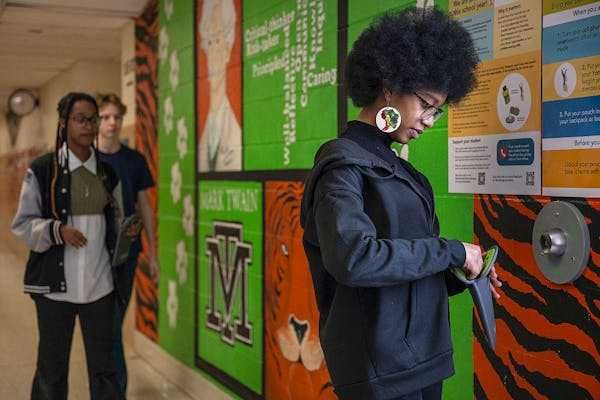
An eighth grader unlocks her cellphone from a pouch at Mark Twain Middle School in Alexandria, Va., in March 2025. Jim Watson/AFP via Getty Images
Lessons from Ohio
Rules are more likely to be respected when students feel they have a voice in the boundaries that affect their daily lives. I think that school leaders could address students’ safety and security concerns in different ways, including by establishing a dedicated family emergency hotline that people can call.
Principals could designate supervised areas where more senior high school students can briefly use their phones for multifactor authentication. School leaders could also offer a specific time window for students to check messages on their phones, or an easy way for the school’s main office to deliver them messages from family.
While these insights from Ohio students and principals offer a helpful starting point, they are just one part of a much larger conversation.
More research is needed to see how these bans affect different types of schools and communities across multiple states. Because every district is different, what works in one town might cause unexpected challenges in another. By continuing to study these effects and listening to everyone involved, especially the students, researchers like myself can figure out how to keep classrooms focused and students interacting without making students feel less safe or less prepared for the adult world.