In our weekly Hustlin’ series, we go beyond the pitying articles about recession-era youth and illuminate ways our generation is coping. The last few years may have been a rude awakening, but we’re surviving. Here’s how.
Down to my last sweet potato and tofu slices, I prepare the ingredients in a casserole dish. Maybe it’s my haste to finally eat something that day or the dish towel I have to use in lieu of potholders, which are currently too expensive for me, but I drop it, all over the inside of the oven, twice. Here’s where I realize how poor I am: I cry. And not just because I’m frustrated. I cry because I need this food, this tofu and these miniature sweet potatoes, to last me through the week.
So what do I do? I do what will later become the basis of my favorite “I’m so poor” joke: I scrape food off the bottom of my oven, put it into a casserole dish, add paprika and cumin, cook it for ten more minutes, and then I call it “dinner.”
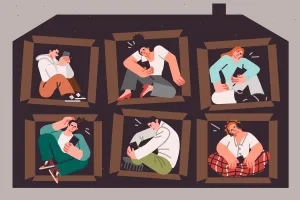
I haven’t been talking about how poor I am in a serious way or how terrifying it is to be on the cusp of my 30th birthday, wondering when I’ll have enough quarters to do laundry again. I’ve distanced myself from the small, artistic circle of people I hung out with when I had enough money for a whiskey at a dive bar. Instead of confessing my financial problems, I’ve removed myself from my lifeline of friends who respond to my suggestions of free activities like going for walks by saying they’d rather hit a club I can’t afford. This isn’t the place I thought I would be after getting a master’s degree, though to be honest, I didn’t really bank on finding a lucrative full-time job with an MFA in creative writing. But I also didn’t foresee the possibility that my fifteen years’ experience of restaurant, publicity, design, administrative, and editorial work would ever not provide me with some possibility of income. And here I am, worried on a daily basis that someone may ask me to do a perfectly fun activity that requires money.
The last time I publicly stated that I was poor, I was met with two main responses from friends and family: Remarkably generous people sent dry groceries and anonymous Trader Joe’s gift cards in the mail and told me I made them sad, and some others asked me why I couldn’t just get something “flipping burgers,” as though this would of course be the easiest task. My grandmother went outside the norm and called to remind me that I should never sell my body. While I appreciated the groceries, I’ve since been dodging these responses by living in a “fake it ‘til I make it” mentality, because our culture—whether you’re rich or poor yourself—is better equipped to deal with middle-class individuals than with those in poverty, and the last thing I want to do to a friend, or a potential employer, is make them feel sad. But “making it” isn’t the same as it used to be, so what exactly does “faking it” accomplish? What am I gaining by not talking about my poverty?
I grew up poor. I also grew up privileged, depending on how you look at it. I had a very poor teenage mother, and my sister and I spent a great deal of time being raised by our grandparents, who were once very poor as well—like, orphans-abandoned-by-their-families poor—but had come into some money with hard work and a decades-long investment in what became our family bar. When I was with my mother, we had potato chips for dinner. When I was with my grandparents, we had potato chips and prime rib, only we still had to eat them on the floor. To this day, none of us knows what money is for different reasons. But now that I am coming to understand, it’s important to ask: Does it seem strange when I say I’m poor, yet eating tofu? Or when I self-reflexively use the phrase “dive bar”? Was my MFA degree the poor life decision that led me to this desperate state, or was it my family history?
The fact is, we can no longer tell someone’s financial reality by what they eat, how they dress, and where they grew up. While I’ve technically surpassed my parents in terms of education and advantage, I am still dependent on a restaurant job, and my peers are now considered the first generation of youths to do worse than their parents. Suddenly, we’re all on a level playing field shaking cocktails side-by-side, and my own burdens of privilege-jealousy have come to a dizzying halt, because even the middle class, of whom I had been previously so resentful, are my coworkers and low-income housing neighbors. At this point, I wish I had never attempted to transcend my class with education; it would make life that much neater. For those of us who have taken the leap to maintain or jump our classes—the interns, graduate students, and college-bound—and who’ve come out disappointed, we’re not alone. The permanent poor are right there with us, and this is a good thing.
My first instinct: There’s no way anyone can compare the harshness of the life of an undocumented migrant worker to that of a former graduate student. But this implies both that I should pity migrant workers and that I’m too good to be associated with their class. I have learned something about pity in my most recent year of poverty: Very few people on all rungs of our society are equipped to assist others who need it without thinking lesser of them, and in some cases, vilifying them.
Recently, New York passed a bill that gave restaurant workers the power to ask for the money they’ve earned and to fight for fair wages and working conditions. Restaurant owners retaliated by insinuating that all restaurant workers involved in class-action lawsuits against the owners were lazy and selfish. Because they must ask for things—in this case, even things that are owed to them—they are lesser. The idea that certain jobs are inherently less valuable or undesirable is so ingrained in our society that in my home state of Michigan, talk of raising the minimum wage of tipped restaurant employees from $2.65 to the standard wage of all workers has sparked an outrageous debate.
The more fortunate tell workers in 2012 to find their “extra”—the thing that makes them stand out—but that implies they have not been doing this all along. Their poverty is a direct result of their own poor choices or mishandled finances, with some people (undocumented migrant workers, for one) possibly getting the pity pass, because they arguably have it harder than a gainfully employed service worker. Maybe it’s time we refuse to give into this divisive reasoning. Maybe it’s time for the “fake it ‘til you make it” class to understand that the goals they’ve had may be misguided, or that the life their parents had may never be attainable. And this is OK, because we’re surrounded by allies, all bound by the same basic goals.
Here’s an experiment for the interns, service workers, graduate students, freelancers, and temps: Think deeply about your privilege, your advantages, your family history, that some may have it better or worse off than you do. Then, forget all of it. The success of our economy will come in the form of indignance, not pity; awareness, not tacit acceptance. Resist the urge to feel sad or pass blame, and we’ll all share our favorite “I’m so poor” jokes at the end. Here’s mine: I’m so poor that I ate some oven crumbs, and two months later, I told the world that I’m poor and felt absolutely no shame.