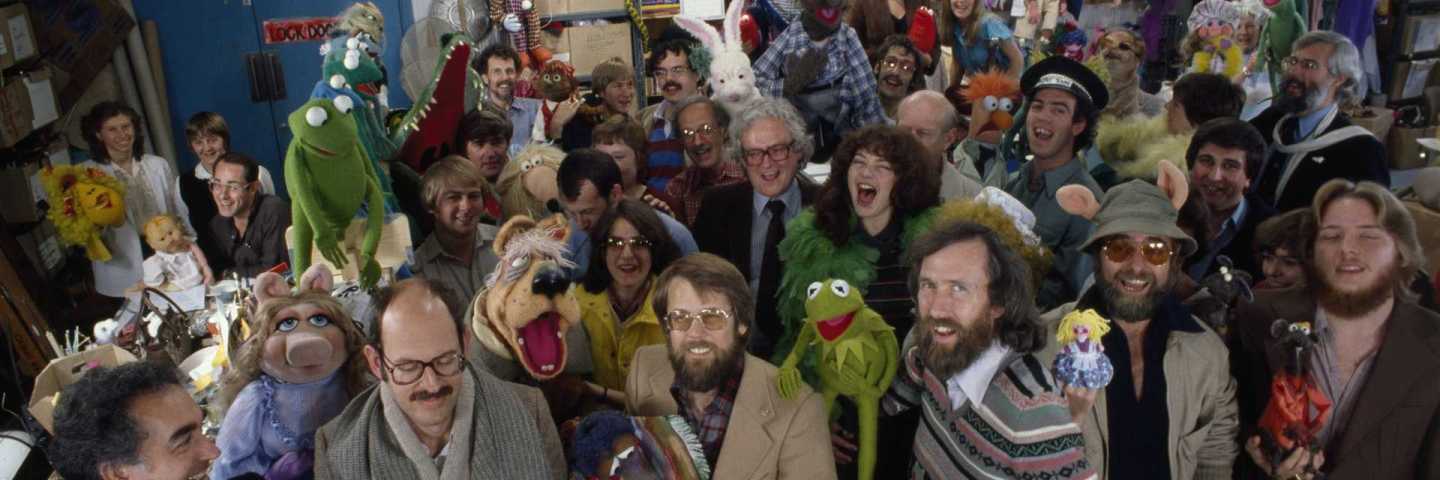
A variety show that’s still revered for its absurdist, slapstick humor debuted 50 years ago. It starred an irreverent band of characters made of foam and fleece.

Long after “The Muppet Show”‘s original 120-episode run ended in 1981, the legend and legacy of Miss Piggy, Fozzie Bear, Gonzo and other creations concocted by puppeteer and TV producer Jim Henson have kept on growing. Thanks to the Muppets’ film franchise and the wonders of YouTube, the wacky gang is still delighting, and expanding, its fan base.

As a scholar of popular culture, I believe that the Muppets’ reign, which began in the 1950s, has helped shape global culture, including educational television. Along the way, the puppets and the people who bring them to life have earned billions in revenue.

Kermit’s origin story

Muppets, a portmanteau of marionette and puppet, first appeared on TV in the Washington, D.C., region in 1955, when Henson created a short sketch show called “Sam and Friends” with his future wife, Jane Nebel.

Their motley cast of puppets, including a lizardlike character named Kermit, sang parody songs and performed comedy sketches.

Henson’s creations were soon popping up in segments on other TV shows, including “Today” and late-night programs. Rowlf the Dog appeared in Canadian dog food commercials before joining “The Jimmy Dean Show” as the host’s sidekick.

After that show ended, Rowlf and Dean performed on the “Ed Sullivan Show,” where Kermit had occasionally appeared since 1961.

From ‘Sesame Street’ to ‘SNL’

As Rowlf and Kermit made the rounds on variety shows, journalist Joan Ganz Cooney and psychologist Lloyd Morrisett were creating a new educational program. They invited Henson to provide a Muppet ensemble for the show.

Henson waived his performance fee to maintain rights over the characters who became the most famous residents of “Sesame Street.” The likes of Oscar the Grouch, Cookie Monster and Big Bird were joined by Kermit who, by the time the show premiered in 1969, was identified as a frog.

When “Sesame Street” became a hit, Henson worried that his Muppets would be typecast as children’s entertainment. Another groundbreaking show, aimed at young adults, offered him a chance to avoid that.

“Saturday Night Live’s” debut on NBC in 1975 – when the show was called “Saturday Night” – included a segment called “The Land of Gorch,” in which Henson’s grotesque creatures drank, smoked and cracked crass jokes.

“The Land of Gorch” segments ended after “Saturday Night Live’s” first season.

Miss Piggy gets her closeup

“The Muppet Show” was years in the making. ABC eventually aired two TV specials in 1974 and 1975 that were meant to be pilots for a U.S.-produced “Muppet Show.”

After no American network picked up his quirky series, Henson partnered with British entertainment entrepreneur Lew Grade to produce a series for ATV, a British network, that featured Kermit and other Muppets. The new ensemble included Fozzie Bear, Animal and Miss Piggy – Muppets originally performed by frequent Henson collaborator Frank Oz.

The Muppet Show” parodied variety shows on which Henson had appeared. Connections he’d made along the way paid off: Many celebrities he met on those shows’ sets would guest star on “The Muppet Show,” including everyone from Rita Moreno and Lena Horne to Joan Baez and Johnny Cash.

“The Muppet Show,” which was staged and shot at a studio near London, debuted on Sept. 5, 1976, in the U.K, before airing in syndication in the United States on stations like New York’s WCBS.

The Muppets hit the big screen

“The Muppet Show” was a hit, amassing a global audience of over 200 million. It won many awards, including a Primetime Emmy for outstanding comedy-variety or music series – for which it beat “Saturday Night Live” – in 1978.

While his TV show was on the air, Henson worked on the franchise’s first film, “The Muppet Movie.” The road film, released in 1979, was another hit: It earned more than US$76 million at the box office.

“The Muppet Movie” garnered two Academy Award nominations for its music, including best song for “Rainbow Connection.” It won a Grammy for best album for children.

The next two films, “The Great Muppet Caper,” which premiered in 1981, and “The Muppets Take Manhattan,” released in 1984, also garnered Oscar nominations for their music.

‘Fraggle Rock’ and the Disney deal

The cast of “The Muppet Show” and the three films took a break from Hollywood while Henson focused on “Fraggle Rock,” a TV show for kids that aired from 1983-1987 on HBO.

Like Henson’s other productions, “Fraggle Rock” featured absurdist humor – but its puppets aren’t considered part of the standard Muppets gang. This co-production between Henson, Canadian Broadcast Corporation and British producers was aimed at international markets.

The quickly conglomerating media industry led Henson to consider corporate partnerships to assist with his goal of further expanding the Muppet media universe.

In August 1989, he negotiated a deal with Michael Eisner of Disney who announced at Disney-MGM Studios an agreement in principle to acquire The Muppets, with Henson maintaining ownership of the “Sesame Street” characters.

The announcement also included plans to open Muppet-themed attractions at Disney parks.

But less than a year later, on May 16, 1990, Henson died from a rare and serious bacterial infection. He was 53.

Of Muppets and mergers

Henson’s death led to the Disney deal’s collapse. But the company did license The Muppets to Disney, which co-produced “The Muppet Christmas Carol” in 1992 and “Muppet Treasure Island” in 1996 with Jim Henson Productions, which was then run by Jim’s son, Brian Henson.

In 2000, the Henson family sold the Muppet properties to German media company EM.TV & Merchandising AG for $680 million. That company ran into financial trouble soon after, then sold the Sesame Street characters to Sesame Workshop for $180 million in late 2000. The Jim Henson Company bought back the remaining Muppet properties for $84 million in 2003.

In 2004, Disney finally acquired The Muppets and most of the media library associated with the characters.

Disney continued to produce Muppet content, including “The Muppet’s Wizard of Oz” in 2005. Its biggest success came with the 2011 film “The Muppets,” which earned over $165 million at the box office and won the Oscar for best original song “Man or Muppet.”

Muppets Most Wanted,” released in 2014, earned another $80 million worldwide, bringing total global box office receipts to over $458 million across eight theatrical Muppets movies.

The ‘Muppet Show’ goes on

The Muppets continue to expand their fandom across generations and genres by performing at live concerts and appearing in several series and films.

Through these many hits and occasional bombs, and the Jim Henson Company’s personnel changes, the Muppets have adapted to changes in technology and tastes, making it possible for them to remain relevant to new generations.

That cast of characters made of felt and foam continue to entertain fans of all ages. Although many people remain nostalgic over “The Muppet Show,” two prior efforts to reboot the show proved short-lived.

But when Disney airs its “The Muppet Show” anniversary special on Feb. 4, 2026, maybe more people will get hooked as Disney looks to reboot the series.

This article originally appeared on The Conversation. You can read it here.
  • Actor shares with Harrison Ford that he was her late dad’s favorite actor. His reply was perfect.
    Photo credit: Apple TV on YouTubeMimi Fletcher acting next to her father's favorite actor.

    Mimi Fletcher has the prototypical origin of a successful working actor: moving out from the Midwest to Los Angeles to become a star. She got her start doing background gigs and now is doing recurring guest roles on television. However, one acting gig she’ll treasure forever was when she got to work with Harrison Ford.

    Ford is a part of the main cast of Shrinking, an Apple+ show starring him and Jason Segel. The show is about a therapist (Segel) who, motivated by grief, takes a more proactive and candid approach with his patients. Ford plays Paul, a senior therapist at the practice who suffers from Parkinson’s disease.

    When Fletcher met Ford

    In 2023, Fletcher got to do scenes with Ford and Segel. It would be one of the biggest highlights of her career so far. However, recently on Threads, Fletcher shared that it was also a highlight of her life that she’ll never forget.

    Fletcher shared that her father was a big fan of Harrison Ford. Her dad was also a big fan of his daughter and very encouraging of her acting dream. She shared how her father supported and believed in her, even when she made decisions that her dad wouldn’t approve of. Her dad passed away in 2005 before Fletcher truly “made it” as a Hollywood actor. She wishes she was able to make him proud.

    Before going on set, Fletcher was waiting in the holding room with both Harrison Ford and Jason Segel. As they were all waiting, Fletcher thought of her father. She approached Ford and said:

    “You know, Harrison, my Dad was a big fan of yours. I remember him taking me to see Witness when I was a little girl. I did some things that I know disappointed him, but he still supported me. He never got to see me do any professional acting, but I’d like to think that today, he’d be proud of me.”

    Harrison Ford’s perfect response

    Fletcher tried to keep it professional, but the tears she was holding back spilled out. Immediately, Ford rushed to give her a hug.

    “He wrapped me in his arms, and held me as I cried. He then kissed my forehead and said, ‘Your dad’s here, he sees you, and he’s proud of you.’”

    In sharing the story, Fletcher expressed her gratitude to Ford and everyone on Shrinking. Fletcher felt compelled to tell this story since her father passed away over twenty years ago this June. And since June is also when we celebrate Father’s Day, he’s been on her mind. While Fletcher still mourns her loss, she treasures this happy memory.

    Fletcher was able to get comfort from a person her father respected even when Ford didn’t have to do anything more than say, “Thanks for sharing.”

    “A little bit of my broken heart was healed that day, through the goodness of Harrison Ford…” she wrote. “I miss and love you, Dad.”

  • Voice actor explains why Americans instantly trust people with British accents, even if they’re lying
    Photo credit: CanvaA traditional town crier, left, and a happy, applauding audience, right.

    Americans have this strange love of British accents—so much so that even when someone is speaking absolute gibberish, we find ourselves transfixed and absurdly trusting them.

    Tawny Platis, a professional voice actor and content creator, expertly captured the phenomenon in her YouTube video, “Why Americans Love This Accent.” In the video, she analyzes why Americans find Billy Butcher’s voice so compelling despite the character’s violent and morally chaotic behavior on the TV show The Boys.

    Americans trust and love rough, working-class British masculinity

    “So Karl Urban is a New Zealander doing a Cockney, working-class, East End London accent,” Platis explained. Regardless of how well the actor nails the accent for his character, Butcher, Americans buy right into it anyway. “That’s because working-class English masculinity is coded in American media as authenticity,” she added.

    She goes on to give examples to help substantiate her point: “Every Guy Ritchie movie, British gangster film, and working-class antihero from Michael Caine to Tom Hardy has trained American audiences to hear that voice as unfiltered and honest.”

    A 2024 study published in SAGE Journals found that listeners unconsciously form social biases based on accents. People rapidly make assumptions about personality and identity.

    decision making, accents, familiarity, credibility
    A young businessman speaks into a microphone.
    Photo credit: Canva

    Make ordinary information sound important

    The accent becomes a shortcut the brain uses to make immediate decisions about intelligence, honesty, confidence, warmth, and even competence. When it comes to characters like Butcher, the key detail isn’t so much the “Britishness” itself—it’s the association.

    “Butcher is using the working-class Brit voice to showcase honesty,” Platis said. “Butcher is a liar who manipulates Hughie, hides things from his team, and is willing to take out children. But the audience keeps forgiving him because his voice sounds like a man who’s earned the right to do all that, when he very much hasn’t.”

    Psychologists believe part of this effect comes from something called “processing fluency.” A 2023 study published in Scientific Reports found that increased exposure to certain accents reduced listeners’ cognitive effort. As a result, people made more positive social judgments about the speaker.

    Accents that feel familiar after years of movies, television, and media unconsciously influence people. Audiences automatically attach credibility and trustworthiness to them. Simply put, people mistake familiarity for truth.

    A 2024 study found that Americans rate the standard British accent most positively, strongly associating it with traits like intelligence, status, and competence. The Northern English accent is viewed slightly less favorably. Scottish accents are considered strong and friendly. Meanwhile, the Welsh accent falls somewhere in the middle, depending on how well the listener recognizes it.

    factual, educated, casual interactions, performance
    Blocks spell out the words “fact” and “fake.”
    Photo credit: Canva

    Accent bias sways people’s opinions

    The same instinct that makes one accent sound “trustworthy” can also make another sound “unreliable.” In real-world interactions, working-class accents can be perceived as less intelligent or less educated. This can affect hiring decisions and even workplace promotions.

    A 2024 study focusing on “Americanness” found that accented speakers were perceived as “less American.” In simulated hiring scenarios, they were less likely to be hired, demonstrating that an accent can override other judgments.

    When a person speaks, people instantly begin building a story about who they are. Many decide whether a voice sounds trustworthy long before consciously realizing it. Platis points out that a lifetime of exposure to social media, movies, and television has shaped that perspective.

    “Butcher’s accent is the most effective because it’s the only one many viewers don’t even recognize as a performance,” Platis said. Which basically means somewhere out there right now, a confident British accent is talking nonsense that feels totally believable.

  • Italian man claims to be ‘human cheetah’ with lightning-fast reflexes
    Photo credit: CanvaA man with fast reflexes.

    At first glance, this probably looks like a camera trick. Ken Lee, an Italian content creator, has built a massive online following by doing something that doesn’t quite feel real. Viewers refer to him as the “human cheetah” because it appears he has near-instant reflexes.

    Grabbing objects out of the air with uncanny precision, flicking clothespins and lighters, and throwing a blur of punches and kicks at impossible speeds, it is easy to call him unbelievable. Half the audience thinks his viral speed videos are fake. The other half is just as convinced they are watching something incredibly rare.

    Hands so fast they blur time

    In the video above, a timer runs to confirm its authenticity. In what looks like half a second, he reaches out and snags the lighter from the table. To prove it is real, he does it twice.

    Having amassed millions of followers on his TikTok page, the identity behind the mysterious influencer remains largely unknown. Active since around 2022, with almost 100 million accumulated likes, Lee has cultivated a fandom around his self-proclaimed “Superhero per Hobby!”

    Do you believe it is real? Is this person the fastest human alive? Many followers cannot wait for the next video to be posted. Plenty of his fervent fans are Italian, so sifting through the remarks takes a bit of hunting. Here are some comments that sum up how much people enjoy the fun and the spectacle:

    “Ken lee the fastest and the best”

    “Most dangerous human”

    “Is this what the lighter sees before my homie steals it”

    “It was sped up during he grabbed the lighter, if u count up with the timer u would be off by like 0,5 seconds whenever he grabs the lighter.”

    “If the flash were human”

    “How is it possible to get such powers ?”

    “I blinked and I missed it”

    People love good entertainment

    The awe of peak performance attracts people to watch elite athletes, musicians, or even dancers. There is something that deeply satisfies all of us when a human appears to push a skill to its limit. Whether it is real or fake seems to matter less than the opportunity to chime in on some good entertainment.

    How far could any of us go by practicing and repeating a particular motion over and over until it is mastered? Beneath the flashy nickname and his viral speed videos, Lee’s content has a way of drawing people in. This is not a superpower. Just repetition. Focus. Obsession. And maybe some digital wizardry.

    Testing the science of speed

    If you wish to question the validity of Lee’s performances, maybe some basic science can help. Human reaction time is not just a reflex. A 2024 study found that the nervous system can fine-tune responses in real time. Practice can make movements appear almost automatic.

    It has been well established in research that the gap between seeing something and responding has a limit. A 2025 study concluded that the most elite extremes allow for reaction times of 100 milliseconds. At that speed, the human brain can barely process that something has happened.

    Science explains Lee is not necessarily moving as fast as we might perceive him to be. And therein lies all the fun of it. We cannot prove it is real, nor can we actually prove that it is fake.

    Maybe Lee is the “fastest man alive” or the so-called “human cheetah.” Or maybe he is just a remarkable entertainer. Either way, he has clearly tapped into something strange and fascinating: a blend of human ability and fantasy that people do not want to miss.

    To give context to Lee’s videos, watch this performance on Tú Sí Que Vales:

Explore More Culture Stories

Film & TV

Actor shares with Harrison Ford that he was her late dad’s favorite actor. His reply was perfect.

Culture

Voice actor explains why Americans instantly trust people with British accents, even if they’re lying

Internet

Italian man claims to be ‘human cheetah’ with lightning-fast reflexes

Culture

Despite all the likes, literallys and dropped g’s, English isn’t decaying before our eyes