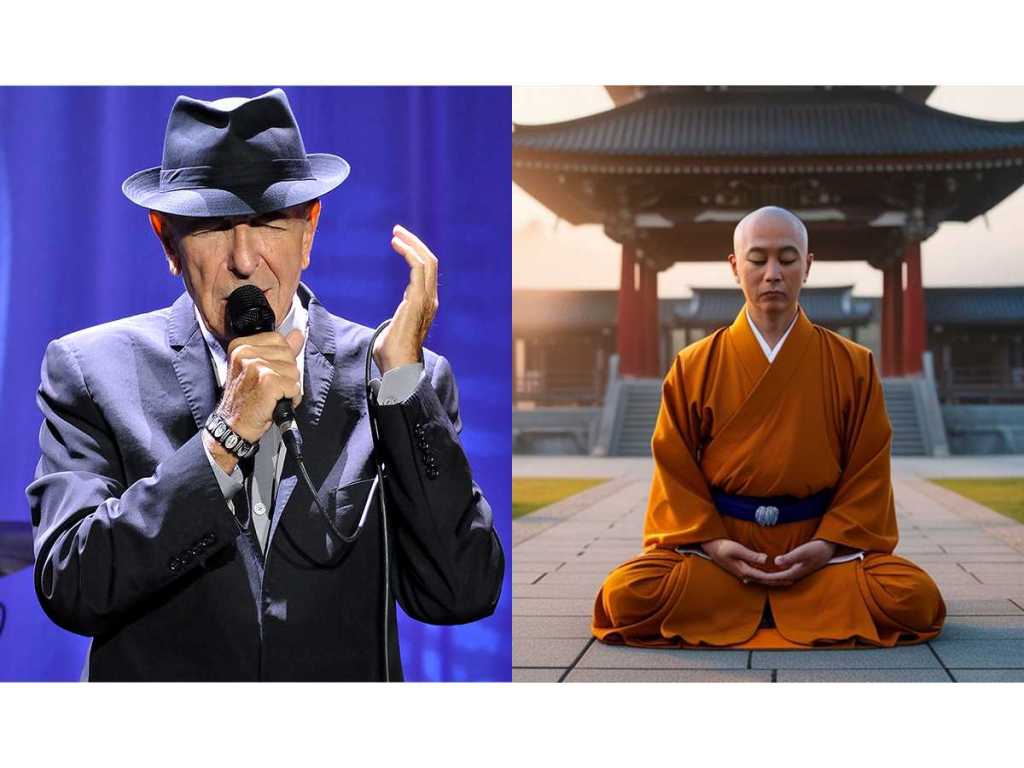
Even the most successful individuals can struggle with a negative perspective and find it challenging to achieve happiness. Legendary folk singer-songwriter Leonard Cohen once shared his own concerns that brought him to live in a monastery.
In a resurfaced video interview, Cohen expressed gratitude for a monk who helped free him from negative thinking. Through spiritual guidance, Cohen learned that his unfulfilled feelings about purpose and achievement were delusions of his own making.
Cohen shares why he lived in a monastery
Cohen briefly stepped away from his music career and lived in a monastery on Mount Baldy under the guidance of a monk named Roshi. There, he sought to let go of the painful habits that reinforced a scarcity mindset. Cohen said Roshi helped him reframe his thinking, explaining, “He cures the illusion that you’re sick, and he was successful in my case.” Cohen then went on to describe the painful thoughts that were interfering with his life:
“I guess the same sicknesses everybody has, that, you don’t get what you want [and] if you do get it, it isn’t what you wanted. The objects of your desire continually escape you. There’s some wisdom, some path that if you could only embrace it. You could extract yourself from distress and suffering. All these aspirations that all of us nourish. That there’s another life that is, that would be better. That another way would be better. Another lover would be better. Another métier [profession] would be better. This idea that there’s something to grasp.”
When the interviewer asked whether Cohen was a victim of this sickness, he responded, “I was a specialist.”

The struggle to find meaning
On Mount Baldy, Cohen practiced Buddhist traditions under a teacher’s guidance: chanting, meditation, and learning to let go of desire and attachment. Suffering from chronic discontent can make even a good life feel less happy. While quietly contemplating his life high in the San Gabriel Mountains, Cohen cooked and cleaned.
After a five-year stay, when many thought his music career was over, Cohen returned to release an album, Ten New Songs. The album was moderately successful, going Platinum in three countries and Gold in six others.

The science of gratitude
There has been significant research into helping people learn to accept their thoughts and feelings. A 2023 study from Cornell University compared people who were better at accepting experiences without judgment with those who struggled to do so. Brain patterns revealed differences in areas linked to emotional regulation and well-being. The findings suggest that acceptance is an important skill that can help people feel happier and healthier.
A 2025 study published in the National Library of Medicine explored a form of psychological training called Acceptance and Commitment Therapy (ACT). The study found that ACT improved skills such as emotional regulation, mindfulness, and forming stronger connections with others. At a minimum, stronger social skills can help people feel better and navigate group settings with greater ease.
A 2025 study on depression and anxiety examined people with a tendency to focus more on negative information, a pattern known as negativity bias. Researchers found reduced activity in brain regions involved in regulating thought and emotion among those inclined toward negativity. Helping people change negative thinking patterns can reduce feelings of anxiety, depression, and hopelessness.
Even though Cohen was extraordinarily successful as a poet, songwriter, and performer, he spoke openly about feeling restless and unsatisfied beneath his fame. Retreating to a temple on Mount Baldy for years to cultivate spiritual discipline gave him a deeper sense of peace. The journey reshaped not only his art and work, but also his life.
Watch this 1996 documentary video of Cohen, filmed on Mount Baldy: