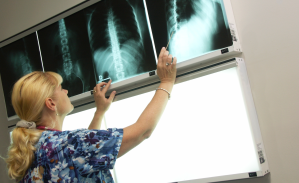
Over the past two years, we’ve seen 3D printing used to make some absolutely bonkers things, from fitted evening gowns to functional guns to extruded edible pizzas. Having grown accustomed to unfathomable rates of innovation, it seemed for a time that almost nothing that came out of that realm would surprise us anymore —until last month when doctors at the University of Peking announced they had printed the first ever essential bone replacement, producing a brand new spinal vertebra for a 12-year-old boy with a rare form of bone cancer. As recently as a year ago, doctors were using roughly molded metal attached with cement and screws to replace bones, resulting in long recovery times and carrying a significant risk of slippage or jamming in the idiosyncratic human skeleton. Now we have the power to, on the cheap and within hours, CTRL-P a bespoke, sturdy, and durable part of a human spine.
And that wasn’t the only medical marvel of that late August. Days earlier, scientists announced that they had grown the first ever fully functional organ inside of a living animal—a thymus gland inside a mouse—using only an injection of reprogrammed cells. Together, these two developments represent breakthroughs in the worlds of bioprinting and artificial organ creation that may, within our lifetimes, help us conquer a variety of physical damage, revolutionize reconstructive surgery, and bypass the minefield that is human organ donation. These discoveries won’t just change the way we repair a shattered cheekbone or failing kidneys, but as we continue to revolutionize medical care, one day spare parts could become as common and easy to replace as say, a carburetor or a sparkplug.
We’ve been working on 3D printed bones about as long as 3D printers have been available. Back in 2011, Belgian doctors printed a titanium jaw for a female patient who lost her own to infection, and ever since we’ve employed fixes like skull patches, windpipes, hips, skin, and even more minor elements of the spine. Most of these have been titanium or polymer-based implants, both cheaper (a printed bone can cost $100 or less in raw materials) and better at replicating complex 3D shapes to match individual skeletons than traditional materials. The process of printing also means it’s easier to match skin tones when printing a graft, to scan rather than painfully cast a missing body part, and to detail and replicate things like fake eyes, which used to be handcrafted each time with great labor.
Newer designs, though, replace missing body parts with an artificial lattice upon which a patient’s own cells are seeded, not just replacing organic matter with a synthetic implant, but re-growing bone, flesh, and even organs in place of the scaffolding, which disintegrates over time. One clever team in Australia had even, as of late 2013, developed a biomatter-secreting pen to essentially draw bone-regenerating matter into complex breaks or fractures. Beyond just bones, this lattice and seeding structure is behind the creation not just of the recent fully-grown thymus, but of blood vessels, bladders, ears, noses, and tear ducts. Some hope soon we’ll be able to grow new and functional heart valves and kidneys as well.
For organs, the human use of this technology is further off in comparison to bones and cartilage, as we don’t yet know how artificially grown or 3D-printed organs hold up over time or if the body will reject them. All we know is that, in previous efforts to grow organs, researchers faced the standard problems (as well as some new ones) that accompany implanting a quasi-functional piece of flesh into a living host. Granted, any efforts to create a new organ is good, considering the overburdened human organ donor system—18 Americans die each day waiting for unavailable parts, and things like functional thymuses are especially rare. But the new thymus grown last month may be a sign that, in a few decades time, we’ll simply be able to inject and develop a compatible and functional organ rather than scouring the earth for rare matches, enduring the trauma of surgery, and then hoping that everything takes.
Even if the effect of last month’s body part replacement breakthroughs aren’t felt for years to come, we’ve come a long way from the turn of the century, when the mere notion of these technologies was utter sci-fi. In the meantime, we already have the practical applications of printed bone implants to look forward to, not only in the hospital but also in research labs, where perfect replicas will help us to study things like the effects of head trauma. These are monumental advances, but they’re just the latest in what seems an unending daisy chain of accelerating innovation. Whether it’s in-human organ growth or 3D printed bones, we could be on the precipice of an entirely new era of replaceable parts.