Here’s some science news to chew on: the reason humans and other animals have jaws may have been revealed thanks to a recent fossil discovery. In the Arctic, a fossilized fish species has been found to have teeth on the bony plates lining the roof of its mouth. Not only does this mean scientists found that teeth and jaws appeared far earlier in evolution, but we may have found the grandmother of all jaw biters.
The Romundina gagnieri, a new species of ‘acanthothoracid’ fish from the Early Devonian of Arctic Canada, had tooth-bearing plates on skull fragments recovered from Arctic rocks. The 400 million year old fossils were found in 1995 on Prince of Wales Island on now-dry ancient sea beds. Initially, the researchers assumed that the plates on the skull fragments they recovered lacked true teeth due to the smoother surfaces.
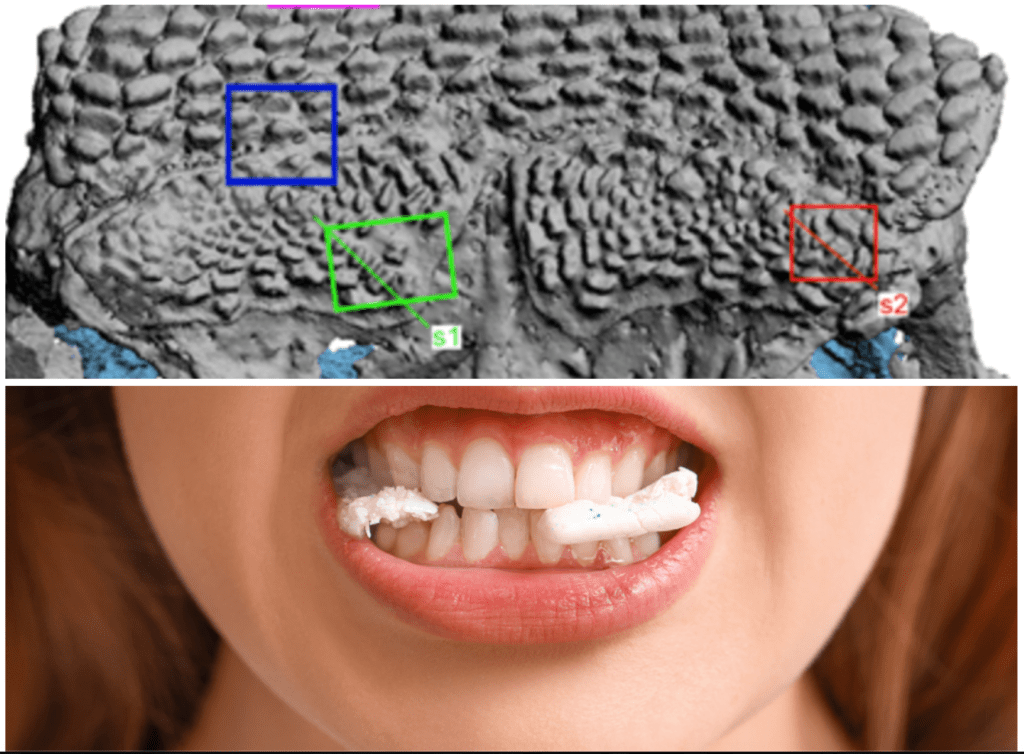
However, upon further study and examination of the fossils through synchrotron imaging (a particle ring that produces multi-angled X-rays to create three-dimensional models of the fossils), teeth were discovered. This method allowed the researchers to deeply re-analyze the fragile fossils without worrying about potentially breaking them. The scans showed evidence of teeth, including odontodes (hard bumps of mineralized tissue on the skin or in the mouth), layered over them.
This adds to the debate among researchers about whether teeth started on the skin and moved inward toward the mouth, or if teeth originally started inside the mouth. A 2020 study argued that prehistoric fish teeth mostly appeared in the back of the mouth, eventually evolving over time and moving towards the front to form the jaws we know of today. The report regarding Romundina gagnieri contests this, saying that the scans showed the teeth being “arranged in a concentric manner” and not matching the “back-only” rule that had been believed. This completely shifts the widely accepted timeline of when and how teeth were developed.
“We are looking here at one of the first steps in tooth evolution,” said Dr. Sébastien Olive, leader of the research team at the Royal Belgian Institute of Natural Sciences. “This allowed our distant ancestors to exploit new food sources and occupy new ecological resources.”
Further research needs to be conducted and scrutinized before determining whether Romundina gagnieri is officially the matriarch of teeth as we know them or a new evolutionary branch. New discoveries may also refute this theory down the line.
Whether or not these Arctic fish fossils are the true beginnings of chewing, they certainly help us better understand where our teeth came from and give us something to gnaw on until the next big discovery.