
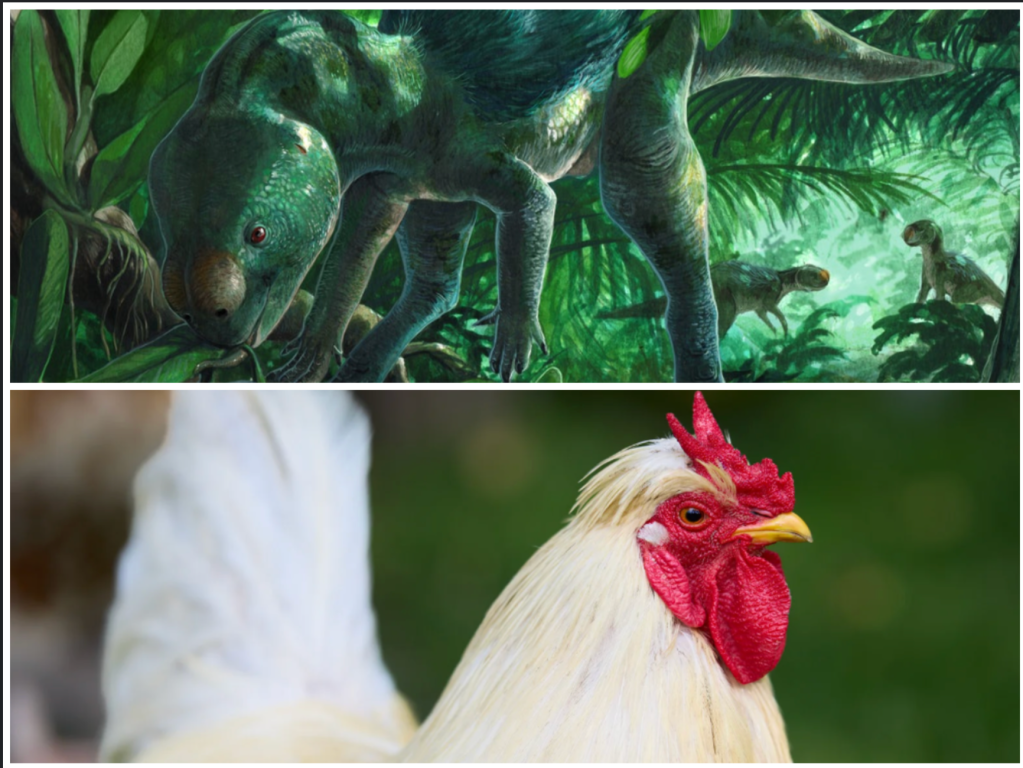
Our understanding of dinosaurs has changed over time. The “thunder lizards” are considered to be more related to birds than we previously thought. The brontosaurus went from existing to not existing to possibly existing. Now, a chicken-sized paleontology discovery could fill in a 70 million year old hole in fossil records.
Foskeia pelendonum is a small, chicken-sized plant eater with a “weird” skull that’s unique enough to change evolutionary trees and fill in a gap in dinosaur evolution. Discovered in Spain, the fossils were initially considered to be of a baby bipedal dinosaur. Upon closer inspection, however, they were found to be fully mature fossils of a new small species. The new herbivore dinosaur has been compared to the height of the modern chicken. It’s also only 18-inches in length, contesting previous notions about how dinosaurs evolved due to its small size and unique features.
One of the more fascinating features of this tiny dinosaur is its skull. After a high-resolution CT scanning of skull bone fragments, the skull of Foskeia looked like a more evolutionary advanced animal. The bones of the front of the skull were fused together, its front teeth angled forward rather than straight down, and the jaw joint sat higher in the skull with an attachment point suggesting that it had a different chewing motion than other dinosaurs related to it.
“Miniaturization did not imply evolutionary simplicity—this skull is weird and hyper-derived,” said Dr. Marcos Becerra, a paleontologist at the Universidad Nacional de Córdoba, according to Sci.News.
“Its anatomy is weird in precisely the kind of way that rewrites evolutionary trees,” said Dr. Penélope Cruzado-Caballero, a paleontologist at the Universidad de La Laguna.
Given its height, unique skull structure, and bone analysis, paleontologists believe this smaller-than-the-average-dog dinosaur could be a missing chapter in dinosaur history and evolution. Foskeia is classified as a Rhabdodontomorpha dinosaur. Before this discovery, the earliest known Rhabdodontomorpha dated back to the Late Cretaceous period. The Foskeia fossils are dated 70 million years before that.
“From the beginning, we knew these bones were exceptional because of their minute size,” said Dr. Fidel Torcida Fernández-Baldor, a paleontologist at the Dinosaur Museum of Salas de los Infantes. “It is equally impressive how the study of this animal overturns global ideas on ornithopod dinosaur evolution.”
The belief is that the condensed size and lightweight bone structure of Foskeia would allow it to survive and thrive due to its ability to hide from larger predators and dart away quickly. However, the fossils themselves were scattered and assembled. This means that, while the skull of Foskeia was able to be analyzed, there isn’t a completed skeleton to confirm all theories. Future discoveries could either confirm or contradict these current findings.
It’s exciting to see how, over time, we uncover new things about our world’s history. Who knows what other creatures will be revealed to us next? For now though, dinosaur chicken nuggets are even closer to the real thing than ever before.