
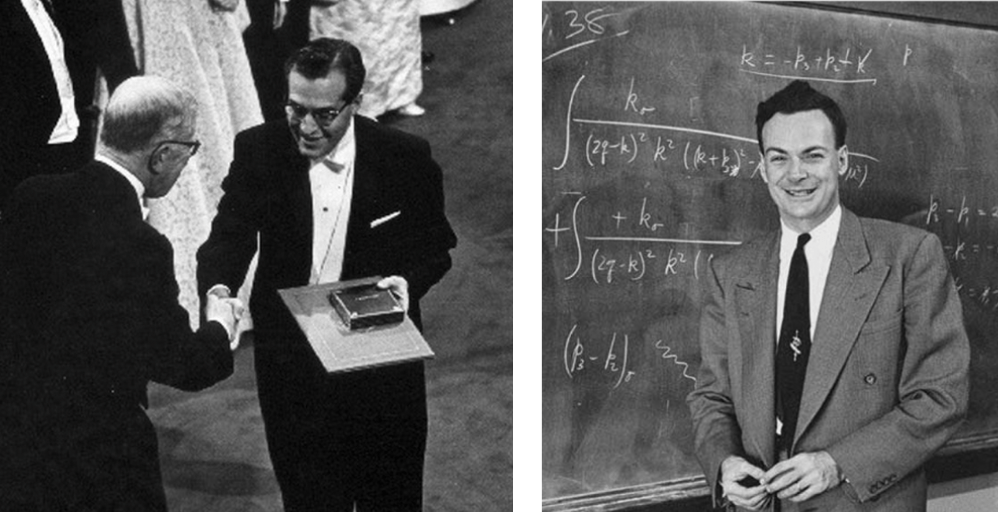
Richard Feynman is one of the top scientific minds in modern history. He was invited to participate in the Manhattan Project, helping develop the first atomic bomb. When the Challenger shuttle tragically exploded, it was Feynman who figured out what went wrong to prevent future NASA disasters. He was even given the Nobel Prize for his work in physics for essentially remaking the concept of quantum electrodynamics. He was also riddled with self doubt, incredibly unsure of himself, and criticized people of high intelligence.

Why was this so? Well, because in his mind and in life, people who are highly intelligent tend to rely on their intelligence to the point in which they make mistakes in judgment. In trusting in their own smarts, something gets overlooked or a mistake is made—but it’s covered over in pride. They could also become too afraid of asking the right questions that could lead to the next answer. Some argue that Feynman’s greatest scientific finding wasn’t in physics, but in human ignorance and ego.

@numeramath

Physicist Richard Feynman – you can do anything if you put your mind to it. #physics #stem #engineering #study #math #feynman ♬ Cornfield Chase – Hans Zimmer

A quote from Feynman’s 1974 lecture sums up his philosophy on learning and scientific study:

“The first principle is that you must not fool yourself—and you are the easiest person to fool. So you have to be very careful about that. After you’ve not fooled yourself, it’s easy not to fool other scientists. You just have to be honest in a conventional way after that.”

In other words, he was arguing and warning that people of high intelligence tend to make more mistakes due to them relying on their intellect and judgment for answers rather than asking additional and bigger questions to obtain knowledge that could’ve been overlooked or underserved. They rely on the fact that they are smart to the point that they overlook the possibility that they could be mistaken, misguided, or just plain wrong. Some who are our most intelligent are less open to learning because they mistakenly thought they already learned it all, rather than asking questions and observing results. To put it plainly, the smartest person in the room is the person who doesn’t think they’re the smartest person in the room.

https://www.instagram.com/p/C3GPAEtSE1S/

Feynman didn’t just preach this philosophy, but showcased it in practice. He publicly called himself a man of “limited intelligence.” While his IQ of 125 put him in the above-average range of intellect, it is definitely lower than the MENSA member requirements that many of his scientific peers fell into. It should be noted that the concept of IQs being an indicator of intellect are being put into question more and more in recent years. Also, while he appreciated the Nobel Prize, he didn’t really see the point in them, seeing the results of his work and his questions as the true prize itself—that, and the fact that there were other mysteries to unlock that could lead to even more mysteries.

True intelligence isn’t relying on what you believe you know, justifying mistakes you have made, or letting certainty cloud your judgement. It’s going into the unknown or knowing that there are known unknowns with an open mind. It’s never being afraid to ask questions and never relying on answers to be untested truths. In fact, it’s best to test those answers again and again from all angles to see where the next question lies.

It’s how Feynman changed what we believed about quantum electrodynamics and how he solved the Challenger problem: questions. Doubting everything in order to see if there were further questions within the provided answers. Finding deeper understanding and seeing something that was overlooked.

When it comes to intellect, don’t worry about test scores, degrees, or if you’re smart enough. While it might be good to take an expert’s word into account or into theory, it doesn’t mean that what they say shouldn’t be tested and scrutinized to make sure a bigger truth isn’t overlooked. Knowing yourself and your limitations can often move you further than believing that you’re already at the peak. If you think you’re at the peak, you might not see the other taller mountains around you because you’re too busy looking down from the smaller mountaintop you’re already on.

This quote from Feynman in The Character of Physical Law is an educational mantra to live by:

“I would rather have questions that can’t be answered than answers that can’t be questioned.”

Stay curious.

This article originally appeared in May

  • Body language experts reveal the secret truth about people who walk with their hands behind their backs​
    A man and a woman walking with their hands behind their backsPhoto credit: Canva
    , ,

    Body language experts reveal the secret truth about people who walk with their hands behind their backs​

    It isn’t just an old-fashioned habit; experts say this specific posture signals confidence, deep thought, and openness.

    The way a person walks is a silent broadcast of their current state of mind. A fast pace with swinging arms suggests determination; a slow shuffle with eyes downcast suggests detachment or aimlessness.

    But what about the person strolling with their hands clasped firmly behind their back?

    Well, body language experts believe that walking with your hands behind your back reveals a great deal about your mindset and your personality. They believe that, by keeping your hands behind your back while walking, a person is removing a distraction from their field of vision. This can allow a person to better process complex ideas, difficult emotions, or mentally work through problems as they walk. In short, walking with your hands behind your back indicates deep overall thoughtfulness.

    @the.mcfarlands

    not an ounce of stress in that walk ? follow us on IG: itsthemcfarlands ? #dad #dan #dadsoftiktok

    ♬ original sound – notrigby


    It’s not just deep thinking either. Other experts believe that walking with your hands clasped behind your back shows off confidence but without intimidation. By walking with your hands away from your torso, you’re fully exposing your chest and belly rather than being in a traditionally defensive position. While you may be walking deep in thought, it also allows people around you to know that you can be approached and will respond without malice. This is in contrast to body language in which the arms are in front of the body, indicating that you’re closed off or not in the mood for interaction.

    @yajairarh40

    Old people know what they are doing with this walk. #walks #saturdaymorning #carync #fy

    ♬ original sound – ar1esluver

    However, while walking with your arms behind your back can be seen as an invitation, it can come off as authoritative, too. By walking tall with your chest fully exposed, it mentally communicates that you’re calm and in control of the situation, not worrying about any incoming threat. This is partially why you see world leaders, military folks, teachers, and other persons in such roles walk this way in order to appear authoritative yet approachable. By having your arms behind you, your defense appears down but your authority appears up simultaneously.

    Alongside the psychological body language aspects of this type of walk, it also has some physical benefits. While walking with your hands behind your back shows a more confident posture, it improves your posture overall, too. Putting your arms behind your back naturally pulls your shoulders back and opens your chest, allowing your spine to straighten up and align. While it won’t improve your posture instantly, habitually walking with your hands behind your back can turn proper posture into an instinctual habit as well.


    So, if you’re heading to and from places and your mind’s racing with stress, you may want to try putting your hands behind your back. The posture helps reset your mind and keeps it calm while searching for solutions to your every day problems. Will it work? Maybe. Maybe not. Some things cannot be willed into existence. However, you’ll at least appear like you have your act together (and great posture, too!).

    This article originally appeared earlier this year.

  • Dogs can recognize a bad person and now there’s science to prove it
    A little dog looks at the camera suspiciously Photo credit: Canva
    , ,

    Dogs can recognize a bad person and now there’s science to prove it

    A study from Kyoto University confirms that if you lie to your dog, they will remember it—and stop trusting you.

    Dog owners have long suspected their pets are excellent judges of character, often joking that if their dog doesn’t like someone, they shouldn’t either. As it turns out, that intuition is backed by hard science.

    Research led by Akiko Takaoka of Kyoto University in Japan has confirmed that dogs are surprisingly adept at detecting untrustworthiness in humans. The study, which focused on “social intelligence,” revealed that dogs can quickly determine if a person is reliable—and they hold a grudge if they aren’t.

    The study involved tricking dogs in the name of science. Humans have known for a long time that if you point at an object, a dog will run to it. Researchers utilized this information in their study. During the experiment, they pointed at a container that was filled with hidden food. Sure enough, the dog ran towards the container. Then, they pointed at a container that was empty. The dogs ran towards it, but found that it had no food.


    dog intelligence, Akiko Takaoka, Kyoto University, dog psychology, animal cognition, trustworthy, dogs and liars, canine science, pet behavior, animal studies
    Cute dog looks off camera at someone Canva

    The third time the researchers pointed at a container with food, the dogs refused to go to the container. They knew the person pointing wasn’t reliable based on their previous experience. 34 dogs were used in the experiment, and every single dog wouldn’t go towards the container the third time. This experiment either proves that dogs can spot a liar or that dogs have major trust issues.

    In other words, if you lie to your dog, your dog forms the opinion that your word isn’t good and will behave accordingly. “Dogs have more sophisticated social intelligence than we thought. This social intelligence evolved selectively in their long life history with humans,” said Takaoka, who was also surprised that dogs were quick when they devalued the reliability of a human.”

    John Bradshaw of the University of Bristol in the UK, who wasn’t involved in this study, says that the results indicate that dogs prefer predictability. When gestures are inconsistent, dogs tend to become nervous and stressed. The researchers have plans to repeat the experiment swapping out the dogs with wolves because wolves are closely related to dogs. The point of this isn’t to get bitten by wolves, but rather, to see the “profound effects of domestication” on dogs.

    A similar experiment was conducted on preschool-aged children by a team of researchers led by Kimberly Vanderbilt of the University of California, San Diego. The experiment was conducted over different ages and it was found that 3-year-olds accepted advice from established liars just as much as they did from truthful people. The test found older children making the distinction between truthful people and liars. While four-year-olds were more skeptical, 5-year-olds leaned towards truthful people.

    This article originally appeared six years ago.

  • Psychologists reveal 10 signs that someone is secretly super intelligent and may not even know it
    Colorful representation of a brain and a woman holding a coffee cupPhoto credit: Canva
    , ,

    Psychologists reveal 10 signs that someone is secretly super intelligent and may not even know it

    It isn’t about solving complex math equations; true intelligence often hides in how you listen, adapt, and handle change.

    When we think of a “genius,” we often picture a mathematician scribbling formulas on a chalkboard or a tech mogul launching rockets. But according to psychologists, true intelligence isn’t always about raw computing power. Often, it manifests in subtle behaviors, emotional regulation, and how a person navigates the world.

    A 2025 article in Global English Editing explored the subtle ways smart people behave that don’t always garner much recognition. These behaviors exhibit true levels of intelligence, and they’re habits you might already be doing. The real magic lies in the secrets behind what they do that exhibits true wisdom.

    They are great at problem-solving

    signs of intelligence, emotional intelligence, psychology, high IQ traits, adaptability, critical thinking, open-mindedness, self-reflection, cognitive patterns, Global English Editing
    A woman looks at post-it notes while thinking Canva

    Smart people are adept at identifying a challenge, understanding it, and then finding the best ways to overcome it. Two tools help them do it in a way that psychologists highly approve of and consider brilliant.

    • 1. Asking thoughtful questions: A 2021 study in Science Direct found asking questions to be an important cognitive activity. The quality of a question plays a crucial role in inspiring curiosity, critical thinking, and learning. A thoughtful question requires critical thinking, and smart people don’t shy away from it.
    • 2. Recognizing Patterns: “Pattern recognition” is a core skill behind problem-solving and creative thinking. A 2022 study on pattern recognition published in EBSCO states, “Pattern recognition is a cognitive process that enables individuals to identify and interpret patterns in their environment, allowing them to recognize objects, sounds, and other stimuli. This capability is fundamental to human perception and plays a crucial role in everyday activities, from appreciating art to making change.”

    They have better relationships because they listen

    signs of intelligence, emotional intelligence, psychology, high IQ traits, adaptability, critical thinking, open-mindedness, self-reflection, cognitive patterns, Global English Editing
    Two women on a couch are having a conversation Canva

    Better relationships require listening. When both people feel they have the opportunity to express themselves, there is validation. People tend to be more trusting and feel more connected when they feel safe and heard.

    • 3. Listening to both sides of an argument: Psychologists would call this being open-minded. A 2025 article in Psychology Today notes, “Open-mindedness does not require agreement with every viewpoint. However, it demands the ability to understand and engage with ideas that differ from our own.”
    • 4. Listening more than talking: People who value listening are more empathetic. They can self-regulate and not dominate a conversation. Their listening affords a better perspective. A 2022 study in the National Library of Medicine states that high-quality listeners use more cognitive processing to remain attentive and process information.

    They are emotionally intelligent

    signs of intelligence, emotional intelligence, psychology, high IQ traits, adaptability, critical thinking, open-mindedness, self-reflection, cognitive patterns, Global English Editing
    A father and son sit on a porch talking Canva

    Emotional intelligence is the ability to be in touch with your own feelings as well as the feelings and experiences of others. In a recent article, The Times reported that empathy allows people to live a more peaceful life because they don’t to take things personally.

    • 5. Self-reflection: The ability to truly look at ourselves doesn’t have to be negative. Smart people don’t just sit down and think about all the bad things they might be doing. Instead, they can positively reflect on their own habits and behaviors. A 2022 study published in the Cambridge University Press found that positive-themed self-reflection produced better psychological well-being.
    • 6. Admit they don’t know: Nobody likes a know-it-all. Some of the greatest minds have moments when they don’t have an answer. Recognizing the limits of one’s own knowledge is a sign of intellectual humility. These people are better learners and demonstrate a “growth mindset.” A 2021 study in the National Library of Medicine found that older individuals exhibiting higher levels of belief in the malleability of intelligence and abilities showed larger cognitive gains.

    They are creative and innovative

    signs of intelligence, emotional intelligence, psychology, high IQ traits, adaptability, critical thinking, open-mindedness, self-reflection, cognitive patterns, Global English Editing
    A woman paints on a canvas Canva

    Innovation isn’t just ideas. The ability to work with others, adapt to situations, and communicate well are all signs of higher intelligence. Creative people are capable of divergent thinking, which requires the ability to come up with multiple answers or choices moving forward.

    • 7. Sense of humor: Humor is a complex cognitive ability that requires creativity, perspective, and understanding. A 2024 study in the National Library of Medicine found humor allowed professionals to manage challenges more effectively. Humor also helps people cope with anxiety, stress, and adversity.
    • 8. Quiet time: Consistent meditation reduces negative moods and lowers anxiety. Smart people know the benefits of gaining stronger emotional regulation and better impulse control. The Melbourne School of Psychological Sciences reported on the value of just doing nothing. People doing nothing eventually find a high degree of calm and rest with little discomfort, tension, anxiety, or restless boredom.

    They are adaptable

    signs of intelligence, emotional intelligence, psychology, high IQ traits, adaptability, critical thinking, open-mindedness, self-reflection, cognitive patterns, Global English Editing
    A student high-fives withu00a0his teacher Canva

    Psychologists consistently emphasize that adaptability is a core trait of intelligence. It isn’t just physical flexibility, but also emotional. Smart people just know how to flow with life.

    • 9. Adapt: A 2023 study on college students published in the National Library of Medicine found the structure of students’ adaptability pulled from their emotional, interpersonal, professional, and even economic experiences. Navigating all these areas required emotional intelligence, and struggling in any one area was a predictor of their ability to handle their feelings.
    • 10. Open to change: Psychological research has consistently shown that one of the strongest personality traits linked to intelligence is openness to experience. Smart people enjoy exploring new concepts and thinking more deeply. In 2023, Frontiers published a study on the neurobiology of openness. The study revealed that people who are open to change had more active and larger prefrontal brain regions, which are responsible for planning, decision making, memory, and flexible thinking. These people had stronger brain connections, revealing higher levels of intelligence.
    Psychology suggests that smart people are more emotionally aware and capable of navigating their feelings. The ability to implement tools that help a person manage relationships, themselves, and their experiences requires high levels of cognitive ability. If you have a deep capacity for empathy, self-awareness, compassion, and patience, you’ve been living the life of a genius without even knowing it.
    This article originally appeared earlier this year.

Explore More Exploration Stories

Exploration

Body language experts reveal the secret truth about people who walk with their hands behind their backs​

Exploration

Psychologists reveal 10 signs that someone is secretly super intelligent and may not even know it

Exploration

Dogs can recognize a bad person and now there’s science to prove it

Exploration

Two baseball players have the same name, height, and surgery scar. A DNA test revealed the truth.