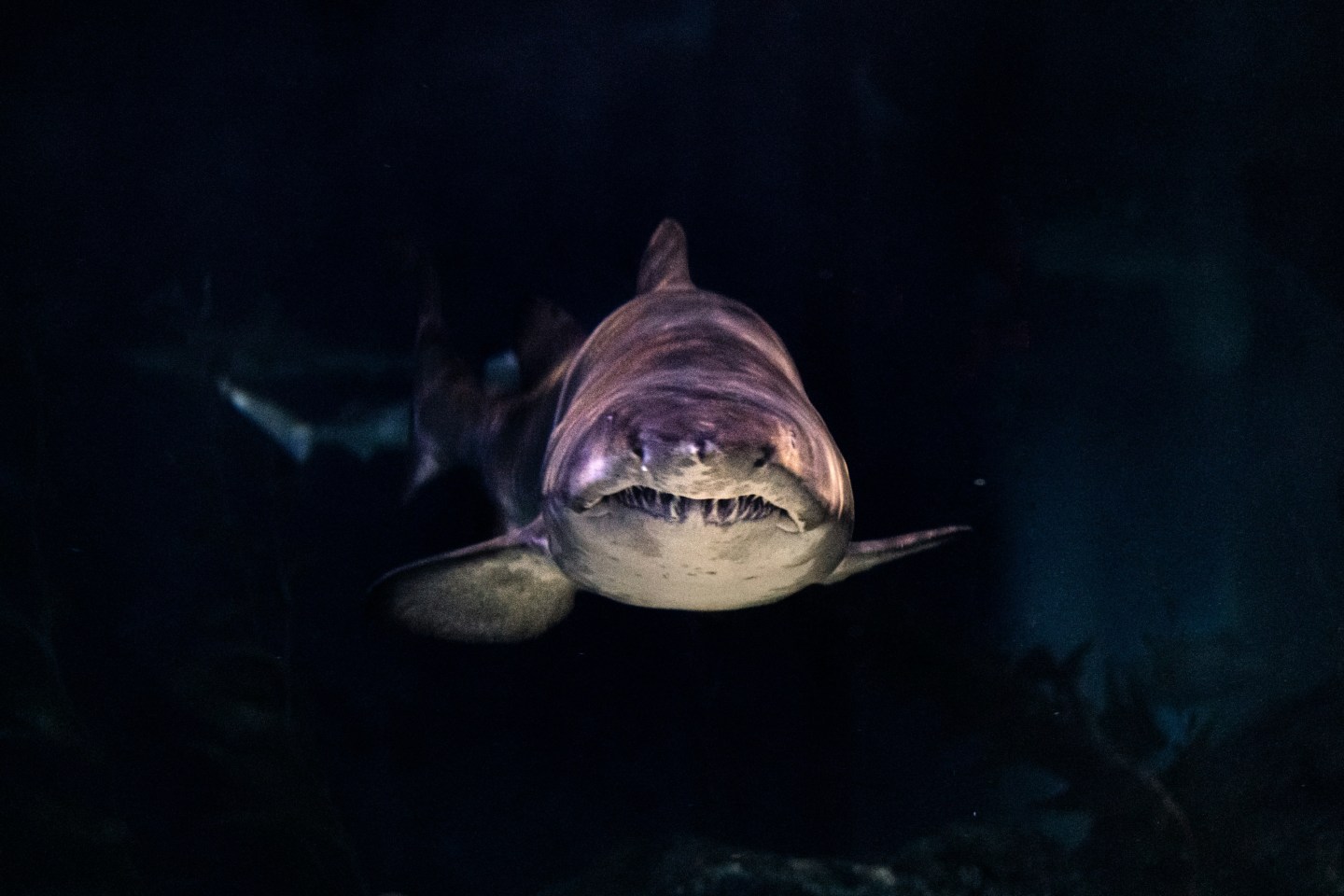
Photo credit: Photo by Wai Siew on Unsplash – Close-up of a gray shark.
When you think of sharks, what sounds come to mind? The swishing of ocean water? Robert De Niro’s voice as the kingpin shark in the critically panned film Shark Tale? Or, probably for many of us, the simplistic yet haunting “du nuh, du nuh” notes from Jaws? Plenty of us might even have assumed sharks were completely silent. Turns out, they’re not. Researchers in New Zealand have recorded the sounds that sharks make, and they’re actually pretty loud.
Back in 2021, marine biologist Carolyn Nieder heard what she believed to be “short clicking sounds” when she moved sharks to examine them. A research team was eventually assembled to investigate further. Nieder, along with other scientists, gathered both male and female rig sharks of different lengths and conducted a study in a tank. They published their findings in the journal Royal Society Open Science Journal, noting that “all sound recordings were conducted in a rectangular plastic tank.” They added, “To the best of our knowledge, this study would be the first to show that sharks can actually produce sounds.”
In an article for Smithsonian Magazine, science writer and fact checker, Sara Hashemi notes that Nieder relayed to Peter de Kruijff of the Australian Broadcasting Corporation, that when she first heard the sound, she though they “sound[ed] like electric sparks.”
Hashemi continued, “The noises were loud: Their volume reached above 155 decibels, which is comparable to a shotgun. The clicks were mostly single pulses, but roughly a quarter happened in pairs. About 70 percent of the sounds were accompanied by a calm, swaying body movement, while 25 percent came with vigorous thrashing of the head or body. The other 5 percent occurred while the shark was still.”
Listen for yourself:
Posted on the USA Today YouTube page, the noises sound like light tapping on a keyboard or a gentle, crackling fire. It’s noted on the video (as previously reported) that “Researchers have recorded a shark species making sounds underwater for the first time.” It also mentions that “Scientists propose that rig sharks produced the clicking sounds by snapping their teeth,” but that “more studies are necessary to determine why the sharks make these sounds.”
There are some astute (and cute) comments. A few people liken it to a potential shark version of Morse code. One noted, “It really does sound like electrical sparks!” Another observer, possibly yearning for Gen-X candy, claimed, “It sounds like Pop Rocks!”
Yet another had an interesting theory: “I wonder if it’s the shark’s method of echolocation.” Echolocation, according to BBC’s Wildlife Magazine’s offshoot Discover Wildlife, is “a technique used by bats, dolphins, and other animals to determine the location of objects using reflected sound. This allows the animals to move around in pitch darkness, so they can navigate, hunt, identify friends and enemies, and avoid obstacles.”
But perhaps the best comment to sum it up? “So their language is literally ‘bite bite bite bite bite.’”

Childhood activities like playing house, superheroes and villains, the floor is lava, and the classic tea party all involve imagination. We create stories and worlds with rules and roles to play.
Humans want to believe that our creativity and art make us unique. But a bonobo named Kanzi was part of research that has scientists wondering how different we really are. In three evolving experiments, Kanzi correctly identified pretend objects, demonstrating that he could understand and engage in make-believe situations.
Kanzi associates words and symbols with Sue Savage-Rumbaugh. Photo by William H. Calvin, Phd/ Wikimedia Commons (Cropped)
Kanzi has a make-believe tea party
Researchers developed a simple setup using cups, a pitcher, and actions that began as real pouring and gradually shifted into pretend play. The first experiment used real liquids. The second had a combination of real and pretend liquids. The final scenario had no real liquids and relied entirely on imagination.
The scientists used gestures and make-believe to see if Kanzi would react differently depending on what he was being shown. He didn’t react the same way in each setup. His responses showed he was paying attention to more than just the objects, but also to the way the situation was presented.
Kanzi participates in an indoor test. Photo by William H. Calvin, Phd/ Wikimedia Commons (Cropped)
Animals engaging in fantasy
The experiment revealed that non-human animals can understand and follow along with imaginary situations.
“[It] shows that animals are capable of understanding pretence in a controlled experimental setting, which hadn’t been done before,” Dr. Amalia Bastos, first author of the research from the University of St Andrews, told The Guardian.
Scientists involved in the research are careful about how they describe it. They don’t treat it as proof that bonobos imagine things the same way humans do. Instead, they suggest that animals are capable of responding to situations where meaning is implied rather than directly shown.
Albert Einstein, one of the greatest scientific minds in history, is often credited with the idea that logic gets you from A to B, but imagination can take you everywhere. This study suggests that the more we learn about animals, the more it seems the difference between us may not be as great as we once thought.
Developmental research credits early social and cognitive growth in human children to imagining situations that aren’t physically present. A 2024 meta-analysis found that make-believe is not just entertainment but also directly linked to social understanding and real-world interpretation.
Researchers now describe animal play as more flexible than once believed. A 2025 study of ravens revealed that play included the manipulation of sticks, stones, and other items, suggesting social awareness and responsiveness to context rather than simple instinctive behavior.
Play and imagination may be versatile behaviors no longer seen as uniquely human traits. A broader cognitive toolkit shared across multiple species suggests the gap between humans and animals may be smaller than it once seemed. Things we’ve long believed to be uniquely human may instead exist along a spectrum of abilities expressed in different ways.
West London’s Greenford Tube station had an ongoing problem. Due to climate change, the station would often flood during heavy rains. The rain would cause a nearby creek to overflow, flooding the ticket office and beyond. But in 2023, officials tried a natural method to help offset the flooding. All they had to do was bring back a vanished species to the area: beavers.
A family of five beavers was released through the Ealing Beaver Project to act as “nature’s engineers” and help solve London’s flooding problem. Within weeks, the beavers built a dam in the creek, causing it to pool into a pond. Along with that, the beavers created new pathways and tributaries that further diverted water from the main creek. The small group of beavers not only built seven dams in their first year but also expanded biodiversity near populated areas.
The combination of rerouting water and felling trees has brought new animals and species into the area. Some of the new additions inhabiting the creek are freshwater shrimp, two types of bats, a rare brownstreak butterfly species, and eight new species of birds. A whole new nature preserve is forming remarkably close to urban areas. In fact, the beavers are working just 100 meters behind a McDonald’s.
What happened to the original beavers?
The whole project is addressing the changing climate, but also undoing another man-made issue. The Eurasian beaver had been hunted to extinction in England and Wales more than 400 years ago. At the time, beavers were a valuable source of meat, fur for coats, and castoreum. Castoreum is a secretion from beavers that was used to enhance perfumes and flavor food. Had beavers still thrived, one could argue that the climate change-related flooding might not have occurred in the first place.
The Ealing Beaver Project is one of several efforts to bring beavers back to the United Kingdom. One of the first attempts to repopulate beavers occurred in Scotland, where Norwegian beavers were introduced to Inverness-shire. Norwegian beavers were chosen because scientists determined they were the most genetically similar to the extinct U.K. beaver population.
This beaver introduction hasn’t just solved a climate-related flooding problem, but it has also brought other benefits. Visitors and residents enjoy the newly biodiverse nature reserves by going on “beaver safaris” to see the creatures at work in person. Then there is the obvious benefit of the beavers solving these flooding problems effectively free of charge.
Beavers are an international solution
The U.K. isn’t the only place using beavers to address climate issues. Beavers were brought in to create dams and conserve river water during droughts in Utah. Similarly, beaver reintroduction into California’s streams and rivers was so beneficial that it was codified into state law.
This shows that something as funny-looking as a swimming rodent with buck teeth and a paddle tail can make a huge difference in whether a place has enough natural water or too much. Humans just have to give a dam about them.
Photo credit: Sean Gladwell/Moment via Getty Images – It’s all too easy – by design – to agree to a privacy policy without checking the voluminous fine print to find out what you’re giving away.
Computer algorithms – step-by-step instructions – can connect the digital breadcrumbs of your existence, including Google searches, browsing histories, social media posts, credit card records and GPS locations to paint an astonishingly accurate picture of your preferences, routines and inner mental life.
And as McNealy said nearly three decades ago, many people seem to have given up on the idea of ever reclaiming their privacy. When was the last time you carefully read the terms and conditions of the products you’re using?
In talking to my students as a business professor at Columbia University and giving public talks around the world over the past decade, I have come to realize that people often substitute the question of whether they care about their privacy with two simpler and misleading ones: Is sharing my data worth it? And am I worried about my data being out there?
These questions act as mental shortcuts. They seem reasonable, but can mask your true feelings and lead you to decisions that don’t serve your long-term interests.
The ‘it’s worth it’ fallacy
When I ask people whether they care about their online privacy, they often respond by listing the benefits they get from sharing their personal data: Google Maps navigation, Netflix recommendations, Uber rides.
These are fantastic perks, no doubt. But that’s answering a different question: Is sharing my personal data worth it?
Swapping these questions seems like a reasonable approach on the surface. People often assess value by how much it would hurt to give something up. For instance, I know that drinking five cups of coffee a day might not be great for my health, but I enjoy it too much to stop. Similarly, sharing personal data brings benefits you may be unwilling to give up.
But this substitution is problematic.
First, the upside of sharing data is typically obvious and immediate: If I share my GPS location, Google maps can tell me how to get from A to B. But the downside of sharing data is often far more nebulous and abstract. My GPS location, for example, can also reveal to anyone who collects or buys the data whether I might be at risk of depression. With the carrot in plain sight, and the stick hidden away, that’s hardly a fair battle.
Apps that use your location may show convenient information like your running route, but the privacy policies you accept when apps install often give companies license to sell that information. Gemth/E+ via Getty Images
Second, people’s attention naturally gravitates toward the few instances where data sharing benefits them. But those instances are the exception, not the rule. Much of your data is collected and used without any direct benefit to you at all.
Finally, even if the benefits were to outweigh the risks in a particular instance, that doesn’t mean you don’t care about privacy. Ideally, wouldn’t you prefer to enjoy these services while also maintaining a high level of privacy?
The ‘I have nothing to hide’ fallacy
A second common response is I don’t care because I have nothing to hide. This idea has been carefully nurtured by Big Tech: If you’re uncomfortable sharing your data, something must be wrong with you.
You might not be worried about your data today, but that sense of safety can be fragile. Take history: In 1933, Germany was a democracy. In 1934, it wasn’t. Personal data, such as religious affiliation, included in the census, played a major rolein enabling persecution during the Holocaust. Now imagine such regimes having access to today’s digital footprints.
That scenario may feel distant, but the principle is not. The 2022 overturning of Roe v. Wade – which had guaranteed a constitutional right to abortion for five decades – made privacy suddenly relevant for millions of American women, whose search histories, app usage and location data could suddenly be used against them.
No matter how safe you feel today, you cannot predict how your data will be used tomorrow.
Asking the right questions isn’t enough
Understanding the true value of privacy, and realizing that you care about protecting it more than you might have thought, is a necessary precursor to action. But personal motivation isn’t enough.
Managing your personal data in today’s world is time-consuming. It’s too much for even a very efficient and diligent person to read and decipher the legalese of all the terms and conditions they sign off on.
For the intention-action gap to close, the burden to protect privacy needs to shift away from individuals and toward systemic solutions. That means designing policies and technologies where the safe choice is the easy one, and where maintaining privacy doesn’t automatically mean giving up on convenience and better service. Privacy-by-design standards could include more restrictive default settings. Connected computers could process information without exchanging raw data by using decentralized networks such as federated learning. New forms of collective data governance such as data trusts could also help serve that function.
Because data is permanent but leadership is not, I believe that the real solution isn’t to expect people to outmaneuver the system that exploits them but to build one that is worthy of their trust.