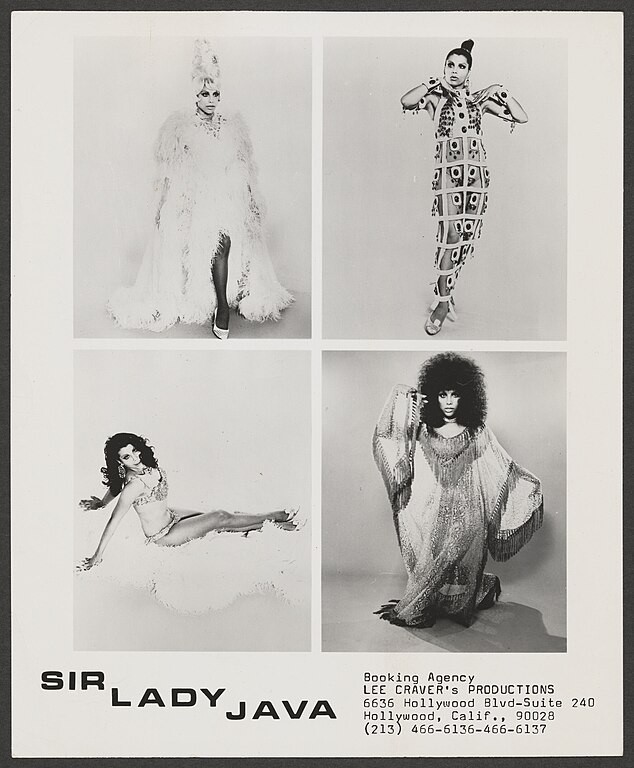
“If you can’t be yourself, who can you be?” Sir Lady Java asked in 2022. By fighting for a place for herself in 1960s Los Angeles, the transgender entertainer and activist also made space on and off the stage for those who followed her.

Sir Lady Java was born in Louisiana, and with her mother at her side transitioned in her youth. She eventually moved to Los Angeles. There, she began working as a cocktail waitress at The Redd Foxx Club, owned by the comedian of the same name. It was there she was spotted by columnist and nightlife entrepreneur Gertrude Gipson, who encouraged her to get onstage. Known as a great beauty and a scintillating performer, Sir Lady Java’s star soon started to rise. She eventually played two shows a night, dancing, singing, doing impressions and striptease. According to the Natural History Museum of Los Angeles County, she became “first transgender woman of color to perform” in the city’s nightclubs, and she did so alongside the likes of Sammy Davis, Jr., Ray Charles, James Brown, Richard Pryor, and more luminaries of the time, including Lena Horne, one of her longest-standing inspirations.
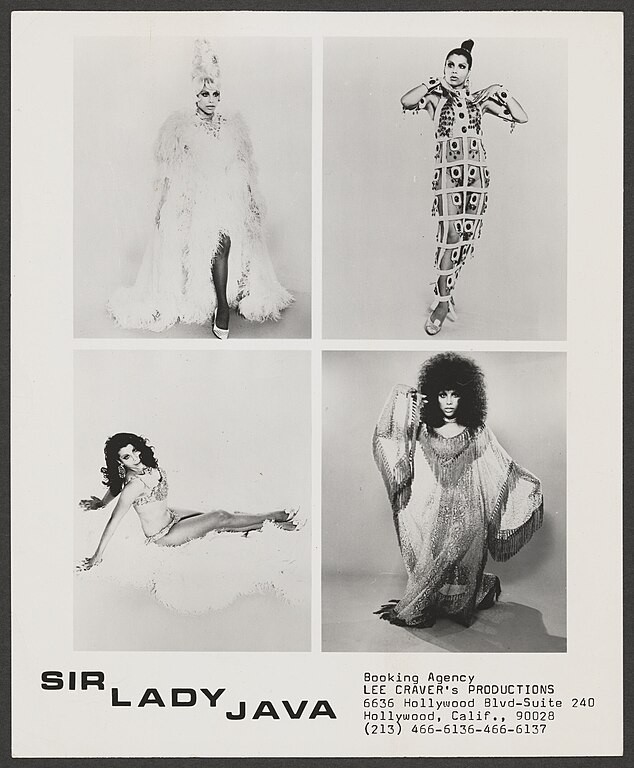
File:SLJ-HL1.jpg – Wikipedia en.wikipedia.org

As Java’s profile rose, however, so too did attention from authorities. Billing herself as a female impersonator, the discriminatory Los Angeles city ordinance Rule 9 would soon be used against her. The rule declared “No entertainment shall be conducted in which any performer impersonates by means of costume or dress a person of the opposite sex” and that any venue with such entertainment would now require a permit. This was not a time when transgender identity was as recognized or understood but Java was clever. The first time the police came knocking–at a club in the middle of a performance, no less–she shook them off. The “three-piece rule,” which had been used in many cities to ensnare gender-bending performers, declared that a person had to wear “at least three articles of clothing that corresponded to the sex they were assigned at birth, or they would be arrested for cross-dressing,” the NHM shared, so Java wore a man’s watch, socks, and a bow tie with her bikini, and the cops had to leave in defeat, she remembered. “I had three attorneys in the building and there was one judge to see me, that’s the kind of crowd that I drew,” she recalled proudly.

However, when The Redd Foxx Club applied for a permit to have Java perform, they were turned down. Being denied her right to work based on discriminatory laws, Java took to the streets to protest and to the courts–she appears in a now-famous photograph with Redd Foxx, who was also under threat of arrest if he hired her. They stand outside his club, she in a chic white dress and matching pumps holding up a sign that said “Java vs. Right to work” with a big smile on her face. Beloved by local press and leaders like the aforementioned Gipson, she was able to draw attention to her cause. Java took her case to the California Supreme Court to sue police with the assistance of the ACLU attorney Jean Martin. However, they lost, as the ACLU wrote, “on a technicality — the court ruled that a club owner had to bring the suit against Rule No. 9 for it to be heard.” But Martin and Java couldn’t find club owners to help. It seemed, at least for the moment, that Java and other performers like her would no longer be allowed in Los Angeles.

But Java didn’t back down and continually rallied her fellow performers and supporters around her to protest the laws. About two years later, in 1969, Rule 9 was nullified when another lawsuit related to cabaret went to court, and Java returned to the stage in her signature gorgeous costumes, feathers and sparkles, visible as she was always meant to be. To be as vocal as she was at a time like this was groundbreaking and she’s remembered as a trailblazer for transgender rights. “It’s got to stop somewhere, and it won’t unless somebody steps forward and takes a stand,” Java said. “I guess that’s me.”Upon her passing in November 2024, Java was remembered in publications across the country, and still now. There is also an archive of her press materials at Harvard, and she appears in the 2022 book Legends of Drag. As actress Hailie Sahar, Java’s chosen daughter, wrote in Out: “Like so many trans girls, I saw myself reflected in her strength, grace, and unapologetic authenticity. For a young trans girl navigating a world that often felt cold and unwelcoming, Sir Lady Java was an icon, a beacon of hope, and living proof that staying true to yourself was a powerful act of defiance.” Sahar will play Java in an upcoming film.


  • A 6-year-old girl thought skateboarding was just for boys. One stranger at the skate park spent an hour proving her wrong.
    A young skater performs a trickPhoto credit: Canva

    According to data tracked by the Duke of Edinburgh’s Award program, the number of young women and girls who identify skateboarding as their chosen activity rose 800% between 2017 and 2022. At the international competition level, according to a peer-reviewed study published in early 2025, the number of female competitors has quadrupled since 2016. Right now, the best skaters on the competitive circuit are teenage girls, some as young as 15.

    None of that was true yet when Jeanean Thomas (@JeaneanThomas) took her 6-year-old daughter Peyton to a skate park in Cambridge, Ontario, in October of 2015. But the moment that happened that afternoon has been quietly circulating the internet ever since, and it keeps finding new audiences because the thing it’s really about hasn’t changed at all.

    Thomas, a firefighter, had spent months convincing Peyton that skateboarding wasn’t just for boys. “She’d only ever seen boys skateboard so she just assumed that it was a boy sport,” Thomas told Today. When they finally arrived at the park, her resolve nearly broke. It was full of teenage boys, smoking and swearing. Peyton wanted to turn around immediately.

    Thomas did too, if she’s being honest. “I secretly wanted to go too,” she later wrote, “because I didn’t want to have to put on my mom voice and exchange words with you. I also didn’t want my daughter to feel like she had to be scared of anyone, or that she wasn’t entitled to that skate park just as much as you were.”

    So they stayed. Peyton slipped onto the board and started falling. And then one of the boys skated over.

    “I heard you say, ‘Your feet are all wrong. Can I help you?’” Thomas wrote in a letter she posted to X that night, addressed to the teenager she never got to thank in person. “You proceeded to spend almost an hour with my daughter showing her how to balance and steer and she listened to you. I even heard you tell her to stay away from the rails so that she wouldn’t get hurt.”

    skate park kindness viral story, girls skateboarding, Jeanean Thomas skate park letter, Ryan Carney Cambridge Ontario, teenage boy helps girl skate, female skateboarders rising, skateboarding gender stereotypes, heartwarming parenting story, kids and kindness, breaking gender stereotypes skateboarding
    A young woman on roller skates flies off the ramp. Photo Credit: Canva

    His friends made fun of him for it. He kept going anyway.

    “I want you to know that I am proud that you are part of my community and I want to thank you for being kind to my daughter,” Thomas wrote. “She left with a sense of pride and with the confidence that she can do anything, because of you.”

    The letter went viral almost immediately. It later emerged, through reporting by the Cambridge Times, that the young man wasn’t a teenager at all. His name was Ryan Carney, a 20-year-old skate coach who worked at an indoor park in nearby Kitchener. He was baffled by the attention. “If I didn’t know what the heck I was doing, and I was in a place that could be intimidating at that age, I’d want someone to help me,” he told CBC News. “That’s all I did.”

    When they left the park, Peyton had gone from slipping off the board entirely to riding up and down ramps. She asked to go back every day after that.

    The culture Peyton stepped into that afternoon was one that had actively excluded girls for decades. What Carney did, without thinking much of it, was exactly the kind of thing that changes a kid’s relationship to a sport before she’s old enough to know she was supposed to be excluded from it. The 800% participation increase didn’t come from nowhere. It came from moments like this one, scaled up, repeated, normalized.

    “I just seen a little girl struggling to enjoy her time there,” Carney said. “I wanted to see her leaving wanting to skateboard again.”

    She did.

    This article originally appeared last year. 

  • These seven simple phrases could be the secret to deepening trust and romance in your relationship
    A happy couple enjoys coffee togetherPhoto credit: Canva
    , , ,

    These seven simple phrases could be the secret to deepening trust and romance in your relationship

    If you want a more secure relationship a Harvard expert recommends using these seven phrases.

    Maintaining a deep sense of connection and trust in a long term relationship is often easier said than done. Even for couples who have been together for years, the daily grind can sometimes dull the spark of romance. However, Dr. Cortney Warren, a psychologist trained at Harvard Medical School, has identified a specific set of verbal habits that distinguish highly successful, trusting couples from those who struggle.

    Dr. Warren recently shared seven phrases that secure partners use every day to reinforce their commitment. These small shifts in language are designed to foster vulnerability, safety, and a sense of shared purpose.

    The first few phrases focus on the core of any partnership: the belief that your partner is on your side.

    @drcortneywarren

    Feeling that twinge of jealousy or insecurity in your relationship? It happens to all of us, but how you respond can make all the difference. Instead of immediately reacting, try this: pause and ask yourself: What does my reaction to this situation say about me? Is it about fear of being unloved? A belief that you’re “not enough”? Often, our strongest emotional reactions are more about our own insecurities than about our partner’s actions. Taking the time to reflect on your triggers, where they come from, and how you can strengthen your self-esteem can help you communicate with your partner in a healthier, more productive way. This clip is from my recent conversation with Shanenn Bryant on the Top Self Podcast. #SelfAwareness #EmotionalIntelligence #HealthyRelationships #JealousyTriggers #TopSelfPodcast #RelationshipAdvice

    ♬ original sound – DrCortneyWarren – DrCortneyWarren

    1. “I trust you.”

    Simple, to the point, and clear. This communicates that you know your partner and that you believe they have your best interest in heart, even if you get into an argument. It also allows them to feel safe making some decisions on both of your behalf.

    2. “You see me as I am.”

    This not only tells your partner that they know all there is to know about you without fear of hiding parts of yourself, but that you’re comfortable being vulnerable should a difficult subject come up. It communicates that you trust your partner will respond with compassion, not judgment, while implying that they can trust you to do the same in return.

    Dr. Cortney Warren, relationship advice, Harvard psychologist, building trust, healthy communication, romance tips, non-verbal cues, marriage success, intimacy, partnership
    A couple on a romantic date. Credit: Canva

    3. “We’ll get through this.”

    Arguments, fights, and conflicts happen in even the most solid relationships. However, saying this phrase reinforces that while things still need to be sorted out, there is no intention of breaking the relationship over the disagreement. It allows more open communication and reiterates that it is you and your partner against the problem, not each other.

    4. “Go have fun with your friends/Thanks for giving me space!”

    If your relationship is solid, time apart shouldn’t be a threat. Alone time is natural and, frankly, healthy. Respecting your partner’s independence in turn respects yours.

    Dr. Cortney Warren, relationship advice, Harvard psychologist, building trust, healthy communication, romance tips, non-verbal cues, marriage success, intimacy, partnership. Credit: Youtube

    5. “I miss you.”

    As a counterbalance to the previous phrase, “I miss you” isn’t an indicator of being too clingy unless you’re not offering your partner the trust to have space. It’s just a nice way of saying that you look forward to being together and builds upon that when you reunite, whether it’s after a long business trip or later in the evening after work.

    6. “Let’s make a plan!”

    A growing relationship means mutually planning and investing in each other’s futures to further turn “your plans” and “my plans” into “our plans.” This phrase relays to your partner that you want them around for the long haul.

    7. “Can we talk?”

    Communication issues are one of the primary reasons relationships fail. Asking this simple and direct question accompanied with the previous phrases as foundations in your relationship will allow trust for you to ask and be asked when something troubling occurs with either of you.

    While verbal communication is important in sustaining relationships, it’s good to incorporate non-verbal gestures of support, love, and trust, too.

    Now, pairing these loving wordless gestures that expertscounselors, and psychologists recommend with the previous seven phrases could help your relationship develop deeper connection and trust.

    1. Eye contact

    Seeing eye-to-eye literally helps you both see eye-to-eye better when discussing a difficult topic or when you want to express loving attention to your partner.

    2. Smile

    Smiling is a nonverbal cue to reiterate that your partner’s presence is welcomed and safe. It also reminds your partner that you’re both okay, too.

    3. Supportive touch

    Caressing a shoulder, a peck on the forehead, holding hands, or a tight hug—any of these and all of these are ways to provide comfort and reassurance along with your words. It could also be a way to indicate your interest in further intimacy.

    4. Mirroring

    Matching your partner’s posture and pose helps foster connection while also indicating you’re absorbing what they’re verbally communicating to you. So, when you adjust your posture to meet theirs when they’re discussing something important to them, they’ll know you think it’s important, too. On the other end, if you match their relaxed pose, they’ll in turn feel more relaxed, too.

    5. Enjoy quiet time together

    Being able to enjoy the silence in the same room bolsters feelings of safety and comfort. It shows that you and your partner don’t feel panicked or stressed about the other feeling bored, awkward, and you don’t cary the pressure of needing to be entertained/entertaining. Shared silence is precious in a relationship.

    6. Handwritten notes

    Okay, this might be a cheat technically, but written notes and letters can be left for your partner to find when they wake up after you have left for work early, on the kitchen table, or on a bathroom mirror as ways to express those previous seven phrases. For some people, written communication is much easier for them than speaking, too, so there’s that factor to consider.

    7. Acts of service

    This is a bit of a grab bag as what acts of service are depends on who you are in the relationship with. It could be making them coffee each morning the way they like it so they don’t have to. It could be doing a chore they hate doing. It could be cooking them their favorite food after finding out that they had a long day. These acts remind your partner that they’re known and safe with you.

    This article originally appeared last year.

  • Experts reveal the sweet spot for how often healthy couples fight and it’s more than you think
    A happy couple playing with their dogPhoto credit: Canva

    Experts reveal the sweet spot for how often healthy couples fight and it’s more than you think

    Relationship experts answer the age-old question of whether happy couples actually fight.

    Many people believe that a total lack of conflict is the hallmark of a perfect relationship. However, relationship experts are now suggesting that the “sweet spot” for a healthy marriage involves much more frequent disagreements than most couples realize. While the average pair might only have two or three significant arguments per month, new research is sparking a conversation about why upping that frequency could actually save your relationship.

    According to a report by The Healthy Marriage, most couples are likely not arguing enough. Experts believe that engaging in about two arguments every week can provide a massive boost to a relationship’s long-term health. The key, however, lies in how those arguments are defined and conducted.

    The Basics

    relationship advice, healthy marriage, conflict resolution, communication skills, marriage therapy, arguing in relationships, emotional intimacy, Gottman method, happy couples, mental health
    A couple engages in a serious conversation Canva

    What is an argument? The Merriam-Webster Dictionary defines an argument as, “a coherent series of reasons, statements, or facts intended to support or establish a point of view.” Notice it doesn’t say, hysterical people trying to intimidate and abuse one another with the intention of causing emotional harm.

    Robert Menuet, LCSW a relationship therapist in Louisianna, states there is a healthy and unhealthy way to have an argument. Unhealthy arguing involves: constant negativity, personal attacks, threats, name-calling, and stonewalling (which is one person refusing to participate in the conversation.) Healthy arguments involve: a focus on specific issues, active listening, compromise, apologies, an attempt for resolution, and willingness to understand your partners point of view.

    You should be arguing more

    Seeking confrontation for the sake of it is not the right idea. However, in an article by IDEAS.TED.COM they explain couples that believe arguments need to be avoided were surprisingly more aggressive, and the women were more depressed. Avoided confrontation means less communication, less happy, and less dedication to the relationship as time moves forward.

    Embracing frequent low-stakes disagreements means fewer big confrontations. Conflict presents opportunities to improve upon the relationship. Secure Intimacy found that healthy arguments: reveal unmet needs, unclear boundaries, and hidden emotional wounds. Healthy fights deepen connection and improve intimacy. They help validate mutual respect and confirm values.

    @samcity_

    Reply to @faesalmurad Not saying you should never fight, but they’re definitely not needed for a healthy relationship. #rareaesthetic #couplegoals

    ♬ original sound – samcity

    Why some couples are afraid to argue?

    There are a lot of people out there avoiding confrontation and disagreements with their partners. Uncover, a health counseling service based in New York City, broke down some common causes for conflict avoidance. Here are a few of the important reasons:

    1. Fear of confrontation – general discomfort with emotional escalations and attachment to past traumatic experiences.

    2. Desire to maintain harmony – afraid issues can disrupt the peace and bring negative consequences.

    3. Emotional discomfort – arguing can bring emotions like anger and sadness which they can try to shield themselves from experiencing.

    4. Power imbalance – the person with less power may avoid conflict out of fear of retaliation.

    5. Perceived threat to the relationship – belief issues jeopardize the stability of the relationship.

    The big takeaway

    Couples benefit from communication. Listening to your partner and seeing the best in them instead of the worst can help evolve and tighten a relationship. Repairing things that need addressing while still sharing empathy for one another can be uncomfortable. But, it is necessary to resolve issues that can bring resentment and eventual failure to a relationship. Arguing about small yet important details a couple times a week will strengthen the foundation of a relationship and make for long term success.

    This article originally appeared last year.

Explore More Uncategorized Stories

Ideas

A 6-year-old girl thought skateboarding was just for boys. One stranger at the skate park spent an hour proving her wrong.

Well-being

These seven simple phrases could be the secret to deepening trust and romance in your relationship

Uncategorized

Experts reveal the sweet spot for how often healthy couples fight and it’s more than you think

Uncategorized

A father-daughter dance inside a Louisiana prison provided rare moment to reunite