
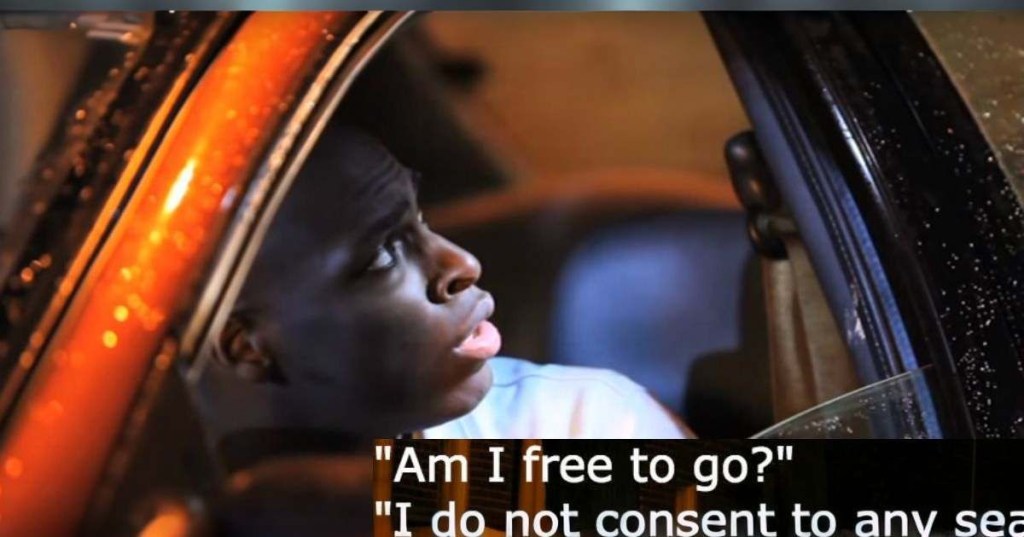
Whether it’s a traffic stop that turns into “We smell something in your car” or a “driving while black” situation, you have rights when you’re pulled over, and it’s for the best if you actually use them.

So how does this work, anyway? Well, you have rights when you’re pulled over. These have been established via case law, and ultimately, some stem from the Constitution itself. In order, here are the magic phrases, along with some graphics to help you remember.1. “Am I free to go?”

In any situation involving the police, you can ask this question. Some people ask it slightly differently: “Am I being detained?”—which is a version of the same question. Basically, if they’ve got nothing on you, they have to let you go. If they answer no to that question, you are in fact not free to go. In that case, you are suspected of doing something, and it’s their job to try to get you to admit to it or to say a bit too much and incriminate yourself.

2. “I do not consent to any searches.”

One of the trickiest things that some law enforcement folks try is to talk you into letting them search your vehicle—or house, for that matter. “So if you haven’t done anything, then you’re ok with us searching your car … right? I mean, if you’re innocent. We’ll go easier on you if you let us.” Do NOT give up your rights that easily. Are you certain your buddy didn’t leave a bag of weed in the glove box? Are you sure your boyfriend took his target pistol out of the trunk after he went to practice shooting the other day? Are you absolutely certain that the body in your trunk was removed and buried in that farm fiel … whoops. Did I say that last one out loud?! The point is, don’t give up your rights easily. And believe me, cops are gooooood at trying to play psychological games. Which leads to #3.

3. “I want to remain silent.”

You have that right, and if things start getting thick, you need to use it. “We clocked you going 60 in a 50, but when you opened your window to give us your license, we smelled marijuana.” The correct answer to something like this is, “I want to remain silent.” The temptation is to say, “Yeah, my buddy and I smoked in my car this morning but I wasn’t driving, blah blah blah”—but then you’re already nailed. Time for them to get the dogs and search. Congratulations, you’re on your way to the pokey for the night.

4. “I want a lawyer.”

If you’ve reach this particular point, then you’re in deep doodoo anyway, so go ahead and ask for one, and say nothing until he or she arrives. Remember these four things. It will be hard in the moment, with your adrenaline pumping, your freedom in question, and when you’re possibly in physical danger, depending on the cops involved and your skin color.

“Am I free to go?”

“I do not consent to any searches.”

“I want to remain silent.”

“I want a lawyer.”

Perhaps a word involving the first letter of the four statements will help you remember: FoSSiL (Free, Searches, Silent, Lawyer)

Or maybe a mnemonic:

— Fiscal Suns Scramble Lives

— Fresh Sushi Smell Lemons

— Flexible Straws Sell Lobsters

— Free Subjects Steam Lobsters

And here’s a graphic to help you remember.
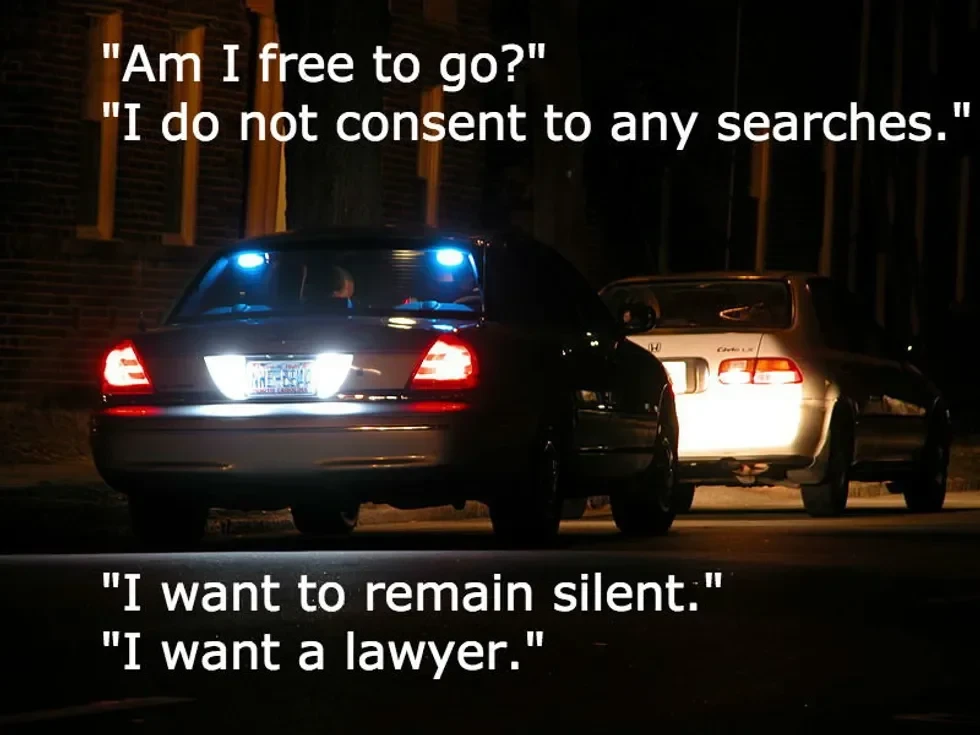
Know your rights.
Image by Ildar Sajdejev via GNU Free License | Know your rights.

The clip below is a shortened version of a much longer one that explains your rights, detailing what you can and cannot do in these situations. Note that the order of the above is a bit different than in the clip, but the principles are the same. Also, the idea for this article was inspired by this article on Alternet.


This article originally appeared five years ago.

https://youtube.com/watch?v=sVx0NpYbtus%3Frel%3D0

Good luck out there!

This article originally appeared on 09.12.17

More on Good.is

A Police Officer Makes Profound Statement After Pulling Over A Black Teen

Whistleblower cop says teen was murdered by police as part of department ‘gang’ initiation

5 ways everyday citizens can start holding police departments accountable
  • A man asked how to be less scary to women and the Internet prescribed quality, empathetic tips
    How can we make women feel safer while jogging?Photo credit: Canva
    ,

    A man asked how to be less scary to women and the Internet prescribed quality, empathetic tips

    A man went on his usual jog down a trail he used daily, but this time it was a little different. Dressed in matching sweatpants and a hoodie, he saw a woman coming from the opposite direction. The man noticed that the woman changed pace from walking to running. He then looked behind him and…

    A man went on his usual jog down a trail he used daily, but this time it was a little different. Dressed in matching sweatpants and a hoodie, he saw a woman coming from the opposite direction. The man noticed that the woman changed pace from walking to running. He then looked behind him and saw her giving him a concerned look when their eyes met. Later, the man went on Reddit to discuss the situation, writing, “I can’t help but feel like she was running from me.”

    While he was just doing his routine exercise, the man couldn’t help but feel “bad and in a way gross.” Wanting to make sure he didn’t make women feel unsafe, he then asked folks online what he could have done better.

    @tomtrottercoaching

    No one should feel scared doing this 😞 This made raised awareness for me and I’ll run differently now ❤️ #fyp #viral #running

    ♬ Boundless Worship – Josué Novais Piano Worship

    Men empathized and offered advice

    The comments were filled with men who empathized and offered advice:

    “I had a teacher put cat bells on his runners so people would stop calling the police on him for running in his own neighborhood. Can’t sneak up on anyone or surprise them.”

    “I’m 7’2”. I have an oddly quiet and frankly creepy voice, I have many tattoos and I walk like im a killer in a slasher movie due to knee issues. I couldn’t be more scary if I tried. I was once walking to my truck after working at an office park with a shared parking lot. It was just going dark and I think I gave a woman a heart attack. I thought about a propeller hat but that just feels somehow more sinister.”

    “Neon running clothes can help you be seen and have the benefit of looking goofy.”

    “Man, the sneak up thing is a real headscratcher. People just do not pay attention and there’s only so much you can do. I was running with a bright (I mean BRIGHT) headlamp one evening and still managed to scare the piss out of a lady. She actually screamed.”

    “I believe a closed mouth smile can go a long way. It says “I’m friendly but not trying to be friendly with you.”

    Women offered context, tips, and explanations

    There were also comments from women offering tips and explaining their feelings about such situations:

    “I’d suggest you keep the interaction to a minimum — just a “morning” is enough, or even pretending not to notice. And, unless you feel like you are in danger (say, you hear footsteps approaching you from behind), no need to look back. Speaking from a woman’s perspective: it’s not personal. You’re a stranger, and some of us will be wary regardless, especially alone.”

    “I feel safest when I think I’m going unnoticed. Pretending like you dont see her is best bet but if you do make eye contact, a short hello would be fine. Thanks for caring, OP.”

    “When I am approaching someone from behind I say ‘beep beep.’ But I’m also female and dress like a dude when I go out for walks so I don’t get harassed. I go for walks at night with dark colored pants, hoodie on over my head, stun gun flashlight in my hand. It’s funny how we have to behave differently for the opposite gender. It’s like instinctual for me. I never really thought about it. But yeah if I saw a man in some neon colors or doing little dance-run moves I’d feel safer than if I saw me coming.”

    “Personally, I’ve had a few men over the years call out from a decent distance ‘coming up behind you!’ when they were running, and I’ve appreciated their thoughtfulness and I always thank them. I even had a guy at a craft store looking at the same display as me several years ago say ‘reaching behind you’ when he needed something in front of me, and I found that extra sweet and thoughtful, too.”

    “Not taking it personally is the only thing to do. When we do things for our safety it’s not about you. We’d rather be safe than risk being hurt to avoid hurting your feelings. The only way to stop that is to stop men from being threats to women and that’s just not possible. Or at least, it’s never happened. The best way to make a woman feel safe when you’re out running at night is to go about your business and pay no attention to her.”

    “As a woman, my advice would be to try and not take things personally. The way we react has little to do with you, and more to do with previous situations me and many others have found ourselves in. One creepy dude is all it takes for us to become extra cautious forever, and react in ways which might make you feel like there’s something about you that causes it. There isn’t. And honestly, other than minding your business there’s not much else you can do, unfortunately.”

    There are many thoughts on how to make women feel safer when jogging, including how women prepare and how men should behave. Regardless of what specific advice one follows, staying mindful can help everyone involved stay and feel safe.

  • A 6-year-old girl thought skateboarding was just for boys. One stranger at the skate park spent an hour proving her wrong.
    A young skater performs a trickPhoto credit: Canva

    According to data tracked by the Duke of Edinburgh’s Award program, the number of young women and girls who identify skateboarding as their chosen activity rose 800% between 2017 and 2022. At the international competition level, according to a peer-reviewed study published in early 2025, the number of female competitors has quadrupled since 2016. Right now, the best skaters on the competitive circuit are teenage girls, some as young as 15.

    None of that was true yet when Jeanean Thomas (@JeaneanThomas) took her 6-year-old daughter Peyton to a skate park in Cambridge, Ontario, in October of 2015. But the moment that happened that afternoon has been quietly circulating the internet ever since, and it keeps finding new audiences because the thing it’s really about hasn’t changed at all.

    Thomas, a firefighter, had spent months convincing Peyton that skateboarding wasn’t just for boys. “She’d only ever seen boys skateboard so she just assumed that it was a boy sport,” Thomas told Today. When they finally arrived at the park, her resolve nearly broke. It was full of teenage boys, smoking and swearing. Peyton wanted to turn around immediately.

    Thomas did too, if she’s being honest. “I secretly wanted to go too,” she later wrote, “because I didn’t want to have to put on my mom voice and exchange words with you. I also didn’t want my daughter to feel like she had to be scared of anyone, or that she wasn’t entitled to that skate park just as much as you were.”

    So they stayed. Peyton slipped onto the board and started falling. And then one of the boys skated over.

    “I heard you say, ‘Your feet are all wrong. Can I help you?’” Thomas wrote in a letter she posted to X that night, addressed to the teenager she never got to thank in person. “You proceeded to spend almost an hour with my daughter showing her how to balance and steer and she listened to you. I even heard you tell her to stay away from the rails so that she wouldn’t get hurt.”

    skate park kindness viral story, girls skateboarding, Jeanean Thomas skate park letter, Ryan Carney Cambridge Ontario, teenage boy helps girl skate, female skateboarders rising, skateboarding gender stereotypes, heartwarming parenting story, kids and kindness, breaking gender stereotypes skateboarding
    A young woman on roller skates flies off the ramp. Photo Credit: Canva

    His friends made fun of him for it. He kept going anyway.

    “I want you to know that I am proud that you are part of my community and I want to thank you for being kind to my daughter,” Thomas wrote. “She left with a sense of pride and with the confidence that she can do anything, because of you.”

    The letter went viral almost immediately. It later emerged, through reporting by the Cambridge Times, that the young man wasn’t a teenager at all. His name was Ryan Carney, a 20-year-old skate coach who worked at an indoor park in nearby Kitchener. He was baffled by the attention. “If I didn’t know what the heck I was doing, and I was in a place that could be intimidating at that age, I’d want someone to help me,” he told CBC News. “That’s all I did.”

    When they left the park, Peyton had gone from slipping off the board entirely to riding up and down ramps. She asked to go back every day after that.

    The culture Peyton stepped into that afternoon was one that had actively excluded girls for decades. What Carney did, without thinking much of it, was exactly the kind of thing that changes a kid’s relationship to a sport before she’s old enough to know she was supposed to be excluded from it. The 800% participation increase didn’t come from nowhere. It came from moments like this one, scaled up, repeated, normalized.

    “I just seen a little girl struggling to enjoy her time there,” Carney said. “I wanted to see her leaving wanting to skateboard again.”

    She did.

    This article originally appeared last year. 

  • Neuroscientist reveals the 3 dead giveaways someone is pretending to be smarter than they really are
    Are they full of it or not?Photo credit: Canva

    Neuroscientist reveals the 3 dead giveaways someone is pretending to be smarter than they really are

    And one way to have a great intellectual conversation that doesn’t turn into a fight.

    Getting information through quality conversation can be enjoyable or a struggle. Figuring out solutions and fielding valuable expert opinions can be difficult to discern when the person you’re talking to (or debating with) seems suspect. Fortunately, a neuroscientist online has laid out what to look out for to see if your conversation partner is actually intellectual or just talking out of their…well, you know.

    Neuroscientist turned musician/comedian Alex Riordan discussed how to spot pseudo-intellectuals and how they differentiate themselves from actual intellectuals. For Riordan, who spends ample time with his colleagues at Princeton University as well as his degree-less intellectual friends (because you don’t need to go to college to be intelligent), he’s identified three signs that helped him separate the fake-it-til-you-make-its from actually thoughtful individuals.

    https://www.tiktok.com/@alex_riordan_/video/7163445028688301354

    Pseudo-intellectuals will talk past you

    Riordan mentions that pseudo-intellectuals will often go out of their way to use colorful rhetoric and terms to try to talk past you and get you to talk past them. To expand on Riordan’s point, the purpose is a means to bait you into an argument by cutting you off before fully explaining your point or trying to move the conversation past your points to focus in on their own point. They may use tactics such as whataboutism, a tactic that asks, “But what about ______?” to shift the focus of the conversation from one issue to another in order to distract or deflect from initial point.

    They aim to ‘win,’ not aim to understand

    The folks that aim to appear smarter than they truly are don’t have any interest in coming to an understanding with their conversation. They want to win. This is common in what Riordan calls “debate bro tactics.”. Being right isn’t as important as appearing right, regardless of any logical holes or pushback that they cannot rationally defend.

    The Dunning-Kruger effect

    Riordan briefly mentions the Dunning-Kruger effect as a way to spot if someone is talking nonsense. The Dunning-Kruger effect is a cognitive bias in which people overestimate their knowledge and/or abilities in a specific area. When they encounter a new subject, they immediately think they have a complete grasp of it and lack the self awareness to see their own limitations. Once they read an article by an actual expert that conflicts with their understanding, they reject it and assume they’re right despite their lack of education, skills, or actual knowledge.

    @aliabdaal

    Why smart people think they’re not smart ? The Dunning-Kruger effect is real. The more you know, the more you realise how much you don’t know – and it can make you feel like you’re falling behind, even when you’re not. Meanwhile, those with less knowledge often feel more confident because they’re unaware of what they’re missing. Classic case of small fish, big pond vs big fish, tiny puddle ? Ever felt this way? Let me know in the comments ?

    ♬ original sound – Ali Abdaal – Ali Abdaal

    If a person in a conversation demonstrates those behaviors, you may want to politely shut it down. However, even if with a person who knows what they’re talking about, conversations can get heated and people can devolve into these pseudo-intellectual behaviors. Fortunately, Riordan shared one great way he and his colleagues keep the conversation focused on understanding and respect.

    Ask clarifying questions

    Asking clarifying questions is a habit Riordan and his colleagues and friends practice to curb any pseudo-intellectualism and arguments that might arise from it. They do so because asking for clarification goes against all of the previously mentioned tactics of fake know-it-alls. It doesn’t claim to know everything, it’s aimed for understanding rather than “winning,” and acknowledges that you may not know everything about the subject at hand.

    Asking clarifying questions, especially the right ones, shows your conversation partner that you’re curious about them and their thoughts, which encourages them to feel more connected with you. If you disagree with a person’s point and respond with a clarifying question it allows you to see where they’re coming from, find common ground, or learn something you hadn’t considered before. In some cases, answering clarifying questions helps your conversation partner to notice errors or discrepancies in their own thinking that may change their conclusions to line up with yours.

    Some examples of clarifying questions include:

    – What did you mean about ____?

    – Could you further elaborate on that?

    – I heard you say ____, am I interpreting that correctly?

    – Are there specifics about ____?

    – Can you break that down into detail for me?

    Whether you’re conversing about politics, the universe, or what the best pizza topping is, leading with curiosity can ensure that everyone is not only enjoying the conversation, but are learning legitimate truths as well.

Explore More Justice Stories

Justice

Martin Luther King Jr. was ahead of his time in pushing for universal basic income

Justice

HOA demanded she remove her garden. Her response shows how to fight back the right way.

Justice

A freed slave’s response to his former master is still shaking readers today

Justice

Facing discrimination and harassment, a female cop sued her department and won $10 million