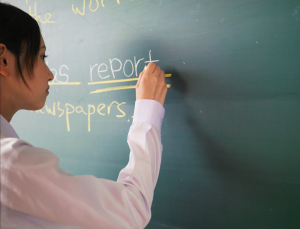
Today’s the day to thank the people who assigned the evens for math homework, made you memorize obscure verb conjugations, and (hopefully) inspired learning.
Sunday is the 20th anniversary of World Teachers’ Day, which UNESCO started in order to recognize the 1966 adoption of the ILO/UNESCO Recommendation Concerning the Status of Teachers. Underscoring that high-quality education requires high-quality educators, the document outlined standards in preparation, working conditions, and overall responsibilities of teachers.
You won’t find the word “standardized testing” in the recommendation—which covers instruction from nursery to secondary school. However, it does call tenure “essential in the interests of education,” a statement that could ignite an instant debate.
Policy arguments aside, teaching is far from an easy profession. That’s where World Teachers’ Day comes in. Show some overdue appreciation for those who didn’t just give you a warning for going up the slide (sorry kindergarten teacher Ms. O’Rourke!) but also offered enlightenment about the world and how it works.
“Strangely one of the most central, vital professionals to society does not receive the respect it deserves in some parts of the world,” UNESCO states.
While not all teachers will earn the Mr. Holland’s Opus treatment, it’s hard to argue that they don’t deserve a nice card (the better to show off those cursive handwriting skills!) or other expressions of gratitude today. If UNESCO doesn’t convince you teachers have it rougher than most, here’s five statistics showing how far away we still are from those 1966 expectations.
-
We desperately need them. Millions of them.
According to UNESCO, nearly four million teachers will be needed worldwide by 2015 just to ensure that every child completes primary school. Broken down, that is 1.4 million new roles (as well as about 2.6 million more replacements) to achieve universal primary education.
A mere 81,000 are needed in central Asia, compared to a whopping 1.4 million in the sub-Saharan Africa region. As the 1966 recommendation suggests, changing the status of teachers is one way for “overcoming any existing shortage of competent and experienced teachers.”
-
Fewer teachers means more crowded classrooms.
Class size is an issue mentioned in 1966 that persists in many countries today. “Class size should be such as to permit the teacher to give the pupils individual attention,” according to the ILO/UNESCO resolution.
Data from 2012 show that 21 students were in the average public primary school class, among OECD—or primarily industrialized—countries; 24 were in the average public lower secondary school class.
In the United States, which averaged 22 and 28 respectively, teachers in many states contend with classrooms filled with 30 students or more. However, those numbers pale in comparison to China, where the typical public primary classes had 38 students and their lower secondary counterparts had 52. So much for individual attention.
-
They do much more than come up with lesson plans.
Lower secondary teachers—in the United States, think middle-school educator—spent less than 80 percent of class time on actual lessons. That’s according to the OECD’s 2013 Teaching and Learning International Survey (TALIS) of nearly three dozen countries. (U.S. responses were not factored into the international average for failing to meet the required response rate.)
How is the rest of that time spent? About 13 percent (or 8 minutes in an hour class) is used on managing behavior. Another 8 percent goes to administrative tasks.
-
Society may not have faith in them.
Yikes. 6.3 out of 10: That’s the average score from “Do you trust teachers to deliver a good education?”—a question the Varkey Gems Foundation asked in its 2013 Global Teacher Status Index.
However, as the organization notes, trust does not necessarily lead to academic success.
Finland, whose classroom successes are well known among comparative-education enthusiasts, had the second highest trust rating, a little more than seven. Thousands of miles away in Brazil, where respondents trusted teachers most, test scores were abysmal.
-
Despite all of this, they still love their jobs.
Yup, that’s right. A resounding 91.2 percent of lower secondary teachers responding to OECD’s 2013 TALIS agreed or strongly agreed with the statement, “All in all, I am satisfied with my job.” Again, that stat doesn’t include the United States. For what it’s worth, 89.1 percent of U.S. survey takers at least agreed with the sentence.
Thank a teacher today for being there, regardless of the external circumstances (e.g., funding, bureaucracy) that they contend with on a daily basis. A little appreciation can go a long way for those who, according to the resolution, do no less than contribute “to the development of man and modern society.”