The first time I watched Spirited Away, the 2001 anime masterpiece from Japanese animation studio Studio Ghibli, I was floored—not only by acclaimed writer/director Hayao Miyazaki’s compelling narrative and fantastical visual sequences, but by a much more pedestrian lure: its conspicuous, and drool-worthy, food. Long after the credits rolled, I remembered—in vivid detail—the impossibly springy cakes, enviably fluffy steamed buns, and fantastic lurid foodscapes.


It wouldn’t be the last time I’d be spellbound by a fictional depiction of food. To this day, I find myself craving the Lord of the Rings’ leaf-wrapped, nourishing lembas bread; the dangerously enchanting spice coffee from sci-fi epic Dune; Steven Universe’s Cookie Cat ice cream sandwiches from Cartoon Network.

I’m not the only one salivating over these details that help bring fantastical, literary worlds to life. Articles upon articles expound upon the greatness of not just Studio Ghibli’s culinary depictions, but also those of Brian Jacques’s Redwall series; Turkish Delight as featured in C.S. Lewis’s The Lion, the Witch and the Wardrobe; and of course, the Harry Potter series’ many now-iconic foodstuffs. But while food in general is a familiar and inescapable presence on the social web, the food of fiction, particularly fantasy fiction—in which recipes are alluded to but never quite fully explained—have begun crystallizing into canonical, “official” recipes.

The Wizarding World of Harry Potter parks sell an “authentic,” trademarked butterbeer; meanwhile, George R. R. Martin wrote the foreword to A Feast of Ice and Fire: The Official Game of Thrones Companion Cookbook, which offers over 100 regional delicacies: mutton in onion-ale broth hailing from the Wall or honey-spiced locusts from across the Narrow Sea, for example. But before standout series like Harry Potter and GoT ruled mainstream entertainment, fandoms had already begun to actualize the most tangible, and edible, details of these fictional universes, forming their own communities centered on fandom and their subsequent food fixations.

“I started watching Top Chef, and they’d have an episode on food based off of movies, and I’d look at what they created and think, ‘Where did you get that? That has nothing to do with the actual source material,’” says Catherine Barson Eastis, aka The Gluttonous Geek, a blog on which she recreates her favorite fantasy meals to exactitude. “Then I’d start seeing [the same lack of attention] in other geeky-type food on the internet.”

Like many other fantasy food bloggers and recipe makers, Eastis had no formal culinary training when she started her blog, but has over the years entered a coven of fantasy, sci-fi, and folklore enthusiasts whose fictional food appreciations have become IRL, well-researched recipe interpretations. Along with other similarly-minded bloggers like Pretty Cake Machine, Feast of Starlight, and Food in Literature, Eastis has transformed her long-time love of fictional foodstuffs into a social hobby. She’s even parlayed it into a fandom cooking mentorship at Battle and Brew, an Atlanta-based restaurant that caters to fandom diners with Lord of the Rings-themed dinners and regular geek trivia nights.

At first, Diana Ault started off solely blogging about books, but soon found herself paying attention to one specific detail.

“As I wrote posts, I would start to include the food in the books, just making a list of the dishes,” she explains. “It gradually started to stand out to me more. But then food started standing out to me in other media—not just books, but TV shows and movies and video games.”

Now, Ault runs the recipe blog Fiction-Food Café and co-hosts the podcast Fiction Kitchen, run in tandem with the blog Witchy Kitchen.

Though these fiction food bloggers find inspiration in everything from Anne of Green Gables to Orange is the New Black, the realms of fantasy and sci-fi not only draw the most attention, but often provide the earliest entry points into fictional food worlds. Both Eastis and Ault cite the Redwall series as formative to their fictional food awareness—“I remember wanting to drink strawberry cordial before I even knew what a cordial was,” says Eastis—and both participated in #RedwallAugust, a Fandom Foodies Facebook group-organized recipe/link swap that brought many enthusiasts together in celebration of the series’ many spectacular eats.

Utilizing the sprawling reach of social media, bloggers from disparate and/or specialized interests (Japanese animation, fairytales) and skills (pastries, bento boxes) can share and expand upon individual bloggers’ recipe libraries, offering comprehensive analyses on and research into both historical and more speculative (e.g. post-apocalyptic) foods.

These kinds of organized fandom celebrations are a relatively new development in the fictional recipe-sharing world. Nowadays, “geeky” pursuits are embraced by mainstream pop culture (e.g. the massive popularity of Comic-Con, the rise of fandom pandering by networks like The CW and HBO), but that wasn’t always the case—just look at the recent depiction of the Dungeons & Dragons-playing teens in Netflix’s Stranger Things. Yet bloggers who’ve been celebrating their oft-marginalized fandoms long before studios and corporations seized upon them largely bear no ill will toward the commercialization of some of their most beloved fictional darlings. “It’s not a negative thing to be called a geek or a nerd or whatever. Fans rule the industry now. It’s incredible, and really cool in many aspects,” says Auld.

“It has to do with the fact that we have an entire generation raised on books like Harry Potter,” Eastis adds. “It’s become socially acceptable to be into fantasy fiction as an adult. Just about everyone grew up with some sort of fairytale, folklore, make believe, some kind of fantasy.”

The rise of fandom purchasing power makes it so that every aspect of fandom culture, from attire to music, is now scrutinized—but this seems to be the case with food, especially. Case in point: Just two months after Star Wars: A Force Awakens came out, the official Star Wars blog released a recipe for Rey’s Jakku portion bread. In the face of such rapid standardization, you might expect the fictional food community to become angry or suffer creatively, but both Eastis and Auld are quick to note that straight-up originality is not necessarily the aim of the fandom food community.

“We can all look at the same food or read the same description or see it in a movie, and we all connect with it, but we all put our own spin on it,” Auld explains.

And while each blogger has their own personal favorite food universe, they aren’t above following mainstream trends—the Fandom Foodies group’s next monthly recipe theme is #Pokénom.


  • 5 ways how stickers psychologically boost the lives of grown adults
    Photo credit: CanvaStickers can be beneficial for adults as well as kids.

    We tend to associate stickers with childhood. As kids, we put them all over our rooms, furniture, books and notebooks, and wherever else our little hands could stick them. Yet, you have probably seen stickers being used and loved by adults as much, if not more, than kids. They can be found on water bottles, laptops, car bumpers, journals, and many other surfaces. You may even know an adult who uses a sticker chart like an elementary school kid does to keep track of their daily tasks. So, what gives?

    Why do adults love stickers? It turns out that there is psychology behind why many adults still love to stick stickers everywhere. Psychology professionals have reached out to GOOD to share some of the reasons why adult brains benefit from having and using stickers.

    Accountability awards

    Much like with children, many adults turn to stickers as an easy way to stay motivated to commit to a task or achieve a goal. While youngsters turn to sticker charts for reading goals or eating vegetables, adults can use them to motivate themselves to hit the gym or keep up with their budget. It may sound like an innocuous award, but that’s all it needs to be.

    “Small simple tokens or rewards like stickers often cause an instant dopamine rush that leaves us feeling a sense of joy or happiness even if it might be small or fleeting,” said psychology professor and licensed therapist Jillian Amodio

    “In my work as a psychologist, I often encourage clients to use sticker charts, simple grids where you put stickers up when you complete a task,” said registered psychologist Rod Mitchell. “I’ve had many clients who tried positive self-talk, only to find it slid off. Stickers worked for them.”

    It may sound immature on the surface, but what worked to establish good behaviors or habits as a kid can sometimes be just as effective for a grown-up.

    “I had one client who was very resistant to the idea, viewing it as childish,” Mitchell added. “He came back the following week and sheepishly told me that the sticker chart had worked like a charm.”

    Progress markers

    “In addition to creating a sense of accomplishment, seeing a sticker placed on a calendar, chart, or planner after achieving a goal can create a visual history of success,” said Dr. Lori Bohn, medical director at Voyager Recovery Center. “This history can motivate an individual to continue to work towards additional goals.”

    So the benefit of sticker charts isn’t just the dopamine rush, but encouragement. A person can look back at the progress they made, and any “failure” they see becomes an anomaly. It’s why many folks have created sticker charts for things as basic as eating healthy foods to more complex struggles like sobriety.

    “The stickers on the chart serve as small badges of who you are and what you did,” said Mitchell. “A client I had who was struggling to make time for his kids now looks back on a chart full of stickers and knows that he’s become the family man he wanted to be.”

    An easy form of expression

    Placing a sticker on a laptop or water bottle you use daily also allows us to express ourselves. That expression can be as insightful as a political message or as simple as “I like SpongeBob.” It can communicate to others what you’re all about without even speaking a word.

    “Stickers appeal to adults because they often offer an opportunity for self expression and trigger a sense of nostalgia,” said Amodio. “They can also serve social purposes when they speak to people who share similar interests, values, or devotion to a cause.”

    The same logic applies to why many people use digital stickers and emojis when texting or posting on social media.

    Psychologically instill civic duty

    So how powerful are stickers? According to extensive research, very. One sticker standout is they get people to the polls. The “I Voted” sticker folks receive after they vote is a great motivator. They allow folks to feel that dopamine hit after voting, while advertising to others to vote. Stickers can be a reward for voters, a reminder to those who plan on submitting their ballot, or provide FOMO (fear of missing out) to those who don’t vote.

    “It tells other individuals what the person did (voted), what the person values (voting), and what type of individual they perceive themselves to be (a voter),” said Dr. Bohn. “Social psychologists have shown that people are heavily influenced by social norms. In many cases, people rely on other people to help them understand if their behavior is acceptable or not.”

    It may feel like mental manipulation to get people to vote (because it is) but it’s important to note that the sticker doesn’t endorse any particular bill or candidate. It just endorses participation.

    Affordable artwork

    “Stickers are also visually appealing which creates a pleasurable response in the brain as well,” said Amodio.

    Stickers are used by adults because they like how they look. They’re an inexpensive and convenient form of artwork to display. They can easily be put in a book, on a wall, or most other surfaces. They don’t take too much space and are cheaper than paintings, sculptures, and other artwork.

    Many independent artists have turned their work into stickers. It’s a way to keep making a living while also making it affordable for people to purchase their art. Sticker art also benefits the brains of the artists and their supporters alike. It’s just like any other art piece you can display. 

    There are many valid and beneficial reasons why grown adults happily use stickers. The act as a boost, a motivator, and a way to express yourself in one. If you’re already a fan, keep on stickin’.

  • Student with severe facial burns from a frat house fire healed through new innovative treatment
    Photo credit: Hamilton Health SciencesExosomes helped heal severe facial burns with less scarring.
    ,

    Student with severe facial burns from a frat house fire healed through new innovative treatment

    Exosomes could change how we treat various maladies and disease.

    A university student who suffered severe facial burns has remarkably healed thanks to what is being called a world-first biological treatment.

    On December 2, 2025, 18-year-old Kaitlyn Jeffrey was caught in a fire at the Pi Kappa Alpha frat house at Western University in Canada. The fire was caused after rubbing alcohol had been thrown onto a lit torch. Kaitlyn was one of the five people rushed to the hospital for injuries. She suffered serious burns after her face and hair had been set ablaze.

    A new treatment

    Usually, treatment for such burns would require a skin graft, but the burn unit at Hamilton Health Services wanted to try something different. While skin grafting is helpful, the end result isn’t always ideal. Skin grafting can be a slow process that ends with scarring and often a patch-like appearance on the patient.

    “My vision for Kaitlin was to avoid skin graft surgery to her face and neck at any cost,” said Dr. Marc Jeschke, medical director of the hospital’s regional burn program and vice-president of research and innovation at HHS. “You can do the best graft on the planet, but you won’t return the skin to normal.”

    With Kaitlyn’s and her family’s permission, Dr. Jeschke sent an urgent application to Health Canada for a new type of treatment. After Health Canada approved, the doctors proceeded to give Kaitlyn an exosome treatment for her facial burns. The results were a rousing success.

    What are exosomes?

    Exosomes, or extracellular vesicles (EcVs), are present in almost all cells, tissues, and body fluids. They’re tiny vesicles released naturally by nearly all types of cells, carrying proteins, lipids, and genetic material. They essentially carry these “packages” of material and send signals from one cell to another to regulate their behavior. They’re not only being tested for medical applications like this one, but are a part of a skin care trend as well. While exosomes had been studied for burn research, they haven’t been tested on humans before.

    One trillion exosomes were collected and injected into Kaitlyn’s injured areas over the course of two treatments. This helped her cells coordinate in rapidly healing and repairing her facial tissue. The treatments also significantly reduced inflammation. 

    Astounding healing and new possibilities

    After she had healed, Katilyn was amazed and grateful at the result.

    “It’s honestly a miracle,” she said. “Being injured in the fire has also had a deep impact on my mental health, and it’s something I’m continuing to deal with. But having such good results, particularly to my face, is helping me move forward.”

    Exosomes are still being researched for other potential medicinal applications. They are being tested to see how well they could modulate immune responses and deliver biomarkers. This could help combat cardiovascular disease, neurological disorders, and cancer among other ailments. Time and research will tell whether exosomes can help those patients like they helped Kaitlyn.

  • How window‑mounted heat pumps can give tenants efficient heating and cooling
    Photo credit: Spencer Platt/Getty ImagesMany U.S. apartments have individual heating and cooling systems that are less efficient than current technology.

    People who rent their homes, or don’t have enough money to make major upgrades to their homes, have for many years been left out of a major shift in heating and cooling technology that can improve efficiency, save money and be better for the global climate: heat pumps.

    Heating and cooling buildings consumes 35% of all the energy used in the United States each year. Many homes and businesses are converting their fossil fuel-powered heating and cooling systems to electric-powered heat pumps, which use electricity not to generate hot or cold air but to move heat into spaces needing warmth and out of spaces needing cooling.

    Until recently, that process has required a significant amount of sizable and expensive equipment to be permanently installed in a building, which needs a professional contractor and can cost as much as US$10,000 just for the installation – in addition to the actual equipment. Often called mini-splits, these systems usually have a condenser outside the building that exchanges heat with the outdoor air and an evaporator inside that exchanges heat with the indoor air.

    A woman stands in a room looking at a boxy piece of equipment in her window.
    The New York City Housing Authority has been installing window-mounted heat pumps in apartments, like this one in Queens. AP Photo

    But now window heat pumps are becoming available in the U.S. Much like a window air conditioner, these self-contained devices can be installed without professional help and plugged into a wall outlet. Unlike window air conditioners, though, they can provide heat as well as cooling. They cost much less than a permanent system – between $3,000 and $4,000 – and can be moved to a new property if the owner relocates.

    There aren’t many options commercially available yet, and those on the market can’t heat or cool very large spaces on their own. And they work less efficiently when heating homes in places with extremely cold outdoor temperatures. A few models are available on the market that are even cheaper, but they don’t have efficiency ratings, don’t work when outdoor temperatures are very cold, and are louder when running.

    I have designed and evaluated a wide range of building energy efficiency technologies; here’s how these window heat pumps work, and why they may allow apartment dwellers and residents of older houses to easily and relatively inexpensively make significant improvements to their homes’ heating and cooling systems. Federal subsidies for this type of equipment expired in 2025, but some utility companies, states and local governments may still offer money to help pay the costs.

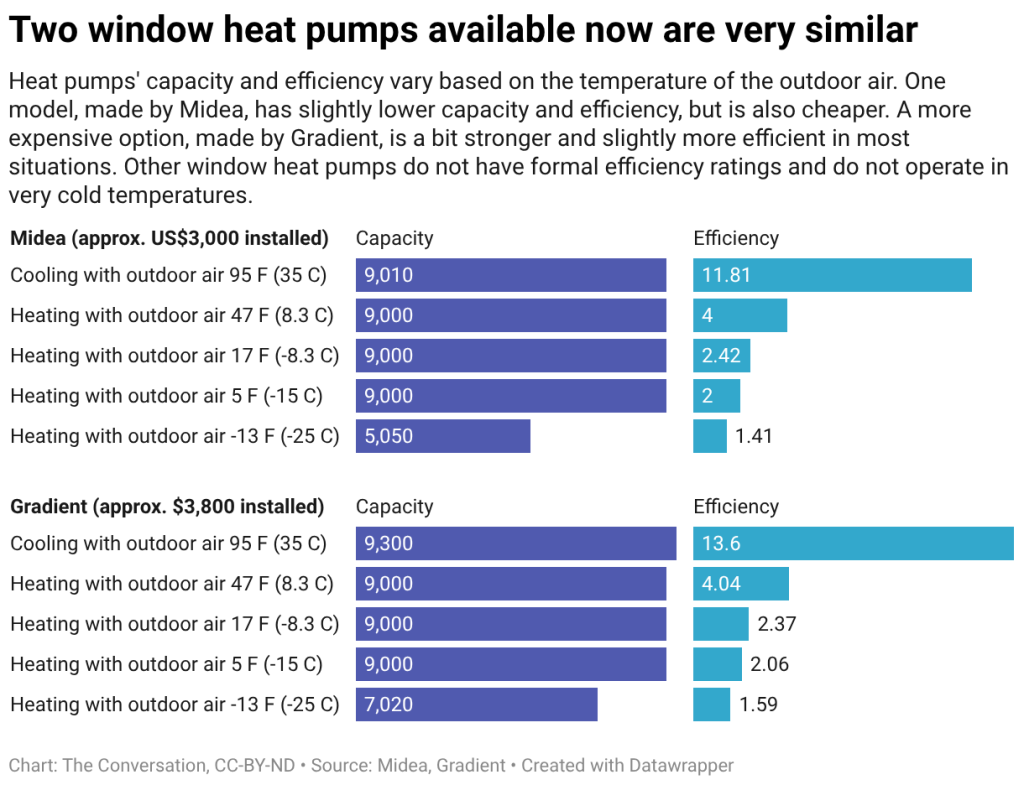
    Two window heat pumps available now are very similar

    Moving heat from one place to another

    Heat pumps use a reversible refrigeration cycle and can provide similar heating and cooling as electric-powered space heaters, furnaces and baseboard heaters, while using less than half the electricity.

    The most common heat pumps transfer heat between air indoors and outdoors, but other systems can exchange heat with the ground or with bodies of water, such as lakes.

    Heat pumps’ capacities are defined by the amount of heat they can transfer in a particular period of time. A heat pump serving an entire home may need a capacity of 12,000 to 60,000 British thermal units (about 12,660 to 63,300 kilojoules) – but the window units’ capacities are much lower, getting up to only about 9,000 Btu (9,500 kJ).

    Performance varies based on the conditions outdoors, where the unit is either sending excess heat to cool the indoors or gathering heat to warm the indoors. In cooling mode, heat pumps are rated by their seasonal energy efficiency ratio, a figure that indicates how much cooling is achieved per unit of electricity used. The corresponding measurement for heating is called heating seasonal performance factor. In general, the larger these numbers are, the better they will perform. The U.S. Department of Energy has established minimum standards for those figures.

    While these units operate even when outdoor temperatures are -13 degrees Fahrenheit (-25 degrees Celsius), their heating output is reduced to almost half of its rated capacity, and their energy efficiency falls to one-third of its rated performance at that temperature.

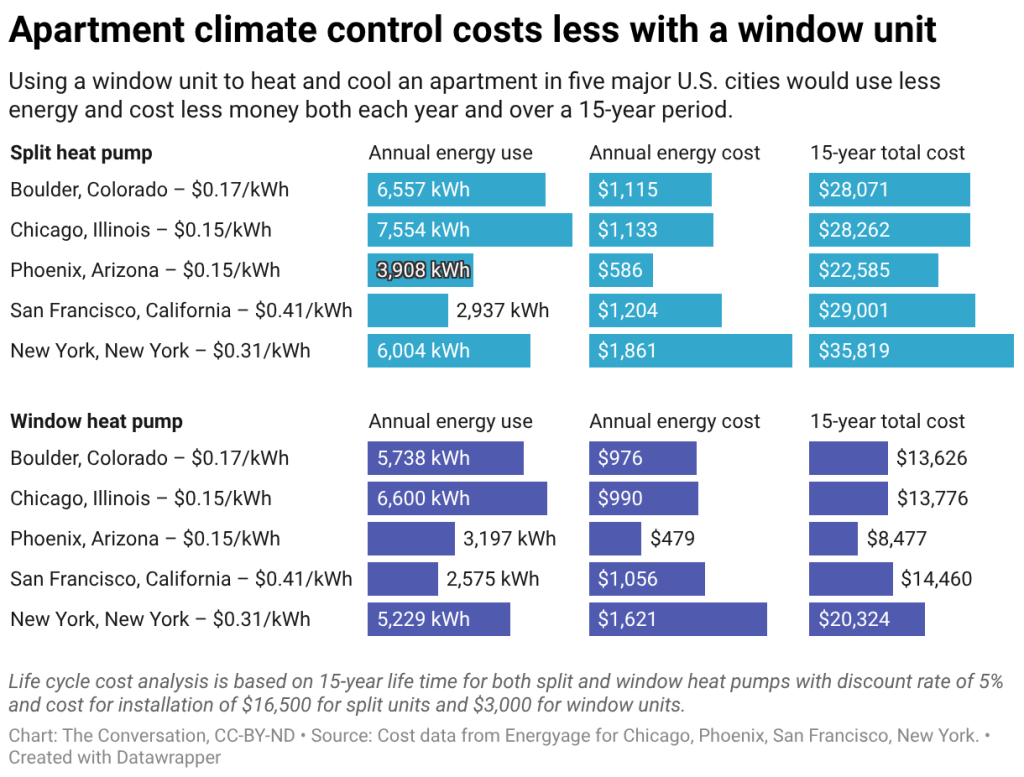
    Apartment climate control costs less with a window unit

    In addition to their low cost compared to conventional split heat pumps, packaged window heat pumps meet heating and cooling needs with lower energy demands and costs. But each window unit serves just one room, while a more common split unit can serve multiple rooms.

    Packaged window heat pumps are easy and inexpensive to install and offer all-in-one heating and cooling options for apartments and older homes, with higher energy efficiency performance than traditional systems. Their main limitations include their low capacities and reduced energy efficiency in extremely cold climates or conditions.

    This article originally appeared on The Conversation. You can read it here.

Explore More Stories

Local

‘But you already helped me’: Elderly woman floored as landscaper reveals $625K GoFundMe in her name

Environment

Solar-powered boat feasts on trash and could solve the ocean’s plastic waste problem

Local

While exploring trails, two friends rescue missing woman trapped in a mud puddle for 3 days

Everyday Economics

5 things to do when the car’s check engine light comes on before spending money at the mechanic