Kristianstad, Sweden, has pulled off an impressive feat. The city, and the surrounding area, with a total population of 80,000, uses virtually no oil, gas, or coal to heat its homes and businesses. (And Sweden isn’t a warm place in the winter.)
What do they use instead? “Potato peels, manure, used cooking oil, stale cookies and pig intestines,” according to The New York Times. Kristianstad has switched over to biogas, a form of methane that’s created from natural biological waste (even residents’ yard trimmings).
Not only has the shift cut the region’s overall fossil fuel use by a staggering 50 percent, it’s also been good for public coffers. The city used to spend $7 million to heat municipal buildings. Using biogas, that bill has been cut to $3.2 million.
The city isn’t completely emissions free. Many cars in Kristianstad still run on gasoline, and biogas does release carbon emissions (though not nearly as much as conventional fuel), but it’s a big step forward.
Here in the United States, biogas might make sense for California, Wisconsin, and other agricultural areas that currently spend a lot of money on fossil fuels.
As many couples aim for more equal partnerships, dividing responsibilities isn’t always straightforward. In households where both partners work full-time, figuring out how to share chores has become an important part of maintaining balance at home.
A new study published in The Journal of Sex Research examined whether couples dividing household chores is linked to a woman’s sexual desire. The researchers found that the relationship between the division of household labor and sexual desire varies based on beliefs about gender roles.
This pattern has long been explained in narrow ways. Low sexual desire among women in long-term relationships is often treated as an individual issue: stress, relationship dissatisfaction, or hormonal changes. Instead, this study examined a broader social dynamic: how work is divided at home compared to perceptions of what that balance should look like.
Focusing on two different survey samples, the researchers found that women generally reported lower sexual desire than men while also indicating that they perform more household labor than their male partners. Mothers who took on a greater share of household responsibilities reported the lowest levels of sexual interest.
The study also examined the impact of benevolent sexism, which refers to beliefs that reinforce traditional gender roles, such as women as caregivers and men as providers. A couple’s attachment to these beliefs significantly influences how household labor and sexual desire are connected.
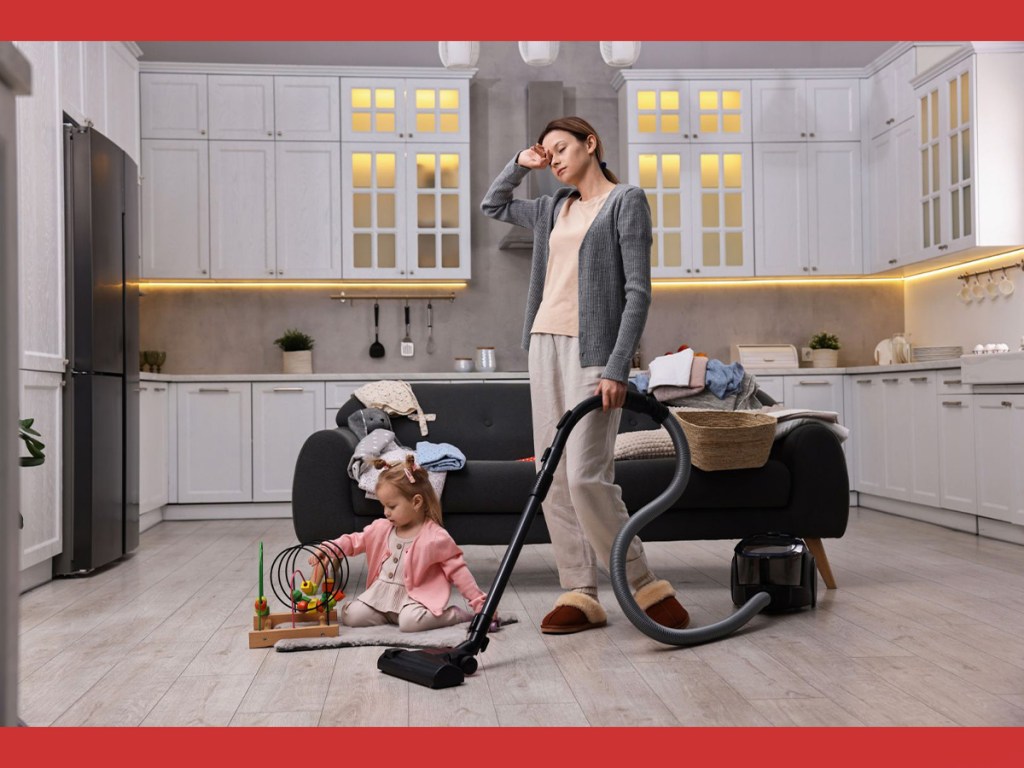
A woman is cleaning while her child plays. Photo credit: Canva
Belief systems sway the balance of sexual motivation
Women who held more egalitarian beliefs and preferred equal partnerships reported the highest levels of sexual desire when chores were split evenly. But when they found themselves doing a greater share of the household labor, they reported the lowest levels of sexual motivation.
For women who endorsed more traditional gender roles, the pattern was different. In those cases, taking on more household responsibilities was not associated with the same decrease in sexual desire.
Leading the research was Alexandra Liepmann, a PhD student in the Department of Psychology and Neuroscience at the University of Colorado Boulder. “Although women who endorse more traditional gender roles may not experience these costs in their sexual desire for their partner when doing more household labor, they may still experience costs in their personal and professional lives,” Liepmann told PsyPost.
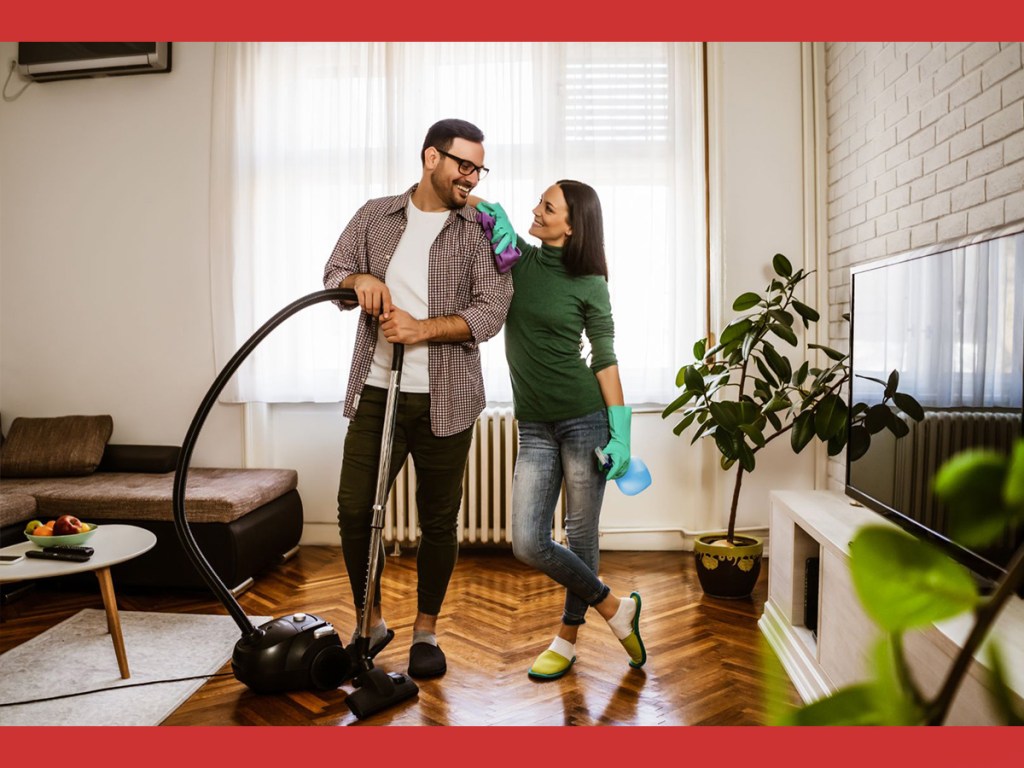
Husband and wife are working from home. Photo credit: Canva
Studies that connect the dots
Adding to the evidence of this imbalance was a 2023 study focused on the distribution of household labor. It found that many relationships still adhere to unequal standards for women’s responsibilities compared to men’s.
Another 2023 study found that women’s sexual desire tends to be more sensitive to the context of a relationship, particularly how things are going at home. This supports the idea that a woman’s perception of expected equality can affect her level of desire.
Taken together, these findings indicate that household labor and beliefs about fairness may directly affect sexual desire for some women. Couples who divide chores more evenly may experience better intimacy outcomes regardless of their personal beliefs about gender roles and responsibilities.
Sometimes the biggest moments in our lives might slip by unnoticed. That’s exactly what was happening to Airman Joel Usher. At his United States Air Force graduation ceremony, he stood alone, already knowing that no family members were coming to celebrate the occasion.
Many people know what it feels like to hit a major milestone and wish someone were there. Usher was visibly emotional as fellow graduates reunited with cheering family members. Suddenly, a friend he made during training stepped forward. Phone in hand, recording the moment, he walked up to “tap him out.”
1 year ago today. it’s been a journey man still can’t believe i’ve made it this far but is only the beginning more blessing to come💫#fypシ#militarytapout#explorepage
Caught completely off guard, a teary-eyed Usher smiles, turning what could have been a lonely memory into one defined by friendship. He posted the video on TikTok with a title overlay reading, “i had no one at my graduation to tap me out but that one good friend i met during training found me and come through for me…”
At military graduations, there’s a tradition known as “tapping out.” Family members or close supporters step forward at the end of the ceremony to officially greet and escort the graduates away. According to the AF WingMoms, it can be an emotional experience, but the Air Force views its military purpose as a productive way to maintain orderly disbursement.
In an exclusive interview with People, Usher described how important that kind act was, leaving him holding back tears:
“When my friend tapped me out, I was overwhelmed in the best way possible. It wasn’t just about finishing, it was about having someone there who truly had my back in that moment.”
Usher went on to explain that the achievement was important, but the friendship and support shown to him are what he remembers most. After sharing the moment online, he was surprised by all the feedback. He believes the overwhelming response was a strong reminder of the beauty behind meaningful acts of kindness.
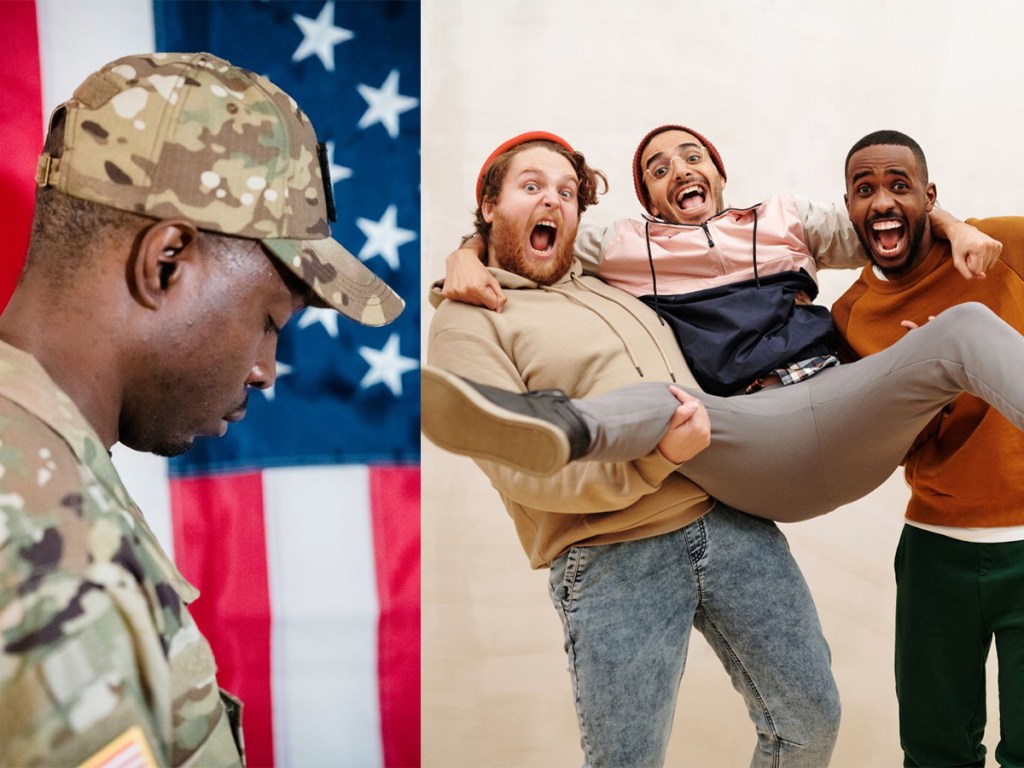
Best friends take a group selfie. Photo credit: Canva
TikTok post resonates
After 4.6 million views, people flooded the comments with emotional reactions. For some, the small gesture perfectly captured the kind of bond people form while going through difficult experiences together. This wasn’t a performative moment—just someone refusing to let another person experience an important occasion alone.
For others, it was heartbreaking. Often, soldiers don’t have family members who are able to make the trip, or they find themselves on a solitary journey. Either way, the idea that people can accomplish something amazing and still be left to stand alone afterward can be difficult to swallow.
Here are some of the comments:
“i’m glad you made a good friend along the way who came looking for ya. those are the meaningful connections you make while in the military”
“now this just broke my heart”
“Those teary eyes”
“This just breaks my heart! Everyone should have someone tap them out. So much respect for the military”
“The pain in bros eyes. Went to my soul. Brother we are here for u! Ty for serving”
“sometimes thats all we need! Just one good friend”
“I’m so sorry no one from your bloodline was there for you in that moment but you have all of TikTok cheering you on and we are so proud of your accomplishments”
“Ex military that tap means more than you think.”
“i really wish they had a volunteer program for something like this… let other mamas and dads come and be there for these young men and women.. we never know how bad they just need SOMEONE to be there for them”
“Been there my man. But you’re going to be an amazing soldier. Use that to be the best you can be”
The mix of responses shows why meaningful moments shouldn’t be faced alone. Friendship and community are defined by simple choices: stepping in, showing up, and refusing to let a proud day also become someone’s loneliest. These small acts turn milestone accomplishments into memories carried forward with a tearful, joyful smile.
Many Americans think of sunscreen at the beach. Fewer consider wearing it for the drive there. And many are questioning if they should wear sunscreen at all.
These trends, uncovered in a new national survey from the nonprofit Melanoma Research Alliance (MRA), highlight a central challenge in skin cancer prevention.
Skin cancer is the most common form of cancer in the United States, according to the CDC. Nine in 10 skin cancers, including melanoma, are linked to exposure to ultraviolet (UV) radiation, according to the MRA. Reducing exposure to UV radiation lowers the risk of skin cancer, making sunscreen a key part of prevention.
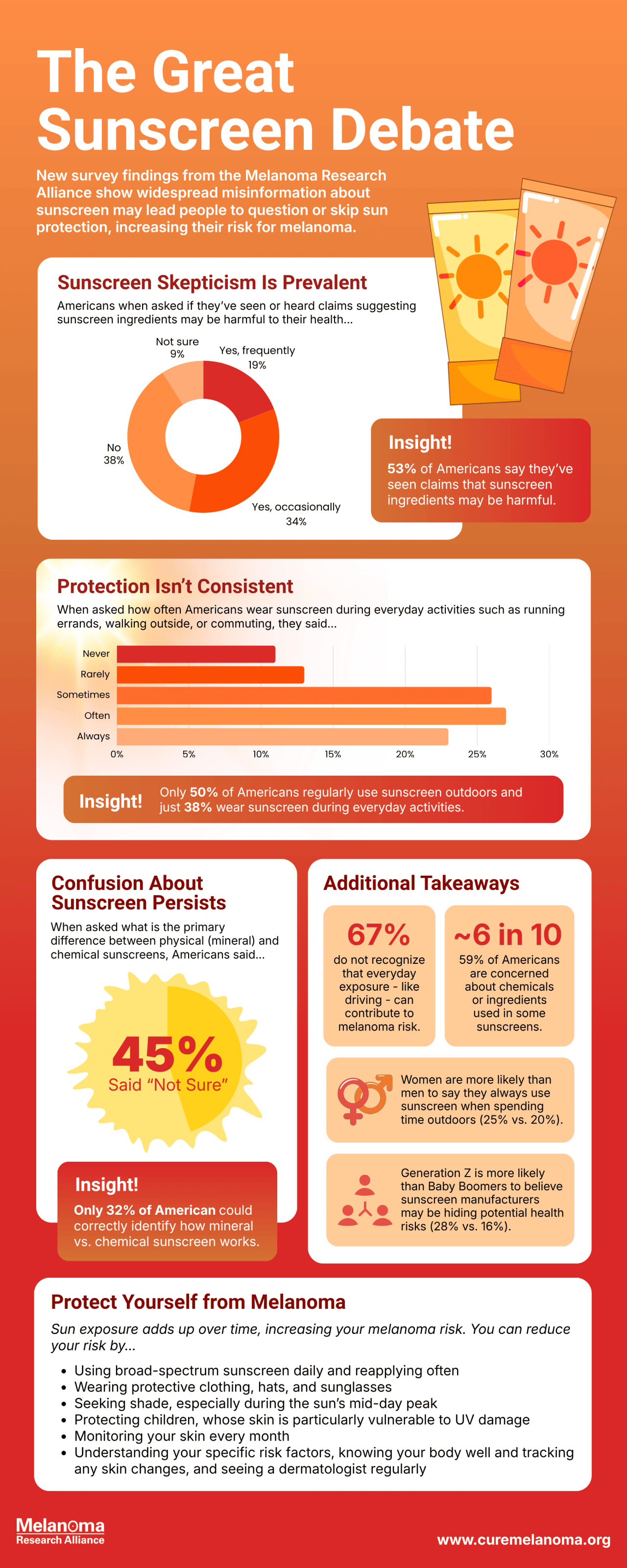
A survey of 2,000 adults found that most Americans have a basic understanding of the risks of sun exposure, but that awareness doesn’t always translate into action. More than 8 in 10 recognize that spending long hours in the sun contributes to melanoma risk, yet roughly one-quarter say they rarely or never use sunscreen when spending time outdoors.
Then there are those everyday moments that most people don’t recognize as risky. The light coming through the window over the sink. The short walk from the parking lot. The hour in the bleachers with the sun hitting one side of your face. A single sunburn can be dangerous, but it’s the accumulation of exposure over time that often drives risk.
Sunscreen is widely recognized as an effective tool for skin cancer prevention, yet confusion and misinformation persist, especially on social media. Fifty-three percent of respondents say they have seen claims that sunscreen ingredients may be harmful. Fifty-nine percent say they are concerned about what’s in sunscreen, and 38% don’t believe sunscreen is safe and effective.
Many Americans also say they aren’t sure how sunscreen works. Only about a third can correctly explain the difference between types of sunscreens, while a much larger share reports being unsure.
Sunscreen works by absorbing or blocking UV radiation from reaching the skin, preventing DNA damage that can cause skin cancer. In the United States, the active ingredients in sunscreen undergo rigorous review by the Food and Drug Administration, which evaluates them as over-the-counter drugs. This drug-level standard requires extensive testing and contributes to a more limited set of approved UV filters compared with Europe, where sunscreens are regulated as cosmetics. The FDA is currently evaluating additional methodologies for assessing sunscreen ingredients, a process that could expand the number of approved UV filters available to U.S. consumers.
All of this is unfolding during a period of real progress in melanoma research. While melanoma remains the deadliest form of skin cancer, more than 8,500 Americans are expected to die from it in 2026, roughly one person every hour, according to the American Cancer Society. Recent advances are improving outcomes for many patients with advanced disease, though approximately 50% of patients do not respond to current treatments, according to MRA, underscoring why prevention and early detection remain critical.
Survey methodology: The Melanoma Research Alliance commissioned Atomik Research to conduct an online survey of 2,000 U.S. adults between March 27 and April 1, 2026. The sample is nationally representative based on gender, age, and geography. Margin of error: ±2 percentage points at a 95% confidence level. Atomik Research, part of 4media group, is a creative market research agency.