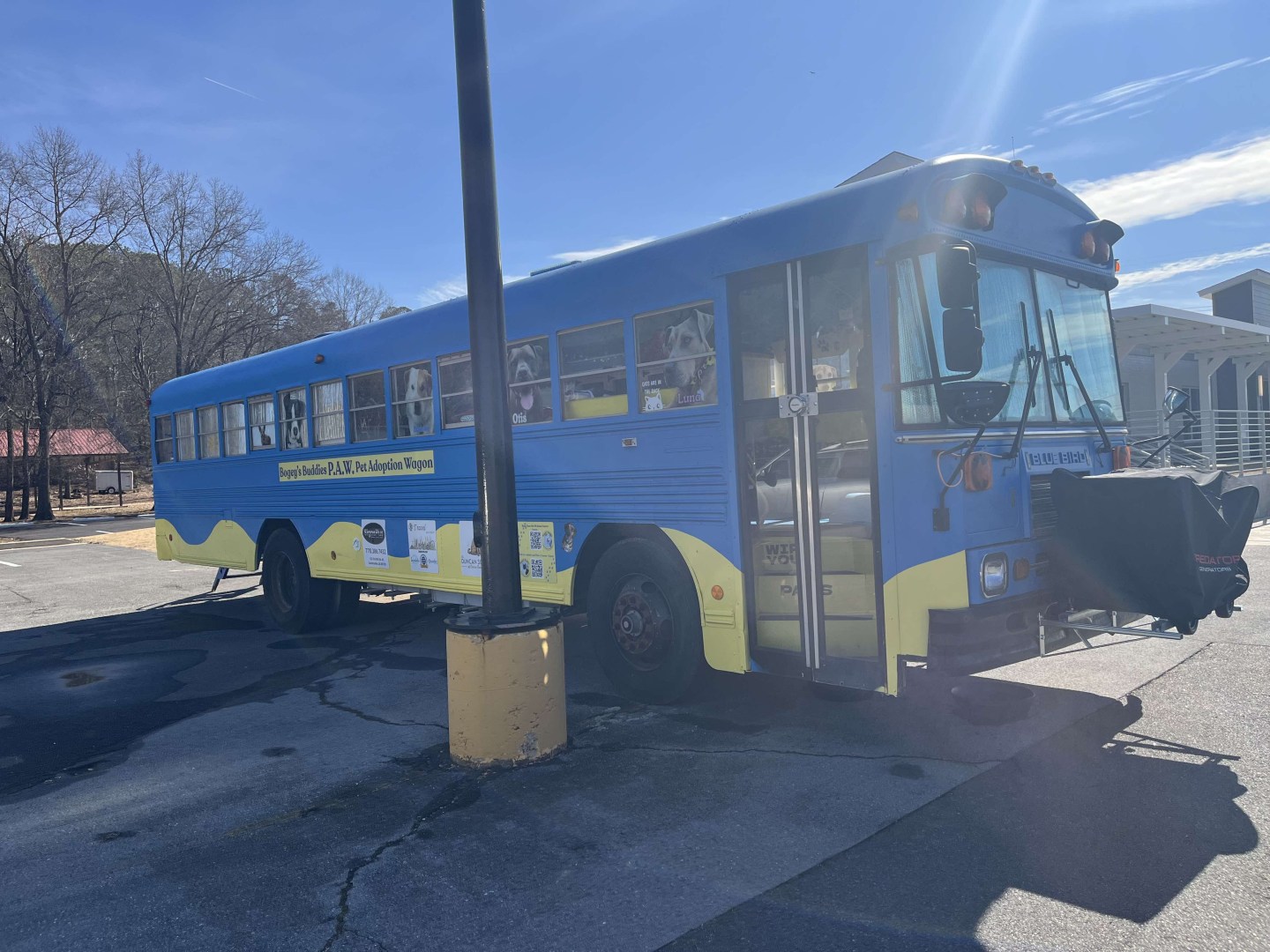
During periods of severe cold, many cities offer warming centers: temporary shelters for those in need, often operated out of churches and non-profit facilities. But if animals aren’t allowed inside, this creates a conundrum for pet owners who are homeless. Now Bogey’s Buddies, an animal rescue based out of Bartow County, Georgia, is confronting this challenge in an innovative and admirably selfless way.

When needed, the staff park outside a local warming center in their bus and stay through the night with pets who can’t accompany their owners indoors. In a recent Facebook livestream, you can see a couple pups playing with toys and munching on treats in the spacious vehicle, which is decked out with plenty of crates and blankets.

You can find more information about the Bogey’s—officially known as Bartow Rescue & Resources—at their website. “At Bogey’s Buddies, our mission goes beyond just rescuing pets; we are dedicated to keeping families united,” reads their “About Us” section. “This is why we engage in community outreach to support pet owners and prevent unnecessary separations. We provide resources and guidance while organizing educational events to strengthen the bond between humans and their cherished pets.”

To help support their ongoing efforts, you can donate to their Givebutter campaign, helping cover the cost of both owner-surrendered pets and those who arrive as strays. In addition, Bogey’s recently announced a three-hour live fundraiser with the national animal advocacy organization Jordan’s Way, set for March 9th.

The timing is critical. “The country is in crisis mode. Healthy dogs and cats are being euthanized. Animals are getting sick and dying from preventable diseases that are being spread from overcrowding,” they write on the Givebutter site.

Jo’El Lapp, director and founding member of Bogey’s, spoke to GOOD about the origins of their organization, launched in April 2024 with co-director Becca Gosnell, whom she knew casually through rescue efforts.

“I knew from online she was a cat person, and I reached out because I had a foster dog that needed to be tested with cats,” she says. “We got along very well. Samantha [Able] is another co-founder, and her dog passed away the year before. As I went around town with my foster dogs, people would tell me that I needed to meet Sam because her dog Bogey just died and she might be looking for another pet. With these two ladies, the first glimmer of a rescue started.”

They named their organization after that dog because of his powerful path to rehabilitation. “[Bogey] was on the euthanasia list, severely emaciated, heartworm-positive, and terrified,” Able wrote on their website. “The only reason we were able to adopt him was thanks to an incredible woman who chose to foster him! It’s fitting that Bogey became the namesake of our rescue organization, as his story embodies the spirit of hope and second chances that we strive to provide for other animals in need.”

The all-woman crew expanded to include board member/Bogey’s Boutique supervisor Elizabeth “June” Boardman, board member Kelsey Strawn, non-board members Macie Rae and Madie Rose, and a crew of volunteers and fosters. And despite the heavy hours they clock, this has never been a financial endeavor.

“Becca and I are self-employed, and Sam is a manager at a brewery in Cartersville. All but one of the ladies on the board have full-time jobs or are business owners. One is a retired school teacher,” Lapp says. “Yes, volunteering the amount we do is a challenge. Our goal is to have a facility and start getting some form of compensation for the 60-plus hours we put in a week. Not to mention that we desperately need a place to put at-risk pets that do not have a foster home waiting, like soon-to-whelp moms and abandoned pets.”
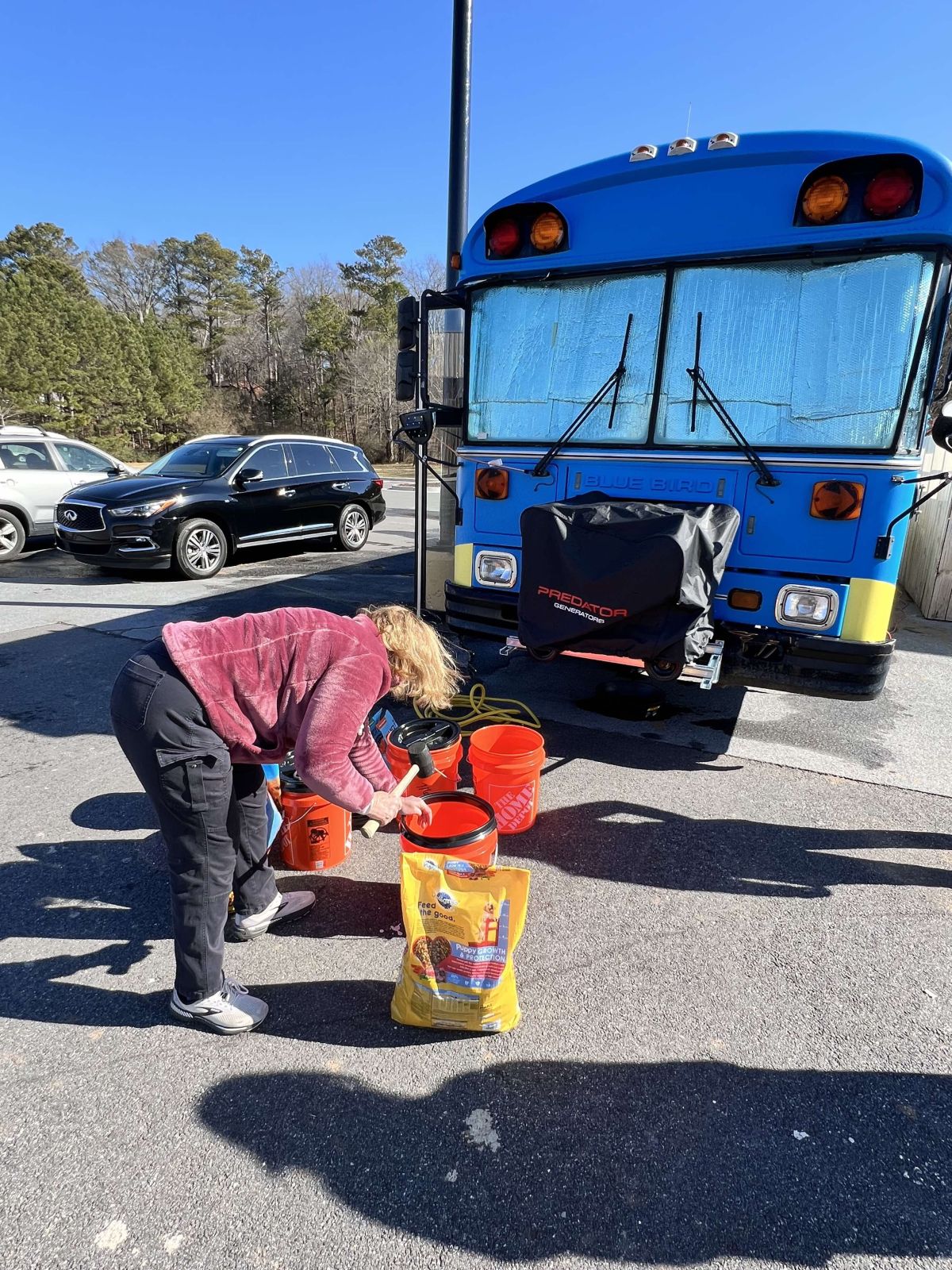
The Bogey’s team is clearly putting in an exceptional amount of effort—and that’s before even mentioning their Internet-viral bus, the P.A.W. (Pet Adoption Wagon).

“We were having an adoption event in the summer, and the temps got into the 90’s,” Lapp says, detailing that project’s early days. “It was miserable. Even with fans blowing, it felt like we were in a convention oven. So I started thinking about a mobile adoption center. I had the idea of an air-conditioned and heated vehicle that we could use at events. A place for pets and humans to be comfortable.

“Becca also needed a meeting area for cats, so the meet and greets did not need to keep happening at her home,” she continues. “We looked at buses and RVs and finally fell on a semi-converted skoolie for a fair price. As we started the planning, we brainstormed on possible uses and something that always bothered me was that people had to choose between warmth in the bitter cold and their pets. It was an easy path to where we are.”

The bus was originally was parked on Lapp’s lawn—a temporary measure. (“It resulted in an 85-pound German Shepherd getting tied to my neighbor’s porch and two other dogs that were found on my street being brought to my house. I like not having a 45-foot sign on my lawn. Not sure where the bus will stay once the weather gets warmer.”) But for now it will be parked at the Compassion Center, a nonprofit in Cartersville, Georgia, through the winter. And, crucially, they have a plan in place, helping them prepare for those bus sleepovers.

“Once we receive a call from the Compassion Center with the expected dates that the warming shelter will be open, we let them know if we can staff the bus,” she says. “They then spread the word that we will be there. We get there about an hour before sunset, and then we start taking in the dogs. We had a cat this past week. The pet’s human is asked to walk the pet before 11 p.m. when lights are out and to get the pet by 8 a.m. The shelter allows pets during the day use.”

Given the success they’ve already seen, I wondered if Lapp has any advice for places like warming centers—suggestions that could help them welcome pets into facilities in the future.

“The bus is dual-purpose and not necessary if this is what they are trying to achieve,” she says. “The community is very supportive of helping the pets of the unsheltered. My suggestion is to get with the local humane society or a rescue group and fundraise for a heated shed with kennels. Just the type that are in Home Depot or Lowe’s parking lot. They may even be able to get one donated if the company can get some bragging rights. Maybe a local builder? Does not need to be fancy, only functional.

“People need to think out of the box. We are not in a normal situation with the current pet crises, so the usual solutions are not going to work. Be creative and make the big asks. People want to help if you give them the opportunity.”

Despite the noble efforts of the Bogey’s crew, there are still “many” people going unserved in similar situations. “It is a trust issue that we are still working through,” Lapp notes. “Municipalities are not kind to the unsheltered. I understand that there are challenges, but a little humanity goes a long way.”

A key theme, she adds, is that “we sometimes overlook those who cannot help themselves.”

“We are trying to bridge that gap,” Lapp says. “We have taken two of the pups to get fixed after our last cold spell. Another got all of his shots. We try to educate on how dangerous it can be for a dog to have puppies and how easy it is for the puppies to die in those conditions. We are hoping to be able to track and manage these dogs so that they live healthy, happy, and safe lives and continue to be the support that their human needs.”

  • Air Force graduate tears up when friend steps in to ‘tap him out’ during graduation
    Photo credit: CanvaA lone soldier and friends celebrating.

    Sometimes the biggest moments in our lives might slip by unnoticed. That’s exactly what was happening to Airman Joel Usher. At his United States Air Force graduation ceremony, he stood alone, already knowing that no family members were coming to celebrate the occasion.

    Many people know what it feels like to hit a major milestone and wish someone were there. Usher was visibly emotional as fellow graduates reunited with cheering family members. Suddenly, a friend he made during training stepped forward. Phone in hand, recording the moment, he walked up to “tap him out.”

    @slimgudda305

    1 year ago today. it’s been a journey man still can’t believe i’ve made it this far but is only the beginning more blessing to come💫#fypシ #militarytapout #explorepage

    ♬ Gods creation – daniel.mp3

    A teary-eyed moment defined by friendship

    Caught completely off guard, a teary-eyed Usher smiles, turning what could have been a lonely memory into one defined by friendship. He posted the video on TikTok with a title overlay reading, “i had no one at my graduation to tap me out but that one good friend i met during training found me and come through for me…”

    At military graduations, there’s a tradition known as “tapping out.” Family members or close supporters step forward at the end of the ceremony to officially greet and escort the graduates away. According to the AF WingMoms, it can be an emotional experience, but the Air Force views its military purpose as a productive way to maintain orderly disbursement.

    An overwhelming gesture

    In an exclusive interview with People, Usher described how important that kind act was, leaving him holding back tears:

    “When my friend tapped me out, I was overwhelmed in the best way possible. It wasn’t just about finishing, it was about having someone there who truly had my back in that moment.”

    Usher went on to explain that the achievement was important, but the friendship and support shown to him are what he remembers most. After sharing the moment online, he was surprised by all the feedback. He believes the overwhelming response was a strong reminder of the beauty behind meaningful acts of kindness.

    airman graduation, military support, chosen family, military friendship, tapping out, tap him out
    Best friends take a group selfie.
    Photo credit: Canva

    TikTok post resonates

    After 4.6 million views, people flooded the comments with emotional reactions. For some, the small gesture perfectly captured the kind of bond people form while going through difficult experiences together. This wasn’t a performative moment—just someone refusing to let another person experience an important occasion alone.

    For others, it was heartbreaking. Often, soldiers don’t have family members who are able to make the trip, or they find themselves on a solitary journey. Either way, the idea that people can accomplish something amazing and still be left to stand alone afterward can be difficult to swallow.

    Here are some of the comments:

    “i’m glad you made a good friend along the way who came looking for ya. those are the meaningful connections you make while in the military”

    “now this just broke my heart”

    “Those teary eyes”

    “This just breaks my heart! Everyone should have someone tap them out. So much respect for the military”

    “The pain in bros eyes. Went to my soul. Brother we are here for u! Ty for serving”

    “sometimes thats all we need! Just one good friend”

    “I’m so sorry no one from your bloodline was there for you in that moment but you have all of TikTok cheering you on and we are so proud of your accomplishments”

    “Ex military that tap means more than you think.”

    “i really wish they had a volunteer program for something like this… let other mamas and dads come and be there for these young men and women.. we never know how bad they just need SOMEONE to be there for them”

    “Been there my man. But you’re going to be an amazing soldier. Use that to be the best you can be”

    The mix of responses shows why meaningful moments shouldn’t be faced alone. Friendship and community are defined by simple choices: stepping in, showing up, and refusing to let a proud day also become someone’s loneliest. These small acts turn milestone accomplishments into memories carried forward with a tearful, joyful smile.

  • 59% of Americans worry about sunscreen chemicals. Only 32% understand how sunscreen works.
    Two persons applying sunscreen while sitting on a beach.

    Tiffany Miller for Melanoma Research Alliance

    Many Americans think of sunscreen at the beach. Fewer consider wearing it for the drive there. And many are questioning if they should wear sunscreen at all.

    These trends, uncovered in a new national survey from the nonprofit Melanoma Research Alliance (MRA), highlight a central challenge in skin cancer prevention.

    Skin cancer is the most common form of cancer in the United States, according to the CDC. Nine in 10 skin cancers, including melanoma, are linked to exposure to ultraviolet (UV) radiation, according to the MRA. Reducing exposure to UV radiation lowers the risk of skin cancer, making sunscreen a key part of prevention.

    A survey of 2,000 adults found that most Americans have a basic understanding of the risks of sun exposure, but that awareness doesn’t always translate into action. More than 8 in 10 recognize that spending long hours in the sun contributes to melanoma risk, yet roughly one-quarter say they rarely or never use sunscreen when spending time outdoors.

    Then there are those everyday moments that most people don’t recognize as risky. The light coming through the window over the sink. The short walk from the parking lot. The hour in the bleachers with the sun hitting one side of your face. A single sunburn can be dangerous, but it’s the accumulation of exposure over time that often drives risk.

    Sunscreen is widely recognized as an effective tool for skin cancer prevention, yet confusion and misinformation persist, especially on social media. Fifty-three percent of respondents say they have seen claims that sunscreen ingredients may be harmful. Fifty-nine percent say they are concerned about what’s in sunscreen, and 38% don’t believe sunscreen is safe and effective.

    An infographic on Melanoma Research Alliance's surveys on sunscreen facts and usage.

    Many Americans also say they aren’t sure how sunscreen works. Only about a third can correctly explain the difference between types of sunscreens, while a much larger share reports being unsure.

    Sunscreen works by absorbing or blocking UV radiation from reaching the skin, preventing DNA damage that can cause skin cancer. In the United States, the active ingredients in sunscreen undergo rigorous review by the Food and Drug Administration, which evaluates them as over-the-counter drugs. This drug-level standard requires extensive testing and contributes to a more limited set of approved UV filters compared with Europe, where sunscreens are regulated as cosmetics. The FDA is currently evaluating additional methodologies for assessing sunscreen ingredients, a process that could expand the number of approved UV filters available to U.S. consumers.

    All of this is unfolding during a period of real progress in melanoma research. While melanoma remains the deadliest form of skin cancer, more than 8,500 Americans are expected to die from it in 2026, roughly one person every hour, according to the American Cancer Society. Recent advances are improving outcomes for many patients with advanced disease, though approximately 50% of patients do not respond to current treatments, according to MRA, underscoring why prevention and early detection remain critical.

    Survey methodology: The Melanoma Research Alliance commissioned Atomik Research to conduct an online survey of 2,000 U.S. adults between March 27 and April 1, 2026. The sample is nationally representative based on gender, age, and geography. Margin of error: ±2 percentage points at a 95% confidence level. Atomik Research, part of 4media group, is a creative market research agency.

    This story was produced by Melanoma Research Alliance and reviewed and distributed by Stacker.

  • The salary you need to live comfortably in 100 US cities
    A view of the San Antonio River walkway in San Antonio, Texas.
    ,

    The salary you need to live comfortably in 100 US cities

    Big-city comfort comes with a six-figure price tag.

    Jaclyn DeJohn, CFP for SmartAsset

    To truly understand the context of a household’s income, it must be compared to local costs and long-term goals, which both may fluctuate over time. For most people, the same pillars will make up the biggest nonnegotiables in their budget. These include basic necessities like housing, groceries, utilities, and transportation, and likely some discretionary spending on hobbies, activities, and other enrichment. In an attempt to secure this lifestyle for the future, many households aim to save some of their income for emergencies, investments, retirement, education, and other long-term goals. A common budgeting technique that encapsulates these three pillars is called the 50/30/20 rule: 50% of your post-tax income goes to needs, 30% to your wants, and 20% gets set aside for the future.

    With this in mind, SmartAsset assessed the salary needed to reach this 50/30/20 ideal — designated as a comfortable salary — based on the local costs in 100 of the largest U.S. cities.

    Key Findings

    • A single adult needs to earn $150,000 to live comfortably in these places. New York has the highest individual salary needed to live comfortably at $158,954. San Jose, California, follows closely at $158,080. Orange County cities Irvine, Anaheim, and Santa Ana require an estimated $151,965 in income for a single adult.
    • These cities have the lowest salary needed to live comfortably. San Antonio has the lowest salary threshold for both single adults and families of four at $83,242 and $192,608, respectively. New Orleans has the second-lowest salary needed for a single adult to live comfortably at $84,406, followed by Memphis, Tennessee, at $86,320.
    • The Bay Area is the most expensive place for a family to live comfortably. Bay Area cities make up the top four of the five places with the highest salary needed for a family of four to live comfortably. Incomes across two parents are projected at $407,597 in San Francisco, $402,771 in San Jose, and $371,488 in both Fremont and Oakland. Boston rounds out the top five at $368,742.
    • Families in these Texas cities are closest to a comfortable salary. In Frisco, the median household earns $145,444 — substantially higher than the national median of $83,730. This figure also accounts for 63.1% of the $230,464 income a family of four in Frisco needs to live comfortably. In McKinney, the $124,177 median household income accounts for 53.9% of the $230,464 needed.
    Table listing the top cities by the lowest annual salary needed for a single adult to live in sustainable comfort using the 50/30/20 budgeting rule.

    10 Cities With the Highest Salary Needed to Live Comfortably

    1. New York, New York

    • Salary needed for a single adult: $158,954
    • Salary needed for a working family of four: $337,875
    • Median household income: $81,228

    2. San Jose, California

    • Salary needed for a single adult: $158,080
    • Salary needed for a working family of four: $402,771
    • Median household income: $148,226

    3. (tie) Irvine, California

    • Salary needed for a single adult: $151,965
    • Salary needed for a working family of four: $327,226
    • Median household income: $145,731

    3. (tie) Anaheim, California

    • Salary needed for a single adult: $151,965
    • Salary needed for a working family of four: $327,226
    • Median household income: $101,145

    3. (tie) Santa Ana, California

    • Salary needed for a single adult: $151,965
    • Salary needed for a working family of four: $327,226
    • Median household income: $95,118

    6. Boston, Massachusetts

    • Salary needed for a single adult: $139,776
    • Salary needed for a working family of four: $368,742
    • Median household income: $97,791

    7. (tie) San Diego, California

    • Salary needed for a single adult: $136,781
    • Salary needed for a working family of four: $312,915
    • Median household income: $111,032

    7. (tie) Chula Vista, California

    • Salary needed for a single adult: $136,781
    • Salary needed for a working family of four: $312,915
    • Median household income: $105,101

    9. San Francisco, California

    • Salary needed for a single adult: $134,950
    • Salary needed for a working family of four: $407,597
    • Median household income: $139,801

    10. (tie) Fremont, California

    • Salary needed for a single adult: $134,410
    • Salary needed for a working family of four: $371,488
    • Median household income: $175,816

    10. (tie) Oakland, California

    • Salary needed for a single adult: $134,410
    • Salary needed for a working family of four: $371,488
    • Median household income: $102,235

    10 Cities With the Lowest Salary Needed to Live Comfortably

    1. San Antonio, Texas
    • Salary needed for a single adult: $83,242
    • Salary needed for a working family of four: $192,608
    • Median household income: $66,176
    1. New Orleans, Louisiana
    • Salary needed for a single adult: $84,406
    • Salary needed for a working family of four: $197,766
    • Median household income: $58,821
    1. Memphis, Tennessee
    • Salary needed for a single adult: $86,320
    • Salary needed for a working family of four: $193,939
    • Median household income: $52,679
    1. Oklahoma City, Oklahoma
    • Salary needed for a single adult: $86,861
    • Salary needed for a working family of four: $213,325
    • Median household income: $70,040
    1. Baltimore, Maryland
    • Salary needed for a single adult: $87,485
    • Salary needed for a working family of four: $224,224
    • Median household income: $64,778
    1. Louisville, Kentucky
    • Salary needed for a single adult: $88,234
    • Salary needed for a working family of four: $212,742
    • Median household income: $67,251
    1. Tulsa, Oklahoma
    • Salary needed for a single adult: $88,317
    • Salary needed for a working family of four: $215,238
    • Median household income: $60,930
    1. Winston-Salem, North Carolina
    • Salary needed for a single adult: $88,442
    • Salary needed for a working family of four: $205,421
    • Median household income: $57,758
    1. Tucson, Arizona
    • Salary needed for a single adult: $88,899
    • Salary needed for a working family of four: $218,400
    • Median household income: $60,483
    1. Fort Wayne, Indiana
    • Salary needed for a single adult: $88,982
    • Salary needed for a working family of four: $233,126
    • Median household income: $61,436

    Data and Methodology

    SmartAsset used MIT Living Wage Calculator data to gather the basic cost of living for an individual with no children and for two working adults with two children. Data includes the cost of necessities, including housing, food, transportation, and income taxes. It was last updated to reflect the most recent data available on Feb. 15, 2026.

    Applying these costs to the 50/30/20 budget for 100 of the largest U.S. cities, MIT’s living wage is assumed to cover needs (i.e., 50% of one’s budget). From there, the total annual wage was extrapolated for individuals and families to spend 30% of the total on wants and 20% on savings or debt payments. Median household income data for cities comes from the U.S. Census Bureau’s 1 Year American Community Survey for 2024.

    This story was produced by SmartAsset and reviewed and distributed by Stacker.

Explore More Stories

Well-being

You know exercise is good for you – so why is it so hard to put it into practice?

Society

Foreign aid’s hidden benefit: Recipients are more likely to pay the generosity forward

Health

Photographic memory is a myth – here’s what research really says about remembering

Well-being

How workplace stress hijacks the nervous system to cause headaches − and a neurologist’s guide to managing them