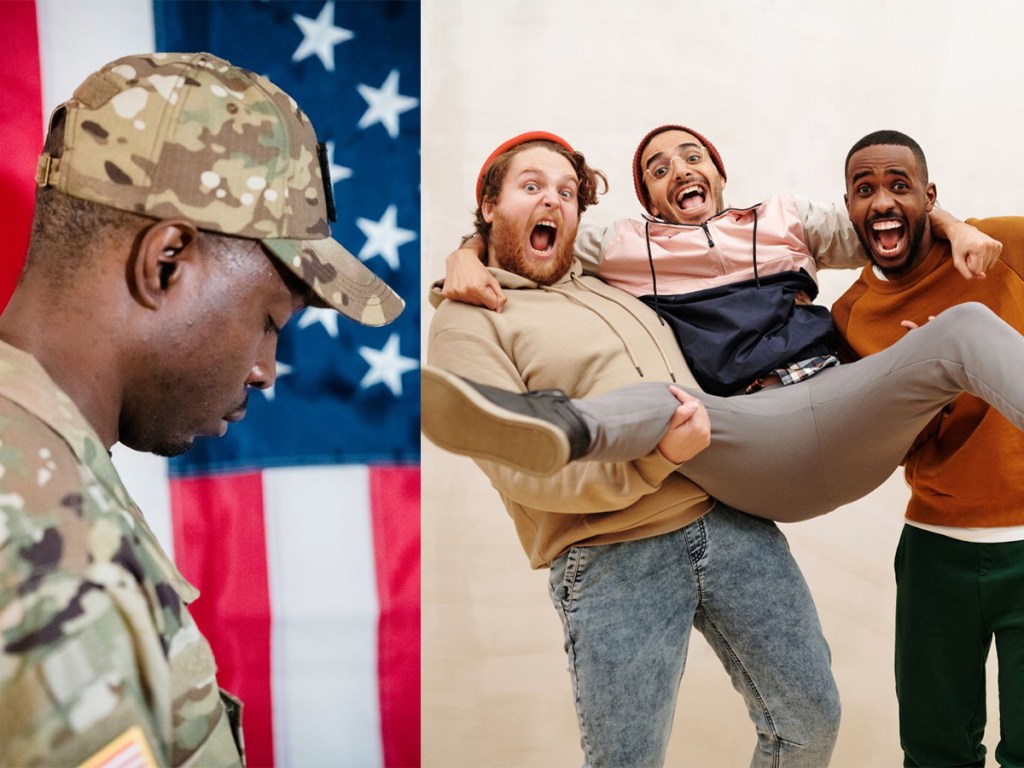
Sometimes the biggest moments in our lives might slip by unnoticed. That’s exactly what was happening to Airman Joel Usher. At his United States Air Force graduation ceremony, he stood alone, already knowing that no family members were coming to celebrate the occasion.

Many people know what it feels like to hit a major milestone and wish someone were there. Usher was visibly emotional as fellow graduates reunited with cheering family members. Suddenly, a friend he made during training stepped forward. Phone in hand, recording the moment, he walked up to “tap him out.”

@slimgudda305

1 year ago today. it’s been a journey man still can’t believe i’ve made it this far but is only the beginning more blessing to come💫#fypシ #militarytapout #explorepage ♬ Gods creation – daniel.mp3

A teary-eyed moment defined by friendship

Caught completely off guard, a teary-eyed Usher smiles, turning what could have been a lonely memory into one defined by friendship. He posted the video on TikTok with a title overlay reading, “i had no one at my graduation to tap me out but that one good friend i met during training found me and come through for me…”

At military graduations, there’s a tradition known as “tapping out.” Family members or close supporters step forward at the end of the ceremony to officially greet and escort the graduates away. According to the AF WingMoms, it can be an emotional experience, but the Air Force views its military purpose as a productive way to maintain orderly disbursement.

An overwhelming gesture

In an exclusive interview with People, Usher described how important that kind act was, leaving him holding back tears:

“When my friend tapped me out, I was overwhelmed in the best way possible. It wasn’t just about finishing, it was about having someone there who truly had my back in that moment.”

Usher went on to explain that the achievement was important, but the friendship and support shown to him are what he remembers most. After sharing the moment online, he was surprised by all the feedback. He believes the overwhelming response was a strong reminder of the beauty behind meaningful acts of kindness.

airman graduation, military support, chosen family, military friendship, tapping out, tap him out
Best friends take a group selfie.
Photo credit: Canva

TikTok post resonates

After 4.6 million views, people flooded the comments with emotional reactions. For some, the small gesture perfectly captured the kind of bond people form while going through difficult experiences together. This wasn’t a performative moment—just someone refusing to let another person experience an important occasion alone.

For others, it was heartbreaking. Often, soldiers don’t have family members who are able to make the trip, or they find themselves on a solitary journey. Either way, the idea that people can accomplish something amazing and still be left to stand alone afterward can be difficult to swallow.

Here are some of the comments:

“i’m glad you made a good friend along the way who came looking for ya. those are the meaningful connections you make while in the military”

“now this just broke my heart”

“Those teary eyes”

“This just breaks my heart! Everyone should have someone tap them out. So much respect for the military”

“The pain in bros eyes. Went to my soul. Brother we are here for u! Ty for serving”

“sometimes thats all we need! Just one good friend”

“I’m so sorry no one from your bloodline was there for you in that moment but you have all of TikTok cheering you on and we are so proud of your accomplishments”

“Ex military that tap means more than you think.”

“i really wish they had a volunteer program for something like this… let other mamas and dads come and be there for these young men and women.. we never know how bad they just need SOMEONE to be there for them”

“Been there my man. But you’re going to be an amazing soldier. Use that to be the best you can be”

The mix of responses shows why meaningful moments shouldn’t be faced alone. Friendship and community are defined by simple choices: stepping in, showing up, and refusing to let a proud day also become someone’s loneliest. These small acts turn milestone accomplishments into memories carried forward with a tearful, joyful smile.

  • Foreign aid’s hidden benefit: Recipients are more likely to pay the generosity forward
    Photo credit: Kim Hong-Ji/Getty ImagesSouth Korean soldiers oversee the arrival of a batch of Johnson & Johnson’s Janssen COVID-19 vaccines donated by the U.S. government on June 5, 2021.

    Foreign aid may not improve how recipients view donor countries – but it can set off a chain of goodwill that spreads far beyond the original act of giving.

    That is what a colleague and I found when we studied how South Koreans responded to COVID-19 vaccines donated by the United States.

    The South Korean government reserved donated Johnson & Johnson vaccines for military reservists and, for medical reasons, excluded anyone under 30. As a result, we could compare the views of South Koreans just above and below that threshold.

    We found that the donated vaccines did not improve people’s views of the United States. South Koreans who received American vaccines reported similar views of the U.S. as those who had not been vaccinated.

    Yet the results were striking in another way. Those who received donated American vaccines became more supportive of their own government sending aid abroad. Recipients shifted from neutrality on the matter to expressing moderate support for foreign aid, scoring about one point higher on a seven-point scale than those who didn’t make the eligibility cutoff.

    There is also evidence that these effects extend beyond direct recipients. South Koreans who were simply told that the U.S. was providing vaccine aid to developing countries also became more supportive of their own government doing the same – though this effect was concentrated among political moderates.

    Together, these patterns point to what social scientists call “generalized reciprocity” – the impulse not to repay kindness directly but to pass it on. In this way, one act of aid can prompt another, and spread across borders.

    Why it matters

    From Washington and London to Berlin and Tokyo, foreign aid budgets have been cut. In November 2020, former U.S. Agency for International Development Administrator Samantha Power invoked a common assumption when she argued that providing vaccines abroad would restore American leadership – that the value of aid lies in the goodwill it generates toward the donor.

    Our findings suggest this is one way aid can matter, but not necessarily the most important.

    Instead, aid may foster a form of international cooperation that does not depend on treaties or direct reciprocity between nations but emerges from ordinary people’s willingness to pass on goodwill.

    A nurse administers a vaccine shot to an elderly lady.
    A South Korean woman receives a COVID-19 vaccine on April 1, 2021. Chung Sung-Jun/Getty Images

    If aid can trigger chains of giving across borders, then how we assess its value may need to change. Current frameworks tend to emphasize donor nations’ direct returns or strategic benefits, but the cooperative effects we identify are largely invisible to those metrics.

    This suggests that current cuts may be shutting down effects that policymakers have not yet learned to measure – a form of international cooperation that, once set in motion, can generate cascading effects well beyond what any single donor nation could achieve alone.

    What we don’t know

    Important questions remain: Do similar patterns emerge with other forms of aid – such as disaster relief, food assistance or long-term development programs? And how long do these effects last?

    There are also hints that the threshold for triggering this response may be lower than previously thought. The effect persisted even when using eligibility for donated vaccines, rather than actual receipt, as the measure – suggesting proximity to aid, not just receipt, may be enough to activate the impulse to give.

    If evidence that past recipients of aid have themselves become donors strengthens public support for giving in donor countries, then aid may be more self-sustaining than critics assume – reinforced not just by its immediate effects, but by the example it sets.

    This article originally appeared on The Conversation. You can read it here.

  • Americans care more about future generations than many think – and that gap could matter for policy
    Photo credit: Andriy Onufriyenko/Moment via Getty ImagesDecisions made now can affect people far into the future.

    Caring about future generations means believing that people who will live decades or centuries from now deserve ethical consideration. In practice, that means taking their interests into account when making all kinds of decisions across a range of issues – from aggressively cutting carbon emissions to investing in pandemic preparedness initiatives and regulating powerful emerging technologies, such as artificial intelligence.

    While it may sound like a niche moral view to care about future generations in this way, our new research, published in the academic journal Futures, suggests otherwise. In fact, Americans appear to care substantially about future generations. Nevertheless, they also systematically underestimate how much other Americans care.

    To study this, we conducted two online surveys of U.S. adults, totaling 1,000 respondents. The samples were built to roughly match the U.S. population in age, gender, race or ethnicity, and political affiliation. In one survey, people told us their own views about future generations. In the other, a different group told us what they thought the average American believes.

    We examined this in three ways. First, we asked how many future generations people think society should keep in mind when making collective decisions. For example, when setting climate targets or designing pandemic response systems, how many future generations should count as stakeholders in that decision? Second, we asked how many future generations elected officials should keep in mind when making decisions about laws and public policy. Third, we asked how far into the future people still deserve “moral concern.”

    For the third question, participants were shown a list of the present generation and the next 50 generations, with each generation defined as a 25-year period. They then indicated how many of those generations still belonged inside their “moral circle.” In plain terms: If someone will live 100, 200, or even 1,000 years from now, does their suffering matter – and do we have some responsibility to help make their lives go better?

    Americans worry about people many generations from now

    We found that Americans, on average, extended at least some moral concern about 28 generations into the future, or roughly 700 years. But there was a mismatch about when other people’s concern faded – respondents guessed that it happened around 21 generations out, about 175 years sooner.

    A similar pattern appeared on the policy questions. Americans said society and government should take into account people living roughly 16 to 17 generations ahead, respectively – around 400 to 425 years into the future. But they assumed other Americans would endorse a shorter horizon of only about 13 generations, or roughly 325 years. In other words, Americans are more future-oriented than they think their fellow citizens are.

    Americans' concerns extend centuries into the future

    Why it matters

    Public support for long-term policies depends partly on what people think other people value. Research on climate policy, for example, shows that Americans often underestimate how much support already exists for major mitigation measures. When people wrongly think their view is unusual, they can become less likely to speak up, join with others or pressure leaders to act.

    Our findings suggest a similar dynamic may shape support for future-oriented policies more broadly. For issues such as pandemic preparedness, nuclear risk and emerging technologies, decisions made now can affect people far into the future.

    It’s possible that a person might support stronger emissions cuts, better disease-prevention systems or safeguards on high-risk technologies, but stay quiet if they assume most other Americans do not care about those kinds of long-term consequences.

    What’s next

    Several hands holding up a globe which appears to be made from blue and green fabric.
    Research shows Americans underestimate support for major climate change mitigation measures. Alistair Berg/DigitalVision via Getty Images

    For climate change, misperceptions are partly driven by partisan polarization, visible disagreement among leaders and vocal opposition from skeptics. Together, they can make public support appear weaker than it is.

    Concern for future generations, by contrast, is much less overtly politicized – meaning it does not divide along party lines the way climate policy does. Most Americans, regardless of political affiliation, say they care about people living centuries from now. Yet this concern is rarely voiced in everyday conversation, in media coverage or in political debate.

    Future research needs to examine why concern for future generations isn’t more visible in public life, such as in the media or voiced in everyday conversations. As a result, people might assume that others do not care as much as they actually do.

    The Research Brief is a short take on interesting academic work.

    This article originally appeared on The Conversation. You can read it here.

  • The evidence points to a crisis in teaching, yet Gen Z is still choosing to show up in the classroom
    Photo credit: CanvaSmiling Gen Z teachers.

    Anyone interested in becoming a teacher in today’s environment does so under a warning label. With lower pay, political pressure, community standards, lack of necessary funding, and general safety concerns, this profession is in crisis. Seasoned educators are completely burned out.

    As more teachers share on social media that they’re tired of the system and ready to leave education, something unexpected is also happening. Despite every statistic adding up to a profession better avoided, Gen Z graduates are choosing to teach anyway.

    teaching shortage, young teachers, underfunding, work conditions
    Young educator in the classroom.
    Photo credit Canva

    A generation shaped by isolation, Gen Z chooses connection

    Teach for America (TFA), one of the larger teacher pipelines in the country, brings in thousands of new educators every year. In 2025, over 2,300 college graduates from 600 colleges and universities have joined up.

    In January 2026, The Guardian wrote that despite a nationwide decline in teachers, a significant number of Gen Z graduates are entering the classroom. A generation that faced the social isolation created during COVID lockdown looks to make connections and give back. “Teaching is a job where they can find that,” said Whitney Petersmetyer, TFA’s chief growth and program officer. She believes the generation is “craving human connection and experiences that feel real.”

    Petersmetyer adds that Gen Z is, “responding to the opportunity for purpose and responsibility at a time where many entry jobs feel uncertain or disconnected from impact.”

    purpose, meaning, mental health, Gen Z teachers
    What’s your purpose?
    Photo credit Canva

    Gen Z craves purpose and meaning

    In a global 2024 survey by Deloitte, a massive sample of 23,000 respondents from 44 countries was surveyed on financial insecurity, rapidly evolving technology, and career choices. Results showed 9 out of 10 Gen Zers believed purpose was the key to job satisfaction. Almost 50% of job opportunities were rejected because they failed to meet their personal values.

    Gen Z actively wants work that has a positive social impact, acknowledges environmental values, and follows ethical concerns. In 2023, Forbes reported that Gen Z is fueled by purpose perhaps more than any previous generation. They prioritize values over salary.

    Many Gen Zers have been rethinking what work should really provide. They want income, yet personal fulfillment and a life balance remain crucial. Business Insider reports this generation is less willing to accept work that feels transactional or leaves them feeling empty.

    impactful career, priorities, education impact, classroom innovation
    The many roles of a teacher.
    Photo credit Canva

    The challenges haven’t gone away

    Teaching is still one of the most challenging jobs in the country. The work is complex, emotional, and highly demanding. A 2024 report in EdWeek found that teachers earn lower pay and experience more stress than workers in other professions. A 2024 report by the U.S. Bureau of Labor Statistics showed the teaching profession in decline due to low wages and reduced freedom in the classroom.

    In2024, the RAND Corporation also conducted a survey that found 53% of teachers report being burned out. Over half of the educators faced frequent job-related stress and declining well-being.

    teaching methods, student engagement, teaching statistics, impact
    A Gen Z teacher.
    Photo credit Canva

    Choosing a profession that others are leaving

    Gen Z knows the challenges. They’ve seen the uncomfortable headlines. Despite everything, they’re still coming to teach.

    “My philosophy is focused much more on being a good human at this age,” said 23-year-old educator Van De Vijver. The third-grade math teacher in Fairfax, Virginia, added, “If they leave my classroom as someone who is willing to help others, who keeps an open mind and is caring, as long as they also don’t get zeros on everything, then I feel like I have done a good job teaching.”

    Whether these incoming, motivated, young teachers decide to stay will likely depend on their personal motivations and the experiences they encounter as educators. Despite burnout in a strained profession, they’re choosing a job that offers them connection and meaning. Even if the path ahead is uncertain, Gen Z brings new energy and ideas into the classroom.

Explore More Public Good Stories

Society

Foreign aid’s hidden benefit: Recipients are more likely to pay the generosity forward

Society

Americans care more about future generations than many think – and that gap could matter for policy

Public Good

The evidence points to a crisis in teaching, yet Gen Z is still choosing to show up in the classroom