
Caring about future generations means believing that people who will live decades or centuries from now deserve ethical consideration. In practice, that means taking their interests into account when making all kinds of decisions across a range of issues – from aggressively cutting carbon emissions to investing in pandemic preparedness initiatives and regulating powerful emerging technologies, such as artificial intelligence.

While it may sound like a niche moral view to care about future generations in this way, our new research, published in the academic journal Futures, suggests otherwise. In fact, Americans appear to care substantially about future generations. Nevertheless, they also systematically underestimate how much other Americans care.

To study this, we conducted two online surveys of U.S. adults, totaling 1,000 respondents. The samples were built to roughly match the U.S. population in age, gender, race or ethnicity, and political affiliation. In one survey, people told us their own views about future generations. In the other, a different group told us what they thought the average American believes.

We examined this in three ways. First, we asked how many future generations people think society should keep in mind when making collective decisions. For example, when setting climate targets or designing pandemic response systems, how many future generations should count as stakeholders in that decision? Second, we asked how many future generations elected officials should keep in mind when making decisions about laws and public policy. Third, we asked how far into the future people still deserve “moral concern.”

For the third question, participants were shown a list of the present generation and the next 50 generations, with each generation defined as a 25-year period. They then indicated how many of those generations still belonged inside their “moral circle.” In plain terms: If someone will live 100, 200, or even 1,000 years from now, does their suffering matter – and do we have some responsibility to help make their lives go better?
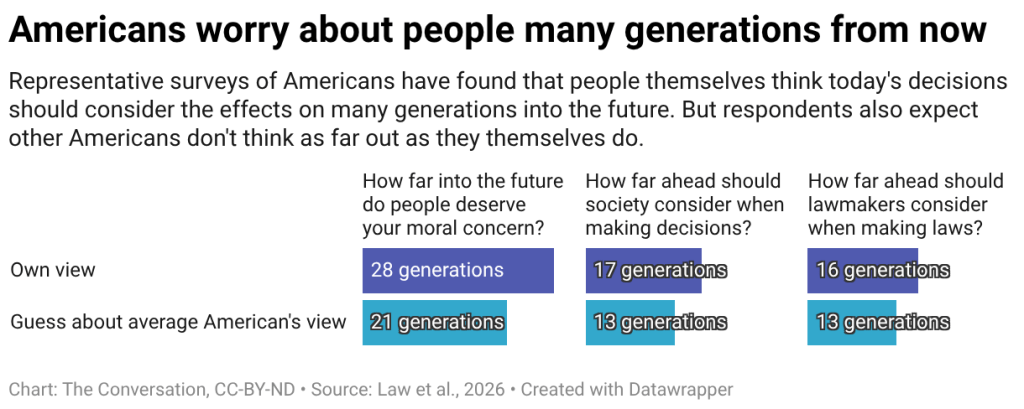
Americans worry about people many generations from now

We found that Americans, on average, extended at least some moral concern about 28 generations into the future, or roughly 700 years. But there was a mismatch about when other people’s concern faded – respondents guessed that it happened around 21 generations out, about 175 years sooner.

A similar pattern appeared on the policy questions. Americans said society and government should take into account people living roughly 16 to 17 generations ahead, respectively – around 400 to 425 years into the future. But they assumed other Americans would endorse a shorter horizon of only about 13 generations, or roughly 325 years. In other words, Americans are more future-oriented than they think their fellow citizens are.
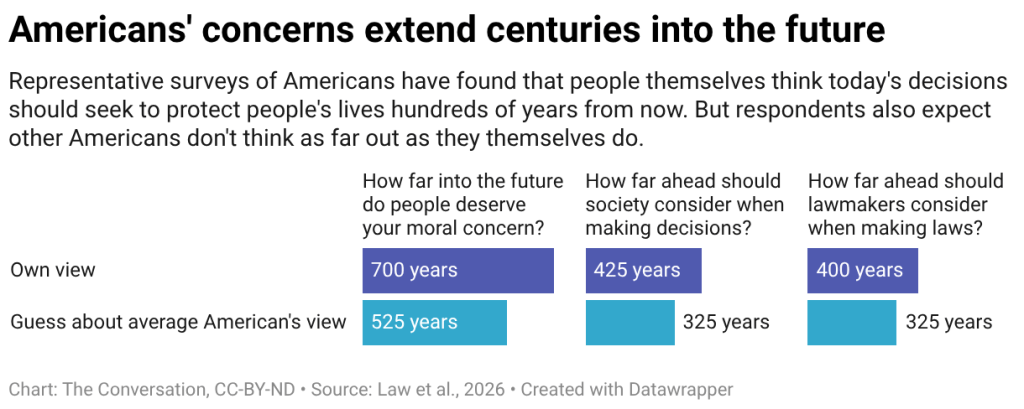
Americans' concerns extend centuries into the future

Why it matters

Public support for long-term policies depends partly on what people think other people value. Research on climate policy, for example, shows that Americans often underestimate how much support already exists for major mitigation measures. When people wrongly think their view is unusual, they can become less likely to speak up, join with others or pressure leaders to act.

Our findings suggest a similar dynamic may shape support for future-oriented policies more broadly. For issues such as pandemic preparedness, nuclear risk and emerging technologies, decisions made now can affect people far into the future.

It’s possible that a person might support stronger emissions cuts, better disease-prevention systems or safeguards on high-risk technologies, but stay quiet if they assume most other Americans do not care about those kinds of long-term consequences.

What’s next

Several hands holding up a globe which appears to be made from blue and green fabric.
Research shows Americans underestimate support for major climate change mitigation measures. Alistair Berg/DigitalVision via Getty Images

For climate change, misperceptions are partly driven by partisan polarization, visible disagreement among leaders and vocal opposition from skeptics. Together, they can make public support appear weaker than it is.

Concern for future generations, by contrast, is much less overtly politicized – meaning it does not divide along party lines the way climate policy does. Most Americans, regardless of political affiliation, say they care about people living centuries from now. Yet this concern is rarely voiced in everyday conversation, in media coverage or in political debate.

Future research needs to examine why concern for future generations isn’t more visible in public life, such as in the media or voiced in everyday conversations. As a result, people might assume that others do not care as much as they actually do.

The Research Brief is a short take on interesting academic work.

This article originally appeared on The Conversation. You can read it here.
  • People thought cats lay on laptops to get in the way. The real reason is surprisingly sweet. 
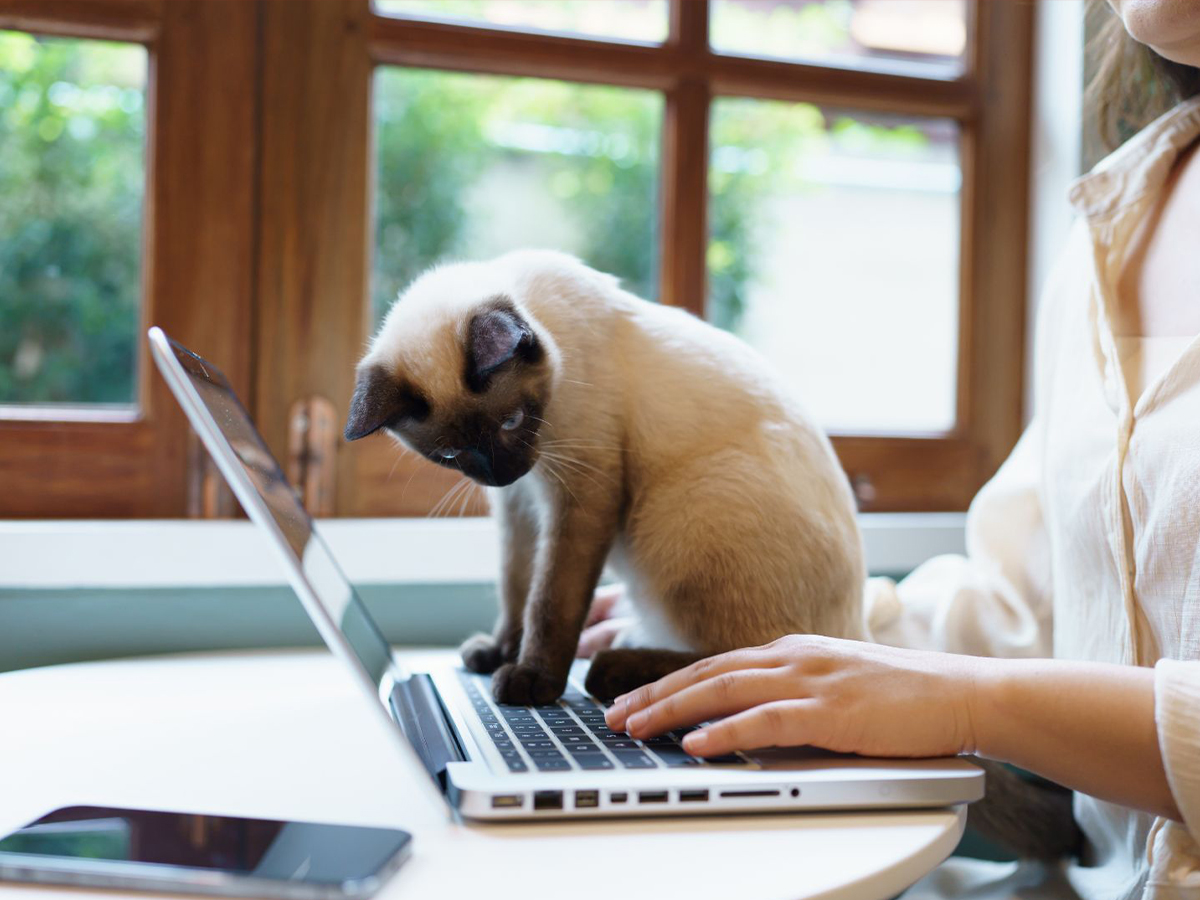
    Photo credit: CanvaA kitty decides when it's time to work.

    People who work from home with a cat nearby tend to recognize this moment well. The instant a laptop opens and a document appears on the screen, a cat arrives within seconds, claiming ownership of the keyboard.

    It can feel like an unwelcome interruption, yet veterinarians and animal behavior specialists have identified a common pattern among domestic cats. Cats often choose to sit on objects their owners are engaged with, particularly when those things are central to human attention or activity.

    pets, psychology, curiosity, scent
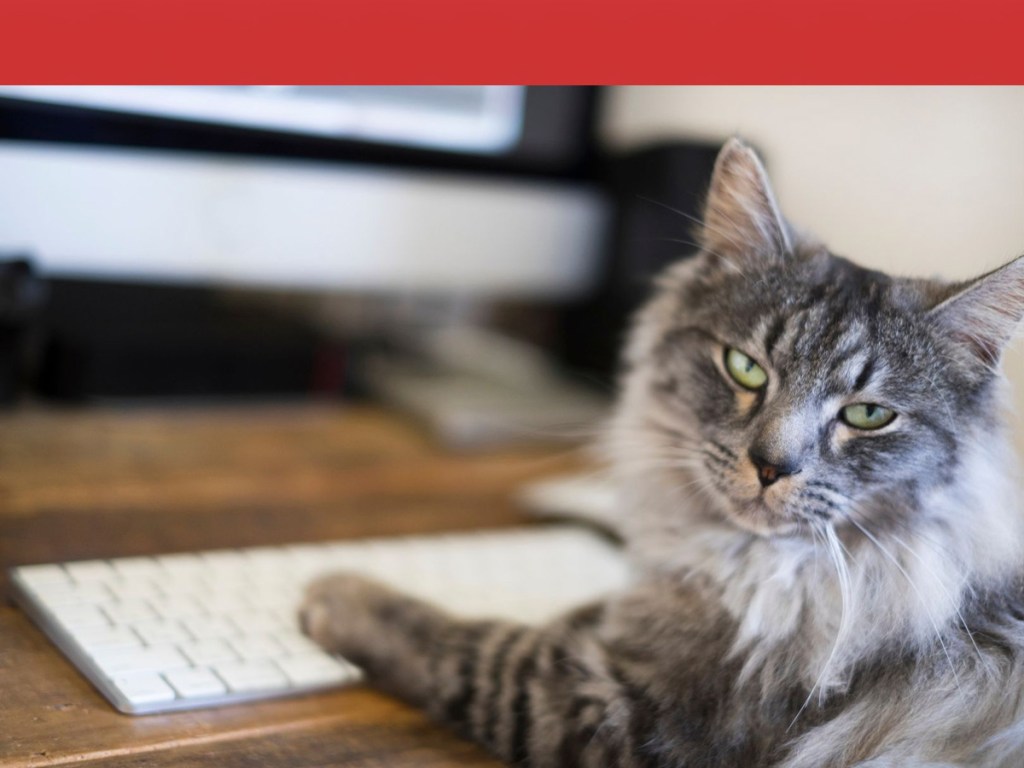
    A cat with a little attitude on the computer.
    Photo credit: Canva

    Cats aren’t trying to be a nuisance

    The first, and probably most familiar, reason a cat jumps on you and the computer when you’re working is attention. Animal behavior experts at vet-reviewed sources like Catster explain that cats repeat behaviors that reliably get responses from their owners. Why work when you can play and look at me?

    Another commonly cited explanation is simple comfort. Laptops, keyboards, and similar devices radiate heat. Cats seek out these warm surfaces for napping. Daily Paws notes that warmth is one of the practical reasons cats may choose electronics over other available spaces in the home.

    And let’s face it, cats are naturally curious. They are highly responsive to human activity and tend to investigate objects their owners are focused on. The laptop, papers, and even a phone being scrolled at home become sources of fascination.

    cat owners, remote work, home life, domestic cats
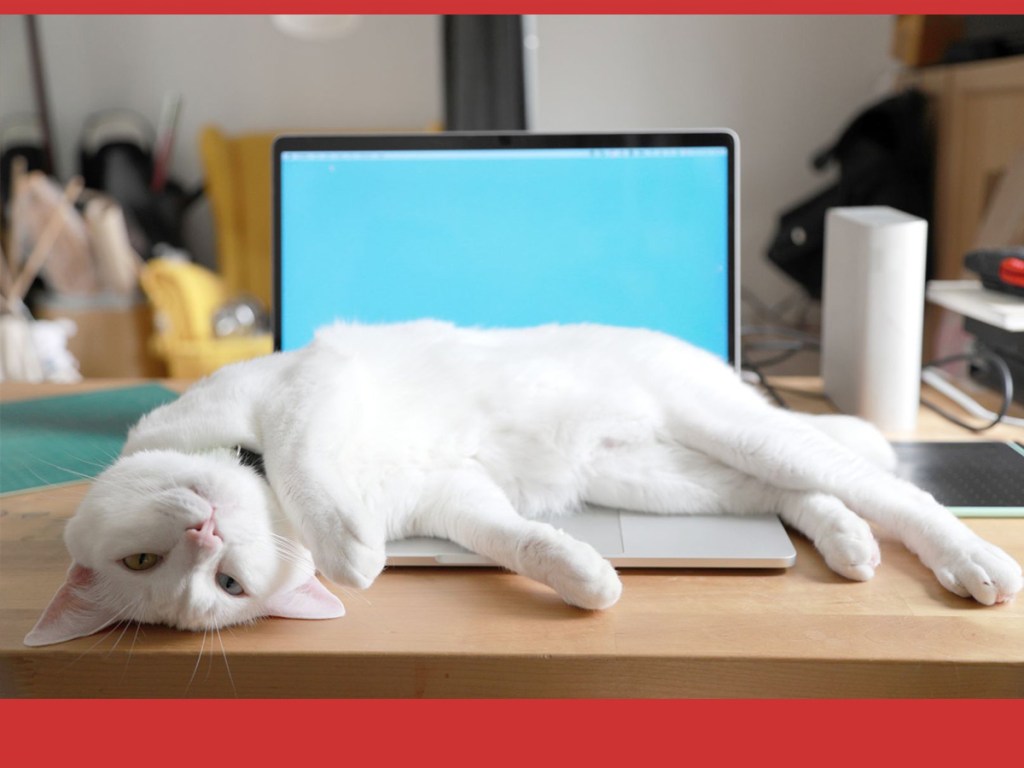
    A white cat relaxes on a laptop.
    Photo credit: Canva

    The science behind cats lying on laptops

    Research suggests there is more behind this behavior than basic attention-seeking and curiosity. Physical contact with objects can shape how cats interact with their environment, especially with items frequently handled by humans. For cats, scent helps create and strengthen connections with their owners.

    “Cats are very possessive individuals,” Dr. David Sands, an expert in animal psychology, told BBC Science Focus. “For them, the more they can brush past you and deposit your scent, the better!”

    The laptop is not just a warm surface but also a shared space that already carries a lot of its owner’s presence.

    Research from the Tokyo University of Agriculture found that cats can differentiate between familiar and unfamiliar humans using smell alone. In everyday settings, this may explain why cats often spend time on items like clothing, beds, or computers that carry their owner’s scent. These objects are strongly associated with a favorite human.

    animal science, feline behavior, pets,  animal bonds
    A kitty on a laptop.
    Photo credit: Canva

    Cats want to be close to their owners

    These explanations point in a similar direction. What may seem like a deliberate effort to interrupt work is more likely the result of several well-intentioned feline behaviors. The family mouser is probably not plotting against your productivity.

    From seeking warmth and comfort to investigating the objects that hold our attention to interacting with surfaces carrying our familiar scents, cats have plenty of reasons to gravitate toward a laptop. These soft and cuddly family members adapt to the people and environments around them, even if that process occasionally lands them squarely on our keyboards.

  • Girl Scouts use their cookie sale money to 3D print wheelchairs for toddlers
    Photo credit: WBZ/CBS News Boston via YouTubeA group of Girl Scouts are 3D printing wheelchairs for kids in need.
    ,

    Girl Scouts use their cookie sale money to 3D print wheelchairs for toddlers

    Girl Scouts step up to help their peers who need mobility devices.

    When people buy Girl Scout cookies, it’s typically known that the proceeds would go to programs and activities for that particular troop and the organization as a whole. However, for eight third-graders in Dorchester, MA, the money was paid forward to another cause. They used the funds to purchase a 3D printer to make wheelchairs for younger children.

    Along with their troop leader, Corinne Curran, the girls spent nearly $200 of the cookie profits on the supplies. It took about 200 hours for the pediatric wheelchair parts to be fully printed and less than an hour for the group to build it. 

    Kids helping kids

    “They were so excited,” Curran said to ABC News. “One of the cool parts about Girl Scouts is they know they earn this money and they can see where it’s going and how they can use it to do good, make the world a better place.”

    Curran said that the troop was inspired to build wheelchairs for fellow kids after a visit to Curran’s employer, The Boston Home. The Boston Home is a residential care center for adults with neurological conditions. After seeing the wheelchairs in use at the center, the girls wanted to provide such mobility to their peers.

    How to 3D print a wheelchair

    With this mission in mind, the troop discovered a design for a 3D printed toddler mobility trainer wheelchair through MakeGood. MakeGood is a non-profit organization that aims to provide more accessibility for those who need assistive technology. They do this by offering 3D printer designs for such devices to those who want to build them. They are also willing to pick up and deliver finished 3D printed devices to a person in need free of charge. 

    Items like toddler wheelchairs can be incredibly expensive, especially for those without health insurance coverage. According to a 2022 report by the World Health Organization and UNICEF, almost one billion children and adults need a form of assisted technology such as wheelchairs, but lack access. Because of the expense and growing need, many have turned to 3D printing to create those devices on their own. It should be noted that because these 3D printed devices are made from volunteers and aren’t regulated or clinically-approved medical equipment.

    The Girl Scouts are excited to be a part of this movement to help others, and are eager to make more wheelchairs for kids.

    “We do what the girls want to do, and this was a huge project for them. They were so excited about it,” Curran said. “They want to make another one that is multiple shades of violet. And they also said that they want to build [a power wheelchair].”

    If Girl Scouts can make a difference with something as important as free wheelchairs, many more can. You can contribute to those in need of assistive technology locally and globally via different resources available online. The Wheelchair Foundation also has a list of relevant organizations to consider.

  • Window washer’s free cleanings are saving struggling Kansas City restaurants through social media
    Photo credit: CanvaA window washer's social media is helping boost local business.

    No matter where you hang your hat in today’s world, a social media presence can impact your business. Former social media content manager turned window cleaner Davis Roethler knows this more than most. But he isn’t just using social media to boost his Window Wolf cleaning service. He’s actually highlighting other local businesses along the way.

    Knowing that the restaurant industry is one of the hardest to break even, Roethler wanted to help out struggling eateries in Kansas City. Wearing his Meta glasses, Roethler eats from a local restaurant and offers to clean their windows for free. While washing the windows, he records video from his Meta glasses to make a quick profile to promote the eatery. 

    A small video led to huge impact

    The restaurant owners aren’t only thankful for the free window cleaning, but also for the boost in foot traffic that Roether’s covert videos have provided. Yeyo’s Bakery is one of them.

    “He offered to clean our windows for free, and my wife was like, ‘Sure, why not?’” said Pedro Sagrero, co-owner of Yeyo’s Bakery to KCTV 5. “For the last two or three weeks [after Roethler posted a video], we’ve been noticing our sales are increasing tremendously. From, I would say, a hundred per day to four hundred.”

    Another restaurant, Tasty African Food KC, was struggling with an incorrect address listed on Google and low attendance. About 24 hours after Roethler cleaned their windows and posted a video about them, the restaurant’s address was corrected online and they had a line form before they opened.

    “By Friday at 9:30, and I was like, ‘Why are they out there? What’s going on?’ and so I finally just flagged one of them and said, ‘What’s going on?’” said Florence Muni of Tasty African Food KC. “I haven’t seen this much traffic since we’ve been here for two weeks, and he’s like we’re just waiting for the restaurant to open.”

    Social media creating local community

    “When you just look at the data, opening up a restaurant, from a business standpoint, it’s a terrible idea. It’s a huge risk. The numbers are not on your side,” Roethler told the Kansas City Star. “When you realize that, you realize that there’s so much opportunity in KC to help out these small businesses to make sure that they’re not part of that statistic of closing down.”

    While Roethler is a businessman, the focus on the videos was from a community perspective. While he would give a good review of the food, his videos provided a window into the people who prepared it.

    “What’s missing is like the story behind the owner and the person and the magic behind the food,” Roethler said to KCTV 5.  “But ultimately, I know it’s right when I show up and you’ve got mom or dad behind the register and you’ve got their kids working in there…that’s where I’m like, all right, they deserve the limelight.”

    The success that Roethler brings to local businesses isn’t mere social media marketing. His Instagram account has less than 10,000 followers. That number is meager compared to true influencers. But it’s the local community that does follow him that shows up to enjoy good food and uplift one another.

Explore More Society Stories

Society

Who owns the beach? It depends on state law and tide lines

Society

Why fatherhood matters more than ever before

Society

Broken household items bring people to Repair Cafés but community keeps them coming back

Society

The conversations people avoid may be the ones they would enjoy the most